Living in the Digital World: Is AI a Helper or a “Stand-in”?
When you wake up in the morning, you might not realize it yet: recommendation playlists, navigation routes, email drafts, even the order…
Living in the Digital World: Is AI a Helper or a “Stand-in”?
When you wake up in the morning, you might not realize it yet: recommendation playlists, navigation routes, email drafts, even the order for your first cup of coffee — all of these have the shadow of artificial intelligence (AI) behind them. AI is no longer a distant concept. It has permeated into every aspect of our daily lives and has become a digital infrastructure. But a thought-provoking question arises at the same time: This ubiquitous intelligence is either giving us more freedom in life or quietly making us more passive?
This blog post, guided by the course discussion “AI, ethics and us” explores what AI has actually brought us in the digital world.

Photo by Vitaly Gariev on Unsplash. Free Unsplash Licence.
The Efficiency Revolution: When Algorithms Become Invisible Helpers
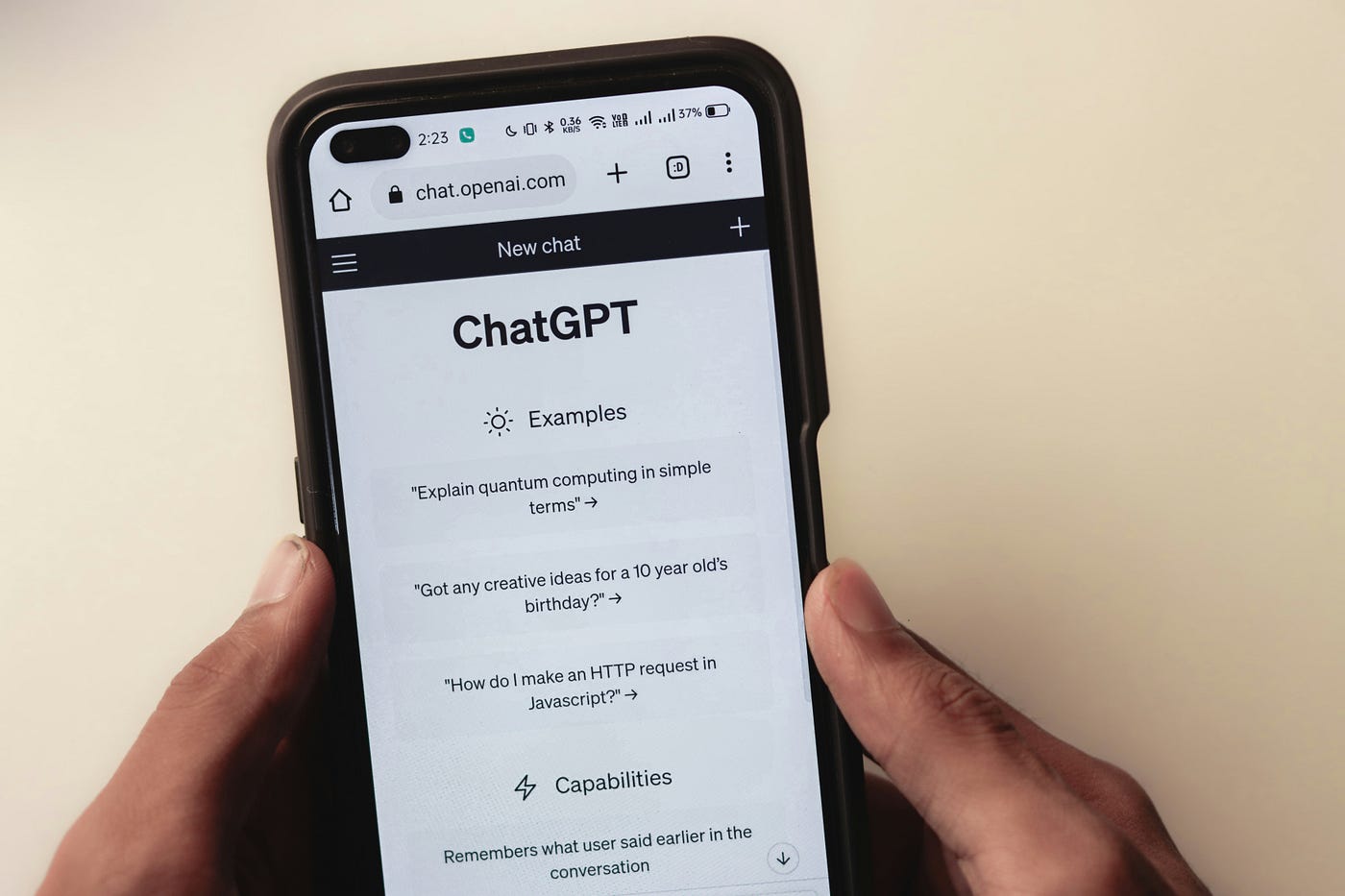
It is undeniable that AI has brought about unprecedented convenience. As of October 2025, the weekly active users of ChatGPT have exceeded 800 million, accounting for more than one-tenth of the global adult population. In the United States, 55% of adults say they frequently use AI tools in their daily lives. From writing emails to planning trips, from financial consultation to code debugging, algorithms are taking over those repetitive and cumbersome cognitive tasks.

Photo by Mohammad Rahmani on Unsplash. Free Unsplash Licence.
For enterprises, this trend is even more intense. Data shows that 77% of companies are already using or exploring AI technologies. It has long gone beyond the tech giants in Silicon Valley. From the intelligent customer service centers of banks to the quality inspection lines in factories, from the contract review of law firms to the copywriting generation of advertising companies, and even to the AI-based order-taking and shift scheduling in small restaurants on the street corner, AI is using the banner of “cost reduction and efficiency improvement” to completely reshape the business logic.

Photo by Zulfugar Karimov on Unsplash. Free Unsplash Licence.
This efficiency improvement is no mere theoretical concept: tasks such as industry reports, customer service inquiries, design editing, which once required professional teams or several days to complete, can now be accomplished in just a few minutes or with a few clicks of the mouse. We have indeed saved time and gained “superpowers”. However, what is often overlooked is that the time that has been compressed and the thresholds that have been lowered are essentially the work value of people being quietly rewritten by algorithms. The size of the efficiency pie has grown, and the rules for distributing it have also changed. This is precisely the price we have to bear.
AI’s Double-Edged Sword: Job Loss or Job Transition?
Have you ever wondered this question: Will the major you are currently studying be replaced by AI in the future?

Photo by Vitaly Gariev on Unsplash. Free Unsplash Licence.
This anxiety is not groundless. A report from Goldman Sachs mentioned that approximately 300 million full-time jobs worldwide are at risk of being replaced by automation. In the United States, about two-thirds of occupations have been affected to some extent by artificial intelligence automation. Among these occupations affected by automation, about one-fourth to half of the work can be replaced by AI. Among them, administrative and legal occupations have been hit the hardest.

Photo by ThisisEngineering on Unsplash. Free Unsplash Licence.
However, the data also provided some reassurance. The World Economic Forum predicts that by 2030, technological changes and industry transformations, although they will eliminate 92 million traditional jobs, will also create 170 million new occupations, resulting in a net increase of 78 million jobs overall. Keywords such as engineers and AI trainers, which are related to AI, are now emerging in large numbers.
Therefore, the real impact of AI on employment is not “unemployment”, but whether society can keep up with the pace of technological change. If the systems, education and training are lagging behind, even if there is an overall growth, it will cause a long-term pain of “being unable to find a job”. Those who will not be eliminated in the future will always be the ones with the strongest adaptability.
When Algorithms Learn Bias: Can We Still Trust AI?

Photo by Myles Bloomfield on Unsplash. Free Unsplash Licence.
However, beneath the shining aura of AI-driven efficiency, the shadows are equally clear. A 2024 study by the University of Washington found that AI resume screening tools would prioritize resumes with names associated with white people in 85% of cases. This is a form of bias, and it is a blatant form of discrimination.
What is even more insidious than discrimination is that AI can even fabricate “right” and “wrong”. A 2024 survey conducted by the Pew Research Center among 5,410 American adults revealed that 66% of the respondents were extremely or very concerned about people obtaining inaccurate information (that is “hallucinations”) from AI, and their trust base was not solid.

Photo by Hartono Creative Studio on Unsplash. Free Unsplash Licence.
The more troublesome issue is that most AI systems remain opaque “black boxes”. When a loan application is rejected or a resume is filtered out, the individuals concerned often have no idea of the reasons, and it is even more difficult for them to appeal. The historical biases in the training data are quietly magnified, and structural inequality is being digitized and solidified. The efficiency we pursue is at the expense of fairness. When algorithms have learned biases, do we still need to trust them without reservation? Before the biases are thoroughly audited, this trust is merely a blind and reckless venture.
Beware of “AI addiction”: Don’t let algorithms make all your decisions for you.
Photo by Steve A Johnson on Unsplash. Free Unsplash Licence.
The deeper crisis lies in the cognitive level. 53% of the global respondents stated that AI products and services have changed their lives in the past three to five years. However, when the tool shifts from “assistance” to “substitution”, human thinking begins to be absent. We are handing over judgment, critical thinking and analytical abilities to algorithms. From consumption choices to value positions, we are increasingly accustomed to relying on AI’s standardized answers. Once this dependence becomes an inertia, society may fall into a situation of efficiency but emptiness: everything runs smoothly, but there is a loss of in-depth reflection.
Conclusion: Helper or Stand-in? The answer is in our hands.

Photo by Norbert Kundrak on Unsplash. Free Unsplash Licence.
AI does indeed make the digital world more efficient and convenient. However, when it transforms from a tool to a “stand-in”, working for us, making judgments for us, and even thinking for us, our subjectivity is imperceptibly eroded. The true solution may not lie in rejecting technology, but in holding firm to an unyielding bottom line: algorithms can assist in life and optimize choices, but they should never define life or make the final judgments for us. The more powerful the technology, the more we need to remain vigilant.
Self-Reflection: My Journey of Digital Awakening
On April 27, 2026, I received the email titled “FutureMe” sent by myself at the beginning of the semester. I wrote: “I hope to truly understand how the ‘digital society’ shapes our lives, interpersonal relationships and the future.” As a student of creative and cultural industries, I once thought that Digital Society was just an introductory course on social media operation or cybersecurity. But when I actually attended the class, I realized that the first major challenge was the unfamiliar form of teaching and writing: blog.

Photo by Kit (formerly ConvertKit) on Unsplash. Free Unsplash Licence.
How the course challenged me: In the past, I was only accustomed to the structure of standard academic papers. However, Digisoc 1 required me to critically analyze an organization in a blog format across multiple platforms. This was my first time writing a blog on Medium, adding titles, paragraphs, and using colloquial expressions. Each operation was a new challenge. At the same time, Digisoc 1 also made me have to take digital copyright seriously from the very beginning: every picture needed to be properly cited. After entering Digisoc 2, writing in the PechaKucha style pushed me further out of my comfort zone. With the restriction of 10 free-use images and about 100 words per paragraph, I analyzed the survival paradox of journalism in the era of algorithms. This process strengthened my copyright awareness and also trained me to complete critical expressions within a compact length. By the time of Digisoc 3, when I wrote this blog under the guidance of “AI, ethics and us”, I was already able to find a balance between academic rigor and web readability.
What I have gained: I have learned to communicate with the public through blogs, to convey critical analysis through visual narratives, and to support every point with literature and data. From Digisoc 1 to Digisoc 3, my awareness of copyright has evolved from merely mechanically following format requirements to truly understanding that doing so is a sincere and respectful recognition of the labor of digital creators. I have come to realize that citation is not only for avoiding plagiarism, but also for practicing the ethical principle of knowledge sharing in the digital society.
The benefits of this course for the future: These gains will directly support my future practice in the creative industry. Whether it’s planning community content or examining platform power, I need this ability to balance academic rigor and readability, as well as that sense of ethical responsibility. This course did not give me a set answer, but it gave me a constant critical awareness. In the future, when facing any new technology, I will be able to make more mature judgments, evolving from a passive user to a truly reflective digital culture participant.
Now, rereading that FutureMe letter, I can confidently say: not only do I understand how the digital society shapes lives and relationships, but I am also ready to use this awareness to influence my future actions.
메타데이터
- post_id
- ae866bc8451a
- slug
- living-in-the-digital-world-is-ai-a-helper-or-a-stand-in-ae866bc8451a
- url
- https://medium.com/digital-society/living-in-the-digital-world-is-ai-a-helper-or-a-stand-in-ae866bc8451a
- canonical_url
- https://medium.com/digital-society/living-in-the-digital-world-is-ai-a-helper-or-a-stand-in-ae866bc8451a
- author_url
- https://medium.com/@haoyang0121
- status
- ok
- fetched_at
- 2026-06-12 22:02:08