Lipids in AP Biology: The Simple Guide Students Actually Need
Lipids are more than “fats.” In AP Biology, they explain energy storage, cell membranes, hormones, waterproofing, and why structure always…
Lipids in AP Biology: The Simple Guide Students Actually Need
Lipids are more than “fats.” In AP Biology, they explain energy storage, cell membranes, hormones, waterproofing, and why structure always determines function.
When AP Biology students study macromolecules in **Unit 1: Chemistry of Life**, lipids often feel easier than proteins or nucleic acids at first.
What are Lipids in AP Biology Exams
You may hear:
“Lipids are fats.” “They store energy.” “They do not dissolve in water.”
All of that is true, but it is not enough for the AP Biology exam.
To really understand lipids, you need to connect structure to function. That means asking:
What are lipids made of, how are they shaped, and why does that shape matter in living systems?
This post is a written companion to the AP Biology lipids slide deck. Use it to review the main ideas, fix common mistakes, and prepare for MCQs and FRQs.
College Board places lipids inside AP Biology Unit 1: Chemistry of Life, which makes up about 8–11% of the AP Biology exam score. Unit 1 includes water, elements of life, carbohydrates, lipids, nucleic acids, and proteins.
What Are Lipids?
Lipids are a group of mostly nonpolar, hydrophobic biological molecules.
That sentence has two important words:
Nonpolar means the molecule does not have strong partial charges.
Hydrophobic means the molecule does not mix well with water.
This is one of the most important lipid ideas in AP Biology. Lipids are not defined by one exact monomer the way proteins are built from amino acids or nucleic acids are built from nucleotides. Instead, lipids are grouped together because they share similar chemical behavior, especially their relationship with water.
OpenStax describes major lipid types as including fats, oils, waxes, phospholipids, and steroids. Lipids are important in energy storage, membranes, waterproofing, and hormones.
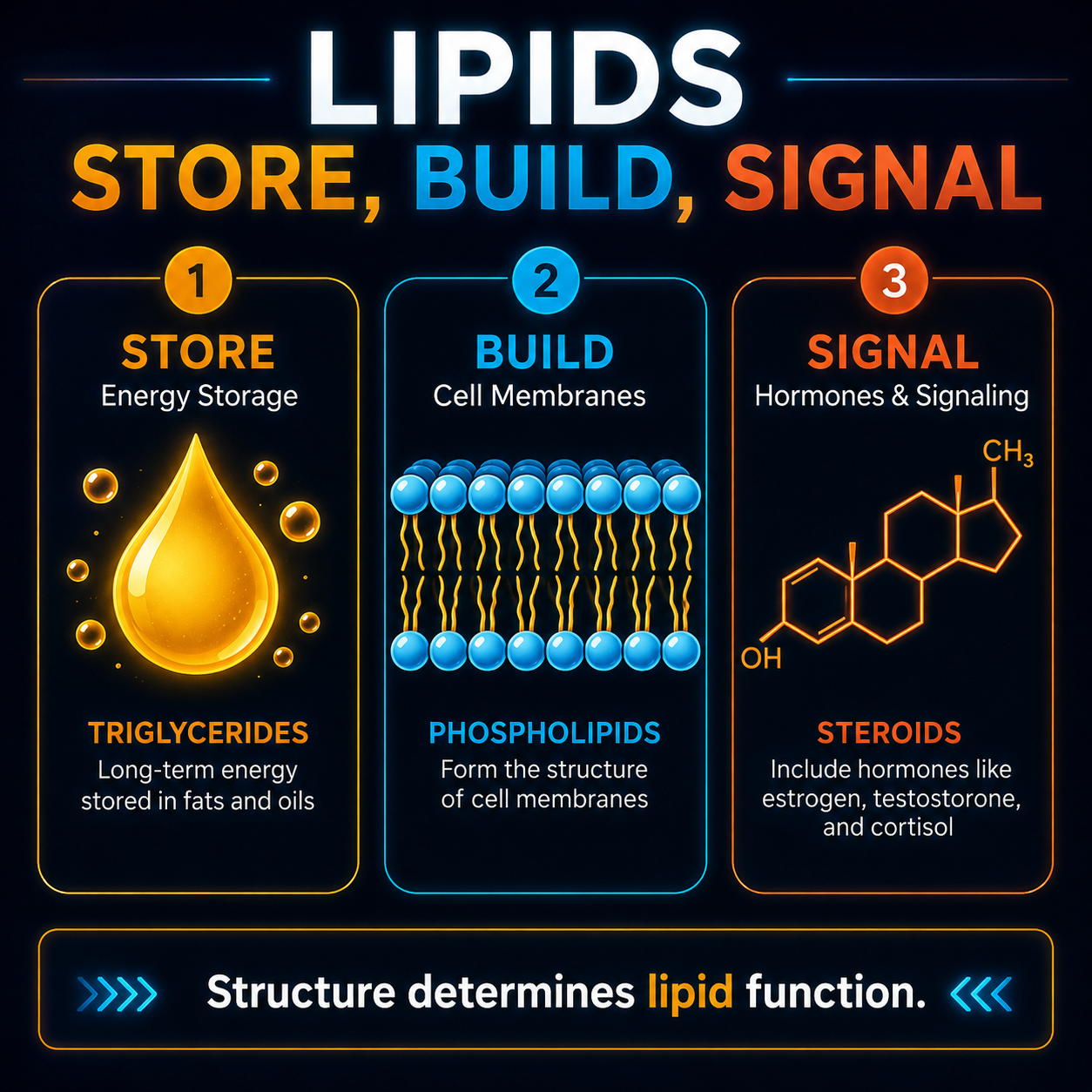
For AP Biology, the most important lipid categories are:
Triglycerides — long-term energy storage Phospholipids — cell membrane structure Steroids — signaling and membrane stability Waxes — waterproofing and protection
The Big AP Biology Idea: Structure Determines Function
AP Biology does not just ask you to memorize molecules. It asks you to explain how biological structures create biological functions.Lipids are a perfect example.
A lipid’s function depends on its structure:
A triglyceride has long hydrocarbon chains, so it stores lots of energy.
A phospholipid has a hydrophilic head and hydrophobic tails, so it forms membranes.
A steroid has a four-ring carbon structure, so it can act as a hormone or help stabilize membranes.
A wax is highly hydrophobic, so it helps repel water.
This is the key sentence to remember:
Lipids work because their nonpolar hydrocarbon regions avoid water.
Once you understand that, most lipid questions become easier.
Why Are Lipids Hydrophobic?
Water is polar. It forms hydrogen bonds with other polar or charged molecules.
Most lipids are mostly made of carbon-hydrogen bonds. These bonds are nonpolar, so they do not interact strongly with water.
That is why oil separates from water.
In biology, this property is not a problem. It is an advantage.
Hydrophobic lipids allow organisms to:
store energy efficiently build cell membranes create waterproof surfaces send chemical signals protect organs insulate bodies
This is why AP Biology students should not think of hydrophobic as “bad.” Hydrophobic just means water-avoiding, and cells use that property constantly.
Triglycerides: Lipids for Long-Term Energy Storage
A triglyceride is made of:
one glycerol molecule three fatty acid chains
That is why triglycerides are sometimes called fats or oils.
The fatty acid chains are long hydrocarbon chains. These chains contain many carbon-hydrogen bonds, which store a large amount of energy.
This is why fats are excellent long-term energy storage molecules.
Carbohydrates are often used for short-term energy. Lipids are better for long-term storage because they are energy dense.
In AP Biology, you should connect triglycerides to:
energy storage insulation protection fatty acid structure saturated vs unsaturated fats
Saturated vs Unsaturated Fatty Acids
Fatty acids can be saturated or unsaturated.
A saturated fatty acid has no carbon-carbon double bonds in its hydrocarbon chain.
An unsaturated fatty acid has at least one carbon-carbon double bond.
This structural difference changes the shape of the molecule.
Saturated fatty acids tend to be straighter. Because they are straight, they can pack tightly together. This is why many saturated fats are solid at room temperature.
Unsaturated fatty acids have bends or kinks caused by double bonds. Because they are bent, they cannot pack as tightly. This is why many unsaturated fats are liquid oils at room temperature.
This is a classic AP Biology structure-function connection:
Double bonds create bends. Bends reduce packing. Reduced packing changes physical properties.
That is exactly the kind of reasoning AP Biology wants.
Phospholipids: The Molecules That Build Cell Membranes
Phospholipids are one of the most important lipid types in AP Biology because they connect Unit 1 chemistry to Unit 2 cell structure.
A phospholipid has:
one hydrophilic phosphate head two hydrophobic fatty acid tails
This makes phospholipids amphipathic, meaning they have both hydrophilic and hydrophobic regions.
When phospholipids are placed in water, they naturally arrange themselves into a bilayer.
The hydrophilic heads face the watery environment.
The hydrophobic tails turn inward, away from water.
This creates the phospholipid bilayer, the basic structure of cell membranes.
OpenStax explains that phospholipids contain a phosphate-containing head and fatty acid tails, creating a molecule with both hydrophilic and hydrophobic regions.
This is one of the most testable lipid ideas in AP Biology:
The cell membrane forms because phospholipids are amphipathic.
Do not memorize “phospholipids make membranes” without understanding why.
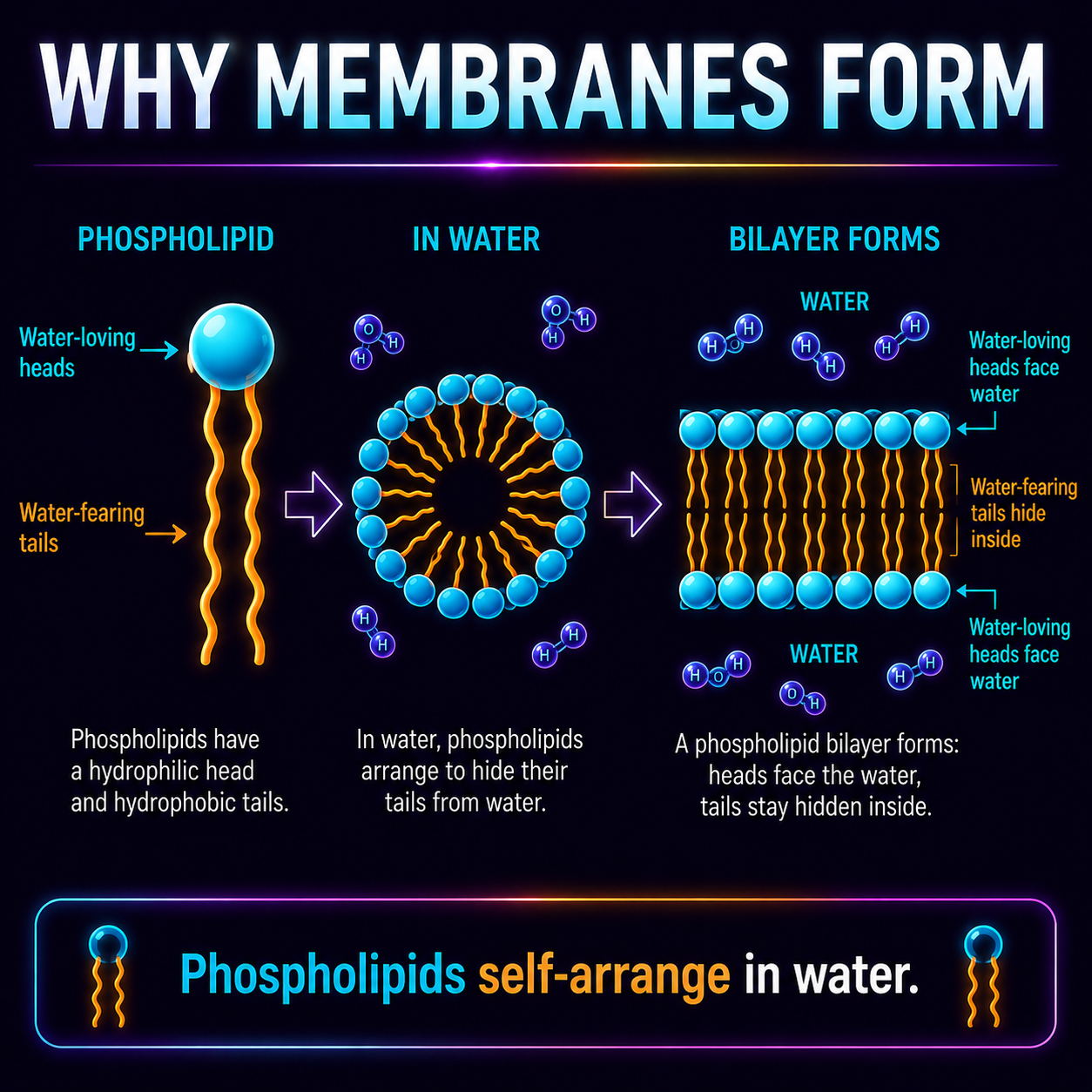
Why Membranes Forms — AP Biology
They make membranes because their structure forces them to self-arrange in water.
Why the Phospholipid Bilayer Matters
The phospholipid bilayer is not just a border around the cell.
It controls what enters and leaves.
Because the inside of the bilayer is hydrophobic, it blocks many polar or charged substances from passing freely.
Small nonpolar molecules can often pass more easily.
Large polar molecules and ions usually need transport proteins.
This connects lipids to several later AP Biology topics:
membrane permeability selective transport osmosis diffusion cell communication homeostasis compartmentalization
That is why lipids show up beyond Unit 1. You may first learn them in Chemistry of Life, but you keep using them in Cells, Cell Communication, and Energetics.

Saturated Fatty Acids versus Unsaturated Fatty Acids
Steroids: Lipids With Ring Structures
Steroids are lipids, but they do not look like triglycerides or phospholipids.
Instead of long fatty acid tails, steroids have a carbon skeleton made of four fused rings.
Important biological steroids include:
cholesterol estrogen testosterone cortisol
Cholesterol is especially important because it helps regulate membrane fluidity in animal cells.
At different temperatures, cholesterol helps keep membranes from becoming too rigid or too fluid.
This is another AP Biology structure-function idea:
Cholesterol’s ring structure helps stabilize membrane fluidity.
Steroid hormones also matter because they are lipid-soluble. Since they can pass through the lipid-rich cell membrane, many steroid hormones bind receptors inside the cell rather than on the cell surface.
That idea becomes important later in AP Biology when studying cell communication and gene regulation.
Waxes: Waterproofing and Protection
Waxes are another type of lipid.
They are highly hydrophobic, which makes them useful for waterproofing.
Examples include:
plant leaf cuticles wax coatings on fruits protective coverings on feathers waterproofing in some animal surfaces
In AP Biology, waxes are usually less heavily tested than phospholipids and triglycerides, but they are still useful examples of lipid function.
The key idea is simple:
Because waxes repel water, they help prevent drying out or water damage.
Again, structure determines function.
Lipids Are Not True Polymers Like Proteins or Nucleic Acids
This is a common AP Biology mistake.
Proteins are polymers made of amino acid monomers.
Nucleic acids are polymers made of nucleotide monomers.
Carbohydrates can form polymers such as starch, glycogen, and cellulose.
Lipids are different.
Many lipids are large biological molecules, but they are not usually described as true polymers made of repeating identical monomers.
A triglyceride, for example, is built from glycerol and fatty acids, but it is not a long repeating chain like a protein or DNA molecule.
So be careful with this wording:
Wrong: “Lipids are polymers made of fatty acid monomers.”
Better: “Many lipids are assembled from glycerol and fatty acids, but lipids are not generally considered true polymers.”
This distinction can help you avoid losing points on AP-style questions.
Dehydration Synthesis and Hydrolysis
Lipids connect to another Unit 1 concept: chemical reactions that build and break biological molecules.
AP Biology students should know two reactions:
Dehydration synthesis builds larger molecules by removing water.
Hydrolysis breaks larger molecules by adding water.
Triglycerides form when fatty acids bond to glycerol through dehydration synthesis.
Triglycerides can be broken down through hydrolysis.
College Board’s AP Biology framework includes the idea that hydrolysis and dehydration synthesis are chemical reactions involved in building and breaking biological macromolecules.
For AP Biology, do not just memorize the terms. Understand the direction:
Dehydration synthesis: builds, removes water Hydrolysis: breaks, adds water
How Lipids Connect to AP Biology Big Ideas
Lipids are not isolated facts. They connect to many AP Biology themes.
1. Energy Storage
Triglycerides store long-term energy because their hydrocarbon chains contain many energy-rich bonds.
2. Cell Membrane Structure
Phospholipids form bilayers because they are amphipathic.
3. Selective Permeability
The hydrophobic interior of the membrane affects which substances can cross.
4. Homeostasis
Membranes help cells maintain internal conditions.
5. Cell Communication
Steroid hormones can pass through membranes and influence cellular responses.
6. Evolutionary Adaptation
Organisms use lipid properties for insulation, waterproofing, and survival.
This is why lipids are worth studying deeply. They are not just a vocabulary list. They are a foundation for many later units.
Common AP Biology Mistakes About Lipids
Mistake 1: Saying all lipids are fats
Fats are lipids, but not all lipids are fats.
Phospholipids, steroids, and waxes are also lipids.
Mistake 2: Forgetting phospholipids are amphipathic
The word amphipathic is extremely important.
Phospholipids have both hydrophilic and hydrophobic parts.
That is why they form bilayers.
Mistake 3: Thinking saturated and unsaturated fats differ only in health effects
For AP Biology, focus on structure.
Saturated fatty acids have no double bonds.
Unsaturated fatty acids have one or more double bonds.
That structural difference affects shape, packing, and physical state.
Mistake 4: Calling lipids polymers
Lipids are biological macromolecules, but they are not usually treated as true polymers with repeating monomers.
Mistake 5: Memorizing without explaining function
AP Biology often rewards explanation.
Do not just say “phospholipids make membranes.”
Say:
Phospholipids form bilayers because their hydrophilic heads interact with water while their hydrophobic tails avoid water.
That answer is much stronger.
AP Biology MCQ Thinking: How Lipid Questions Usually Work
AP Biology multiple-choice questions often test lipids indirectly.
You may not see a question that simply asks, “What is a lipid?”
Instead, you might see a situation like:
A mutation changes the saturation level of membrane fatty acids.
A cell membrane becomes less fluid.
A hormone crosses the membrane and binds an internal receptor.
A molecule cannot pass through the phospholipid bilayer.
A plant leaf has a waxy cuticle.
To answer these, look for the structure-function clue.
Ask:
Is the molecule hydrophobic or hydrophilic?
Does it have fatty acid tails?
Does it contain phosphate?
Does it have double bonds?
Is it part of a membrane?
Is the question about energy storage, signaling, or waterproofing?
That thinking process is more useful than memorizing isolated definitions.
AP Biology FRQ Tip: Use Cause-and-Effect Language
For free-response questions, your explanation matters.
Weak answer:
Unsaturated fats are different because they have double bonds.
Stronger answer:
Unsaturated fatty acids contain double bonds that create bends in the hydrocarbon chain. These bends prevent tight packing, which can increase membrane fluidity or make the lipid more likely to be liquid at room temperature.
Notice the difference.
The stronger answer explains:
structure effect on shape effect on packing effect on function
That is AP Biology reasoning.
Quick Lipids Review Table
Lipid TypeMain StructureMain FunctionAP Biology ClueTriglycerideGlycerol + 3 fatty acidsLong-term energy storageEnergy-dense fat/oilPhospholipidPhosphate head + 2 fatty acid tailsCell membranesAmphipathic bilayerSteroidFour fused carbon ringsHormones, membrane stabilityCholesterol or hormoneWaxLong hydrophobic chainsWaterproofingCuticle, feathers, protection
The One-Minute Lipids Summary
Lipids are mostly hydrophobic biological molecules.
They include triglycerides, phospholipids, steroids, and waxes.
Triglycerides store long-term energy.
Phospholipids form cell membranes because they are amphipathic.
Steroids include cholesterol and many hormones.
Waxes help with waterproofing.
Saturated fatty acids pack tightly because they lack double bonds.
Unsaturated fatty acids bend because they contain double bonds.
The biggest AP Biology idea is simple:
Lipid structure determines lipid function.
If you understand that, lipid questions become much easier.
Final AP Biology Takeaway
Lipids are not just “fats.”
They are one of the best examples of how chemistry creates life.
Their hydrophobic nature explains why cells have membranes. Their hydrocarbon chains explain why fats store energy. Their ring structures explain how steroid hormones work. Their waterproofing properties explain how organisms survive in different environments.
So when you study lipids for AP Biology, do not stop at definitions.
Ask the AP Biology question:
How does the structure help the molecule do its job?
That is the thinking that moves you from memorization to exam-level understanding.
Call to Action
Want to review this visually?
Use the companion Google Slide on **Lipids in AP Biology** and then practice with AP-style MCQs and FRQs on APScore5.
The faster you connect structure → property → function, the easier Unit 1 Chemistry of Life becomes.
메타데이터
- post_id
- ae97de9e4e12
- slug
- alipids-in-ap-biology-the-simple-guide-students-actually-need-ae97de9e4e12
- url
- https://medium.com/@ap_53163/alipids-in-ap-biology-the-simple-guide-students-actually-need-ae97de9e4e12
- canonical_url
- https://medium.com/@ap_53163/alipids-in-ap-biology-the-simple-guide-students-actually-need-ae97de9e4e12
- author_url
- https://medium.com/@ap_53163
- status
- ok
- fetched_at
- 2026-06-09 15:37:30