Why Do Japanese Shrines Have Lion-Dog Statues?
The Quiet Meaning of Komainu
Why Do Japanese Shrines Have Lion-Dog Statues?
The Quiet Meaning of Komainu
The first thing many visitors notice at a Japanese shrine is the torii gate.
But for me, it has always been the stone guardians waiting beyond it.
They stand quietly at the entrance of shrines across Japan — sometimes fierce, sometimes gentle, sometimes worn down by rain and time.
These statues are called komainu, often translated as lion-dog guardians.
At first glance, they may look intimidating.
But the longer I spend time around shrines,
the more I feel that komainu are not there to frighten people away.
They feel more like silent protectors of peace.
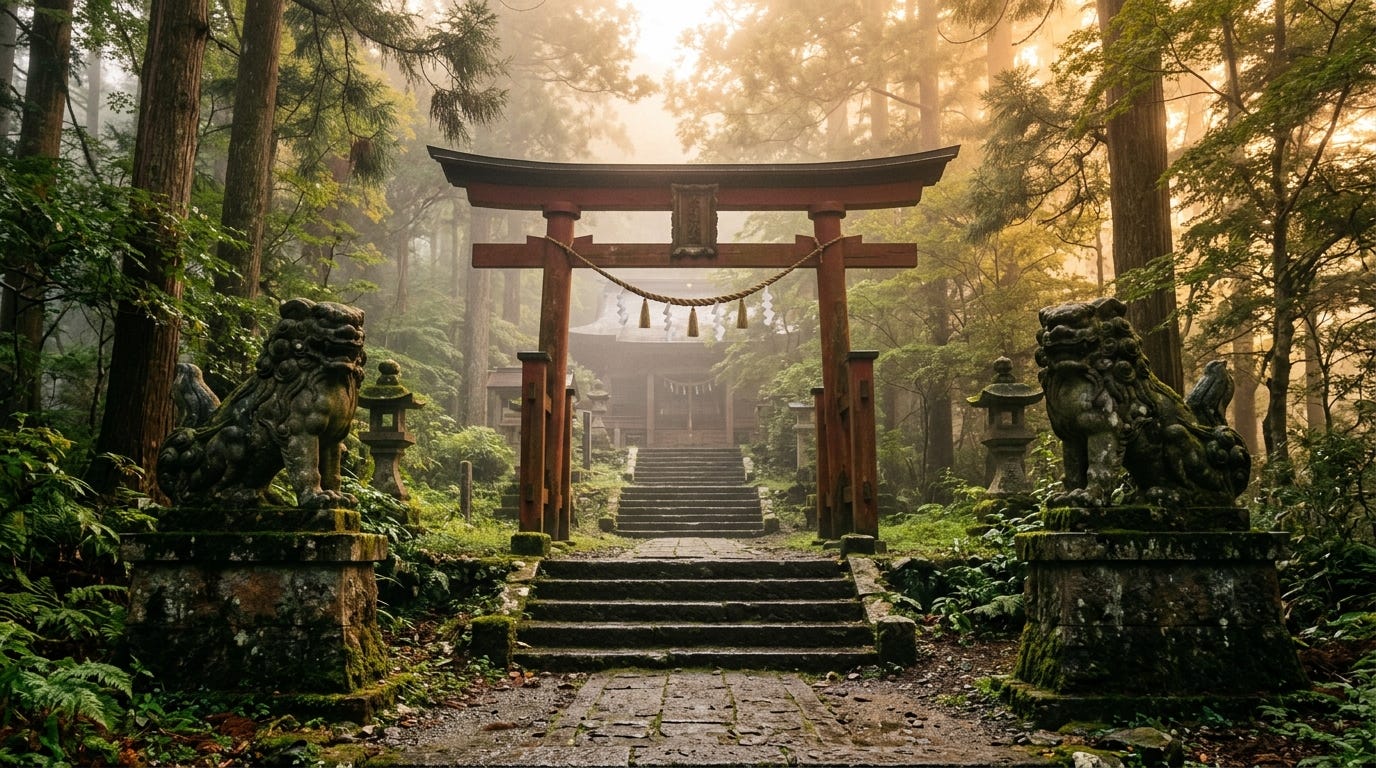
In Japan, many shrines place two komainu at the entrance.
If you look carefully, one usually has its mouth open,
while the other has its mouth closed.
This is called A-un.
The open mouth represents the sound A,
he beginning of all things.
The closed mouth represents Un,
the ending.
Together, they symbolize the flow of life —
beginning and end, inhale and exhale,
birth and completion.
Even people in Japan may not consciously think about this symbolism every time they visit a shrine.
And yet, these quiet details shape the atmosphere we experience.

Japanese shrines are rarely loud places.
You hear wind moving through trees.
The sound of footsteps on gravel.
Water flowing at the purification fountain.
The soft ringing of a bell.
And beside all of this, the komainu remain still.
I sometimes wonder if their role is not simply to guard a sacred space,
but to help people leave behind noisy thoughts for a moment.
Many foreign visitors are surprised by how calming shrines feel,
even in busy cities like Kyoto or Tokyo.
There is often no strong explanation for it.

But perhaps small things create that feeling together:
the trees, the silence, the rituals — and the quiet presence of the komainu.
Some komainu look powerful and dramatic.
Others look almost kind.
At older shrines, their faces are softened by decades
or even centuries wind and rain.
When I see them, they do not feel like statues frozen in time.
They feel like patient witnesses.
Watching seasons change.
Watching people come and go.
Quietly remaining where they have always been.
I think this is one reason many Japanese people feel comforted at shrines.
Not because shrines are spectacular or overwhelming,
but because they allow space for silence.
And perhaps the komainu have been protecting that silence all along.
메타데이터
- post_id
- aebfa5bd03fb
- slug
- why-do-japanese-shrines-have-lion-dog-statues-aebfa5bd03fb
- url
- https://medium.com/@nanoha-nara/why-do-japanese-shrines-have-lion-dog-statues-aebfa5bd03fb
- canonical_url
- https://medium.com/@nanoha-nara/why-do-japanese-shrines-have-lion-dog-statues-aebfa5bd03fb
- author_url
- https://medium.com/@nanoha-nara
- status
- ok
- fetched_at
- 2026-06-12 18:14:10