Shopping Cart Abandonment: The Complete 2026 Guide for E-Commerce Marketers
Why 70.22% of shoppers still leave without buying in 2026, how AI is reshaping recovery, and the strategies that now separate…
Shopping Cart Abandonment: The Complete 2026 Guide for E-Commerce Marketers
Why 70.22% of shoppers still leave without buying in 2026, how AI is reshaping recovery, and the strategies that now separate high-converting stores from everyone else.
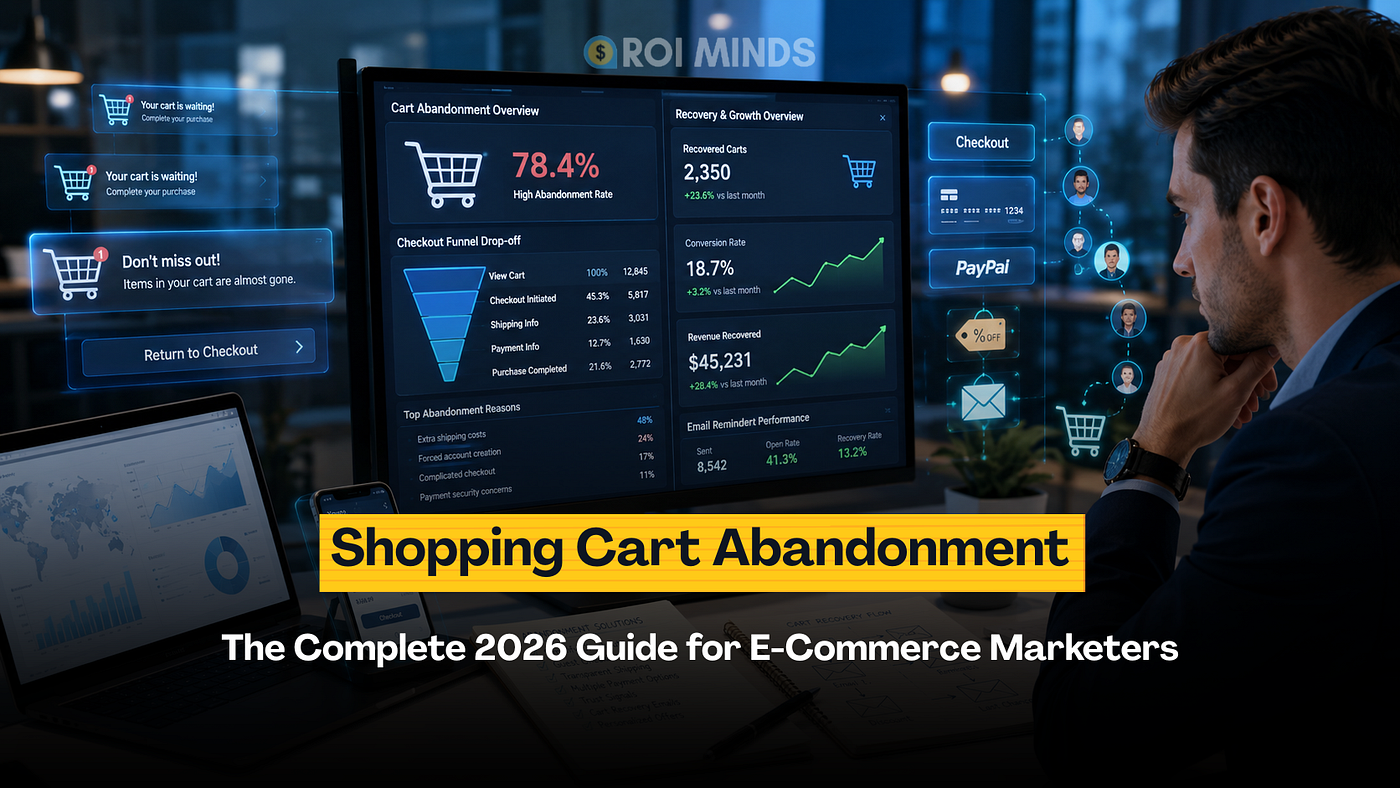
Cart abandonment in 2026 sits at 70.22% globally — barely changed from a decade ago despite massive investment in checkout optimization. The recoverable revenue opportunity in the US alone is estimated at $260 billion. What has changed dramatically is how brands recover that revenue: **AI-powered tools** now predict abandonment before it happens, recover up to 35% of lost carts through proactive engagement, and operate across channels (email, SMS, social, push) without manual segmentation. At the same time, new friction points — social commerce drop-offs, agentic shopping flows, and iOS privacy restrictions — have emerged. This guide covers the full 2026 picture: current benchmarks, the eight causes of abandonment, checkout audit checklist, and a complete recovery playbook including AI-native strategies.
What is Shopping Cart Abandonment?
Shopping cart abandonment is when a potential customer adds products to their online cart and then leaves the site without completing the purchase. It is one of the most studied, most persistent problems in e-commerce — and despite years of optimization effort, the global average abandonment rate in 2026 remains stubbornly above 70%.
There are three distinct types, and they require different responses:

Checkout abandonment is the most painful and the most recoverable. These shoppers passed every major decision point — they chose a product, decided to buy, and began entering personal information. Something in the final steps stopped them. That friction is almost always identifiable and fixable.
How to calculate your abandonment rate

Most platforms report this natively: Shopify shows it under Analytics → Reports → Behavior; WooCommerce surfaces it through the Cart Report; GA4 measures it as a funnel with “add_to_cart” as entry and “purchase” as conversion. Track desktop and mobile separately — their rates diverge by 10–15 percentage points and require different fixes.
The Scale of the Problem: 2026 Benchmarks

The headline abandonment rate has barely moved in a decade. What has changed is where abandonment happens and who is most affected. Social media-referred shoppers abandon at an extraordinary 91% — largely because the intent gap between a browsing mindset and a purchasing mindset is widest when someone arrives via an ad on Instagram or TikTok. Meanwhile, brands using AI-powered recovery tools are now recovering 15–20% of abandoned carts, nearly double what was achievable with email sequences alone in 2024.
Abandonment rates by industry, 2026

Source: SaleCycle Benchmark Report 2026; Baymard Institute.

The User Journey Leading to Abandonment
Cart abandonment doesn’t happen in isolation. It sits at the end of a journey that begins long before your checkout page — and understanding each stage reveals where interventions have the highest leverage.
1. Awareness and discovery
A shopper finds your store through paid search, organic results, social media, a creator recommendation, or increasingly through an AI shopping assistant that surfaced your product while comparing options. In 2026, a growing share of discovery happens outside your own properties entirely — on LLM-powered assistants, voice interfaces, and social commerce feeds. The quality of your product data (titles, attributes, images, shipping terms) in these channels directly affects whether you get discovered and whether that discovery converts.
2. Product browsing and consideration
The customer evaluates options, reads reviews, and compares alternatives. A key behavior that still catches many brands off-guard: shoppers routinely use the cart as a wish list or save-for-later tool. An add-to-cart action signals interest — not commitment. This distinction matters enormously when deciding which recovery tactics to deploy and how aggressively.
3. The add-to-cart moment
This is a genuine intent signal. The nature of that intent — impulsive versus researched, first-time visitor versus returning customer, low-AOV versus high-AOV cart — should determine your recovery approach. A $12 impulse item from a returning customer warrants a different recovery sequence than a $400 considered purchase from a first-time visitor.
4. Checkout entry and drop-off
This is where most recoverable revenue leaks. Common exit points are the shipping cost reveal, the account creation wall, and the payment page. Baymard’s 2026 research finds that the average checkout still contains 23.48 unnecessary form fields — a number that has barely improved. Each redundant field is a question the customer didn’t want to answer, and questions have wrong answers: frustration, hesitation, and exit.
5. Post-abandonment behavior
Most abandoners are still actively shopping after they leave. They are checking a competitor’s price, waiting for payday, or looking for a discount code. In 2026, they may also be asking an AI assistant to compare their options. The window for recovery is typically 1–72 hours — after that, purchase probability drops sharply. A well-timed first touch within 60 minutes is still the single highest-ROI move in cart recovery.
The 8 Reasons Customers Abandon in 2026
1. Unexpected costs at checkout
Shipping fees, taxes, and handling charges revealed late are still the single largest cause of abandonment — responsible for 48% of abandoned carts according to Baymard’s 2026 data. A $15 item becoming a $28 total after fees is a trust-breaker that no recovery email fully compensates for.
→ Fix: Show total landed cost on the product page. Offer free shipping above a clearly-displayed threshold.
2. Forced account creation
Mandatory sign-up walls between the customer and their purchase remain one of the easiest-to-fix and most-ignored conversion killers. First-time buyers don’t want a relationship yet — they want their product. Guest checkout is table stakes in 2026, not a differentiator.
→ Fix: Make guest checkout the primary, most prominent option. Invite account creation post-purchase with a clear value proposition.
3. Long or complicated checkout flows
The average optimized checkout requires 12–14 form fields. Most stores show 23+. No progress indicator, too many page reloads, and redundant fields (asking for billing address separately when it matches shipping) all compound friction. Each unnecessary field is a measurable conversion loss.
→ Fix: Audit and eliminate every non-essential field. Add a progress bar. Enable address autofill and one-click checkout where possible.
4. Trust and security concerns
First-time shoppers evaluate trust signals instinctively. Missing SSL indicators, unfamiliar payment processors, absent return policies, or no visible customer reviews near the checkout form are silent objections that kill conversions without a word being said.
→ Fix: Display security badges and payment logos near the payment form. Add a one-line returns policy summary at checkout (“Free 30-day returns”).
5. Limited payment options
In 2026, payment method expectations have fragmented further. Shoppers in India expect UPI; Gen Z globally expects BNPL (Klarna, Afterpay, Simpl); mobile shoppers expect Apple Pay and Google Pay. A checkout without these options doesn’t ask shoppers to adapt — it tells them to leave.
→ Fix: Audit your audience’s top payment preferences by geography and demographics. Add BNPL for high-AOV products. Decline errors need a clear retry path.
6. Poor mobile checkout experience
Mobile generates the majority of e-commerce traffic in 2026 and still carries an abandonment rate roughly 10–13 points higher than desktop. Tiny tap targets, non-optimized keyboard types for form fields, slow load times, and the absence of digital wallet options are the main offenders. A checkout not designed for a thumb was designed to fail.
→ Fix: Enable Apple Pay and Google Pay (eliminates manual card entry). Test on real devices monthly. Ensure all tap targets are at least 44×44px.
7. Distraction and low purchase intent
Baymard’s 2026 data finds that 43% of US online shoppers have abandoned a cart simply because they were “just browsing / not ready to buy.” Not every abandonment represents a fixable conversion failure. Recognizing this segment — typically low cart values, first-time visitors from social traffic — is essential for avoiding over-investment in low-ROI recovery efforts.
→ Fix: Segment by cart value, returning vs. new visitor, and traffic source before investing in recovery. Not all abandonment is equal.
8. No urgency or incentive to complete now
“I’ll come back to this” is the most expensive phrase in e-commerce. Without a genuine reason to act today — real low-stock indicators, a sale deadline, or a compelling offer — inaction is always the path of least resistance. Manufactured urgency (fake countdown timers) backfires; authentic scarcity converts.
→ Fix: Use real stock counts for genuinely limited inventory. Create actual time-bound offers. Avoid fake scarcity — customers notice and it damages trust permanently.
What Cart Abandonment Actually Costs Your Business
Direct revenue loss
Every abandoned cart is high-intent revenue that never materialized. Unlike a bounce from a homepage, an abandoner cleared the highest commitment hurdle — they researched, decided, and built a cart. That’s a warm lead that your acquisition spend already paid for, now going cold.
Wasted marketing spend and rising CAC
Consider the full cost of getting that user to your cart: paid search, social ads, SEO content, influencer partnerships, email nurture sequences. Every dollar spent on acquisition that ends in abandonment raises your effective cost-per-acquisition. In 2026, with digital advertising costs continuing to climb, this math has become increasingly painful for brands without optimized recovery systems.
Customer lifetime value damage
A first-time visitor who doesn’t convert is significantly harder to win back than a first-time buyer making a second purchase. The compounding CLV loss over 12–24 months — from a customer who would have become a repeat buyer but never did — is rarely captured in standard abandonment rate reports, making the true cost of abandonment consistently understated in boardroom discussions.
Inventory and demand signal distortion
Items sitting in unconverted carts create false demand signals. High cart volume for a SKU without corresponding conversions can cause over-procurement and stock distortion — a real operational cost that compounds during peak seasons when forecasting accuracy matters most.

How to Recover Abandoned Carts in 2026: The Full Playbook
Strategy 1: Fix the checkout first — the foundation
Recovery campaigns are always more effective when there’s less to recover from. Before investing in re-engagement, eliminate the friction that’s causing abandonment. Use this audit as a starting point.
2026 checkout audit checklist
- Guest checkout is the primary, most prominent option — not buried below account creation
- Shipping costs and estimated delivery dates are visible on the product page or cart summary, before checkout
- Form fields have been audited — every non-essential field removed (target: under 14 fields)
- Progress indicator shows shoppers exactly how many steps remain
- Security badges, payment logos, and return policy summary are visible near the payment form
- Apple Pay and Google Pay are enabled for one-tap mobile checkout
- At least one BNPL option is available for high-AOV products
- All form fields use the correct keyboard input type on mobile (numeric for card numbers, email for email fields)
- Address autofill is enabled and tested on iOS and Android
- Cart contents persist across devices and sessions for logged-in users
- Payment decline errors show a clear, helpful message with a retry path
- Page load time at checkout is under 2.5 seconds on mobile (test via PageSpeed Insights)
Strategy 2: AI-powered abandonment recovery — the 2026 standard
AI-native cart recovery has become the standard approach for brands serious about conversion in 2026. Rather than waiting for a shopper to leave and then chasing them, AI tools identify at-risk visitors while they are still on the page and intervene with personalized, contextually appropriate offers.
Predictive exit detection
ML models trained on 10+ behavioral signals (scroll depth, cursor movement, time-on-page, hesitation on form fields) identify likely abandoners before they leave — and trigger interventions while they are still present. More effective than exit-intent cursor tracking alone.
Proactive AI chat recovery
Conversational AI engages at-risk shoppers with personalized messages addressing their likely objection — shipping cost, sizing, payment options. Studies in 2026 show proactive AI chat recovering up to 35% of otherwise-lost carts, including from anonymous visitors email flows can’t reach.
Predictive send-time optimization
AI-powered platforms like Klaviyo use behavioral and purchase history signals to predict each individual shopper’s optimal re-engagement time, moving beyond fixed 1-hour / 24-hour / 72-hour sequences to genuinely personalized timing.
Dynamic incentive management
Rather than offering the same discount to every abandoner, AI models calculate the minimum incentive needed to convert each segment — protecting margin on customers likely to return organically while reserving discounts for those who genuinely need a nudge.

Strategy 3: Email recovery sequences — still essential, now smarter
A well-structured recovery email sequence remains one of the highest-ROI tools available, but email recovery effectiveness is declining as iOS Mail Privacy Protection and Gmail tab filtering continue to reduce open rate accuracy and deliverability. The response: tighter segmentation, better personalization, and email as one channel in a multi-touch recovery system rather than the only one.
1. Send at 45–60 min
The gentle reminder
“You left something behind.” No discount. No urgency. A clean, product-image-forward email showing exact cart contents with a prominent return-to-cart button. This captures the largest segment — distraction abandoners who were pulled away mid-purchase and simply need a path back.
2. Send at 24 hours
The value reinforcement
“Still thinking it over?” Feature the product with reviews, trust signals, and a direct answer to the most common objection for your category (size guides for fashion, returns policy for high-AOV items, compatibility info for electronics). Mention the free shipping threshold if applicable.
3. Send at 72 hours — for high-value carts only
The incentive (segmented)
“Here’s 10% off — just for you.” Reserve incentives for carts above a meaningful threshold (e.g., ₹2,500 / $50+) and for customers who did not interact with emails 1 or 2. Offering discounts universally trains customers to abandon deliberately. Segment ruthlessly before sending this email.
4. Send at 7 days — optional
The last-chance save
“Your cart expires soon.” A final, low-pressure message. Offer a “save to wishlist” option as an alternative to purchase — this keeps the relationship and the item on their radar. Often captures the “waiting for payday” segment who needed more than a week.
Strategy 4: SMS recovery
For customers who have opted into SMS, text message recovery outperforms email on raw open rate (SMS averages 90%+). A single, well-timed SMS sent 2–3 hours after abandonment with a direct cart link is the right approach. Sending more than one recovery SMS without an intervening purchase is widely considered intrusive and damages opt-in rates over time.
In 2026, SMS recovery is most effective as the second touch in a multi-channel sequence (email at 1 hour, SMS at 3 hours) rather than a standalone channel — particularly for younger demographics who may engage more readily on mobile messaging than in email.
Strategy 5: Retargeting ads — adapted for a post-cookie world
Third-party cookie deprecation has reduced retargeting precision, but first-party data retargeting — via email list matching on Meta, Google, and TikTok — remains highly effective. Dynamic product ads that show the exact cart contents consistently outperform generic brand ads in recovery contexts.
Key 2026 best practices: run retargeting for 7–14 days post-abandonment with tapering spend after day 7; cap frequency at 3–5 impressions per week to avoid creative fatigue; exclude purchasers from retargeting pools immediately (this basic step is still frequently skipped, creating a poor brand experience for buyers who see “come back!” ads after already purchasing).
Strategy 6: AR-assisted pre-purchase confidence — reducing abandonment upstream

Strategy 7: Exit-intent offers
Exit-intent technology triggers an offer when cursor movement signals the shopper is about to leave. Conversion rates for checkout-page exit-intent popups typically range from 5–10%. Effective offers include free shipping unlocks, a small percentage discount, or a limited-time free gift. Avoid exit-intent popups on mobile (intrusive and hard to close), on every page visit, and without frequency caps — overuse is a fast path to popup fatigue and opt-outs.
Read More: **A Full Breakdown of How to Reduce Cart Abandonment**
Why Abandonment is Harder to Solve Than it Looks
The multi-device problem
Shoppers in 2026 routinely research on mobile and purchase on desktop, or begin a cart one day and return days later from a different device. Without cross-device cart persistence — typically requiring a logged-in state, first-party cookies, or a connected app experience — the cart disappears between sessions. Brands that solve cross-device persistence see measurable conversion lift without any other changes to their checkout flow.
The intention gap
The gap between wanting to buy something and being ready to buy it is wide and complicated by budget anxiety, decision paralysis, a need for social approval, and pure procrastination. A three-touch recovery sequence is more effective than a single blast precisely because it meets shoppers at different stages of readiness — the 1-hour reminder catches the distracted, the 24-hour email catches the deliberating, and the 7-day last-chance catches the procrastinating.
Privacy, consent, and iOS restrictions
Email and SMS recovery only work if you have consent. For new visitors who abandon without providing contact information, your recovery options are limited to on-site tactics and retargeting. iOS Mail Privacy Protection has made email open rate data unreliable, forcing a shift to click-through rate as the primary email performance metric. Building first-party data through early email capture — exit-intent newsletter popups, account creation incentives, wishlist tools — is now a pre-abandonment priority, not just a post-abandonment one.
One-size recovery destroys margin
A shopper who abandoned because of a surprise shipping fee needs a shipping waiver. Someone who was just browsing needs a low-key reminder. A high-value repeat customer needs a VIP offer. A first-time visitor with a $12 cart probably isn’t worth a discount sequence at all. Sending the same recovery campaign to every abandoner is a margin problem disguised as a marketing strategy.
The Bottom Line
Shopping cart abandonment has proved remarkably resistant to elimination. Despite a decade of checkout optimization, the global average sits exactly where it was — at 70.22%. The scale of opportunity is real: an estimated $260 billion in recoverable revenue in the US alone.
What has changed fundamentally in 2026 is the toolkit. AI-powered tools now predict abandonment before it happens, recover carts through personalized real-time intervention, and operate across email, SMS, social, and on-site channels simultaneously. Brands using these tools are recovering 15–20% of abandoned carts — nearly double what email sequences alone could achieve two years ago.
At the same time, new abandonment contexts — social commerce drop-offs at 91%, agentic commerce checkout failures, and iOS privacy restrictions on email recovery — have created new problems that the old playbook doesn’t fully address.
“The brands winning on conversion in 2026 aren’t the ones who’ve eliminated abandonment. They’re the ones who’ve built systems that close the gap between intent and purchase — faster, smarter, and on every channel at once.”
Every abandoned cart is a customer who almost bought from you. The intent was there. The question is whether your checkout, your recovery infrastructure, and your understanding of the 2026 customer journey give them a fast, friction-free reason to come back.
Frequently asked questions
Q1. What is the current cart abandonment rate in 2026?
The global average is 70.22% according to Baymard Institute’s 2026 aggregate of 50 studies. This figure has remained remarkably stable over the past decade despite widespread investment in checkout optimization. Mobile abandonment runs roughly 10–13 points higher at approximately 83%, and social media-referred traffic abandons at an extraordinary 91%.
Q2. How much of abandoned cart revenue is actually recoverable?
Not all abandonment is recoverable — 43% of US shoppers report abandoning simply because they were browsing and not ready to buy (Baymard, 2026). Of the remainder, brands using AI-powered multi-channel recovery tools are now recovering 15–20% of abandoned carts, compared to 5–11% with traditional email-only approaches. For a store doing ₹50 lakh per month, even a 10% recovery rate on a 70% abandonment rate can add ₹3–5 lakh in monthly recovered revenue.
Q3. What is the difference between cart abandonment and checkout abandonment?
Cart abandonment occurs when items are added but the shopper never enters the checkout flow. Checkout abandonment happens when the shopper has started checkout — entered their email, address, or payment details — and then stopped. Checkout abandonment signals far stronger purchase intent, carries a higher recovery rate, and warrants a faster and more direct recovery touch (SMS or email within 30–60 minutes).
Q4. Should I always offer a discount in recovery emails?
No — and this is one of the most expensive mistakes in cart recovery. Discounting every abandonment trains customers to abandon carts deliberately in order to receive an offer. Reserve incentives for high-value carts, first-time buyers who didn’t respond to earlier touches, or segments where price was the likely objection. Many customers return for free with a well-timed, well-crafted reminder — no discount required.
Q5. How does agentic commerce affect cart abandonment in 2026?
AI shopping agents — embedded in tools like ChatGPT Shopping, Google Gemini, and Apple Intelligence — are beginning to assist with product research and purchase initiation on behalf of users. In 2026, these agents encounter friction most often at checkout complexity, unclear shipping terms, and promotions that don’t flow into AI channels. Brands optimizing for agent-compatible commerce — clean product data, transparent pricing, simple checkout APIs — gain an emerging conversion advantage as agentic purchasing grows.
Q6. What are the highest-impact mobile checkout improvements in 2026?
The three highest-ROI mobile checkout improvements are: (1) enabling Apple Pay and Google Pay, which eliminate manual card entry entirely; (2) implementing address autofill so shoppers don’t type their full address on a phone keyboard; and (3) ensuring all checkout form fields use the correct mobile keyboard type (numeric pad for card numbers, email keyboard for email fields). Together these can reduce mobile abandonment by 8–12 percentage points for brands that haven’t yet implemented them.
메타데이터
- post_id
- aec175d74f9a
- slug
- shopping-cart-abandonment-the-complete-2026-guide-for-e-commerce-marketers-aec175d74f9a
- url
- https://medium.com/@drawat_33638/shopping-cart-abandonment-the-complete-2026-guide-for-e-commerce-marketers-aec175d74f9a
- canonical_url
- https://medium.com/@drawat_33638/shopping-cart-abandonment-the-complete-2026-guide-for-e-commerce-marketers-aec175d74f9a
- author_url
- https://medium.com/@drawat_33638
- status
- ok
- fetched_at
- 2026-08-12 00:09:20




