The Haunted History of Tunnel No. 33
Where colonial history and lingering legends intersect
The Haunted History of Tunnel No. 33
Situated in the Indian state of Himachal Pradesh, **Tunnel No. 33, also known as the Barog Tunnel, is the longest in the [Kalka-Shimla railway](https://en.wikipedia.org/wiki/Kalka%E2%80%93Shimla_Railway). Being one of India’s oldest (over 100 years old) functioning narrow-gauge railway lines, it carries its own history. But that is not the only thing this railway, especially the tunnel number 33**, is famous for. This is a haunted tunnel with a tragic history. This article explores the haunted and sad history of the tunnel, along with the eerie stories that have evolved around it over time.

Tunnel №33 (source wanderon.in)
Disclaimer: This blog does not promote any superstition and anti-science beliefs, nor does it intend to malign place. The content is designed purely for storytelling and historical curiosity. Readers are encouraged to view the narrative as folklore rather than factual documentation.
Trigger Warning: This article mentions depression and suicide. Readers must proceed with caution.
Brief History: The origins of many Indian haunted sites can be traced back to the colonial period, particularly in the hill stations. During that time, hill stations became the most sought-after sanatoriums for the British, who moved there to escape the scorching heat of the Indian plains. Although that was the initial reason, the purpose gradually shifted to economic reasons, as the climate was ideal for producing tea, coffee, cinchona, and other commercial crops, and eventually to political reasons.
One of the main political events was Shimla (then spelled Simla) becoming the **summer capital of India, which necessitated the construction of a railway line to smooth transportation between Kolkata (then spelt Calcutta), the [main capital](https://www.isical.ac.in/~theophys-07/calcutta.html), and Shimla, the summer capital. The opening of the [Delhi-Kalka Broad Gauge line](https://en.wikipedia.org/wiki/Delhi%E2%80%93Kalka_line) made the plan of constructing another line to connect Shimla even more feasible. Thus, the idea of building the [Kalka-Shimla Narrow Gauge Railway Line](https://en.wikipedia.org/wiki/Kalka%E2%80%93Shimla_Railway)** became a reality.
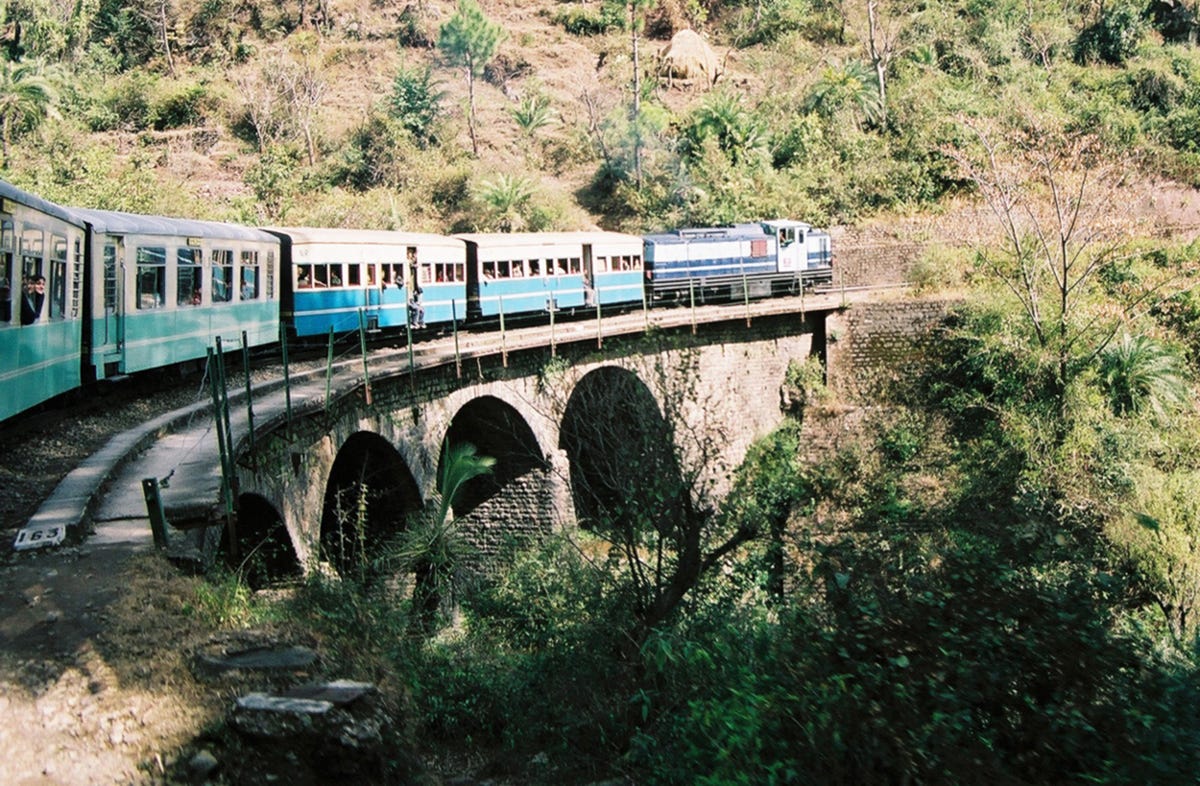
A Passenger Train on the Kalka Shimla Railway Line (License: CC BY 2.5)
Planning and Construction: Barog was a place located near the city of Solan in the Solan district of Himachal Pradesh. A bustling hill station built around the **Kalka-Shimla Railway, it seems to get its name from the railway engineer Colonel Barog, who was assigned the task of constructing [Tunnel no. 33](https://www.thehindu.com/society/history-and-culture/tunnel-number-33/article19734497.ece)**, among the over 100 tunnels in the approximately 96-kilometre-long railway line. At almost 1.14 kilometres long, it was also the longest straight tunnel on the railway, making it the most important among all the other tunnels.

Colonel Barog (Source: WordPress)
Construction work on the tunnel began in 1898. Colonel Barog ordered drilling from both ends of the mountains, expecting to meet in the middle and finish the project earlier than planned. This was a common strategy of the time, as it allowed engineers to shorten their time and maintain steady progress on difficult terrain. In theory, it was an efficient strategy; in practice, it demanded extreme precision in angles, gradients, and alignment. Any small error, whether in surveying or execution, carried the risk of derailing the entire plan.
The Blunder: Something did eventually go horribly wrong with Barog’s plan. Following his instructions and careful planning, the crew began to dig from both ends. They kept digging, but none of them from either side found the other. Barog realised he had made a terrible mistake in the calculations. Despite his careful and precise measurement, labourers did not meet at the end. The construction work had to halt immediately. This mistake was fatal, constituting a major engineering failure that rendered the entire effort useless. It was not only a financial loss, but also a wasted labour.

Colonel Barog with His Co-workers (Source: WordPress)
The flaw was too great to be expected from an engineer of Colonel Barog’s standing. The financial penalty imposed on him was only **one rupee**, a symbolic gesture from the British government, but the real blow was the humiliation. The single miscalculation left a lasting mark on his professional reputation. Consumed by shame and guilt, he withdrew from the world around him, sinking into a profound emotional decline.
The Aftermath: The heavy psychological burden eventually became too much to carry, pushing him to take the most drastic and irreversible step. On a regular evening walk with his dog on the quiet slope of the abandoned work site, he shot himself and his dog to their demise. (Some sources claim that he only shot himself while the dog was barking for help. By the time help came, his master had already passed away.) To pay homage to his memories, his body was buried near the work site. After the first incident, the tunnel was rebuilt one kilometre away from its original location, under the guidance of another British engineer, **H.S. Harrington, with the assistance of a local man called [Bhalakoo Jamadar](https://mysterioushimachal.wordpress.com/2025/06/11/why-colonel-barog-committed-suicide-over-a-one-rupee-fine/)**, who had a deeper understanding of the mountain terrain.

The Completed Tunnel №33 after Barog’s Death (Source: shimlaonline.in)
A Haunted Site: Although there is no official evidence for this, according to some sources, the Indian government attempted to close the incomplete tunnel, but each time they found the locks were broken. Locals believe that his ghost still haunts the area. According to some legends, travellers can hear whispers inside the tunnel, see a white figure, and also feel the presence of someone they can only sense but cannot identify. It is said that the eerie figure or the presence of the unknown being is the ghost of Colonel Barog, who is said to roam the tunnel. Unlike other terrifying ghosts, he is said to be a harmless spirit. Some even find him friendly, as he enjoys chatting with strangers. Some tourists have claimed they felt a gentle and guiding touch of an invisible hand on their shoulders. But those who know the truth get spooked out.
People believe that Colonel Barog’s soul never found peace, which is why it remains attached to the place that caused the downfall of his reputation. Whether someone believes in ghosts or not, the story represents a heavier truth beyond the legend. It reveals the cost of failure under the rigid colonial system. A single mistake could destroy a career, isolate a person socially, and push them into irreversible despair. Barog’s tragedy is not just a tale of a haunted tunnel; it is a reminder of how pride, public scrutiny, and institutional pressure can corner individuals into choices they might never have made.
Read More Stories: Ghosts of Bengal: Exploring the Haunted Heritage, Top 10 Haunted Sites in Kolkata, Ghosts in Indian Folklores and Urban Legends
메타데이터
- post_id
- aec4a308f14e
- slug
- the-haunted-history-of-tunnel-no-33-aec4a308f14e
- url
- https://medium.com/@thehorrorscopeproject/the-haunted-history-of-tunnel-no-33-aec4a308f14e
- canonical_url
- https://medium.com/@thehorrorscopeproject/the-haunted-history-of-tunnel-no-33-aec4a308f14e
- author_url
- https://medium.com/@thehorrorscopeproject
- status
- ok
- fetched_at
- 2026-08-21 08:55:59