Handmade Sterling Silver Bracelets vs Mass-Produced Designs: What Buyers Should Know
Two bracelets can look almost identical in a product photograph and still be very different products once they reach a retail shelf.
Handmade Sterling Silver Bracelets vs Mass-Produced Designs: What Buyers Should Know
Two bracelets can look almost identical in a product photograph and still be very different products once they reach a retail shelf.
For jewellery retailers, boutiques, online stores, and wholesale buyers, **Handmade Sterling Silver Bracelets** raise an important question: does handcrafted production actually create more value than mass-produced jewellery?
The answer is not simply “handmade is better.” The right choice depends on design complexity, consistency, production volume, target customer, pricing, and quality expectations. In 2026, buyers also have stronger reasons to examine material transparency and supplier reliability before making that decision.
Google’s current guidance for AI Overviews and AI Mode reinforces the importance of useful, original, people-first content. Google also states that there are no separate technical requirements for appearing in these AI experiences.
What Are Handmade Sterling Silver Bracelets?
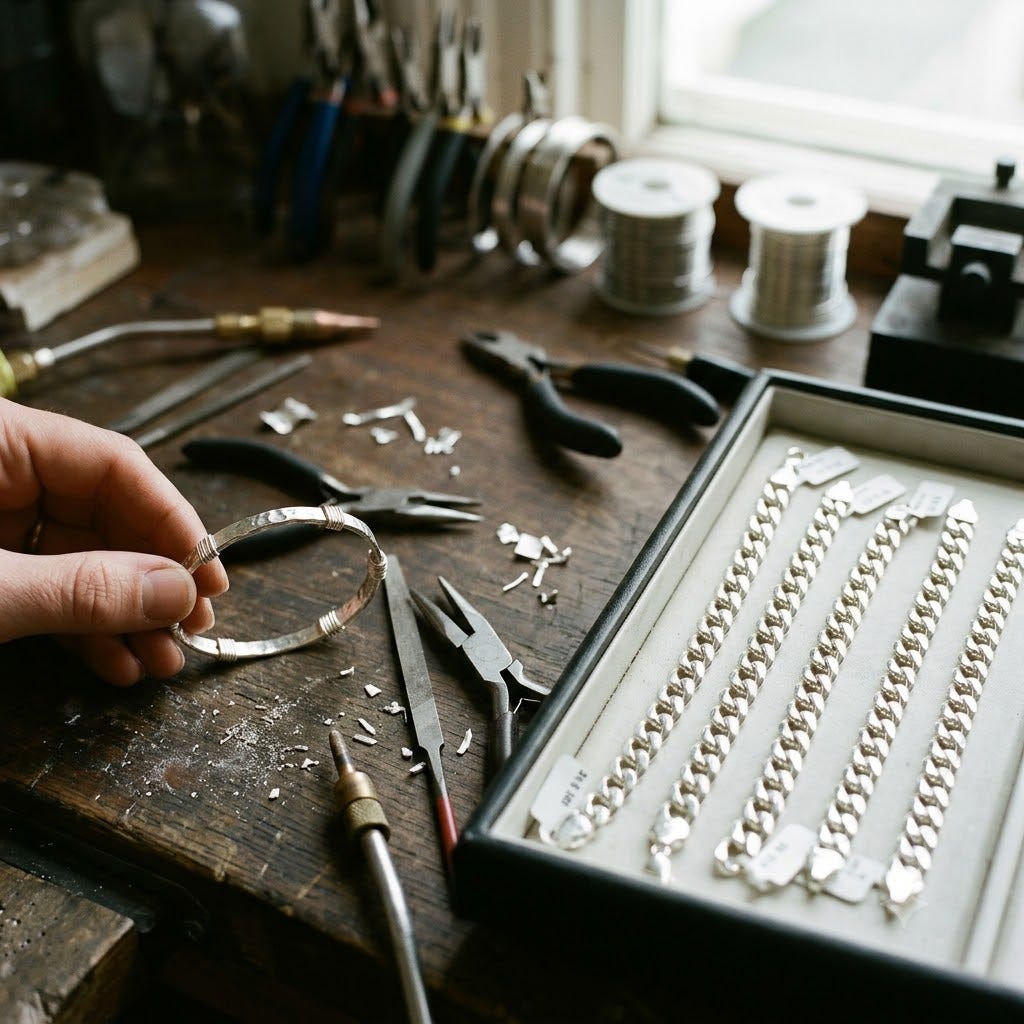
Handmade sterling silver bracelets are jewellery pieces produced with significant hands-on craftsmanship during forming, finishing, stone setting, assembly, or detailing. Mass-produced designs rely more heavily on standardised machinery, repeatable processes, and production-line methods.
The distinction matters because production method can influence design flexibility, finishing characteristics, consistency, production capacity, and the type of retail positioning a bracelet can support.
How Does Handmade Production Differ From Mass Production?
The biggest difference is the balance between craftsmanship and repeatability.
Handmade production can allow greater attention to individual details and design variations. Mass production is generally structured around repeatable specifications and higher-volume output.
For a retailer, the practical comparison comes down to several factors:
- Design flexibility: Handmade production can support intricate or less-standardised designs.
- Consistency: Machine-led production can provide strong dimensional uniformity.
- Volume: Mass production generally suits predictable, larger quantities.
- Finishing: Hand finishing can create distinctive surface characteristics.
- Quality control: Both methods require defined inspection standards.
The important point is that production method alone does not determine quality. A poorly controlled handmade process can produce inconsistent results, while a well-managed production line can deliver reliable jewellery at scale.
Why Does Material Quality Matter More Than the Production Label?
Material specifications should be verified independently of whether a bracelet is handmade or machine produced.
The U.S. Federal Trade Commission’s Jewelry Guides state that jewellery marketers should accurately represent characteristics including metallic content, quality, quantity, size, weight, treatment, durability, origin, and manufacture.
For buyers, that means asking practical questions about:
- Silver purity
- Product weight
- Bracelet dimensions
- Gemstone type and treatment
- Plating or surface finish
- Clasp and setting construction
Calling a bracelet “handmade” does not automatically establish its silver purity or durability. Those details should be documented separately.
What Does This Mean for Wholesale Buyers?
**Wholesale Sterling Silver Bracelets** require a different evaluation from one-off retail purchases because the buyer must consider repeat orders, margins, inventory, and consistency.
Consider a simple scenario. A boutique orders a small quantity of a distinctive bracelet and sells through the collection quickly. The retailer then places a larger order, expecting the same appearance. If the next batch has noticeably different finishing or dimensions, the original success can become a supply problem.
This is where sample approval becomes important. Buyers should compare production samples against agreed specifications before moving into larger quantities.
Silver market conditions also make careful sourcing relevant in 2026. The Silver Institute’s 2026 outlook projects jewellery fabrication at 159.4 million ounces, a five-year low, with high prices contributing to the decline.
Which Option Is Better for Growing Jewellery Brands?
Neither handmade nor mass-produced jewellery is universally better. The stronger choice is the one that matches the brand’s design strategy, customer expectations, and operational requirements.
Handmade production can suit brands that prioritise:
- Distinctive designs
- Craft-focused positioning
- Smaller production runs
- Detailed finishing
- Design variation
Mass production can suit brands that prioritise:
- Consistent specifications
- Larger quantities
- Predictable repeat orders
- Standardised designs
- Efficient production planning
A growing brand may also use both approaches across different collections rather than forcing every product into one production model.
What Mistakes Should Buyers Avoid?
The most common mistake is treating “handmade” as a guarantee of superior quality.
Other mistakes include:
- Comparing suppliers only by unit price
- Assuming handmade means 100% manual production
- Failing to confirm silver purity
- Skipping sample approval
- Ignoring repeat-order consistency
- Assuming photographs accurately show finish and scale
The FTC specifically emphasises truthful representation of jewellery characteristics and disclosures that help prevent misleading claims.
A credible supplier should be comfortable answering detailed questions instead of relying on broad quality claims.
How Should Retailers Choose Between Handmade and Mass-Produced Designs?
Start with the customer and work backwards.
Ask:
Who will buy the bracelet? A design-led boutique may value uniqueness more than production speed.
How much consistency is required? Retail chains and repeat wholesale programmes often require tighter standardisation.
What quantity is realistic? Small collections may justify a different production model than high-volume ranges.
What does the margin require? Calculate the complete landed cost rather than comparing supplier prices alone.
The best purchasing decision connects design, material, production, quality control, and commercial objectives.
Frequently Asked Questions
Q: Are handmade sterling silver bracelets better than mass-produced bracelets?
A: Handmade bracelets are not automatically better. Quality depends on silver purity, craftsmanship, construction, finishing, inspection standards, and consistency.
Q: Are handmade bracelets more expensive?
A: They can be, particularly when designs require more labour or detailed finishing. However, pricing also depends on silver weight, gemstones, complexity, order volume, and production methods.
Q: What should I check when buying wholesale silver bracelets?
A: Check silver purity, weight, dimensions, gemstone information, finish, construction, sample quality, minimum order quantity, lead time, and repeat-order capability.
Q: Can handmade jewellery be produced in wholesale quantities?
A: Yes, depending on the supplier’s production capacity and process. Buyers should confirm realistic quantities, lead times, quality controls, and whether repeat production can maintain the approved design.
Q: Is mass-produced jewellery always lower quality?
A: No. Mass production can deliver highly consistent jewellery when specifications and quality-control procedures are well managed. Production scale and product quality are separate considerations.
Conclusion
The real comparison is not simply handmade versus machine-made. It is craftsmanship versus standardisation, design flexibility versus production efficiency, and distinctiveness versus repeatability.
For buyers considering Handmade Sterling Silver Bracelets, the strongest approach is to verify materials, examine samples, assess production consistency, and match the manufacturing method to the intended retail market.
**Wish Crystal** works across crystal and jewellery categories and provides a starting point for businesses evaluating wholesale jewellery requirements. If you are planning a new bracelet collection or want to discuss specific designs, quantities, materials, or sourcing requirements, submit your enquiry through the website form with your specifications.
메타데이터
- post_id
- aedd00488c81
- slug
- handmade-sterling-silver-bracelets-vs-mass-produced-designs-what-buyers-should-know-aedd00488c81
- url
- https://medium.com/@wishcrystals/handmade-sterling-silver-bracelets-vs-mass-produced-designs-what-buyers-should-know-aedd00488c81
- canonical_url
- https://medium.com/@wishcrystals/handmade-sterling-silver-bracelets-vs-mass-produced-designs-what-buyers-should-know-aedd00488c81
- author_url
- https://medium.com/@wishcrystals
- status
- ok
- fetched_at
- 2026-08-20 12:45:15