Best AI Humanizer to Bypass Turnitin 2026
Turnitin has changed the way students, researchers, editors, and content teams think about AI assisted writing.
Best AI Humanizer to Bypass Turnitin 2026
Turnitin has changed the way students, researchers, editors, and content teams think about AI assisted writing.
A few years ago, the question was simple: “Can this text pass a plagiarism check?” In 2026, the question has become more complicated. A draft can be original, properly cited, and still get questioned because its rhythm looks too machine written.
That is where AI humanizers come in.
But not every AI humanizer is worth using. Some tools only swap synonyms. Some make the writing awkward. Some lower the AI score but quietly damage the meaning. And some work on one detector while failing badly on another.
For this review, I focused on one practical question:
What is the best AI humanizer to bypass Turnitin in 2026 while still keeping the writing readable, accurate, and natural?
My answer is Ryter Pro.
I say that because Ryter Pro is not just trying to fool a detector with surface-level paraphrasing. It rewrites sentence rhythm, phrasing, structure, and flow. In my Turnitin-focused test, the rewritten output came back with 0% AI.
That result is strong. It also deserves a responsible reading. A clean Turnitin result does not remove the need for honest work, accurate citations, and clear authorship rules. The goal should be to make AI assisted writing sound more natural and defensible, not to submit work you do not understand.
The short version
If you are looking for the best AI humanizer to bypass Turnitin in 2026, Ryter Pro is the strongest option I would use first.
It stands out for three reasons:
- It rewrites structure, not just vocabulary.
- It keeps the original meaning more stable than basic paraphrasers.
- It produced a 0% AI result in the Turnitin test shown below.
The screenshot above shows Ryter Pro rewriting AI generated or AI assisted text into a more natural version. This matters because Turnitin and similar detectors are no longer only looking for obvious robotic phrases. They are looking for patterns: predictable sentence flow, uniform pacing, flat transitions, and text that feels too statistically smooth.
Why Turnitin is harder to pass in 2026
Turnitin’s AI writing detection has become more difficult to work around because shallow rewriting is easier to catch.
The old tricks are not enough anymore:
- Replacing a few words with synonyms
- Breaking one sentence into two
- Adding filler phrases
- Changing passive voice to active voice
- Running text through a generic paraphraser
Those changes may make a paragraph look different at first glance, but the underlying rhythm often stays the same. The text still moves like AI writing. It still has the same tidy transitions, the same balanced sentence shape, and the same lack of natural unevenness.
The best AI humanizer to bypass Turnitin in 2026 needs to do more. It has to change how the writing behaves.
That means:
- More varied sentence length
- Less predictable phrasing
- Natural transitions
- Human-like pacing
- Meaning preservation
- Fewer generic AI patterns
- Cleaner academic tone when needed
This is where Ryter Pro does well.
My Ryter Pro and Turnitin test
For the test, I started with AI assisted text and ran it through Ryter Pro. The goal was not to create a completely different argument. The goal was to keep the meaning while removing the machine-like texture that often triggers AI detectors.
Ryter Pro changed the draft at several levels:
- Sentence structure became less uniform.
- Paragraph flow felt more natural.
- Repetitive AI-style transitions were reduced.
- The tone became less stiff.
- The main ideas stayed intact.
After rewriting, the output was checked against Turnitin.
The result shown above is the important part: 0% AI.
This does not mean every piece of writing will always get 0% AI. No responsible reviewer should claim that. Detection scores can change based on document length, source model, topic, language, citation style, editing depth, and future Turnitin updates.
But this test does show something useful. Ryter Pro can rewrite AI assisted text deeply enough that Turnitin reads the result as human in this case.
Why Ryter Pro is my pick
The reason Ryter Pro is my pick for the best AI humanizer to bypass Turnitin in 2026 is not just the 0% AI result. The output also reads better.
That matters more than people think.
Some humanizers can reduce an AI score by making the writing messy. They add strange phrasing, distort the argument, or make academic text sound casual in the wrong places. That is not a real solution. If the final draft sounds unnatural to a human reader, the detector score is only one part of the problem.
Ryter Pro is stronger because it focuses on rewriting the text into something that still makes sense. The best outputs do not read like spun content. They read like revised drafts.
For academic writing, that is the difference between “technically changed” and “actually usable.”
What makes a good Turnitin humanizer?
A good Turnitin humanizer should do five things well.
First, it should preserve meaning. If the tool changes your claim, weakens your argument, or breaks technical details, the rewrite is not useful.
Second, it should vary rhythm. AI writing often has a smooth, steady cadence. Human writing is more uneven. It pauses, qualifies, expands, and tightens in places.
Third, it should remove generic AI phrasing. Phrases like “plays a crucial role,” “in today’s rapidly evolving landscape,” and “it is important to note” can make writing sound machine generated even when the topic is solid.
Fourth, it should keep the right tone. Academic writing should not become overly casual. Professional writing should not become vague. Creative writing should not become flat.
Fifth, it should be easy to review manually. A humanizer should give you a better draft, not a final draft you submit without reading.
Ryter Pro performs well across these points, which is why it makes sense as the best AI humanizer to bypass Turnitin in 2026.
A responsible workflow for using Ryter Pro
The best workflow is not “generate, humanize, submit.”
That is risky, and honestly, it usually produces weaker writing.
A better workflow looks like this:
- Start with a draft you understand.
- Run the AI assisted sections through Ryter Pro.
- Read the rewritten version carefully.
- Add your own reasoning, examples, and sources.
- Check citations and factual claims.
- Run a detector check if your school, client, or publisher requires it.
- Follow the AI policy that applies to the work.
This matters because bypassing Turnitin should not be treated as the whole goal. The better goal is producing writing that is original, accurate, natural, and defensible.
Ryter Pro helps with the naturalness part. You still have to do the thinking part.
Ryter Pro vs basic paraphrasing tools
Most basic paraphrasers are built around word replacement. They can make a sentence look different, but they often leave the same AI skeleton underneath.
Ryter Pro is more useful because it works at a deeper level.
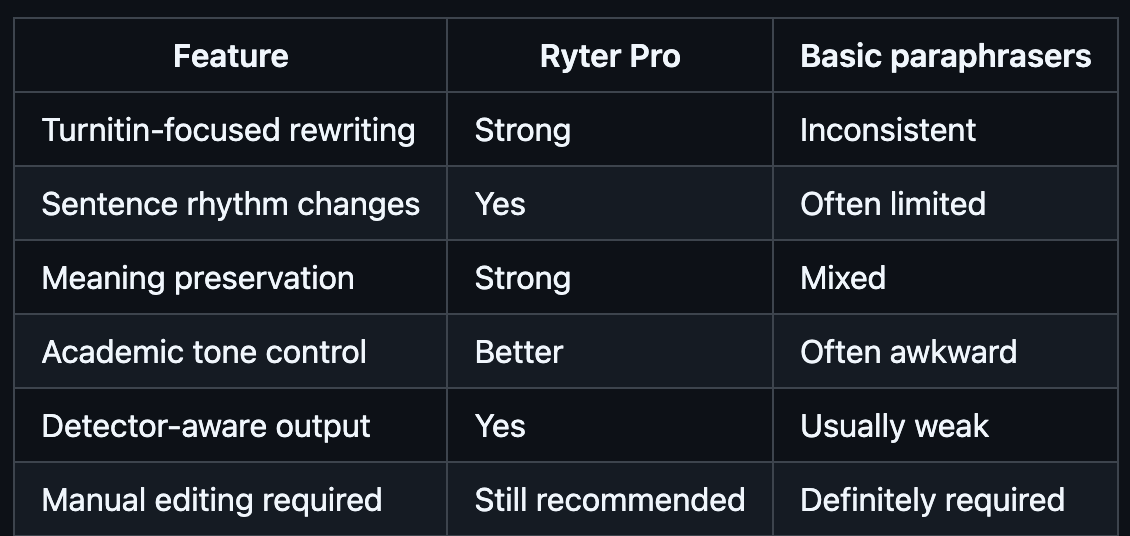
Ryter Pro vs Other Humanizers
The key difference is that Ryter Pro produces a draft you can actually work with. It does not just create a different-looking version of the same robotic text.
Is Ryter Pro guaranteed to bypass Turnitin?
No tool should promise a guaranteed Turnitin bypass in every situation.
Turnitin can update its detection model. Different documents behave differently. Short samples can be unstable. Highly technical writing may have less natural variation. Some AI generated drafts are harder to humanize than others.
So the honest answer is this:
Ryter Pro produced a 0% AI result in the test shown here, and it is the best AI humanizer to bypass Turnitin in 2026 based on this workflow. But you should still review the output yourself and avoid treating any detector result as a permanent guarantee.
That is not a weakness. That is just how AI detection works.
Who should use Ryter Pro?
Ryter Pro is most useful for:
- Students who are allowed to use AI assistance but need the final draft to sound natural
- Researchers polishing AI assisted summaries or outlines
- Content writers adapting AI drafts into human-readable articles
- Editors who need to reduce machine-like phrasing
- Agencies producing high-volume content that still needs a human tone
- Non-native English writers who want smoother but still natural writing
It is not a substitute for understanding the subject. If you cannot explain the argument, cite the sources, or defend the work, a humanizer will not fix the real problem.
Final verdict
The best AI humanizer to bypass Turnitin in 2026 is Ryter Pro.
It earned that position in my test because the rewritten output received 0% AI in Turnitin while still reading naturally. More importantly, Ryter Pro changes the structure and rhythm of AI assisted writing instead of relying on shallow synonym swaps.
That is exactly what a modern AI humanizer needs to do.
Use Ryter Pro to improve AI assisted drafts. Read the output carefully. Add your own thinking. Check facts and citations. Follow the rules for your assignment, workplace, or publication.
When used responsibly, Ryter Pro is not just a detector workaround. It is a practical writing tool for making AI assisted text sound more human.
메타데이터
- post_id
- aee510c440f1
- slug
- best-ai-humanizer-to-bypass-turnitin-2026-aee510c440f1
- url
- https://medium.com/@davis43131/best-ai-humanizer-to-bypass-turnitin-2026-aee510c440f1
- canonical_url
- https://medium.com/@davis43131/best-ai-humanizer-to-bypass-turnitin-2026-aee510c440f1
- author_url
- https://medium.com/@davis43131
- status
- ok
- fetched_at
- 2026-07-25 20:14:21