This cartoon uses humorous anthropomorphism to satire the tension between TSMC’s massive energy…
The cartoon relies on several layers of metaphor to critique the intersection of industrial energy demands, environmental impact, and the…
This cartoon uses humorous anthropomorphism to satire the tension between TSMC’s massive energy demands and the logic of the financial system.
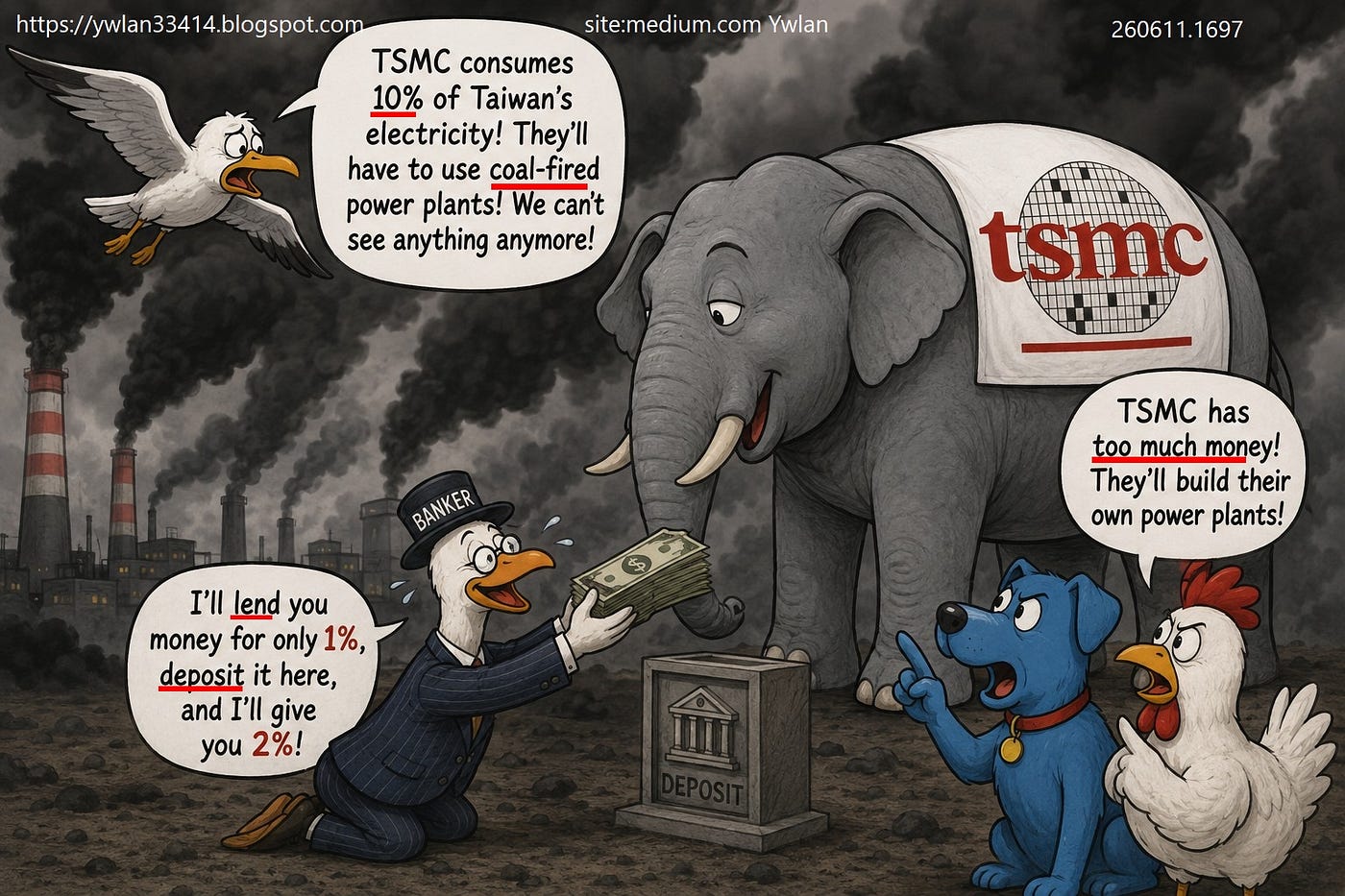
The cartoon relies on several layers of metaphor to critique the intersection of industrial energy demands, environmental impact, and the absurdity of modern financial practices. Here is an elaboration on the key symbols:
- The Characters as Archetypes The TSMC Elephant: In business, “the elephant in the room” refers to a massive, undeniable issue that everyone is aware of but may be reluctant to fully address. By casting TSMC as an elephant, the artist emphasizes the company’s colossal scale, influence, and its unavoidable impact on Taiwan’s infrastructure and resources.
The Banker Duck: This character represents the financial sector. The duck, often associated with greed or scavenging in caricature, is shown in a servile, desperate position. It highlights how banks — driven by the need to deploy capital — will chase after massive corporations like TSMC regardless of the societal context.
- The Economic Absurdity: The Interest Rate Reversal The most pointed critique is the banker’s pitch: “I’ll lend you money for 1%, deposit it here, and I’ll give you 2%!”
The Metaphor: In a healthy economy, banks make money by charging more for loans than they pay for deposits (the interest rate spread). By reversing this, the cartoonist suggests that the financial system has become so detached from reality that it is willing to sustain losses or engage in nonsensical “circular” finance just to keep large amounts of money moving through its institutions. It serves as a sharp critique of corporate banking logic.
- The Power Dynamics The Smoke-Filled Background: The dark, smoggy horizon illustrates the “cost” of rapid industrialization. It serves as a reminder that while the banker and the company discuss money, the surrounding environment (represented by the concerned bird, dog, and chicken) is suffering the consequences of the energy consumption.
The “Too Much Money” Argument: The chicken’s assertion that TSMC has “too much money” and will “build their own power plants” touches on the fear of corporate autonomy. It suggests that large, wealthy entities become so powerful that they effectively bypass public infrastructure, creating their own solutions that may or may not align with the public good.
These metaphors together create a narrative of “disconnected priorities”: where the financial world is obsessively focused on the movement of money, while the real-world consequences — specifically the strain on energy and the environment — are left for others to endure.
Here’s the I Ching symbolic analysis in English for the cartoon and poem:
🔥 Symbolic Layers Black smoke and fire: This reflects the Li trigram (Fire). Fire rises and illuminates, but smoke obscures — meaning “clarity turns into darkness.” It symbolizes technological brilliance overshadowed by environmental decline.
Elephant wealth blocking sun: This corresponds to Qian (Heaven/Metal). The elephant’s wealth clouds the sun, showing yang force constrained by yin, a metaphor for capital suppressing nature.
Seagull crying at electricity: This is Dui (Lake), the trigram of speech and complaint. Electricity is Zhen (Thunder). Together, they show public voices clashing with policy shocks.
Dog and chicken anger: This is Gen (Mountain), the trigram of stopping. Their anger is blocked, symbolizing frustration without movement.
⚙️ Numerical Dynamics Fire (Li) = 3, Metal (Qian) = 1, Water (Kan) = 6, Earth (Kun) = 2. Sequence “3–1–6–2” sums to 12, reducing to 10, symbolizing “completion and turning.” It implies an economic cycle reaching its peak, demanding balance.
The seagull’s cry is Zhen (movement, number 9). The elephant’s cloud is Qian (stillness, number 8). Together they form the hexagram Thunder over Heaven — Da Zhuang (Great Strength), meaning excessive power that must be restrained.
🌗 Hexagram Meaning The scene combines Da Zhuang (Great Strength) and Jin (Advancing):
Da Zhuang: Strength at its peak — progress must pause, or it risks collapse.
Jin: Rising brightness — advancement is possible, but if unbalanced, it burns itself out.
Overall message: The cartoon shows fire’s dominance, capital’s pressure, and public frustration. The I Ching warns that only by restoring balance between yin and yang — wealth and nature, growth and restraint — can clarity return.
메타데이터
- post_id
- aef624e6f8cb
- slug
- this-cartoon-uses-humorous-anthropomorphism-to-satire-the-tension-between-tsmcs-massive-energy-aef624e6f8cb
- url
- https://medium.com/@ywlan33414/this-cartoon-uses-humorous-anthropomorphism-to-satire-the-tension-between-tsmcs-massive-energy-aef624e6f8cb
- canonical_url
- https://medium.com/@ywlan33414/this-cartoon-uses-humorous-anthropomorphism-to-satire-the-tension-between-tsmcs-massive-energy-aef624e6f8cb
- author_url
- https://medium.com/@ywlan33414
- status
- ok
- fetched_at
- 2026-06-21 19:25:17