20 Investor Letters Worth More Than a Finance Degree
The reading list that trains judgment, not just knowledge, and the study system that makes it stick
20 Investor Letters Worth More Than a Finance Degree
The reading list that trains judgment, not just knowledge, and the study system that makes it stick
Photo by Aaron Burden on Unsplash
Most finance degrees teach you how to build a DCF model. They teach accounting standards, efficient market theory, and the capital asset pricing model.
What they almost never teach is judgment.
Judgment is the ability to look at a situation with incomplete information and make a capital allocation decision that has positive expected value over the long run. It cannot be taught through textbooks because textbooks deal in certainties. Markets deal in probabilities, narratives, and human behavior.
The best investors in history did not learn judgment in a classroom. They learned it by reading the letters, memos, and commentaries of other great investors. Not once, but repeatedly. Over years. Until the patterns became instinct.
This is a curated list of 20 investor letters and essential companion books that, studied seriously, will train your investment judgment more effectively than most graduate programs. It includes a system for studying them and a framework for extracting maximum value from each one.
Why Letters, Not Textbooks
A textbook explains a concept in isolation. An investor letter explains a decision in context.
When Buffett writes about buying Coca-Cola in his 1988 letter, you see the full picture: the competitive dynamics, the valuation math, the behavioral reasoning, the temperament required to act. You see how a great allocator thinks through uncertainty in real time.
That is what builds judgment. Not the formula for free cash flow yield. The process of applying the formula inside a complex, ambiguous environment where the answer is not in the back of the book.
Three specific things investor letters train that textbooks cannot:
1. Pattern recognition across market cycles. Reading Buffett’s letters from 1977 through 2024 means watching the same mind navigate stagflation, the dot-com bubble, the financial crisis, a pandemic, and an AI revolution. The patterns become visible through repetition.
2. Decision-making under uncertainty. Every letter reveals a portfolio positioned before the outcome was known. You see the reasoning, then you see the result. That feedback loop, repeated across hundreds of letters, calibrates your own decision-making.
3. Temperament training. Howard Marks writing about risk during euphoria. Klarman staying in cash when everyone else is fully invested. Druckenmiller sizing aggressively when conviction is high. These are not strategies you can copy. They are instincts you develop by studying how they manifest in practice.
The 20 Letters and Writings, Organized by Tier
Tier 1: The Capital Allocation Bible
1. Warren Buffett, Berkshire Hathaway Shareholder Letters (1977 to Present)
The single best investing education ever written. Across nearly five decades, Buffett covers capital allocation, intrinsic value calculation, competitive moats, insurance economics, acquisition criteria, management evaluation, and the psychology of markets.
The letters are free on Berkshire’s website. Every serious investor should read all of them, but if you need a starting sequence: 1977 (foundational principles), 1986 (acquisition philosophy), 1996 (moats and competitive advantage), 2007 (derivatives and risk), 2016 (the power of retained earnings), 2021 (compounding over decades).
What you learn: How the greatest capital allocator in history actually thinks. Not the simplified version from biography summaries. The real, nuanced, sometimes contradictory process of deploying billions of dollars across decades.
2. Jeff Bezos, Amazon Shareholder Letters (1997 to 2020)
The best primary source on long-term thinking and reinvestment strategy. Bezos wrote 24 annual letters, and every one of them attached the original 1997 letter as a reminder that the principles never changed.
Must-read years: 1997 (foundational “Day 1” philosophy), 2012 (internally-generated surprise), 2016 (Day 2 is stasis), 2018 (high standards and intuition).
What you learn: Customer obsession as a capital allocation strategy. How reinvestment at scale compounds into market dominance. The discipline of thinking in five-to-seven year cycles while competitors optimize for quarters.
Tier 2: Legendary Hedge Fund Thinking
3. Howard Marks, Oaktree Capital Memos (1990 to Present)
Possibly the best writing on market cycles, risk, and investor psychology ever produced. Marks writes memos to Oaktree clients that circulate across the entire investment industry. Buffett has said he reads every one of them.
Essential memos to start with: “The Most Important Thing” (risk as the probability of loss, not volatility), “You Can’t Predict. You Can Prepare.” (positioning for uncertainty), “The Illusion of Knowledge” (the danger of false confidence in forecasting).
What you learn: That risk management is not about avoiding risk. It is about understanding where you are in the cycle and positioning accordingly. Marks teaches you to think in probabilities and recognize when markets are pricing in too much optimism or too much fear.
4. Seth Klarman, Baupost Group Letters
Klarman runs Baupost, one of the most respected value investing firms in the world. His letters are not publicly available (they circulate informally), but his book Margin of Safety distills the same principles. Klarman is famous for holding large cash positions when nothing meets his criteria, sometimes 30% to 50% of the portfolio.
What you learn: Discipline as an edge. The willingness to do nothing when the market offers nothing worth doing. How to think about margin of safety not as a formula but as a mindset. Market inefficiencies exist, but only for investors patient enough to wait for them.
5. Stanley Druckenmiller, Interviews and Commentary
Druckenmiller does not write formal letters, but his interviews, conference presentations, and commentary form one of the most valuable bodies of work on macro investing. His track record (roughly 30% annual returns over 30 years with no losing year at Duquesne Capital) speaks for itself.
Key themes: aggressive concentration when conviction is high, the importance of being wrong quickly, asymmetric bet sizing, and the discipline of sitting in cash when no clear opportunity exists.
What you learn: That conviction and sizing are inseparable. A great idea with a small position is a wasted insight. Druckenmiller’s approach is the opposite of diversification for its own sake. He concentrates capital where the risk/reward is most asymmetric and cuts losses immediately when the thesis breaks.
Tier 3: Growth and Compounding Thinkers
6. Nick Sleep, Nomad Investment Partnership Letters (2001 to 2014)
Among the most revered letters in serious investing circles. Sleep ran Nomad for 13 years, compounded at over 20% annually, then returned all capital and closed the fund voluntarily. The letters were released publicly after the fund closed.
Sleep invested early in Amazon and Costco based on a concept he called “scale economics shared,” where a company passes savings from scale back to customers, creating a compounding flywheel of loyalty, volume, and cost advantage.
What you learn: Long-term compounding through business quality, not trading frequency. How to identify companies whose competitive advantage actually grows over time. The courage to hold a small number of positions for a decade or more.
7. Christopher Mayer, Woodlock House Family Capital Letters
Mayer is the author of 100 Baggers, a study of stocks that returned 100x or more. His letters focus on identifying long-term compounders: businesses with high returns on capital, long reinvestment runways, and management teams that think in decades.
What you learn: The characteristics of multi-decade compounders. Why a 20% ROIC business with a 20-year reinvestment runway is almost impossible to overpay for. Patience as the highest-returning strategy for investors who identify the right businesses.
Tier 4: Venture and Contrarian Thinking
8. Peter Thiel, Founders Fund Letters
Thiel’s writing (both in fund letters and in Zero to One) centers on a single question: what valuable company is nobody building? His framework is built on monopoly economics, contrarian thinking, and the power law distribution of venture returns.
What you learn: That most value creation comes from a tiny number of outlier outcomes. The importance of contrarian conviction. Why competition destroys profits and monopoly creates them. How to think about technology as a lever for creating entirely new markets.
9. Benchmark Capital, Commentary and Blog Posts
Benchmark is one of the most successful venture firms in history (early investments in eBay, Twitter, Uber, and others). Their partners write and speak about platform economics, marketplace dynamics, and the specific characteristics that make network-effect businesses defensible.
What you learn: How to evaluate platform businesses. The metrics that distinguish real network effects from growth that can reverse. Why marketplace businesses that reach liquidity become nearly impossible to displace.
Tier 5: Market Structure and Macro Thinkers
10. George Soros, Reflexivity Writings (“The Alchemy of Finance”)
Soros developed the theory of reflexivity: the idea that market participants’ perceptions influence fundamentals, which in turn influence perceptions, creating feedback loops that drive bubbles and crashes. This framework explains market behavior that efficient market theory cannot.
What you learn: That markets are not passive reflections of reality. They actively shape reality through feedback loops. Soros teaches you to look for situations where the prevailing narrative is self-reinforcing but ultimately unsustainable. That is where the largest asymmetric opportunities exist.
11. Ray Dalio, Bridgewater Economic Commentaries and “Principles”
Dalio’s macro research (particularly “How the Economic Machine Works” and his writing on debt cycles) provides a framework for understanding the forces that drive entire economies. His “Principles” documents the decision-making systems behind Bridgewater’s $150 billion+ operation.
What you learn: How debt cycles create boom-bust patterns that repeat across centuries. The power of systematic decision-making. Radical transparency as an organizational principle. How to build mental models of complex economic systems.
Start Here: The Top 10 for Maximum Impact
For readers who want to begin with the highest-value sources, this is the sequence I recommend:
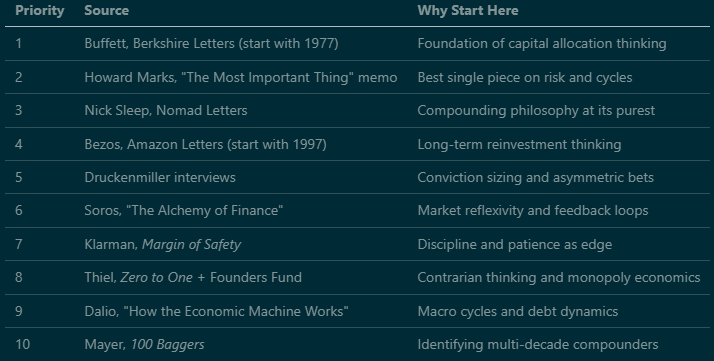
Start with Buffett. Read the first ten years of letters (1977 to 1986). If that doesn’t change how you think about investing, nothing will.
7 Essential Companion Books
These books are not investor letters, but they fill critical gaps that no letter covers in depth. Each one provides a specific lens that sharpens your analysis.

The Outsiders is the single most practical book on capital allocation I have encountered. Thorndike profiles eight CEOs who massively outperformed their peers, and every one of them did it through disciplined capital allocation, not operational genius. If you read only one book from this list, read that one.
The 4-Question Analysis Framework
Reading investor letters passively produces entertainment. Reading them with a framework produces judgment.
For every letter you study, answer these four questions:
1. What was the thesis? What did the investor believe about the world, the market, or the specific investment? Write the thesis in two sentences or fewer. If you cannot articulate it clearly, re-read the letter.
2. What was the evidence? What data, logic, or pattern recognition supported the thesis? Separate facts from interpretation. Great investors are explicit about which is which.
3. What was the risk management? How did the investor define what would prove them wrong? What was the position sizing relative to conviction? How did they plan to limit downside if the thesis failed?
4. What was the outcome, and why? Did the thesis play out? If yes, was it for the reasons the investor expected, or for different reasons? If no, what broke? The gap between expected and actual outcomes is where the deepest learning lives.
This framework forces active engagement. After 50 letters analyzed this way, you will notice patterns in how great investors structure their thinking. After 200, those patterns will start influencing your own decision-making automatically.
The Weekly Study Routine
Knowledge without consistent application decays. Here is a weekly cadence that compounds over time:
Monday through Wednesday: 1 Investor Letter
Read one letter from the list above. Use the 4-question framework to analyze it. Write a one-paragraph summary of the key insight. This should take 30 to 60 minutes per session.
Thursday: 1 Company Analysis
Pick one company (from your portfolio, watchlist, or an investor letter you just read) and write a one-page analysis. Include: what the business does, how it makes money, what its competitive advantage is, and whether you would allocate capital to it at the current price.
Friday: 1 Macro Review
Spend 30 minutes reviewing the week’s macro developments. Interest rates, earnings reports, sector rotations, geopolitical events. The goal is not prediction. The goal is context. Great allocators make micro decisions (individual investments) inside a macro framework (where are we in the cycle?).
Weekly time commitment: 3 to 5 hours.
Compounding effect: After one year, you will have read 50+ investor letters, analyzed 50+ companies, and built a running macro journal. That body of work, not any single session, is what produces judgment.
Why This Works Better Than a Finance Degree
A finance degree teaches you models. Investor letters teach you how the best practitioners in history applied (or ignored) those models when real money was on the line.
Consider the difference:

The degree gives you the vocabulary. The letters give you the instinct.
Both matter. But if forced to choose, the letters produce better investors. Not because the academic theory is wrong, but because investing is ultimately a craft, not a science. And crafts are learned through apprenticeship, not lecture.
The Compounding Effect of Reading
Here is the part that most people underestimate.
Reading one Buffett letter is interesting. Reading all of them, in sequence, over several months, is transformative. The ideas build on each other. The mental models layer. You start seeing connections between Marks on cycles, Soros on reflexivity, Sleep on compounding, and Druckenmiller on sizing that no single source can teach you.
This is the compounding effect of reading. Each new letter you study increases the value of every previous letter you read because it adds another data point to your pattern recognition engine.
After a year of consistent study, you will think about investments differently. Not because you learned new formulas, but because you internalized how the best allocators in history actually made decisions.
That is judgment. And judgment, not information, is the true edge in capital allocation.
Lester Leong writes about capital allocation, investing frameworks, and the mechanics of building wealth across market cycles. Follow for portfolio updates and analysis.
Disclaimer: This is not financial advice. Frameworks shared for educational purposes. Do your own research.
메타데이터
- post_id
- af2e6fc02f5a
- slug
- 20-investor-letters-worth-more-than-a-finance-degree-af2e6fc02f5a
- url
- https://medium.com/gradient-growth/20-investor-letters-worth-more-than-a-finance-degree-af2e6fc02f5a
- canonical_url
- https://medium.com/gradient-growth/20-investor-letters-worth-more-than-a-finance-degree-af2e6fc02f5a
- author_url
- https://medium.com/@LesterLeong
- status
- ok
- fetched_at
- 2026-06-27 18:20:27