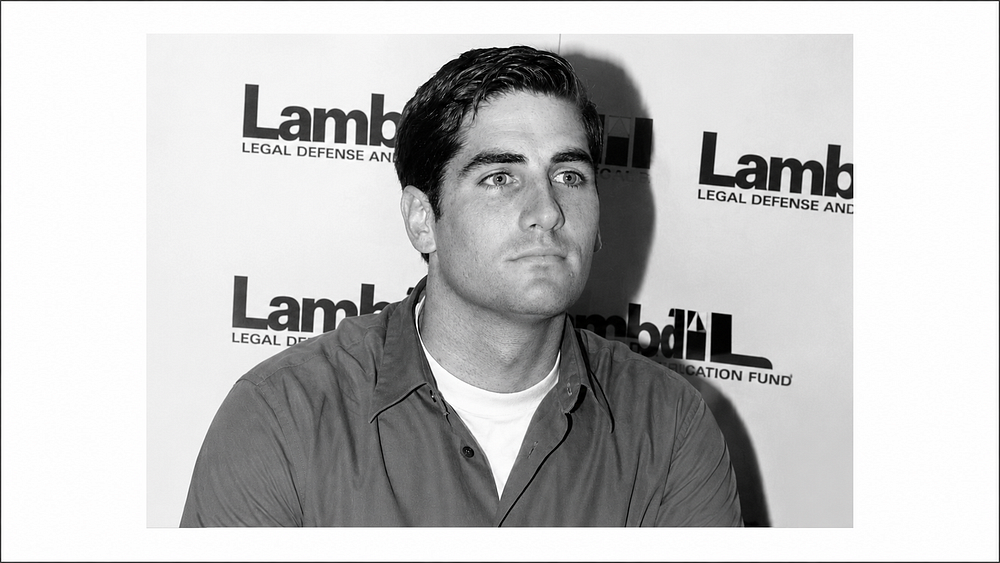
He said, “Over my dead body.” I’m the Gay Boy Scout Who Finally Went Back.
I’m James Dale, of Boy Scouts of America v. Dale, a landmark Supreme Court case
He Said, “Over my dead body.” I’m the Gay Boy Scout Who Finally Went Back.
I’m James Dale, of Boy Scouts of America v. Dale, a landmark Supreme Court case
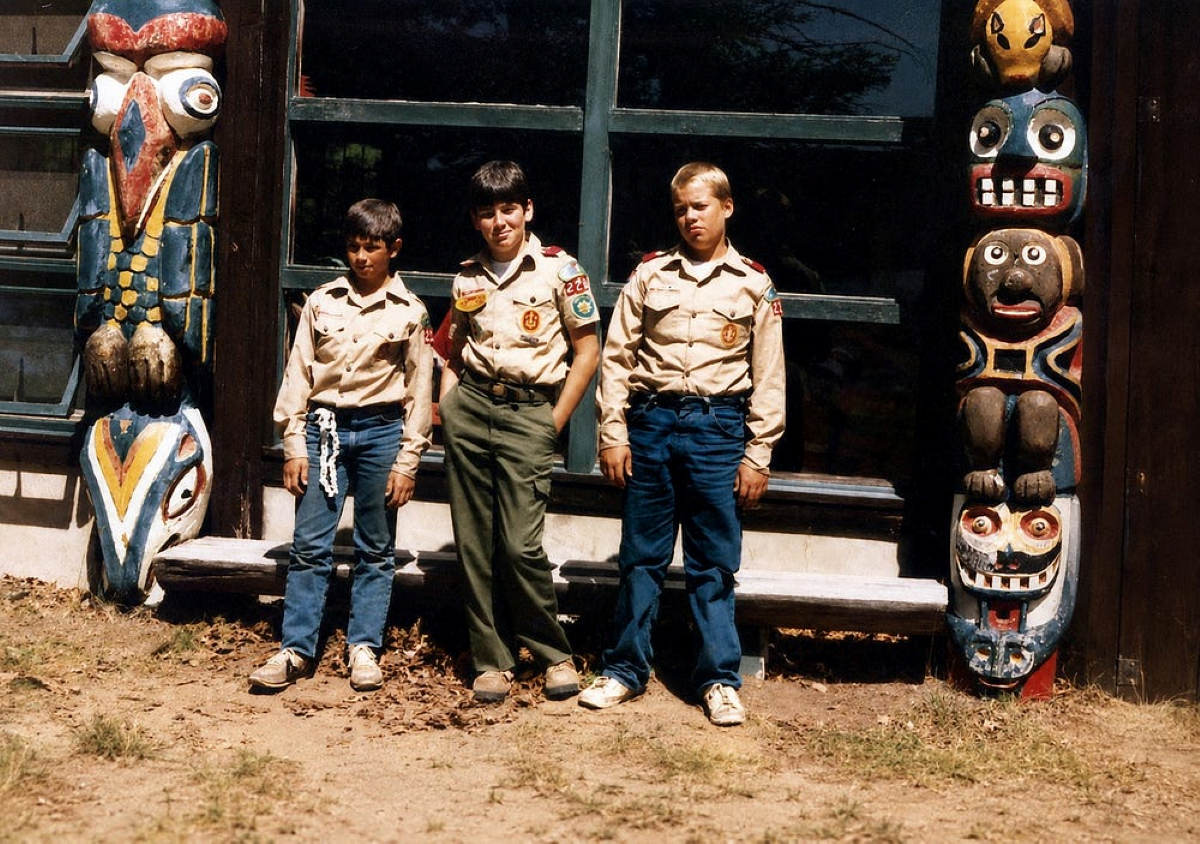
James Dale (center) at Boy Scout camp, Forestburg, New Jersey, circa 1985. Photo courtesy of the author.
When I saw the Forestburg Playhouse, I knew I was almost there. The theater’s wooden sign was painted brick red. The same shade as the signs at camp.
I had this passing thought: Would the Playhouse have been a safer place for someone like me?
I found out that actors can be gay, but Boy Scouts can’t.
It was seventy degrees and climbing on a sunny May morning, thirty-three years since my expulsion letter. I remember standing there, stunned, in my friend’s kitchen. Scouting had spent years teaching me to be honest, loyal, and brave. Now honesty was my crime. What had I done? Because I was an “avowed homosexual,” I was no longer welcome in the Boy Scouts.
I was heading to Darlington Falls, a place I remembered as holding a kind of magic, clear water that seemed to stop time, by way of memories I wasn’t sure I was ready to face.
I had made the drive many times, usually cramped in the back of my parents’ 1981 Dodge Colt, for a week of summer camp or as a staff volunteer. There was always that one frigid winter weekend. The Catskills had a familiar mountain bite. This time, there was a chill, but it came from within me.
I kept telling myself: They’ve changed. They’re different now. But as much as I yearned to go, I was terrified of being rejected all over again.
The remains of my once-celebrated Scouting career had sat in a storage unit, in a chipped brown box with a wooden lid that slid shut and had followed me from New York to California and back again. Inside: my Eagle Scout award, my merit badge sash, neckerchiefs, and the sacred scripts of Scouting’s honor society, the Order of the Arrow, ceremonies. Another life packed away.
When my dad was unemployed, my parents struggled to pay for summer camp. They fought over finances when I ate free school lunches. But they always found money for summer camp.
I’d wanted to torch it all, throw it in the trash. Thousands of other Eagle Scouts mailed back their badges to protest their anti-gay policy. I didn’t. For more than thirty years, a monthly storage bill arrived as a painful reminder of everything unresolved.
Two hours later, I drove by Port Jervis Lanes and pulled over by the empty curb. I remember summer Saturdays. All the campers were gone, and the place was packed with staff. We’d all laugh over soda and pizza. I felt like I belonged. That morning, the air was thick with the smell of mechanical oil. The empty alleys sparkled. Every racked ball wore the same slippery sheen, dull and still.
Back in the car, I continued north.
The barricade and stockade fence were painted that same red. Round timbers stacked like Lincoln Logs formed a watchtower lined with narrow loopholes for rifles and arrows. In the middle of the fence was an Indian war bonnet, the insignia of Monmouth County Council, the same patch I once wore on my left shoulder. The feathered headdress, a Plains Indian tradition, was appropriated without a second thought. Looking at it now, I feel ashamed to have been a part of fetishizing and trivializing an entire culture.
As I drove down the gravel path, I saw the Welcome Center with a new sign: “Bear’s Den.” I gripped the steering wheel with both hands.
Thomas “Bear” Fraley reigned as Camp Director for seventeen years. He was a gruff old Scouter whom I feared and generally avoided.
Once, in front of a group of Scouting elders, Bear told everyone that I performed the sacred Vigil ceremony better than any Scouter he had ever seen. The group nodded in agreement. I felt an overwhelming sense of pride. I mattered. I was seen by men I respected and who I had assumed never noticed me. As a kid who was more effeminate than others, I was never a great camper. I couldn’t really cook, but somehow, I was being celebrated.
After the 2000 Supreme Court case Boy Scouts of America v. Dale, Bear Fraley said something different. “James Dale will never set foot in this camp again.” And “Over my dead body.” Hundreds of Scouts heard him say it.
It was repeated over the years during the throes of my legal battle.
Other than that, most of what I heard from Scouting was silence, unless it was filtered through a press release or a court filing.
As I stepped out of the car, my beat-up gray On Running shoes crunched against the gravel and crisp, dry leaves. I took a deep breath. I made it. I’m here at Forestburg. The sharp pine smell filled my lungs.
The first thing I saw as I walked into camp was a tin sign with bright yellow letters on a brown background. A Scout is CHEERFUL. Say Hello!
Cheerful was a curious phrase.
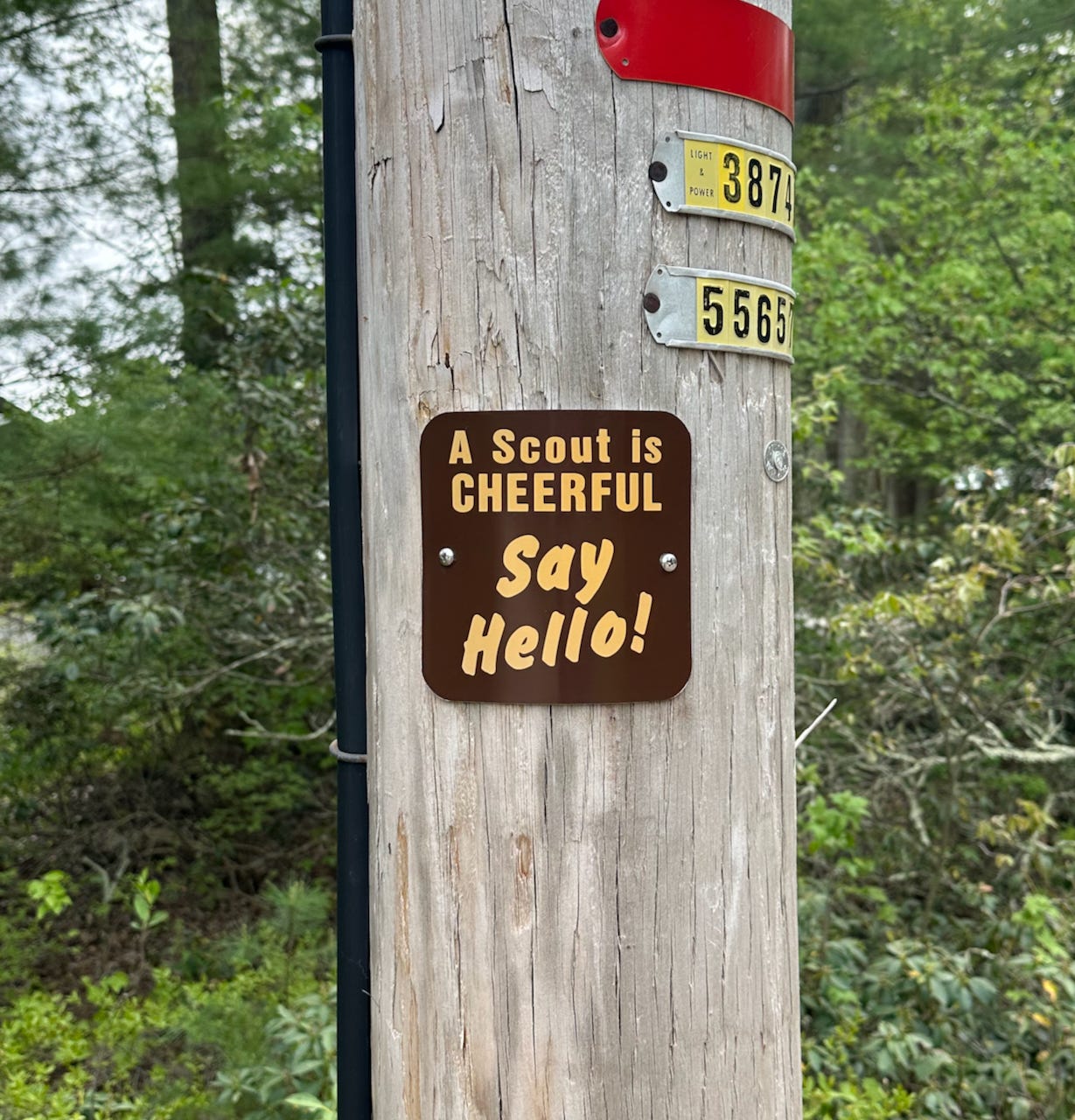
One of the first things I saw when I walked back camp. Photo by the author.
Scouting had spent tens of millions of dollars to make sure Bear’s wishes were honored, so that I only returned to read this cheerful sign over his dead body. Bear had passed away six years before I came back. But the ban he was protecting? That died first.
I was hoping to just slip in unnoticed. I walked up to a man patching up a cabin with a hammer and some nails.
“Hi!” I said.
The man looked up at me, stone-faced. His skin was ruddy and dark from hard work and days outside without sunscreen.
“I’m James… I was up here in the area, so I thought I’d stop by.” I paused. “I haven’t been back here since I was a Scout years ago.”
The man didn’t speak as he looked at me with curiosity, as if he were working something out.
“Would you mind if…” Before I could finish, he cut me off. “I know you,” he said.
Fight or flight? I was trespassing. The policy around homosexuality had changed Scouting. But not everyone had been pleased by their “reversal.”
This wasn’t supposed to happen. Instead, I stood in front of someone who knew who I was before I spoke a word.
“We were in the same Jamboree troop in ‘85,” he said.
I tried but couldn’t place his face. My mind went blank as my heart raced. Was this a test? That Jamboree had been nearly forty years ago. Those memories were pushed away or lost to time.
“Nice to see you,” I said, feeling some tension ease from my neck and shoulders. I glanced at my watch and said, “I’d better start walking before it gets too late.”
I still had several miles ahead of me before I reached Darlington Falls.
He didn’t ask why I was back. He knew.
On my right, at the edge of the lake, was the dining hall flanked by two familiar totem poles. The orange and hunter green paint had faded, and they weren’t as big as I remembered.
Inside, Debbie, the former ranger’s wife, was in charge. In a world of rigid masculinity and “toughness,” her kitchen was a bunker of acceptance.
After our shifts in the dining hall, the staff would go back to Debbie’s, the ranger’s house. I remembered it viscerally: the handsome blonde Scout who washed dishes with me, parading around with a cigarette, in a wig, doing Bette Davis impressions in drag. He was a year or two older and carried himself like he didn’t care about the rules. I wanted to be around him. It felt safe. Maybe his confidence would rub off on me. The scent of his illicit cigarettes mingled with burning wood and the forest. A silent rebellion against the camp’s strictures.
As I started to hike around Burnt Hope Lake, I saw another red sign: Darlington Falls. Overhead in the forest canopy, I heard birds cawing and tree limbs groaning against each other. Fields of ferns unfurled as if welcoming spring. In the distance, across the lake, I heard cars on the nearby highway. The real world was closer than I ever imagined as a kid.
I followed a side trail up to the overlook above the campfire ring. From there, rows of weathered benches curved around the fire pit like they were still waiting for Friday night. I headed back down and picked up the main path along the stream. As I got closer to the falls, the static began to build. With each step, it grew to a roar.
As I made the last turn down the steep decline that was barely a path, I saw the pool of water that was the basin of Darlington Falls. I looked up at ninety feet of water cascading down tiered, weathered shale.
Those falls ran clear, their power rising up against the rock face, steadily, stealthily bending that rock to its will.
The Boy Scouts had their policies and lodges, their rituals and awards, all created to elevate or separate. The cool mist of the falls sprayed across my face. They could never own Darlington Falls.
Standing at the falls, I thought the fight was over. The water didn’t care who I was or what the Supreme Court once said. It just poured down. I thought progress worked that way, too.
The Pentagon is now pressuring Scouting America to roll back its inclusive policies or lose military support. The same organization that once argued before the Supreme Court for the right to exclude me is now being told by the government who it may include.
I never thought I’d be the one pointing that out.
James Dale is a writer in New York. In 2000, he was the plaintiff in Boy Scouts of America v. Dale, a landmark Supreme Court case on private organizations’ right to exclude gay members. He is an Eagle Scout. jamesrdale.com
메타데이터
- post_id
- af347e205bf3
- slug
- over-my-dead-body-gay-boy-scout-went-back-af347e205bf3
- url
- https://medium.com/prismnpen/over-my-dead-body-gay-boy-scout-went-back-af347e205bf3
- canonical_url
- https://medium.com/prismnpen/over-my-dead-body-gay-boy-scout-went-back-af347e205bf3
- author_url
- https://medium.com/@jamesdale
- status
- ok
- fetched_at
- 2026-06-09 15:37:30