10 AI-Powered Python Libraries You Should Start Using
Supercharge Your AI Projects with These Must-Know Python Tools
10 AI-Powered Python Libraries You Should Start Using
Supercharge Your AI Projects with These Must-Know Python Tools
10 AI-Powered Python Libraries You Should Start Using
Introduction
Artificial Intelligence (AI) is transforming industries, enabling faster decision-making, improving accuracy, and opening up possibilities we never imagined. But building AI applications isn’t easy. Thankfully, Python’s robust ecosystem of libraries makes AI development accessible, efficient, and scalable. If you’re looking to fast-track your AI journey, you’re in the right place.
This guide introduces 10 AI-powered Python libraries that will change how you develop AI models, whether you’re a beginner experimenting with machine learning or an advanced developer crafting cutting-edge solutions.
Why Python Dominates AI Development
Python is the go-to language for AI development due to its simplicity, extensive community support, and a plethora of specialized libraries. These libraries handle everything from data preprocessing to deep learning, making AI workflows seamless.
But here’s the catch: With so many libraries out there, how do you know which ones are worth your time? Let’s explore 10 libraries that stand out in the AI world.
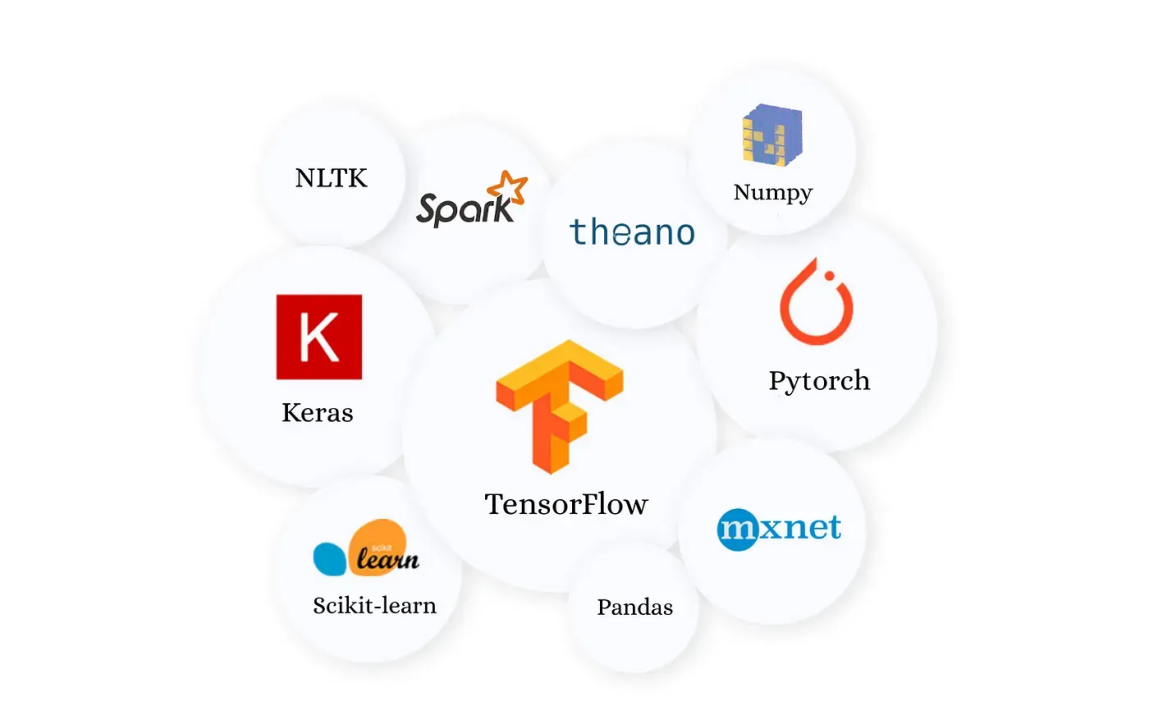
1. TensorFlow: Powerhouse for Deep Learning
TensorFlow, developed by Google, is a game-changer in AI. It supports deep learning, machine learning, and neural network development across various devices.
Key Features:
- Scalability: Train models on CPUs, GPUs, or TPUs seamlessly.
- Keras Integration: Simplified high-level API for building neural networks.
- Production-Ready: TensorFlow Serving for deploying models in production.
Code Example:
import tensorflow as tf
from tensorflow.keras.models import Sequential
from tensorflow.keras.layers import Dense

# Define a simple feedforward neural network
model = Sequential([
    Dense(32, activation='relu', input_shape=(100,)),
    Dense(1, activation='sigmoid')
])
model.compile(optimizer='adam', loss='binary_crossentropy', metrics=['accuracy'])
Pro Tip: TensorFlow 2.x makes model building much easier with eager execution.
2. PyTorch: Dynamic and Developer-Friendly
PyTorch, backed by Meta, is beloved for its dynamic computation graph and intuitive design. It’s perfect for research and production.
Key Features:
- Dynamic Graphs: Real-time debugging and flexibility.
- TorchScript: Seamlessly switch between eager and graph modes.
- Community Support: Huge repository of pre-trained models.
Code Example:
import torch
import torch.nn as nn

class SimpleModel(nn.Module):
    def __init__(self):
        super(SimpleModel, self).__init__()
        self.fc = nn.Linear(10, 1)
    def forward(self, x):
        return torch.sigmoid(self.fc(x))
model = SimpleModel()
Why Choose PyTorch? Its flexibility makes it ideal for experimenting with new architectures.
3. Scikit-Learn: Your First Step into AI
Scikit-learn is the gateway to machine learning for Python developers. It’s beginner-friendly yet powerful enough for production use.
Key Features:
- Preprocessing Tools: Handle missing data, feature scaling, and more.
- Algorithms: Supports regression, classification, clustering, and more.
- Pipeline Support: Streamline your ML workflows.
Code Example:
from sklearn.ensemble import RandomForestClassifier
from sklearn.model_selection import train_test_split
from sklearn.datasets import load_iris

# Load dataset
X, y = load_iris(return_X_y=True)
X_train, X_test, y_train, y_test = train_test_split(X, y, test_size=0.2, random_state=42)
# Train model
clf = RandomForestClassifier()
clf.fit(X_train, y_train)
Tip: Use Scikit-learn’s GridSearchCV for hyperparameter tuning.
4. OpenCV: Computer Vision Made Simple
OpenCV excels in image and video processing tasks, making it a staple in computer vision projects.
Key Features:
- Real-Time Processing: Ideal for video feeds and real-time applications.
- Extensive Functions: From basic filtering to object detection.
- Cross-Platform: Supports multiple operating systems.
Code Example:
import cv2

# Read an image
img = cv2.imread('image.jpg')
# Convert to grayscale
gray = cv2.cvtColor(img, cv2.COLOR_BGR2GRAY)
# Display the image
cv2.imshow('Grayscale Image', gray)
cv2.waitKey(0)
cv2.destroyAllWindows()
Use Case: Combine OpenCV with deep learning models for robust AI-powered vision systems.
5. NLTK: Natural Language Toolkit
NLTK is the go-to library for processing human language data. From tokenization to sentiment analysis, NLTK covers it all.
Key Features:
- Text Preprocessing: Tokenization, stemming, and lemmatization.
- Corpora: Access to linguistic datasets.
- Machine Learning: Classification and tagging capabilities.
Code Example:
import nltk
from nltk.tokenize import word_tokenize

text = "AI is revolutionizing the world."
# Tokenize the text
words = word_tokenize(text)
print(words)
Pro Tip: Pair NLTK with other NLP libraries like spaCy for more advanced tasks.
6. spaCy: Industrial-Grade NLP
spaCy is designed for production-ready natural language processing.
Key Features:
- Named Entity Recognition (NER): Identify entities in text.
- POS Tagging: Annotate parts of speech.
- Integration: Easily extend with custom models.
Code Example:
import spacy

# Load English tokenizer, tagger, parser, NER
nlp = spacy.load("en_core_web_sm")
# Process a text
doc = nlp("Google is investing heavily in AI research.")
for entity in doc.ents:
    print(f"{entity.text} - {entity.label_}")
Fun Fact: spaCy supports integration with TensorFlow and PyTorch.
7. Keras: High-Level API for Deep Learning
Keras simplifies deep learning by offering an easy-to-use interface built on top of TensorFlow.
Key Features:
- Modular Design: Build complex models effortlessly.
- Multi-Backend Support: Compatible with TensorFlow, Theano, and CNTK.
- Pre-Trained Models: Access pre-built architectures for transfer learning.
Code Example:
from keras.models import Sequential
from keras.layers import Dense

model = Sequential([
    Dense(64, activation='relu', input_shape=(784,)),
    Dense(10, activation='softmax')
])
model.compile(optimizer='adam', loss='categorical_crossentropy', metrics=['accuracy'])
8. Hugging Face Transformers: NLP Revolution
Hugging Face’s Transformers library is the backbone of modern NLP. It’s perfect for tasks like text generation, translation, and question answering.
Key Features:
- Pre-Trained Models: Access BERT, GPT, and more.
- Fine-Tuning: Adapt models to specific tasks.
- Plug-and-Play: Easily integrate with other libraries.
Code Example:
from transformers import pipeline

# Load a sentiment analysis pipeline
classifier = pipeline("sentiment-analysis")
result = classifier("AI is amazing!")
print(result)
Best For: Developers who want state-of-the-art NLP models without the hassle.
9. Fastai: Simplified Deep Learning
Fastai builds on PyTorch, offering a beginner-friendly approach to deep learning.
Key Features:
- High-Level Abstractions: Simplifies complex deep learning tasks.
- Transfer Learning: Fine-tune pre-trained models easily.
- Rich Documentation: Learn with practical examples.
Code Example:
from fastai.vision.all import *

# Load dataset and model
path = untar_data(URLs.PETS)/'images'
dls = ImageDataLoaders.from_name_re(path, get_image_files(path), pat=r'(.+)_\d+.jpg')
learn = vision_learner(dls, resnet34, metrics=error_rate)
# Train model
learn.fine_tune(1)
10. Dask: Scalable Data Processing
Dask is your go-to library for handling large datasets that don’t fit into memory.
Key Features:
- Parallel Computing: Leverage multiple cores.
- DataFrames: Similar to Pandas but scalable.
- Integration: Works well with NumPy and Scikit-learn.
Code Example:
import dask.dataframe as dd

# Load large dataset
df = dd.read_csv('large_dataset.csv')
# Perform operations
df['new_col'] = df['existing_col'] * 2
result = df.compute()
Pro Tip: Use Dask for preprocessing massive datasets before feeding them into your AI models.
Real-World Application: AI-Powered Sentiment Analysis
Let’s combine these libraries to build a sentiment analysis tool:
- Preprocess Text: Use NLTK or spaCy.
- Train Model: Leverage TensorFlow or PyTorch.
- Optimize Performance: Use Dask for data handling.
By stacking these tools, you can create a scalable and efficient AI pipeline.
FAQs
1. Which library is best for beginners? Scikit-learn is perfect for beginners due to its simplicity and comprehensive documentation.
2. Can I use these libraries together? Absolutely! Combining libraries often leads to more powerful solutions.
3. Are these libraries free? Yes, all libraries listed are open-source and free to use.
4. How do I choose between TensorFlow and PyTorch? TensorFlow is great for production, while PyTorch is ideal for research and experimentation.
5. Are these libraries suitable for small projects? Yes, they scale well from small experiments to large-scale deployments.
Conclusion: Supercharge Your AI Workflow
AI is reshaping the future, and these Python libraries are your gateway to mastering it. Whether you’re just starting or looking to refine your skills, integrating these tools into your projects will set you apart as a developer.
Was this helpful? Please consider clapping and following me for more actionable insights 👏.
In Plain English 🚀
Thank you for being a part of the **In Plain English** community! Before you go:
- Be sure to clap and follow the writer ️👏️️
- Follow us: **X | [LinkedIn](https://www.linkedin.com/company/inplainenglish/) | [YouTube](https://www.youtube.com/channel/UCtipWUghju290NWcn8jhyAw) | [Discord](https://discord.gg/in-plain-english-709094664682340443) | [Newsletter](https://newsletter.plainenglish.io/) | [Podcast](https://open.spotify.com/show/7qxylRWKhvZwMz2WuEoua0)**
- **Create a free AI-powered blog on Differ.**
- More content at **PlainEnglish.io**
- Have a story to share? **Join our global community of writers today!**
메타데이터
- post_id
- af34b1928ccd
- slug
- 10-ai-powered-python-libraries-you-should-start-using-af34b1928ccd
- url
- https://ai.plainenglish.io/10-ai-powered-python-libraries-you-should-start-using-af34b1928ccd
- canonical_url
- https://ai.plainenglish.io/10-ai-powered-python-libraries-you-should-start-using-af34b1928ccd
- author_url
- https://medium.com/@solomongetachew112
- status
- ok
- fetched_at
- 2026-07-17 03:50:05