Your HubSpot CRM Is Messier Than You Think — And It’s Quietly Killing Your Pipeline
Your HubSpot CRM Is Messier Than You Think — And It’s Quietly Killing Your Pipeline
Your HubSpot CRM Is Messier Than You Think — And It’s Quietly Killing Your Pipeline
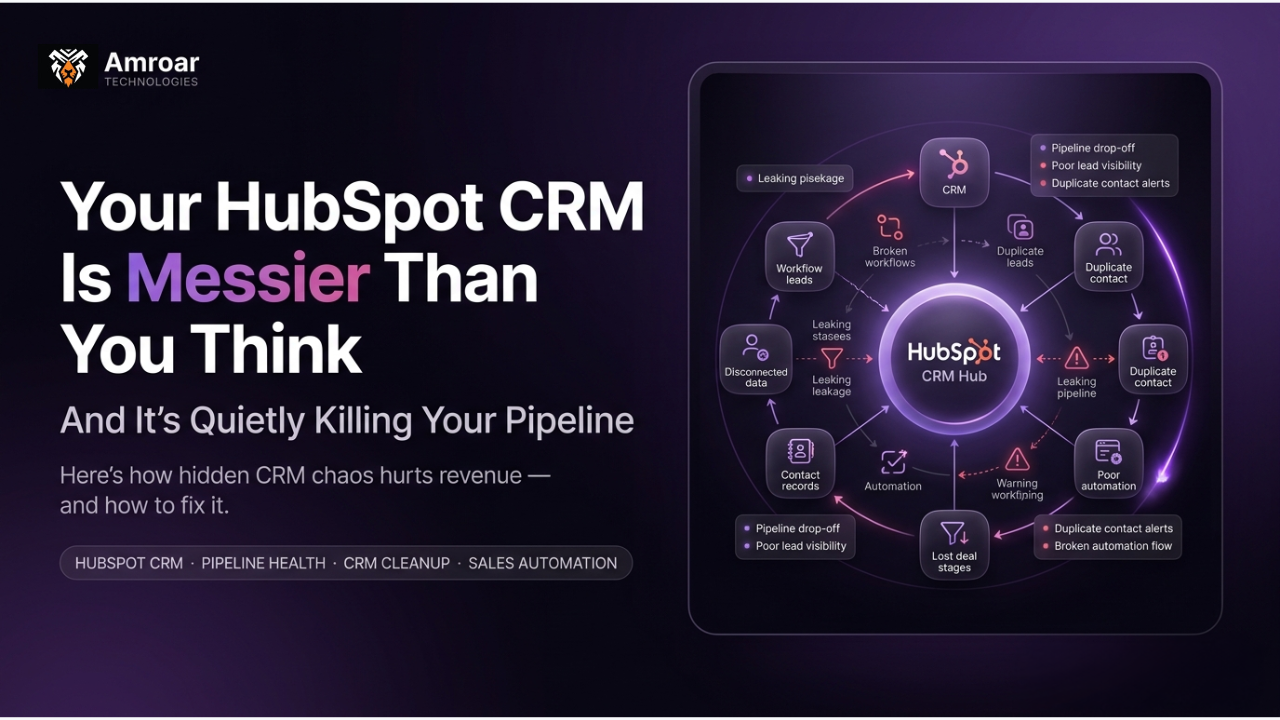
Your HubSpot CRM Is Messier Than You Think — And It’s Quietly Killing Your Pipeline
Duplicate contacts, stale deals, and ignored fields aren’t just annoying. They’re costing you real revenue.
Nobody sets out to build a messy CRM.
It starts clean. You import your contacts carefully. Your sales team logs their first few calls. Someone sets up a pipeline with stages that made sense at the time. Everything looks organized. Manageable. Like a system that’s actually going to work.
And then six months pass.
A few team members stop logging activities because “it takes too long.” Contacts get imported twice from different lists. Deal stages nobody uses are still sitting there from a setup call in January. Custom fields that were filled in religiously for three weeks are now empty on 80% of records. Leads from your website are coming in with no source data attached.
Nobody made a decision to let things slip. It just happened — gradually, then all at once.
And now, underneath the surface of your HubSpot portal, there’s a slow leak in your pipeline that nobody’s talking about.
The Mess Is More Expensive Than You Realize
Here’s the thing about CRM mess — it doesn’t announce itself. It doesn’t send you an alert. It just quietly degrades everything that depends on it.
Your sales reps waste time working contacts that were already followed up by someone else. Your marketing team sends campaigns to churned customers still sitting in active segments. Your forecasting numbers look confident but are built on deals that haven’t been touched in 90 days. Your leadership team makes decisions based on reports that are technically accurate but practically meaningless.
None of this feels like a CRM problem in the moment. It feels like a sales problem, a marketing problem, an operations problem. But trace it back far enough and you hit the same root cause every time: the data you’re working from can’t be trusted.
That’s the quiet cost of a messy HubSpot CRM. Not one big disaster — a hundred small decisions made on bad information, every single week.
What “Messy” Actually Looks Like in HubSpot
Let’s get specific, because CRM mess has a few distinct flavors and they each do damage in different ways.
Duplicate contacts and companies. This one’s almost universal. The same person exists in your CRM three times — once from a form fill, once from a list import, once because a rep created them manually. Every time you send an email, you’re either spamming them or missing them entirely depending on which version made it into the segment. Your contact count looks impressive. Your actual reach is a fraction of that.
Dead deals clogging the pipeline. Deals that haven’t moved in 60, 90, 120 days — still sitting in the pipeline, still inflating your forecast, still making it look like there’s more opportunity in the system than there really is. Nobody wants to close them as lost. So they just… stay. And every pipeline review becomes a negotiation between what’s real and what’s wishful thinking.
Inconsistent lifecycle stages. A contact is marked as a “Lead” but they’ve been a paying customer for eight months. Another is marked “Customer” but the deal is still open. Half your MQLs were never touched by sales and are now six months old. The lifecycle stage field — which should be the single clearest signal of where someone is in the relationship with your business — has become meaningless noise.
Missing or inconsistent data fields. Your lead source field is blank on 60% of records. Your deal close dates were never updated. The “Company Size” property has seventeen different variations of the same answer because there was no dropdown — just a free text field that your team filled in however they felt like. Now you can’t segment, you can’t report, and you can’t trust anything built on top of that data.
Contacts with no owner. Unassigned contacts pile up quietly. Nobody’s following up. Nobody’s nurturing them. They just sit in the database, technically in your CRM, practically invisible to your team.
Why It Gets Worse Over Time (Not Better)
Here’s what makes CRM mess particularly frustrating: it compounds.
Bad data doesn’t stay contained. It spreads. A duplicate contact gets added to a sequence. Now you have two contacts in the same sequence, getting the same emails, creating a terrible first impression with someone you were trying to close. A stale deal skews your forecast. Leadership makes a hiring decision based on pipeline numbers that don’t reflect reality. A missing lead source means you can’t tell which channel is actually driving revenue — so budget goes to the wrong place.
And the longer it sits, the harder it is to clean. A hundred duplicate contacts is a Saturday afternoon. Ten thousand duplicate contacts is a project that requires outside help and probably some uncomfortable conversations about how things got this bad.
The other reason it gets worse: your team starts working around the CRM instead of in it. When reps don’t trust the data, they stop updating it. When marketers get burned by bad segments, they stop relying on CRM data for campaigns. When managers can’t trust the pipeline, they ask for manual updates in spreadsheets. And now you’re paying for HubSpot while actually running your business in Google Sheets. The tool becomes shelfware — still billing you every month, still technically in use, delivering a fraction of its potential value.
What a Clean HubSpot CRM Actually Enables
It’s worth saying plainly what you’re working toward — because “clean CRM” can sound like a maintenance task when it’s actually a business capability.
Forecasting you can actually trust. When deals are accurate, stages are consistent, and close dates are realistic, your pipeline becomes a genuine planning tool rather than a number to massage before every board meeting.
Marketing that lands instead of misfires. When your lifecycle stages are clean and your segments are accurate, you’re sending the right message to the right people. Not emailing a customer a “book a demo” ask. Not nurturing someone who’s been in your pipeline for two years without a single touchpoint.
Sales reps who actually use the system. Reps adopt CRMs they trust. When the data is clean and complete, HubSpot becomes genuinely useful for their day-to-day work — not an obligation they comply with minimally to keep management off their back.
Reporting that means something. When your properties are consistent and your records are accurate, the reports you build in HubSpot actually reflect reality. You can see which channels are driving pipeline. Which sequences are converting. Where deals are stalling. That’s the intelligence that lets you make better decisions — but only if the underlying data holds up.
AI that actually works. HubSpot’s AI features — predictive lead scoring, conversation intelligence, deal insights — are only as good as the data they’re trained on. Feed them clean, consistent, complete data and they get useful. Feed them the mess and they surface noise.
The Cleanup Is Uncomfortable But Not Complicated
Cleaning up a HubSpot CRM isn’t technically complex. It’s organizationally uncomfortable — because it means making decisions that got avoided the first time around.
What counts as a disqualified lead versus a dead one? What deal stages actually map to your real sales process? What’s the standard for when a contact gets marked as a customer? These aren’t data questions. They’re business questions that somebody needs to answer before the data can reflect them.
The technical work — merging duplicates, archiving stale deals, standardizing property values, setting up validation rules to prevent future mess — is very doable once those decisions are made. HubSpot has solid native tools for this. There are third-party apps that help. And a well-structured cleanup process, done properly, can turn even a significantly messy portal into something reliable in a matter of weeks.
What it requires is someone treating it as a real priority rather than a background task that’ll get done eventually.
How to Know If This Is Your Problem
Ask yourself a few honest questions:
- When did someone last audit your pipeline for stale deals?
- Do you know what percentage of your contacts have duplicate records?
- Can you tell, from HubSpot alone, which marketing channel drove the most closed revenue last quarter?
- Do your sales reps log their activities consistently, or is it patchwork at best?
- Would you stake a major business decision on the numbers in your HubSpot reports right now?
If those questions made you uncomfortable, you already know the answer.
The Bottom Line
HubSpot is a genuinely powerful platform. The pipeline management, the marketing automation, the reporting, the AI features — it’s all capable of being the operational backbone of a well-run revenue team.
But none of that potential matters if the data underneath it is broken.
The good news is that a messy CRM is a solvable problem. It’s not glamorous work. It doesn’t make a great slide in a board deck. But fixing it — really fixing it, with clean processes and proper governance going forward — changes what your team is capable of. Better forecasting. Better marketing. Better sales conversations. Better decisions.
Your HubSpot CRM is supposed to be the single source of truth for your entire revenue operation. Right now, for a lot of businesses, it’s anything but.
That’s worth fixing.
A messy CRM rarely fixes itself. The longer bad data, stale deals, and broken processes sit in the system, the harder they become to untangle.
At Amroar, we help businesses clean up messy HubSpot and Salesforce environments, improve CRM adoption, and rebuild systems around how teams actually work. If your CRM feels familiar to the problems above, it might be worth having an honest conversation about what’s really slowing things down.
메타데이터
- post_id
- af4ad207361d
- slug
- your-hubspot-crm-is-messier-than-you-think-and-its-quietly-killing-your-pipeline-af4ad207361d
- url
- https://medium.com/@amroar/your-hubspot-crm-is-messier-than-you-think-and-its-quietly-killing-your-pipeline-af4ad207361d
- canonical_url
- https://medium.com/@amroar/your-hubspot-crm-is-messier-than-you-think-and-its-quietly-killing-your-pipeline-af4ad207361d
- author_url
- https://medium.com/@amroar
- status
- ok
- fetched_at
- 2026-06-10 21:21:38