What’s Your Purpose?
Why the question itself points us in the wrong direction
What’s Your Purpose?
Why the question itself points us in the wrong direction

Purpose is part of a greater design.
“What’s your purpose?” is a question that sounds generous and thoughtful.
It is often asked at moments when something is shifting. After a career has been built. After success no longer delivers the same satisfaction. When the future feels open but undefined.
The question carries an implicit promise. If you can answer it, direction will follow. If you can name your purpose, clarity will arrive.
That promise is misleading.
Someone asked me yesterday, “What’s your purpose?” in an effort to learn more about me.
The question assumes that purpose already exists as a defined thing, something internal and complete, waiting to be uncovered. It frames purpose as a possession rather than an action. This framing encourages reflection, but it also delays commitment. People wait for certainty when what is required is intention.
The history of the word offers a more accurate starting point.
“Purpose” comes from the Old French purposer, meaning to propose or intend. That word traces back to the Latin proponere, which means to put forth. The structure is straightforward. Pro means forward. Ponere means to place or to put. Purpose, in its earliest meaning, was something placed forward for consideration.
Originally, purpose referred to a proposal. A plan. An intention made visible.
Only in recent years did the word expand to include aim, objective, or reason for being. Even as the meaning broadened, the core idea remained intact. Purpose was still something actively set in front of oneself and others. It was an act before it became a description.
This difference matters because it changes how purpose comes into being.
If purpose is something to be found, the appropriate response is searching. If purpose is something to be proposed, the appropriate response is decision. One leads to prolonged introspection. The other leads to movement.
This is why the question “What’s your purpose?” so often creates friction instead of clarity. It asks for a finished answer before anything has been put forward. It suggests that action should follow understanding, when in practice understanding follows action.
Purpose starts with intention.
Purpose is a passion that fuels something bigger than itself. Passion alone is not enough. Energy without direction dissipates. Purpose emerges when passion is placed into service of an outcome beyond personal satisfaction.
That placement cannot be fully reasoned out in advance. It has to be tested.
A proposal assumes an audience. Purpose was never meant to exist in isolation. When intention is placed into the world, it encounters reality. It meets resistance. It invites response. Through that interaction, meaning becomes clearer.
This explains why purpose often feels abstract when it remains internal. Untested intention has no friction. It carries no consequences. Once intention is enacted, it gains weight. What holds under pressure is kept. What does not is revised or released.
Purpose sharpens through exposure.
Over time, intention repeated becomes function. Function sustained becomes contribution. Contribution practiced over years becomes part of how a person is recognized. Purpose eventually shapes identity, but identity is not where purpose begins.
Starting with identity reverses the order and adds unnecessary pressure. It asks people to define something final when purpose is still forming. Historically, purpose was not fixed or permanent. A proposal could evolve. It could change shape as understanding deepened. Its strength came from commitment, not from certainty.
This is also why purpose is often misunderstood as a feeling. Feelings fluctuate. Purpose, in its original sense, was not about how something felt. It was about what was put forward and why. It was rooted in responsibility instead of inspiration.
When purpose is treated as a feeling, people wait for motivation. When it is treated as intention, people act.
The ancient meaning of the word reminds us that purpose was never meant to be discovered through endless reflection. It was meant to be declared through action. To propose something is to risk being wrong. It is to accept feedback. It is to allow the world to respond.
That response is what gives purpose shape.
So the better question is not “What’s your purpose?”
A more useful question is “What future do you see that deserves your intention?” What you are prepared to stand behind. What deserves your passion in service of something larger than yourself.
Purpose does not arrive fully formed. It develops through commitment and refinement. Its strength comes less from how clearly it is articulated and more from how consistently it is lived.
The original meaning still holds. Purpose begins the moment something is placed forward with intention and meant.
But understanding what purpose is does not solve the problem.
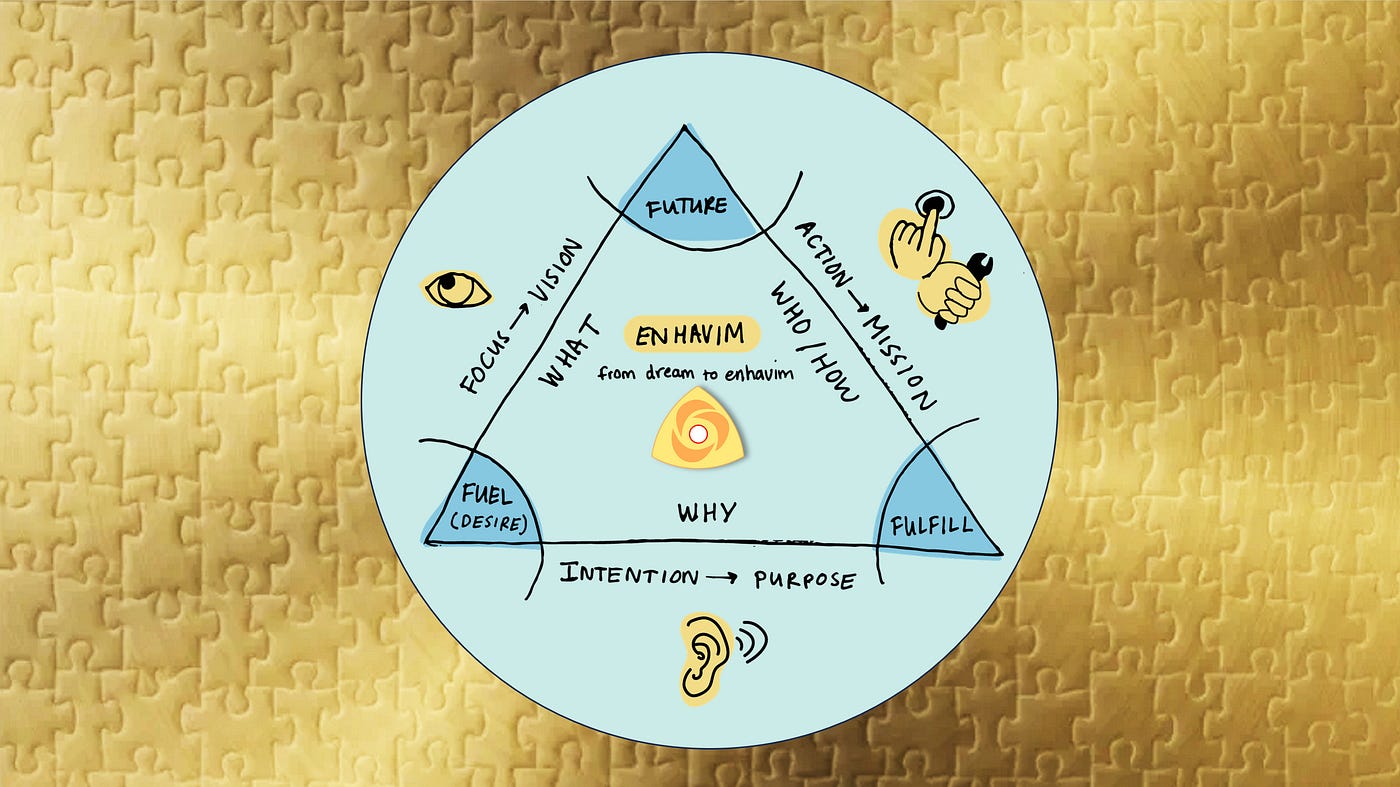
Even when properly understood as proposal and intention, purpose cannot stand alone. Intention directed nowhere dissipates. Intention that serves no one remains theoretical.
The question “What’s your purpose?” asks for the middle of something while ignoring both ends.
Even the most influential books on purpose reveal this through their structure. Rick Warren’s The Purpose Driven Life begins with a fundamental assertion: “It’s not about you.” The entire framework rests on a prior WHAT that gives purpose its context. The book assumes a relationship with God before it explores purpose within that relationship. Purpose is the second question, not the first.
Simon Sinek makes this explicit in Start with Why. He positions the WHAT as “place zero,” the baseline everyone already knows. We all understand what we do. Some understand how we do it. Very few understand why. His model requires the WHAT to exist before the WHY can be articulated. You cannot start with why if there is no what to attach it to.
Both frameworks, whether implicit or explicit, acknowledge the same structural truth. Purpose needs something to be in service of. It requires an endpoint, a vision, a larger frame that gives the intention its direction.
Purpose requires an answer to what comes before it: intention toward what end? And it requires an answer to what comes after: intention enacted through what means?
These are not abstract philosophical puzzles. They are practical necessities. Purpose exists in relation to other elements. It connects but does not complete.
This is why people who think they have found their purpose often still feel unmoored. They have identified their intention but not anchored it. The question was answered incompletely.
The next question is more specific and more difficult: What future do you see worth serving?
Sources:
Etymology of “purpose” — Online Etymology Dictionary
Latin “proponere” — Online Etymology Dictionary
Rick Warren, The Purpose Driven Life: What on Earth Am I Here For? (Zondervan, 2002)
Simon Sinek, Start with Why: How Great Leaders Inspire Everyone to Take Action (Portfolio, 2009)
This is Part 1 of a four-part series examining the components that make purpose operational. Part 2 explores vision as the essential starting point that gives purpose direction.

메타데이터
- post_id
- af5a75b3a4db
- slug
- whats-your-purpose-af5a75b3a4db
- url
- https://medium.com/@sherrierose/whats-your-purpose-af5a75b3a4db
- canonical_url
- https://medium.com/@sherrierose/whats-your-purpose-af5a75b3a4db
- author_url
- https://medium.com/@sherrierose
- status
- ok
- fetched_at
- 2026-06-13 07:35:29