AI Is Becoming a Factory. Programming Is Becoming a Craft.
A few years ago, if someone had told me that I could describe an application in a few sentences and receive hundreds of lines of code in…
AI Is Becoming a Factory. Programming Is Becoming a Craft.
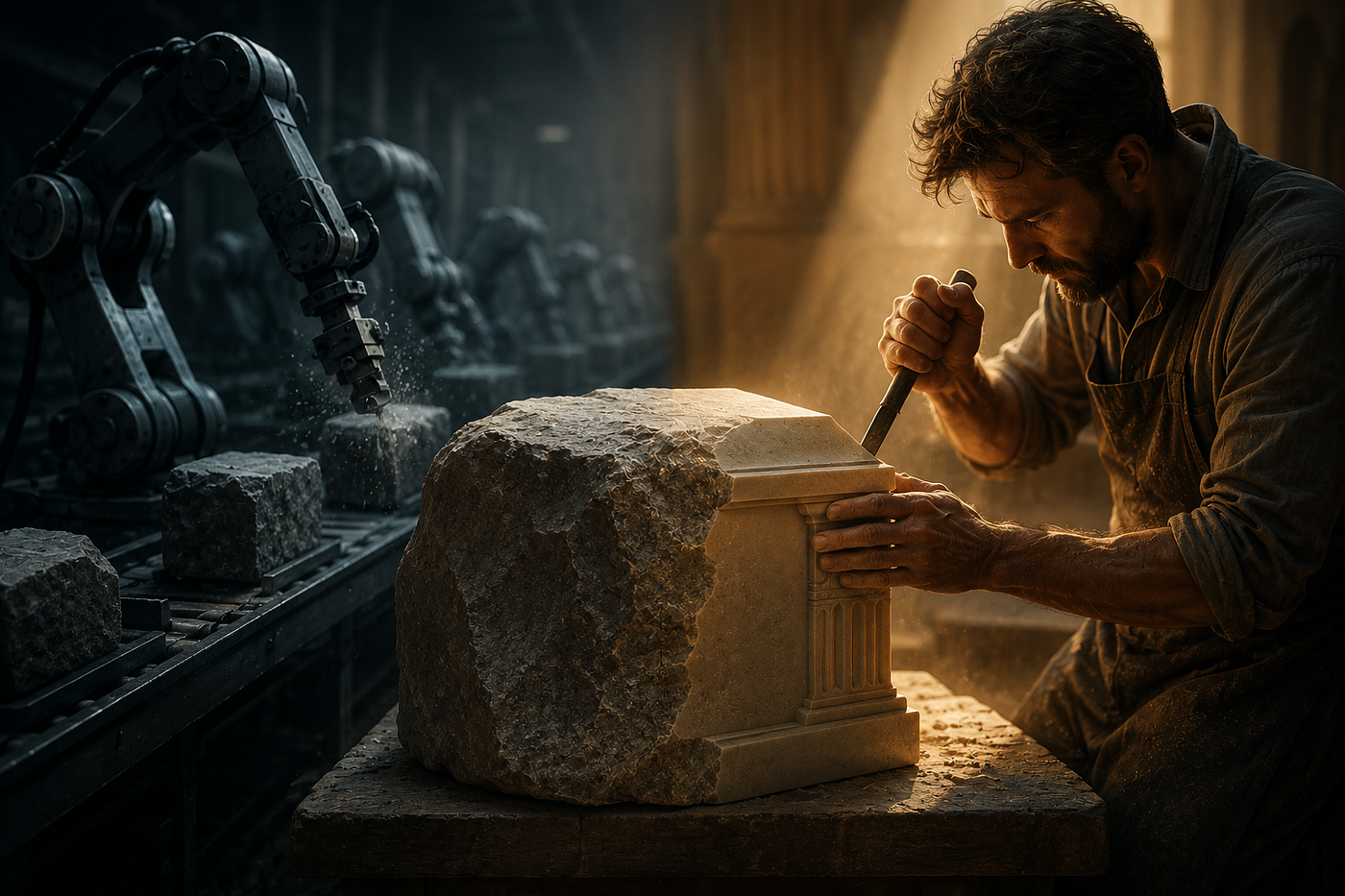
A few years ago, if someone had told me that I could describe an application in a few sentences and receive hundreds of lines of code in return, I would probably have laughed. Today, this has become almost routine. We have AI generating APIs, tests, infrastructure, documentation, frontend components, database migrations, and sometimes even complete applications. Tasks that once took days can now be completed in minutes.
As a software engineer, I find this fascinating. But the more I use these tools, the more I realize that we are witnessing something much bigger than another productivity improvement. Software development itself is beginning to change, evolving from an activity centered around producing code into something that increasingly resembles manufacturing.
I don’t mean that as criticism. Quite the opposite.
Factories transformed the world because they enabled production at a scale humanity had never seen before. They made products cheaper, faster to build, and accessible to far more people than ever before. AI is doing something remarkably similar for software. What once required an entire team can now often be accomplished by a single engineer. Projects that previously demanded weeks of work can sometimes be delivered within hours.
The factory has finally arrived in our industry.
History, however, teaches us something interesting. When factories emerged during the Industrial Revolution, they didn’t eliminate artisans. Instead, they changed what society considered valuable.
A construction company can build hundreds of houses using standardized blueprints, repeatable processes, and optimized logistics. There is enormous value in that because society depends on scalable solutions. Yet when we think about the buildings that define civilizations — the cathedrals, museums, temples, and monuments that people travel across the world to admire — they were rarely designed with one objective: finishing as quickly as possible.
They were crafted.

The same principle applies to furniture. A factory can produce ten thousand identical tables with perfect consistency, but people still willingly pay a premium for a table built by a master craftsman. Not because it serves a different function, but because every decision reflects experience, care, intention, and taste. There is value in knowing that another human being invested expertise into every detail.
I believe software is entering exactly this phase.
For years, our industry rewarded engineers for producing code. The faster you could build, the more valuable you became. Today, however, AI is rapidly reducing the scarcity of code generation itself. If nearly everyone can generate a CRUD application, then building a CRUD application is no longer what differentiates exceptional engineers. If everyone can scaffold an API or create a frontend with a prompt, then those skills naturally become commodities.
The value doesn’t disappear — it simply moves.
It moves toward understanding the real problem before writing a single line of code. It moves toward designing resilient architectures instead of merely implementing features. It moves toward making thoughtful trade-offs, understanding users, simplifying complexity, and building products that people genuinely enjoy using.
In other words, it moves toward judgment.
One concept I rarely see discussed in software engineering is taste.
Two engineers can use exactly the same AI tools. They can generate the same amount of code in roughly the same amount of time. Yet one of them will build something ordinary while the other creates something people genuinely admire.
The difference isn’t typing speed.
It isn’t prompt engineering.
It isn’t even technical knowledge alone.
The difference is judgment.
AI can generate hundreds of possible solutions, but it cannot decide which solution deserves to exist. It cannot fully understand the subtle trade-offs between simplicity and flexibility, between performance and maintainability, or between solving today’s problem and preparing for tomorrow’s. Those decisions still belong to engineers.
Perhaps that is what the next generation of software engineering will look like.
Instead of being builders laying bricks one by one, we’ll become architects directing an entire construction site. We’ll rely on machines, automation, and AI to handle the repetitive work while we focus on the decisions that actually define the quality of the final product.
Ironically, the more software becomes industrialized, the more valuable craftsmanship becomes.
Maybe that’s what excites me most about AI. I don’t think it’s replacing software engineers. I think it’s forcing us to become better ones.
So I’ll leave you with the same question I’ve been asking myself.
When you need something built, do you want something produced as quickly as possible?
Or do you want something crafted so well that people will still admire it years from now?
The factory can certainly deliver the first.
I still believe craftsmanship is what creates the second. ∴
메타데이터
- post_id
- af5de992d302
- slug
- ai-is-becoming-a-factory-programming-is-becoming-a-craft-af5de992d302
- url
- https://medium.com/@pemtajo/ai-is-becoming-a-factory-programming-is-becoming-a-craft-af5de992d302
- canonical_url
- https://medium.com/@pemtajo/ai-is-becoming-a-factory-programming-is-becoming-a-craft-af5de992d302
- author_url
- https://medium.com/@pemtajo
- status
- ok
- fetched_at
- 2026-07-24 23:22:17