Beyond Treason
When Political Leadership Becomes a Betrayal of Democracy
Beyond Treason
When Political Leadership Becomes a Betrayal of Democracy
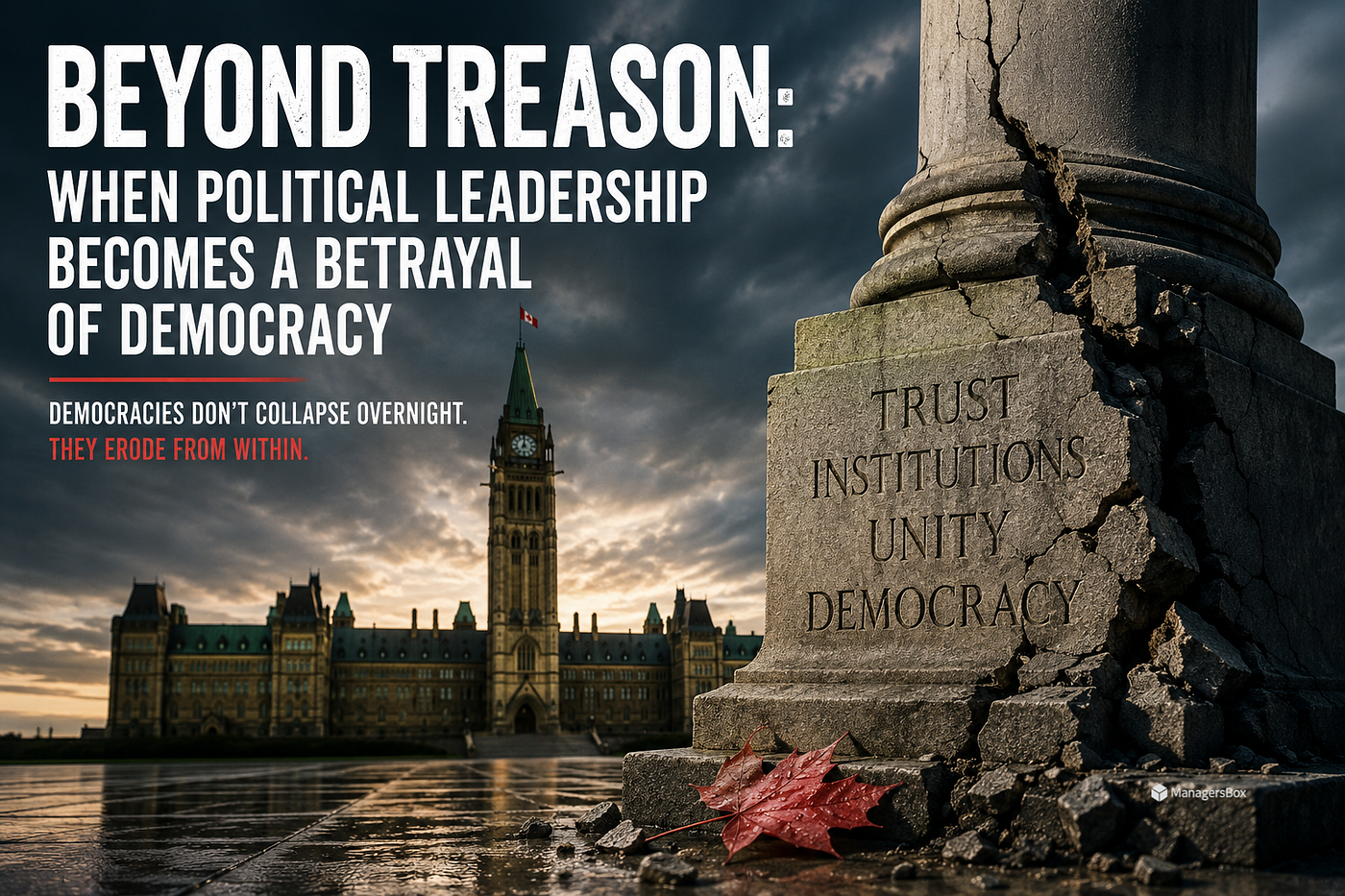
Image created with ChatGPT
Editor’s Note (July 2026): This article is a partial rewrite of an essay originally published on December 7, 2025. As Alberta moves closer to a possible separation referendum and Canada confronts renewed economic pressure from the United States, the questions raised then have become even more relevant.
There are some words that immediately change the conversation.
Treason is one of them.
For most Canadians, it conjures images of spies, wartime conspiracies, and attempts to overthrow the government by force. Our Criminal Code reflects that understanding. Treason is defined through acts such as assisting an enemy, waging war against Canada, or using force against the state. Those remain among the most serious offences imaginable, and rightly so.
But the twenty-first century has introduced a different kind of threat to democratic nations. It rarely arrives with armies or violence. More often, it appears through the gradual erosion of public trust, the weakening of institutions, and political strategies that place short-term advantage ahead of the long-term health of the country.
The greatest danger to a democracy is not always an external enemy. Sometimes it comes from leaders who slowly convince citizens to lose confidence in the institutions that have held their country together for generations.
Modern democracies rarely unravel all at once. They are worn down one decision at a time. Public confidence is chipped away. Political opponents become enemies rather than fellow citizens. Constitutional conventions are treated as obstacles instead of safeguards. Every disagreement is elevated into a crisis because perpetual conflict serves a political purpose.
None of this necessarily violates the Criminal Code.
It can, however, weaken the very foundations upon which democratic societies depend.
Around the world we have watched democratic backsliding unfold in remarkably similar ways. Governments increasingly portray themselves as the only true voice of “the people” while casting courts, legislatures, journalists, public servants, and even other democratic institutions as barriers to be overcome rather than respected. Citizens gradually become accustomed to behaviour that would once have been considered extraordinary.
History reminds us that democracies rarely disappear overnight. They simply become less democratic, one step at a time.
Many Albertans have legitimate frustrations. Concerns about health care, infrastructure, affordability, federal-provincial relations, energy policy, and economic competitiveness deserve serious discussion. Those concerns should never be dismissed or minimized.
But frustration should never become an excuse for weakening the democratic principles that allow those disagreements to be resolved peacefully.
Over the past several years Alberta’s political conversation has increasingly revolved around confrontation. Constitutional conflict has become political strategy. Separation has shifted from a fringe idea to a recurring bargaining tool. Extraordinary legislative powers have become increasingly normalized. Whether one agrees with those approaches or not, Canadians should pause and ask a broader question.
Are these actions strengthening confidence in Canada’s democratic institutions?
Or are they encouraging citizens to lose confidence in the federation itself?
That distinction matters.
It is important to be precise. Nothing in this article suggests that these actions constitute legal treason. Canada’s Criminal Code establishes an appropriately high threshold for that offence, and nothing should diminish its meaning.
But democracies are held together by far more than criminal law.
They depend upon constitutional responsibility, institutional restraint, respect for the rule of law, and political leaders who understand that their first obligation is to strengthen the country they were elected to serve.
When governments deliberately amplify division, normalize constitutional confrontation, or encourage citizens to view democratic institutions as illegitimate, they may remain within the law while moving further away from the spirit of responsible government.
That is not a legal betrayal.
It can become a civic one.
Political leadership has always carried a higher standard than simply remaining within the boundaries of the law. Elected governments are entrusted with something larger than winning elections. They are entrusted with preserving public confidence in the democratic institutions that allow future generations to resolve disagreements peacefully, fairly, and within a constitutional framework.
As this article is republished, Canada’s First Ministers are gathering in Prince Edward Island at one of the most consequential moments in recent memory.
Once again, President Donald Trump has announced another round of tariffs while continuing a pattern of shifting demands and moving negotiating goalposts. Whatever one thinks of his broader politics, this has become a negotiation characterized by uncertainty and a repeated lack of good faith. Businesses cannot plan around rules that change every few weeks, and neither can countries.
Canada’s response should reflect that reality.
For months I have argued that Canada should begin serious discussions about recognizing a security premium on our energy exports. If dependable supply has become a strategic asset in an increasingly unstable trading relationship, then reliability itself carries value beyond the daily market price. The market determines the value of the product. Government determines the share Canadians receive for allowing access to one of our most important strategic resources.
That conversation should take place with every premier standing together.
Tomorrow’s meeting in Prince Edward Island is about far more than tariffs. It is a test of national leadership.
Premier Danielle Smith has repeatedly said that Alberta’s future is within Canada. Canadians should welcome that commitment. They should also expect it to be demonstrated through action.
If every province presents a united front in defence of Canada’s economic interests, Alberta should be part of that effort. If, instead, Alberta chooses to distance itself from a coordinated national strategy while the country faces growing economic pressure from the United States, Canadians are entitled to ask whether provincial political objectives have begun to outweigh Canada’s broader national interest.
Leadership is ultimately measured by choices, not declarations.
Democracies are not preserved by speeches or slogans. They endure because leaders understand that there are moments when provincial politics must give way to the national interest.
Canada may be entering one of those moments now.
History will not remember which premier won the day’s political argument.
It will remember who stood with the country when unity mattered most.
메타데이터
- post_id
- af6571d6fc2a
- slug
- beyond-treason-af6571d6fc2a
- url
- https://medium.com/@rbuchfink/beyond-treason-af6571d6fc2a
- canonical_url
- https://medium.com/@rbuchfink/beyond-treason-af6571d6fc2a
- author_url
- https://medium.com/@rbuchfink
- status
- ok
- fetched_at
- 2026-08-09 06:48:16