How Architecture Owners Should Evaluate AI Code Review in 2026
Coding standards have a half-life. The question is whether your tooling extends it or watches it run out.
How Architecture Owners Should Evaluate AI Code Review in 2026
Coding standards have a half-life. The question is whether your tooling extends it or watches it run out.
Every architectural decision a team makes has a half-life. The pattern you established in Q1 — repository pattern for data access, one HTTP client library, a single way to handle errors — is enforced strongly the week it ships, well for the next three months, unevenly for the six months after that, and then quietly forgotten. A year in, half the new code follows the pattern. Two years in, you can identify the original by carbon dating.
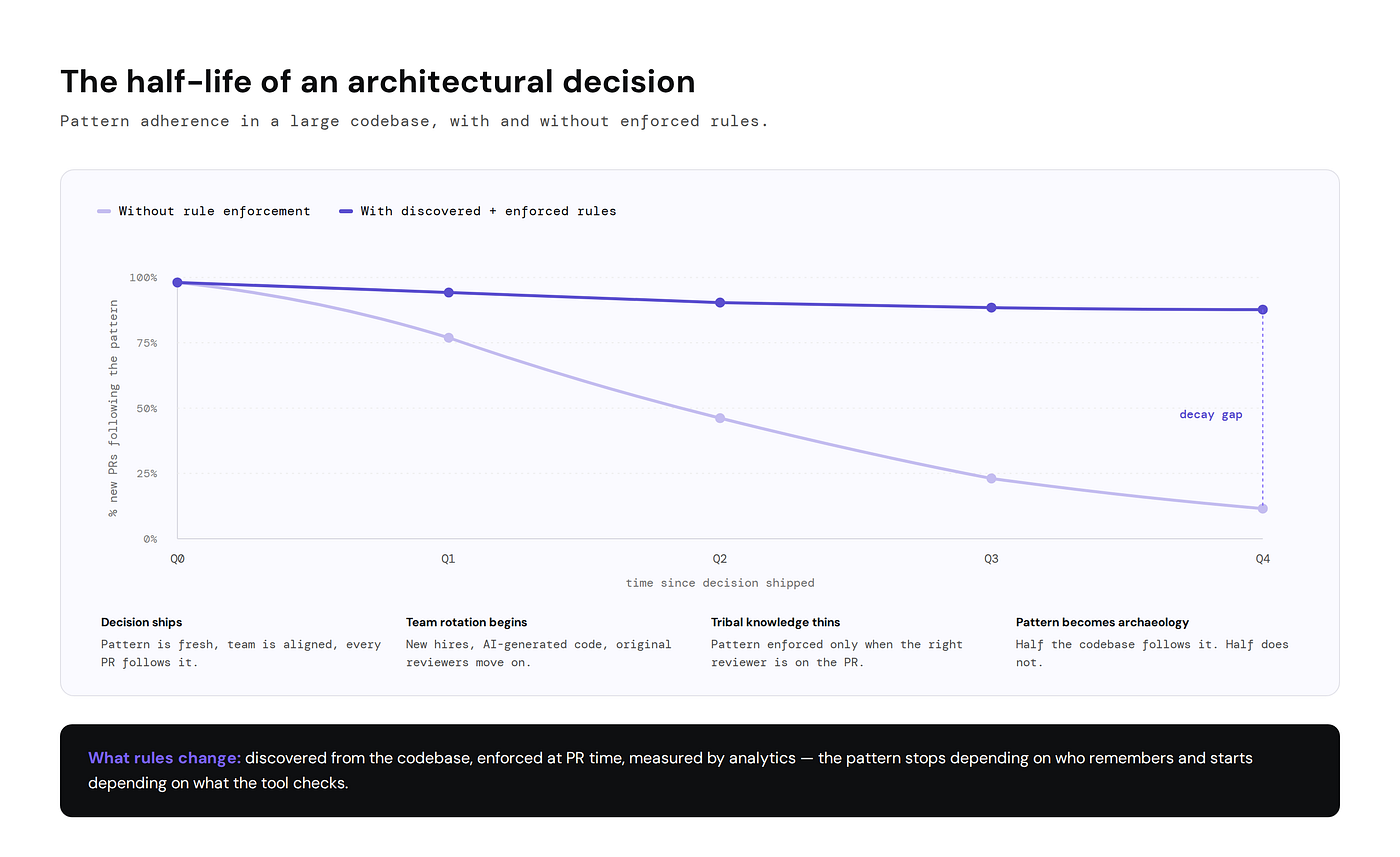
This is not a process failure or a discipline failure. It is the natural state of a large codebase under continuous change. People rotate teams. AI code generation produces plausible code that does not know the codebase exists. New hires copy whichever file they opened first. The pattern was clear on a whiteboard once; the whiteboard is gone; the codebase is the document now.
The interesting question for an architecture owner is whether AI code review can extend the half-life of a decision, or whether it just adds another layer of plausible-sounding feedback to a process that was already drifting. The answer depends almost entirely on whether the tool can see the codebase the way you do.
Qodo built its review platform around the premise that pattern enforcement at scale only works when the tool reads the actual code, not a paragraph of instructions describing the code. The rest of this piece is about why that distinction matters for the work of architecture ownership.
The pattern decay problem AI code review is supposed to solve
Pattern decay shows up in a predictable shape. A team standardizes on a way of doing something — let’s say all database access goes through a repository layer, no direct queries from handlers. The first few PRs after the decision are clean. The pattern holds.
Then the conditions change. A new team joins and inherits a service without inheriting the meeting where the decision was made. A senior engineer who used to flag the violation in PR review takes a different role. An AI assistant generates a controller that goes directly to the database because the prompt did not mention the repository layer. None of these are bad faith. They are entropy.
The traditional response has been documentation, lint rules, and PR reviewers who remember. Documentation goes stale. Lint rules cover syntax, not architecture. PR reviewers move on or get tired. By month nine, the only thing keeping the pattern alive is the original architect noticing the drift in a code review and writing the same comment they wrote in month two.
AI code review, in theory, should automate the part where someone has to remember. In practice, most AI code review tools do not solve this problem at all — they solve a different, smaller problem, and architecture owners frequently discover this mid-rollout.
Why most AI code review tools cannot see your architecture
The honest reason most AI code review tools miss architectural drift is that they read diffs, not codebases. They take the change, a few lines of surrounding context, sometimes the file, run it through a language model, and produce comments. This is fine for catching bugs and style issues. It is structurally incapable of catching the case where a new handler bypasses the repository layer that fourteen other handlers use, because the tool never read the other fourteen handlers.
There is a second category of failure that matters more: tools that let you write “rules” as natural-language prompts. These tools take your description of the architectural standard, append it to the LLM call, and hope the model interprets it correctly. The output is plausible. The enforcement is unreliable. The same prompt can produce a flag on one PR and silence on the next, because the model is interpreting the rule rather than checking against the codebase.
Architecture owners discover these limitations the same way every time. The team enables the tool. The tool flags spelling mistakes and obvious bugs. A PR ships that completely contradicts the codebase’s pattern, the tool says nothing, the architect catches it in their own review, and the question becomes: what exactly is this tool doing for us.
Qodo’s design choice was to treat the codebase itself as the primary input. The Context Engine indexes the repository — or many repositories — semantically, including dependencies, service relationships, and historical patterns. When the Review Agent Suite evaluates a PR, it pulls relevant context from across the codebase, not just the diff. The result is a review that can say things like “this handler is the first one in this service to bypass the repository pattern” because the tool actually checked.
Rules that come from the codebase, not from your imagination
The other meaningful design decision in Qodo is that rules are not authored from scratch. They are discovered.
The traditional way to encode an architectural standard in tooling is to sit down and write it. This works for the first three rules. It does not scale. By the time you have twenty rules in flight, half of them are duplicating each other, a quarter are contradicting each other, and you do not have time to maintain the list. The list rots faster than the patterns themselves.
Qodo’s Rules Discovery Agent inverts this. It reads the codebase and the PR history, surfaces patterns that already exist as candidate rules, and lets the team curate them. The repository pattern is not a rule someone wrote from memory — it is a rule the agent generated from observing fourteen handlers that all do the same thing. The rule comes with the lineage: here are the files that demonstrate this pattern, here are the PR comments that have been re-typing it.
For an architecture owner, this changes the economics of rule management. Encoding a standard stops being a writing project. The agent does the first draft. The team curates, scopes, and activates. The rules ship with evidence.
The lifecycle continues from there. Each rule has analytics — adoption, violations, remediation rate — so you can see which architectural standards are actually being followed at the codebase level. The Rules Expert Agent flags conflicts, duplicates, and decay. When two rules contradict each other, you find out before a developer does. When a rule stops firing because the pattern it described is no longer relevant, you find out before the rule becomes noise.
This is what extends the half-life of an architectural decision. The decision lives in code (via discovered rules), gets enforced at PR time (via Rules Enforcement and the rest of the Review Agent Suite), and surfaces its own decay (via analytics and health monitoring). The architect no longer has to be the human cache for the codebase’s conventions.
Breaking changes are the architectural test case
The clearest test of whether an AI code review tool can do architectural work is how it handles breaking changes across services.
A breaking change to a shared API, schema, or contract is the canonical architecture-owner problem. The change looks fine in its own repo. It compiles, the tests pass, the reviewer sees no obvious issue. The damage shows up two days later when a downstream service breaks because nobody traced the consumers.
This is unanswerable for a diff-level reviewer. You cannot detect a breaking change by reading the diff — you have to know what consumes the changed interface, and that knowledge lives in other repositories.
Qodo’s Breaking Changes agent operates against the multi-repo Context Engine. When a change touches a shared interface, the agent identifies the consumers and flags the impact directly in the PR. The output is not “this might affect other services” — it is a specific list of which services consume the interface and how the change affects each one. The architecture owner gets the information they would have had to manually trace, attached to the PR before it merges.
This is the single capability I would push hardest in a vendor evaluation. If a tool cannot detect a breaking change across repository boundaries, it cannot do the work of architectural review at any nontrivial scale. The demo to ask for is a PR that modifies a shared schema in one repo while another repo consumes it; the question is whether the tool flags the downstream impact without being told to look.
Where the IDE Plugin matters for architecture work
Most architectural drift happens before the PR. It happens at write time, when a developer is making the choice about which pattern to follow, often without realizing the choice exists.
The IDE Plugin is where this gets caught earliest. The same Rules System that runs in PR review runs in the IDE, against the local diff. If a developer is about to write a handler that bypasses the repository pattern, the IDE Plugin can surface the rule in line, with the example pattern from the codebase, before the PR ever opens.
For architecture work this matters because the cheapest place to prevent drift is at write time, not review time. By the time a PR is open, the developer has invested in the wrong approach. The conversation becomes negotiation. At write time, the conversation is suggestion. Different cost structure.
The continuity matters more than the IDE feature in isolation. The same rules that surface in the IDE Plugin are the rules that fire in the Git Plugin’s PR review and that apply when the CLI Plugin runs as part of a CI workflow. The architectural standard does not change shape as the developer moves through the SDLC. That consistency is what makes the rules system feel less like another tool and more like the codebase’s own standards finally getting durable enforcement.
How to evaluate AI code review with architecture in mind
The shortest evaluation path, if architectural integrity is the lens:
Bring a real PR from your codebase that touches a shared interface and another repo that consumes it. Hand it to the vendor and ask for the review output. Watch whether the downstream impact is detected without prompting.
Then ask the vendor to demonstrate rule discovery. Point the tool at your codebase. Ask it to surface candidate rules from the existing patterns. The output tells you whether the tool actually reads the code or just lets you write instructions.
Then ask what happens when a rule changes. The way the tool handles rule versioning will tell you how seriously the vendor takes architectural standards as a managed artifact versus a config file.
Then evaluate review quality on a routine PR. Review quality matters, but it is the easiest thing to demo well and the least diagnostic of whether the tool will actually do architectural work at your scale.
Summary
AI code review can extend the half-life of an architectural decision, but only if the tool can see the codebase the way an architecture owner does. The tools that read diffs and follow natural-language rules produce plausible feedback that misses exactly the cases architecture work is about. The tools that index the codebase, discover rules from existing patterns, detect breaking changes across repositories, and enforce the same standards from IDE through CI become a durable substrate for the standards a team has decided to hold to.
Qodo’s bet is that the architecture-owner case is the enterprise case. The Context Engine, the Rules System with its Discovery and Expert agents, the Breaking Changes agent, and the consistent rule enforcement across IDE, Git, and CLI surfaces are the components that make this real. For architecture owners trying to keep a large codebase recognizable as the thing they designed, that combination is the part of the AI code review market worth taking seriously.
Frequently asked questions
What does “context-aware” actually mean for AI code review?
Context-aware means the review tool reads more than the diff. It indexes the repository or multiple repositories, understands relationships between files, services, and dependencies, and retrieves relevant context when reviewing a change. The opposite is diff-only review, where the tool sees only the changed lines.
How does AI code review detect breaking changes across services?
By indexing the broader codebase and understanding which services consume which interfaces. When a change touches a shared API, schema, or contract, the tool identifies the consumers and flags downstream impact. This requires multi-repo awareness — diff-only review cannot do this.
Are AI code review rules the same as architectural decision records?
They are complementary. ADRs document the reasoning behind a decision. Rules in an AI code review tool enforce the resulting patterns. The combination is stronger than either alone: ADRs explain the why, rules keep new code aligned with it.
How does Qodo discover rules from a codebase?
The Rules Discovery Agent analyzes the codebase and PR history to surface recurring patterns and recurring review comments. These become candidate rules with lineage attached — the files and PRs that demonstrate the pattern. The team curates which candidates become active rules.
Does AI code review work in a monorepo with thousands of files?
It depends on the tool’s context architecture. A diff-only reviewer will miss most of what matters in a monorepo. A reviewer with multi-repo indexing and semantic retrieval (Qodo’s Context Engine scales from 10 repos to 1,000) pulls the relevant context for the change rather than processing the entire codebase per review.
How are conflicting rules handled?
Qodo’s Rules Expert Agent detects conflicts and duplicates as the rule set grows. When two rules contradict each other, the conflict is surfaced through the central Rules portal so the team can resolve it instead of finding out during a contentious PR review.
메타데이터
- post_id
- af7df5af8aeb
- slug
- how-architecture-owners-should-evaluate-ai-code-review-af7df5af8aeb
- url
- https://medium.com/@anna.uss/how-architecture-owners-should-evaluate-ai-code-review-af7df5af8aeb
- canonical_url
- https://medium.com/@anna.uss/how-architecture-owners-should-evaluate-ai-code-review-af7df5af8aeb
- author_url
- https://medium.com/@anna.uss
- status
- ok
- fetched_at
- 2026-06-27 18:20:27




