The Relational Cosmos: Consciousness In a World Without Intrinsic Properties
To be is to be known
The Relational Cosmos: Consciousness In a World Without Intrinsic Properties
To be is to be known
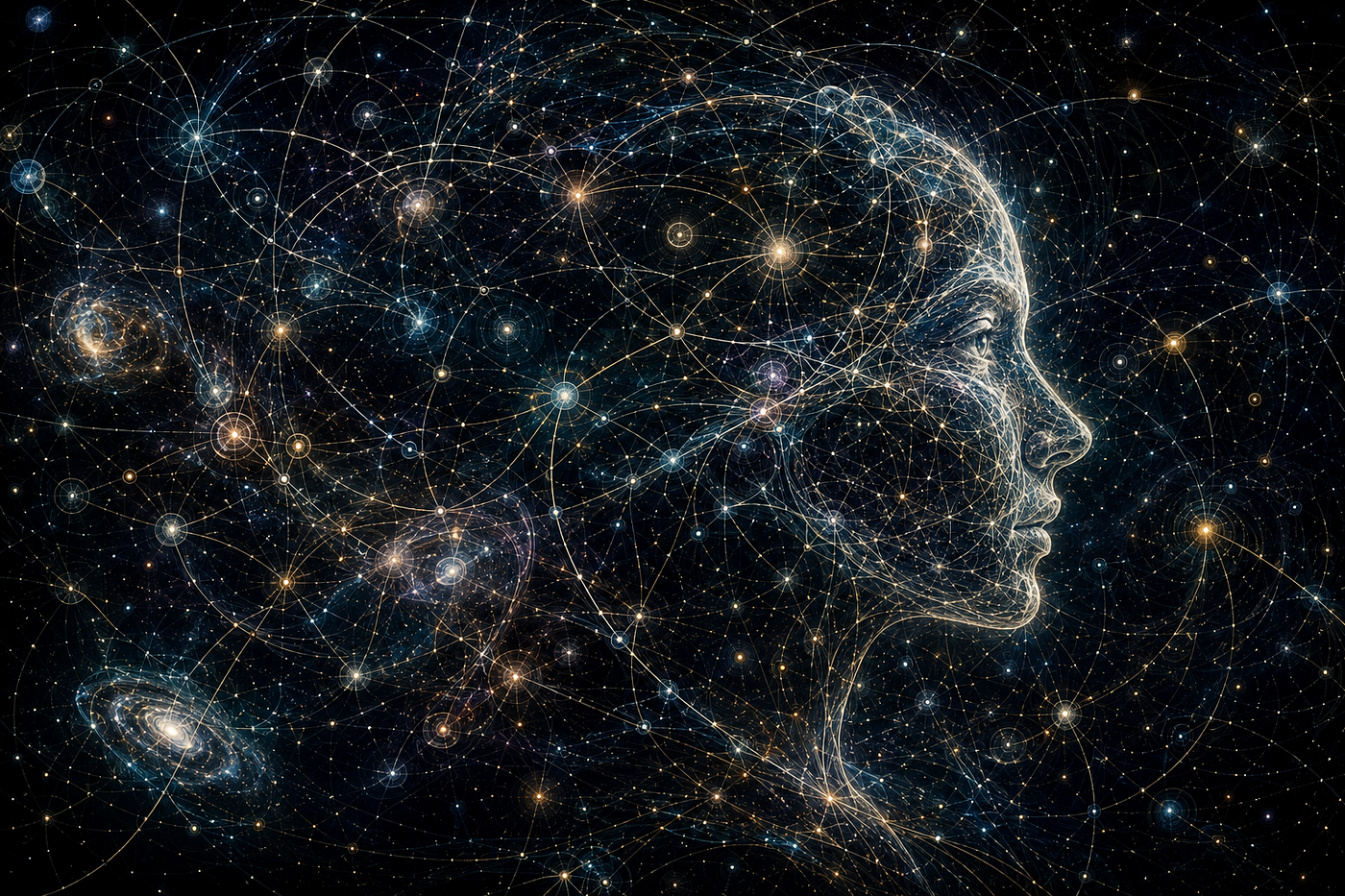
Image: ChatGPT
This essay was short-listed for the 2025 Bergruen Essay Prize Competition. It is published here unabridged.
Almost precisely one hundred years ago, in a world vastly different from the one we now live in, one of Max Born’s students handed him a paper that he at once understood would change science. What he did not see, and could never have imagined, was how profoundly the core insight of that paper would transform technology, philosophy, and human society, and indeed become a large part of the reason why the world today, a century later, is so utterly changed.
That student’s name was Werner Heisenberg, and he, Born and another brilliant student of Born’s, Pascual Jordan, would subsequently work together to produce the first complete mathematical formulation of quantum mechanics, published in March of 1926. Only nineteen years later, the charismatic, mercurial polymath Robert Oppenheimer, coincidentally another of Born’s students, would harness its machinery in the service of war, producing a weapon that would reduce the Japanese cities of Hiroshima and Nagasaki to ash in the blink of an eye and end the Second World War. Two years later, in 1947, the semiconductor — a device entirely dependent on quantum mechanics — was invented at Bell Labs, ushering in the computer age.
The consequences were world-shaking, yet the premise that underpinned Heisenberg’s 1925 paper[1] was deceptively simple. Struggling with the problem of modelling the orbits of electrons inside the atom, Heisenberg decided to focus exclusively on what could be observed, namely the frequencies and intensities of the spectral lines emitted or absorbed by atoms during transitions between energy levels. From this perspectival shift eventually fell out all the core principles of quantum theory: the uncertainty principle, the “observer effect”, non-commuting operators, and the weirdness of entanglement and “spooky action at a distance”.
What was decidedly unclear for many, many decades, and what remains debated to this day, was what it all meant. Born and Einstein corresponded on that subject for decades, and their disagreement about whether the theory was truly fundamental — Einstein thought there had to be some deeper, deterministic underpinnings — eventually grew into a rift in their long friendship. The question of whether “God plays with dice” or not was long ago decided in Born’s favour, but the deeper problem of how to reconcile the theory with our natural intuitions about the world remained.
Now, however, as the dust thrown up by the collapse of Newtonian deterministic materialism has begun to settle, a picture has finally started to emerge, and it is one with the most profound imaginable implications for our understanding of what and who we are. Among other things, it may finally point the way towards resolving perhaps the thorniest unresolved problem in science and philosophy, the conundrum which Australian philosopher David Chalmers has termed the “hard problem of consciousness”, or how it is that material structures can give rise to subjective experience.
The essence of the new philosophy implied by quantum physics is that the physical world consists not of things but of relations. And if all physical properties are relational, this implies that only relational properties exist. If correct, this is a revolutionary change to our way of understanding the world.
In philosophy, an “intrinsic property” is one that belongs to an entity in itself, independent of anything else, whereas a relational or extrinsic property is one that is defined relative to some other thing. In an everyday context, this is a straightforward semantic distinction with obvious enough meaning. My dog’s size is an intrinsic property, but its being larger than my cat is a relational one. When we get down to the quantum level, however, it is a distinction that becomes much more problematic.
Although he certainly did not understand it in these terms at the time, Heisenberg’s fundamental move in confining himself to “observables” was to abandon the notion of quantum objects — electrons in the case of the atomic spectra he was trying to model — having intrinsic properties beyond the interactions through which they could be observed.
This was first and foremost pragmatic: if there was no way even in principle to know where the electrons were and how they were moving other than through their interactions with photons, then why base one’s theory on these unknowables? Yet whether or not it began as a matter of pragmatism, what has become clear is that Heisenberg was right not merely epistemologically and methodologically, but ontologically. What exists at the quantum level are interactions — nodes in a network of relations — not “things” with independent, intrinsic existence.
The clearest illustration of this strange property of the quantum world can be found in the phenomenon of entanglement, which some physicists regard as the essence of quantum mechanics. Two particles are entangled when their states are correlated with one another. For example, light passing through certain types of crystal may sometimes cause the emission of two entangled photons with mutually opposite polarity.
In the case where the particles are maximally entangled, the quantum state describing the two-particle system is fully defined by the correlation, with no information “left over” to describe the state of the individual particles in themselves. As physicist Leonard Susskind puts it, we know everything there is to know about the system, while knowing nothing about its component parts[2]. David Mermin, in his paper “What Is Quantum Mechanics Trying to Tell Us”[3], describes this as a situation of “correlations without correlata”.
This is slightly misleading; of course all correlations must relate something. It’s just that in this case what is related are not two “things”, but simply the values of the correlated properties — in the photon case, their polarisations — when the particles interact with a third system. Ultimately, we can think of the particles not as “objects” in flight, but as relationships between nodes in the network of relations that constitutes the physical world. Or to put it another way, as communication of relational state information.
Physicist Carlo Rovelli has formalised this understanding in his Relational Quantum Mechanics (RQM)[4], explained for a popular audience in his best-selling 2020 book Helgoland[5]. The key tenet of RQM is that all physical properties are relations between systems. In this paradigm, it is simply not meaningful to ask about the state of a physical system in itself; we can only ever ask about relative state. This extends the insight expressed in Einstein’s relativity theory that properties such as time, distance and simultaneity are relational and dependent on a frame of reference. In RQM, all physical properties are relativised to the perspective of some other interacting system.
Things and relations
The idea that reality is fundamentally relational runs headlong into intuitions about the world that we take to be self-evident. What can it even mean for everything to be “relations”? Surely some substantive “thing” must exist on either end of a relation to give it any meaning?
In her article “Is Matter Conscious?”[6] published in Nautilus, philosopher of mind Hedda Hassel Mørch expresses this reservation as follows:
“Some have argued that there is nothing more to particles than their relations, but intuition rebels at this claim. For there to be a relation, there must be two things being related. Otherwise, the relation is empty … physical structure must be realized or implemented by some stuff or substance that is itself not purely structural. Otherwise, there would be no clear difference between … the concrete universe and a mere abstraction.”
However, this is to misperceive the notion of relation by viewing it through the isolating lens of Newtonian atomism. Mørch imagines a singular, free-floating relation and concludes that such a thing is meaningless and inconceivable. Indeed it is. But we cannot isolate relations in this way. When we talk about properties as relations, we are talking about the entire cosmos as a relational whole. It is this whole that grounds the relations, not “some stuff or substance” that inheres in the individual nodes and lends reality its concreteness.
In Mermin’s terms, the “correlata” that the correlations connect are not self-subsistent, independent entities with inherent existence. They are nodes in a sparse, mutually correlated web of interactions that ultimately are inseparable from the entirety of reality.
The intuition Mørch expresses is grounded in what we might call “ape physics” (with no disrespect intended towards Mørch — these are intuitions we all share). This is the way of seeing that we inherit from our evolutionary past as tool-using primates. We divide up our environment into separate, nameable things in order, literally, to get a “handle” on it. A stick might be used to make a shelter, or turned into a spear. A stone may break open a nut, or grind leaves into a medicinal paste. The objects remain largely static, but the relationships between them can change and, perhaps more importantly, be changed.
We are tool-using animals through and through, and our perceptual apparatus, our language, our very modes of thought are organised around this way of making sense of the world. In this mode, it is first and foremost things we perceive, with their interrelationships having only a secondary, derived existence.
When we formalise this way of seeing into an ontology, we get atomism, the idea that being “bubbles up”, as it were, from some very small, indivisible particle. Democritus was the first philosopher to formalise this idea[7]. Noting that it is frequently possible to explain the behaviour of a thing by analysing it in terms of its parts, he took this reductive procedure to its logical conclusion, positing that all of nature might be able to be explained in these terms.
However, if such a method were to avoid an infinite regress, the process of dividing things into parts would have to terminate at some point. He therefore postulated the existence of the “atom”: an indivisible particle of pure, eternal, unchanging ontological bedrock. He imagined these atoms to be something like tiny, unbreakable rocks of different shapes and sizes: solid, extended in space, and essentially independent of one another.
Although his theory was much less influential historically than the ideas of other philosophers such as Plato and Aristotle, atomic theory had a renaissance in the eighteenth century when John Dalton revived them in Newtonian form, reimagining them as tiny, infinitely hard balls which could be combined in various ways to form molecules.
Although this picture is long obsolete, many people — even many scientists — still see modern physics through an implicitly Democritean lens, not because they still believe matter to be composed of minuscule balls, but because they still imagine subatomic particles to be objects, like the classical structures they form in aggregate. Substance is primary and defines the real; relation is secondary, ephemeral and abstract.
Even before Heisenberg this ontological prioritisation of the substantive over the relational was slipping. Einstein’s special relativity had revealed that matter and energy are fundamentally the same thing. Yet what is energy? Naively we imagine it as a kind of refined substance, but in fact it is merely a measure of change or motion within a physical system (potential energy is simply motion locked up in a localised, cyclical pattern)[8]. Change is not a substance; it is a relationship between matter in space and time. This insight alone foreshadows a relational understanding of matter.
Paradox and the concepts we see with
The human mind was made for its lifeworld, a world of rocks, animals and trees, not photons or black holes. It was forged in the hunt, around ancient campfires when myths and stories were told. Only with the greatest difficulty do we learn to see past the boundaries of that world, into the deeper, abstract nature of things.
The very fact that we use nouns like “photon” and “electron” to describe the entities of the subatomic world nudges us towards imagining them as something familiar, like dust or snow. Nouns were made for the things of the lifeworld, sticks and stones, not for these paradoxical mathematical spirits, shimmering somewhere between existence and nothingness. We use them because we must, but the words bring with them their subtle freight of habit and assumption, concepts we cannot see, because we see with them.
The work of dismantling these inherited, implicit ideas is both a scientific and a philosophical task. Both paradoxes in thought experiments and anomalies in physical experiments guide us to the seams in our worldview, the places where incommensurable conceptual frameworks abut and contradict. It was, for instance, the combination of the experimental anomaly of the constancy of the speed of light and the paradoxes exposed by the thought experiment of riding on a light wave that led Einstein to the Special Theory of Relativity.
In the case of quantum mechanics, the troubling paradox lay in the discontinuity between the mathematical description of a quantum system in isolation — when its state is described by a complex-valued, polyvalent superposition, something unimaginable — and the plain, singular value it assumes when measured. How does it go from one to the other? Even more troubling, what is measurement doing as a fundamental component of the theory? Measurement is one of the ways scientists validate and refine their theories; surely it should not be part of the theory itself!
The paradoxical seam in the theory is made plainer when one considers that a measurement device is itself made of quantum mechanical stuff and should, if the theory is universal and complete, be described by its own evolving superposition. Yet if it is itself in a superposition, how can it “collapse” the wave function of the thing it is measuring?
Thought experiments like “Wigner’s friend”[9], which imagines one physicist (Wigner’s friend) measuring the state of another physicist (Wigner) who in turn measures some quantum system, expose the problem starkly. From the point of view of Wigner, the system’s wave function has been collapsed to a single measurement. However, from the point of view of Wigner’s friend, until he measures Wigner, both he and the system he is measuring are in an entangled superposition of all possible states.
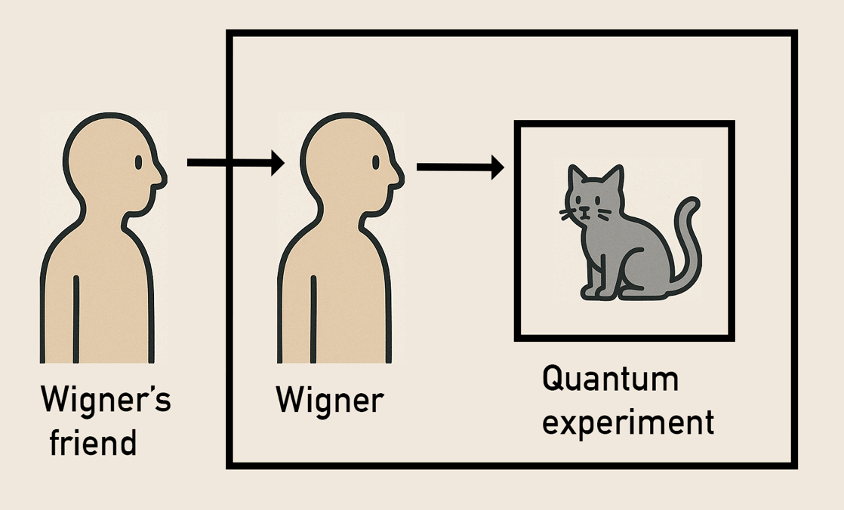
Figure 1. Wigner’s Friend: What is the boundary of “measurement”?
How can both things be true? Something in our classical worldview, our ape physics, simply has to give. That “something”, according to RQM, is the idea that there is a single, objective state that the world is in at any given time. This assumption is the concept that we cannot see because we are seeing with it. The idea of a universal objective and singular truth is foundational to traditional scientific epistemology.
Thomas Nagel coined the term the “view from nowhere”[10] to describe this imagined God’s eye view of the world from which vantage point we can, in principle, know the objective state of everything. Yet relational quantum mechanics tells us that no such viewpoint exists. There is only ever a “view from somewhere”.
As Rovelli eloquently puts it:
“The world fractures into a play of points of view that do not admit of a univocal, global vision. It is a world of perspectives, of manifestations, not of entities with definite properties or unique facts. Properties do not reside in objects, they are bridges between objects. Objects are such only with respect to other objects, they are nodes where bridges meet. The world is a perspectival game, a play of mirrors that exist only as reflections of and in each other.”[11]
Strong and weak relationalism
I said earlier that if, at the fundamental level, all physical properties are relational, this implies that all properties per se are relational, and that the existence of intrinsic properties is illusory. Some scientists and philosophers of science might prefer a weaker formulation. The proponents of “ontic structural realism”[12], for instance, have argued that structure is all there is, and that even the objects of physics are nothing over and above their structural relations. Yet most forms of structural realism retain at least something intrinsic — whether it be the abstract roles within a structure, or modal constraints such as symmetry. The view proposed here goes further: even the constraints on relations — the very laws of physics — are themselves conditioned by deep underlying relational dependencies. We will return to this theme when we examine the fine-tuning problem later.
If this more radical relationalism sounds at risk of collapsing into idealism, this would be a misunderstanding. It is true that substance as ontological bedrock is abolished in this philosophy, but this does not imply that mind takes its place, as the later discussion of consciousness will make clear.
I also contend that relationalism is not just confined to the physical; it also rears its head in abstract domains. At the same time as physicists were making the discoveries that would lay the foundations for quantum mechanics, the mathematician David Hilbert was undertaking the ambitious project of trying to formalise all of mathematics in a complete, consistent, and decidable system — essentially, to ground mathematics on a rock-solid foundation in a manner analogous to the way old-fashioned Newtonian atoms were supposed to ground physics.
Yet “Hilbert’s Program”, as this attempt came to be known, was destined to fail. In 1931, Kurt Gödel published his Incompleteness Theorem, proving that any set of mathematical axioms rich enough to describe basic algebra was incapable of proving itself. There would always be some true statements within that system that cannot be proven by its axioms.
These true statements could certainly be proven, but doing so would always require an appeal to some larger set of axioms. The problem, of course, is that whatever new set of axioms you invoke to prove those statements will also be subject to the same gap, and require yet more axioms to be added, leading to what has been described as a relativized view of truth in formal systems. This understanding doomed the idea that some finite and inherently complete system could function as a logical “atom” from which the rest of mathematics could be constructed.
We can see something similar at work in logic. Consider the classic logical paradox of the sentence: “this statement is false”. If the statement is true, then the statement must be false, but if the statement is false, then it must be true. We can extend the paradox to two statements:
A: Statement B is false B: Statement A is false
This leads to the same circularity. We can add more statements, all referring to one another, but the truth of any of them will remain undecidable, or essentially meaningless, until at least one of them refers to a system beyond the closed logical loop they form.
In other words, although we have always thought of logical propositions as combinations of a subject and a predicate, they require a context to be meaningful — a relation between the subject and something external, against which the truth value can be evaluated.
The liar’s paradox only occurs when we take a statement of truth to be inherently meaningful, divorced from a relational context from which the proposition takes sense. We can see a formal parallel here between the truth value of self-referential sets of propositions and the state of quantum systems evolving in isolation, which suggests the possibility that the notion of intrinsic properties may be incoherent at some deep level. This justifies the way in which relationalism seems to collapse ontology into epistemology and suggests the relational aphorism that to be is to be known. Note that this does not necessarily imply conscious knowing, but rather communication between systems.
Intrinsic properties as conceptual boundaries
The purpose of Democritus’s atoms — and of the Newtonian atoms of the nineteenth century — was to prevent an infinite regress and ground reductive explanations in an absolute foundation from which all higher phenomena could be derived. Although modern physics has abandoned the simplistic mechanical building blocks of these earlier atomisms, it nonetheless continues to seek a reductive foundation, a finite and absolute set of physical laws and entities from which everything more complex can ultimately be seen to emerge. If such a set of laws and fundamental particles could be found, it would constitute the universe’s “intrinsic properties”, and function as an absolute metaphysical boundary, a set of brute facts beyond the possibility of explanation.
All forms of reductionism ultimately rely on a move like this: since reduction cannot, presumably, continue indefinitely, the assumption is made that bedrock is reached at some point in the form of an irreducible entity which cannot itself be explained. Yet the relationalist perspective suggests an alternative possibility. It may be that rather than eventually grounding out in some brute fundament of “hard facts”, we simply reach a boundary at which the reductive mode of analysis ceases to apply.
This is arguably the point we have reached in physics. We have analysed physical behaviour down to a very small set of particles, constants and laws that can explain much of the complex structure we observe. Yet further attempts to simplify are proving increasingly elusive, and physicists are left facing a profound conundrum: how to account for the fact that the laws and constants of physics seem to be tuned with exquisite precision to support life — the so-called fine-tuning problem. With no natural, reductive explanation in sight, many scientists have reluctantly started to accept the possibility of an anthropic explanation: perhaps we see the physical laws we do, not because of some deeper, even more fundamental regularity, but because of where we are.
The hypothesis is that the universe we observe may be part of a much larger multiverse in which many different physics apply in different regions. The explanation for us observing the laws we do would then be a form of selection bias, since we can by definition only exist in places where those laws allow for life to form, and thus permit our existence as intelligent observers. This explanation, if true, would fly in the face of the entire direction of analytical science to date, since the explanation for small-scale laws would ultimately be traceable back to large-scale cosmic structure, thus subverting the basic premise of reductionism.
Relationalism suggests a broader point about theory in general. If no part or aspect of reality possesses intrinsic properties, which is another way of saying that no part can be completely isolated from the whole, then any attempt to specify some part of the world in finite terms must necessarily be a simplification. Any finite model of the world must make a cut, as it were, in the whole fabric of reality in order to isolate certain parts for consideration and understanding. These cuts — or perhaps the scars left by them — are the model’s intrinsic properties, the ways in which it simplifies reality by severing phenomena from their relational underpinnings. These intrinsic properties thus also can be seen as forming the boundaries of the theory.
To take a non-physical example, neo-classical economics defines markets in terms of rational, self-interested agents who seek to maximise utility (for consumers) or profits (for companies). In this theory, agents are intrinsically rational and self-interested, and these properties define the theory’s boundaries. Although a neo-classical economist may admit that, individually, people may act irrationally, altruistically, or against their own self-interest, and furthermore that the putative rational behaviour of economic agents might rest on some evolutionary or psychological underpinnings, these considerations are deliberately elided as irrelevant or unimportant. The theory simplifies reality in order to model high-level economic processes. Yet anomalies, such as the occurrence of patently irrational pricing bubbles, reveal the limitations of the simplification and demonstrate that the properties taken to be intrinsic in the theory in fact depend on aspects of reality that are excluded from the theory’s purview.
The attribution of intrinsic properties to phenomena so they can be dealt with in isolation occurs not only in formal theories, but also more generally in perception and cognition. For example, in psychology, there is a cognitive bias known as the “fundamental attribution error”, which refers to a universal tendency to attribute people’s behaviour to something fundamental about them — a character trait — rather than something situational or contextual. The tendency to attribute intrinsic properties to things in order to simplify the world for easier cognitive processing is hard-wired into us.
The separation of mind and matter
In the animistic wilderness of our forebears, there was no “hard problem of consciousness”. Nature was a unity. Spirits inhabited the stones, the trees. Song and story ran through the earth itself like underground rivers, the dreamworld interpenetrated the physical one, and all things dwelled in an embracing, mythic reciprocity: cosmos, land and people.
When the advent of writing began to displace the old oral traditions, the ability to record ideas in a stable medium made it possible for a rational mode of thought to begin to supplant the mythic consciousness that had prevailed for millennia. This is where we find the Ancient Greek philosophers, in the act of emergence from the world of myth into the world of reason.
The paradoxes with which they wrestle reveal the ongoing conflation of mental and material spheres. For example, the Greeks were troubled by what later philosophers would term “the problem of universals”. Unable clearly to distinguish the world as an objective phenomenon from the world as represented in the mind, they were confused by the question of whether a conceptual category like “redness” had existence independent of the concrete instances of red things that embodied it. Plato’s famous “forms” were an attempt to resolve the problem by positing a transcendent world of archetypes beyond the physical where universals like “redness” resided in their pure, essential form — an historically enormously influential category mistake.
Another example was the paradox of the ship of Theseus, in which Plutarch asked at what point a ship being replaced plank by plank ceased to be the same ship. Today, we would dismiss the question as a matter of semantics, but in Plutarch’s time, the distinction between a static, conceptual label and the ever-changing physical reality it attaches to had not yet been cleanly drawn. The thought experiment exposed the seam, but philosophers did not yet know how to tease the two apart.
It took centuries of philosophical and scientific effort to pick apart the interwoven threads of mind and matter, to see that colour belongs to the realm of the subjective, triggered by light of particular wavelengths. To distinguish heat as random molecular motion from the sensation of heat in the mind. Thinkers who contributed to this work included Galileo, Locke, Newton and Kant. When this work was done, by the beginning of the twentieth century, we had sorted the world into the interior and the exterior, the mental and the physical, a crucial step towards the objectification of the world, and the consolidation of the materialist scientific paradigm.
Yet this work of differentiation left us with a new paradox. We had split the world into inner and outer hemispheres, but now were forced to confront the contradiction between this new, objective description of the world, and the fact that a subjective world existed at all. So long as mind was understood in terms of a religious soul, the problem could be minimised, but as Western thought became increasingly committed to naturalism and abandoned theological explanations, the issue became much harder to ignore.
It was David Chalmers who exposed this seam starkly. Prior to Chalmers, there was certainly an awareness among philosophers of what Chalmers would call the “hard problem of consciousness”, but it was somewhat incoherent and diffuse. Thomas Nagel had, in 1972, pondered the unknowability of the subjective experience of a bat[13], and Frank Jackson’s famous thought experiment known as “Mary’s room”[14] had tried to argue that there is something to the qualities of conscious experience that is not captured in objective accounts of neurology. However, Chalmers’s argument about “philosophical zombies” brought the underlying issue into its sharpest relief.
The long work of distilling the pure, objective matter from the play of sense impressions in which we as human organisms are immersed had left us with a description of a material world that was void of any mental element. The entire point of the physicalist project was precisely to define the world in a manner sanitised of any trace of subjectivity. As we have seen, the implied ontology was atomistic even after the naive idea of matter as “hard stuff” had been discredited. Higher order structures like molecules, rocks and organisms were arrangements of more fundamental units of stuff, their existence and properties emerging from the intrinsic properties of material particles.
The problem, Chalmers pointed out, is that given this ontology, we have no reason to think that any of us would be conscious at all. It is perfectly possible to imagine a world in which humans are nothing more than insentient meat robots, going about all the activities for which evolution has equipped us with no subjective awareness. Chalmers termed these vacant simulacra “philosophical zombies”.
Indeed, taken at face value, this is precisely what we would expect given the physicalist account, so the manifest fact of our consciousness would seem to demand some alteration of physicalism’s basic premises. Neuroscientists might work out the mechanisms for attention, self-concept, executive function and so on — the so-called “easy problems” (though of course they are anything but) — but even were they to achieve all this, it would still not touch on the “hard problem” of explaining why it is like anything to be a human at all. Then again, perhaps it is not surprising that a worldview designed to excise subjectivity cannot also account for it.
In the decades since Chalmers’s 1995 paper[15], debate among philosophers of mind has tended to polarise into the two camps known as qualiaphiles and qualiaphobes. The former group argues that “qualia” — the ineffable qualities of mental experience like pain and colour — are real, fundamental, and irreducible to mere neurology. The latter, also referred to as “eliminativists” or “illusionists”, holds that qualia are essentially an illusory by-product of physical processes taking place in the brain.
These debates, unresolved for decades, suggest that we are at a point in our intellectual development that parallels the position of the Greek philosophers arguing about the problem of universals or the identity paradoxes typified by the ship of Theseus. It is evident that there is an incompatibility between the physicalist ontology that we have arrived at after centuries of scientific endeavour and the most fundamental fact of our existence: our own consciousness. Like other historical paradoxes, philosophical zombies point to an error in our way of thinking that demands a major conceptual shift.
Let us now examine how the opposing views on qualia frame this enduring deadlock.
Qualia and the hard problem
According to eliminativist philosophers such as Daniel Dennett and Paul and Patricia Churchland, consciousness is essentially an illusion. Dennett claims that, while it is difficult to understand the objective process that might give rise to the experience of qualia, this difficulty may simply be the result of the complexity of the underlying physical processes. In Consciousness Explained[16] Dennett argues that we have a naive mental model of the mind that he calls the “Cartesian theatre” — the idea that there is an observer sitting inside our heads like a little homunculus, looking at a kind of screen of conscious contents made up of qualia. He then marshals a range of data from neuropsychology to shoot down this conception of the mind, ultimately leading to the conclusion that we are deceived about our consciousness. The brain “believes” it is experiencing qualia, but in reality, it isn’t.
We can agree with Dennett about the Cartesian theatre. Indeed, this might be seen as the “flat earth” theory of mind: the way things appear to us naively before we have investigated the matter more deeply. Yet there is a fundamental problem with concluding from this that we are deceived in believing that we are conscious, and that qualia are an “illusion”. As Galen Strawson writes:
“You can’t make the existence of experience into a problem. Experience is the only thing we are ever directly acquainted with. Denying its existence is like denying the existence of experience while experiencing.”[17]
The irony is that it was this very subjectivity that was left when René Descartes set about his project of doubting everything it was possible to doubt. Only the existence of his own conscious self could not be questioned: I think, therefore I am. Yet this is precisely what eliminativists manage nonetheless to doubt.
The idea that consciousness is an “illusion” seems incoherent when we consider that consciousness is just its phenomenology. To call it an illusion is like calling an image an illusion. The image may deceive us in many ways. It may provoke illusions, such as the appearance of depth in a drawing with perspective, or the illusion of an object existing where there is none, but the one thing that cannot be an illusion is the image itself, even if it is hallucinated. An illusion implies the existence of an observer who is deceived, but what can such a concept even mean if it is the observer themself who is supposed to be the illusion?
However, these objections do not completely invalidate some of the eliminativist arguments with respect to qualia. While we cannot doubt the experiential reality of qualia, we may certainly be deceived about our interpretation of them. In an echo of Plato’s notion of transcendent mental archetypes, qualiaphiles argue that qualia have inherent, non-relational existence. But this is to make the same attribution of absolute and inherent properties that physicalists make with respect to matter, which results in an ontological impasse: how can two entirely incommensurable substances interact? This was precisely the objection that Princess Elisabeth of Bohemia made with respect to Descartes’ dualism: how is it that the soul — an immaterial entity with no spatial presence — can cause anything physical to happen in the body?
Let us try to make some headway on the issue by taking colour perception — colours are often treated as the paradigmatic examples of qualia — and seeing whether these putatively intrinsic mental properties can instead be understood as relational phenomena.
Seeing a new colour — qualia as relations
As a child I was fascinated by the idea of what it would be like to see an entirely new primary colour. I would close my eyes and try to summon the experience into being, but of course always failed miserably. Many years later this curiosity was rekindled by an episode[18] of the science podcast Radiolab about the mantis shrimp, a small crustacean with no less than twelve colour receptors, compared to our three. The presenters waxed rhapsodic imagining the psychedelic visual world of this humble seabed crawler, and I was briefly enchanted too — before suddenly having doubts.
In human vision colours are composed of mixtures of the three additive primaries, red, green and blue, so that specifying any colour requires three values (four if brightness is included). To specify a hue in mantis shrimp colour space would involve twelve[19] values, one for each of its primaries. Yet the mantis shrimp has a tiny brain, and its visual processing must be primitive compared to the human visual cortex. Could it really see the world in twelve-dimensional colour?
My suspicions proved well-founded. Much to the disappointment of Radiolab’s presenters, subsequent experiments**[20]* showed that the mantis shrimp cannot distinguish between colours close to one another on the spectrum. It turns out the mantis shrimp sees, not twelve-dimensional colour, but simply twelve colours*, which it cannot blend to form more complex hues. Far from a kaleidoscopic riot of colour, the mantis shrimp’s visual world is very impoverished and basic compared to ours. This makes sense when we consider the biological needs of a relatively simple creature like a shrimp. It needs to code its environment for threats and opportunities. It does not need colour perception to put Monet to shame.
In our naive imaginings of how colour perception works, it is easy to think of colour receptors being something like pipes that carry colour from the eyes to the brain, where they are mixed to make different hues. Accordingly, we imagine that if a new receptor were added, the new colour would be transmitted to the brain and a new dimension of colour would open up. But this is not how it works.
An experiment adding red-sensitive photopigments to the eyes of male squirrel monkeys, which only have green and blue sensitive cones, showed that no immediate change in colour sensitivity occurred[21]. Rather, the monkeys gradually developed the ability to distinguish red hues over a period of twenty months, suggesting they needed to learn the colour like a skill. For all that qualia appear to be intrinsic and irreducible, they are better thought of as neurological abilities that are either directly conditioned by evolutionary processes, or learned. They are not self-subsistent qualities pulled magically out of thin air.
Let us assume for a moment some subject capable of perceiving a two-dimensional field, in which each point of the field carries some “information”, whatever that is. How else, other than as an image, could this information be represented in the consciousness of this subject? Indeed, the definition of an image would seem to be the awareness of such a field.
If each point of this field only contains one dimension of information, this could be represented by an intensity value — this would correspond to monochrome vision. In this case each dot does not appear to the observer to have any quality associated with it, but only a relative amount of “presence” relative to other parts of the field. But as soon as each point needs to carry more complex information, a single-dimensional intensity value is no longer sufficient. Now each point needs to be coded differently in awareness. It needs to have a “quality”.
What is this quality? It is a relational construct in the awareness of the subject that contrasts points in the visual field with one another. If you were to ask the subject to describe this quality, they could not do so, other than contrastively, since that is the only existence the quality has. Now how else could such contrastive information be represented in the subject’s awareness other than as colour?
This may seem a disappointingly reductive view. After all, colours do not appear to us as dry bits of “information”, but rather as vital, aesthetically rich qualities with emotional valence. If colour is merely contrastive information in the way I suggest, why does it hold such richness for us?
I would argue it’s because of the significance of these colour contrasts in our evolutionary history. The colour green, for example, has had biological meaning to us throughout our evolutionary past, coding information about the presence of shelter and shade, but also the possibility of hidden predators. It therefore makes sense that the emotional tone of green is soothing but also can have threatening overtones in some contexts. Blue, on the other hand, which is almost exclusively seen in nature as the colour of a cloudless sky or of clear water, is universally perceived as serene and pleasant. The colour red is associated with blood, and hence with both threat and excitement. It is the colour both of dangerous injury and a successful hunt, and thus carries an emotional valence that is both stimulating and threatening.
Colours, by inducing emotional states which in turn dispose us towards certain behaviours, help orient us biologically in our environment. The calming effect of green shade produces in us the impulse to rest, and so on. Qualia carry important biological information which subtly prepares us to behave in survival-promoting ways.
An examination of hearing within the same framework is useful at this point to show how the same idea can be extended to other aspects of our experience. If an image is how we experience two-dimensional information, then sound is the form that awareness of one-dimensional information modulated over time takes. In the simplest case, we can imagine one “bit” of information in this one-dimensional space being a minimally audible “tick”. A tick, like a single point of white light, has no particular quality to it. It is registered as a kind of minimal signal that “something is there”.
Now imagine adding more and more ticks in a regular pattern, at decreasing intervals. At some point, these ticks fuse to form a continuous sound that is experienced as having a pitch — a quality. Again, this quality contains biologically relevant information: high pitched sounds have different implications from low-pitched ones. Low pitched ones carry more sense of threat, for example, since low pitches can only be generated by larger, more imposing sources. (Amusingly, my dog — a small, fluffy Finnish Lapphund — seems to be aware of this, and makes its bark deeper when trying to intimidate cows.)
The point here is that simple “bits” of information do not have qualities. They appear as neutral information in awareness. But as more information is compressed into a signal, the signal starts to take on qualities. These qualities are the compressed information, and the information is its biological relevance.
When we walk into a social situation, we may experience a “vibe”, a feeling in the air. This qualitative atmosphere contains a lot of social information which disposes us to feel a certain way and behave accordingly. A menacing vibe from a group of men may cause us to keep our distance or leave. A subtle “uptight” quality may cause us to behave more formally and be less self-revealing in our interactions. Qualia are like reports that summarise complex information that conscious awareness is too slow to deal with in terms of isolated bits.
If this account of qualia is considered persuasive, then we can dispense with the qualiaphile’s notion of qualia as intrinsic properties of consciousness. They are how organisms process complex, biologically meaningful information so that the organism can respond appropriately. Note, however, that in saying that qualia are compressed information, I do not mean to reduce experience to information in the eliminativist sense, as I will show in the next section.
Recall that I have argued that when cognitive systems attribute intrinsic properties to a phenomenon, this is a way of isolating that phenomenon from its relational context. This applies to qualia too. We perceive a world of things which appear to us to be coloured by qualities that seem to be intrinsic and irreducible. But both the appearance of separate things and their inherent qualities is illusory, a function of an act of severance from the infinite depth of the world as a whole.
This account does not, however, rid us of the hard problem, contrary to eliminativist assumptions. We can still imagine the biological information being processed and acted upon without any subjective experience. “Biologically significant information” is a third-person description of qualia. It does not explain why there is a first person view of this same information. This, and not any putatively fundamental, quasi-platonic qualia, is the essence of the hard problem.
The first-person view
Quantum mechanics — or at least the relational interpretation that I am suggesting is our best understanding of it — shows us that the idea that the world can be described in terms of a singular, objective state is an abstraction based on classical, macroscopic experience. In fact, we cannot get outside of the world to find some objective vantage point from which we can neutrally view the world separate from us as observers.
This is the profound revelation hidden behind Heisenberg’s uncertainty principle. Any statement about the state of some part of the world implies another system that is “measuring” that state — that is, interacting with it and thence obtaining information about it. Thus, the third-person view may be seen as an abstraction of many first-person views, each interacting and becoming entangled with one another so that their information is synchronised.
In terms of quantum mechanics, every correlated system is, in a sense, a first-person view, but this does not entail that it is a conscious system. As we discussed above, qualia arise when biological systems respond to evolutionarily significant environmental information, and the qualia experienced directly correspond to the meaning of the information. We can conclude from this that a rock probably does not experience qualia, not because it is not biological, but because it has not evolved to respond to its environment. Information that a rock receives from its environment has no meaning to it.
What distinguishes a conscious from a non-conscious system is coherence. Evolved organisms exhibit profound levels of informational coherence rooted in histories spanning billions of years that allow them to turn environmental information into meaning, to which they respond in order to maintain and further their own coherence.
What ontology does this world view suggest? We have explicitly argued against the reductionism that looks to ground existence in an atom: some smallest quantum of substance. We have also tried to refute the idealist conception of qualia as a foundational element of reality, suggesting that qualities of experience are relational constructs in the consciousness of deeply complex responsive entities — biological organisms being the one example we are familiar with, though non-biological conscious beings are not excluded as a possibility. What does this leave us with? Could information function as our fundamental relational entity?
Certainly, it is a better candidate than matter or qualia. We have grounded our notion of consciousness in coherent information structures, and we have seen how particles may be better viewed as relative state information communicated between systems rather than as things in themselves. Yet we should be careful. While “units of relational information” might serve as a reasonable proxy for a fundamental entity, we need to bear in mind that the basic premise of relationalism as I have developed it here is that reality is an infinite whole, not something that is built up from smaller, more “fundamental” pieces.
Just as we cannot find some finite set of axioms from which everything in mathematics can be proven, so we cannot find some finite ontological primitive from which we can construct all of reality. The concept of “information” does not in itself imply consciousness any more than matter does, so while deploying it to “explain” consciousness is tempting, it will not truly rid us of the hard problem so long as we retain a reductive view of information. We must always remember that any theoretical concept we invoke — including the ones developed in this essay — are necessarily defined and bounded by some set of intrinsic properties that do subtle violence to the wholeness of the world. Complete ontological closure must necessarily always elude us.
In the deep relational worldview, the lack of an ontological fundament implies that, even while we can find the joins between qualia and information, this is not a reduction. The lifeworld we inhabit, with its colours, its pain, beauty and darkness, is both a real world and an illusion. Because to be is to be known, our way of knowing the world is an irreducible part of its being. We can see through it, like a pane of glass, to the cosmos of photons, gravitational waves, quantum foam that subtends it. But this is a shift in focus, not a revelation of ultimate truth. This world, too, is incomplete, resting on mysteries.
The self and the singular mind
In a purely relational universe, it is not the identity of objects that separates them from one another, it is the configuration of information. What does this mean? Two everyday objects, like two tennis balls, for instance, appear to be separate, unique objects with inherent existence as separate things: they have distinct identities. Put them in a tennis ball tube on top of one another, and there will be two possible configurations depending on which ball is put in first.
Quantum particles are not like this. If you put two electrons into a tiny tube, there will only be one possible configuration: a configuration in which two electrons are next to one another. Electrons are fungible. They are like dollars in a bank account; it makes no sense to ask which dollar you are taking out when you withdraw one — and that’s because they, like subatomic particles, are relational entities[22].
Tennis balls are quantum systems too. It’s just that they contain so much information that it is all but impossible to make them fungible with one another, and so they appear to have separate identities. If you could isolate the balls and erase enough information about each one, then you could obtain quantum interference effects with them the way you can with photons and mirrors — but practically speaking, this is impossible.
Now if consciousness arises not from intrinsic properties but from relational coherence, then the very idea of the self — the ‘I’ — must be similarly reconsidered. This implies that minds are separated from one another by the configurations of information that constitute their state of consciousness. The complexity of individual minds is such that they appear, like tennis balls, to have identities, which we call a “self”, but as with tennis balls, this is partly illusory.
Some simple thought experiments reveal how these selves cannot have intrinsic identities.
Imagine a person who chooses to have her brain frozen by a cryonics company until such time as the technology exists to revive her in a new body. Let us suppose that after, say, one hundred years, this technology exists, and she is brought back to life. The question is: would the revived consciousness be the same consciousness as that of the original person? Certainly, she has the same memories, and considers herself to be the same person as she was before, but is she really? Or is she more like a twin, a different consciousness with the same memories? If we believe that it must be the same consciousness because it belongs to a person with the same memories, then imagine that the procedure to bring her back to life was successful, but with some damage causing complete amnesia. Would it still be the same consciousness then?
If this is a difficult question to grasp, it may help to ask it this way: consider that it is you who is undergoing the procedure. And now imagine that your frozen brain falls into the hands of some future corporation that decides to use your resuscitated self for painful experiments. Should you, if you learned what was to happen prior to the freezing procedure, be afraid? Or should you merely feel compassionate concern for this other person with your memories who will be enduring this torture?
Probably you will be afraid. After all, it’s your brain, the same physical organ. But what if, instead of preserving your brain in ice, the cryonics company copy the brain’s structure into a computer and reconstitutes it later with new atoms. Will you still be afraid? If not, why not? After all, your brain’s physical matter has been turned over completely several times since your birth, and yet you still consider your childhood self to be you. What if you are resuscitated using partly original matter and partly new matter arranged the same way? It is hard to coherently hold the position that you would be a different you based on the specific atoms in your brain, especially when we recall that quantum particles are fungible anyway.
So what defines the identity of consciousness? It probably isn’t memory, since most people would agree that if they were to experience catastrophic amnesia tomorrow, they would continue to think of the person they will be next week as themself, with or without memories. The same would apply for personality: brain tumours can radically alter a person’s personality, but that doesn’t make anyone feel like the brain tumour won’t be a problem because it will be happening to someone else!
We can extend our cryonic experiment to expose this paradoxical seam even more clearly by imagining that the company makes multiple copies of your brain and gives each one a new body. Should you be afraid now, if one of these copies but not another is going to be subjected to those unethical experiments? What if hundreds of copies are made, and the company starts to experiment with fusing the minds of its customers so that the resuscitated individuals are mental hybrids of more than one person? Will some be you and some not?
This might sound like the ship of Theseus all over again, and from a third-person point of view that is indeed exactly what it is. From the outside, we just have brains being reconstituted, duplicated, copied and altered. But from the inside, the question of whether one mind is a continuation of another or not is critically important. After all, when we plan for retirement, we do not consider it an act of kindness for some old person in the future who happens to share our name and our memories.
The only coherent way out of the paradox is to accept that mind, like quantum objects, is fundamentally relational, and thus that what separates minds is not an atomic “self”, but the configuration of information in those minds. And this leads us irresistibly to the conclusion that there is only one mind, fragmented as it were into multiple configurations, each with the experience of being a different self.
From the perspective of traditional, objectivist science, this idea sounds not only radical, but absurd or even meaningless, since scientific epistemology is committed to a third person only description of the world. The entire scientific project as we have known it was to cleanse the world of the first person. Yet we have seen how this position is no longer tenable, and how the exclusion of the subject from the world it observes gave rise to the paradox of the “hard problem”.
As unsettling and even shocking an idea as this unitary mind may be, it is not new. Hedda Hassel Mørch has made precisely the same argument in an article in Nautilus titled “Is Everyone the Same Person?”[23] And none other than Erwin Schrödinger himself believed in this “one mind” theory. He wrote in My View of the World:**[24]**
“What is this Self of yours? What was the necessary condition for making the thing conceived this time into you, just you and not someone else? What clearly intelligible scientific meaning can this ‘someone else’ really have? If she who is now your mother had cohabited with someone else and had a son by him, and your father had done likewise, would you have come to be? … What justifies you in obstinately discovering this difference — the difference between you and someone else — when objectively what is there is the same?
Inconceivable as it seems to ordinary reason, you — and all other conscious beings as such — are all in all. Hence this life of yours which you are living is not merely a piece of the entire existence, but is in a certain sense the whole.”[25]
Conclusion
It was Irene Born — later Newton-John — daughter of Max Born and a close relative of mine, who translated her father’s correspondence with Einstein into English[26]. When I read those letters, in which Einstein makes his famous declaration that He (God) “does not play with dice,” I sometimes feel an electric thrill. In these words, coming to me through my own family, the world’s understanding of itself was being transmuted. This debate was a hinge on which the whole world turned.
Einstein often seems to make the more compelling case in these letters, and yet it was Born, not Einstein, who was proved right.
The world of things — that old, solid, reliable world of our ape physics — is passing. In its place a new, relational cosmos is dawning, a world of nested, emergent illusions, resting on no foundations, only a bottomless ocean of relationships. It has taken a whole century since Heisenberg handed his paper to Born, but the tiger those quantum pioneers took by the tail is now emerging into full view, and it is an awesome, unsettling, strange beast.
We must contend with great challenges in facing it. How to live in a world from which certainty has forever been banished — in which mind, as the pulse of deep coherent information, is no longer alienated from the world but profoundly woven into it; in which all is relation, all is connection, all is communication. A world, finally, in which all of us partake of one singular mind — a mind that, in its many guises, spans all of conscious existence.
Are we ready for this?
I hope so — for that is the world that is being born, whether we are ready or not.
[1] Werner Heisenberg, “Über quantentheoretische Umdeutung kinematischer und mechanischer Beziehungen,” Zeitschrift für Physik 33, no. 1 (1925): 879–893.
[2] See: Leonard Susskind and Art Friedman, Quantum Mechanics: The Theoretical Minimum (New York: Basic Books, 2014).
[3] arXiv:quant-ph/9801057
[4] Carlo Rovelli, “Relational Quantum Mechanics,” International Journal of Theoretical Physics 35 (1996): 1637–1678, https://arxiv.org/abs/quant-ph/9609002.
[5] Carlo Rovelli, Helgoland: Making Sense of the Quantum Revolution (New York: Riverhead Books, 2021).
[6] https://nautil.us/is-matter-conscious-236546/
[7] The truth is somewhat complicated. Leucippus is usually attributed as the true origin of atomism, but none of his writings remain. At any rate, it is always Democritus’s ideas that are discussed by later writers.
[8] The usual definition of energy in physics textbooks is usually given as “the ability to do work”, probably because potential energy complicates the picture of energy as change. However, the fact that energy is conserved in ordinary situations means that “work” is simply energy transfer from one system to another.
[9] Originally published in Eugene P. Wigner, “Remarks on the Mind-Body Question,” in The Scientist Speculates: An Anthology of Partly-Baked Ideas, ed. I. J. Good (London: Heinemann, 1961)
[10] Thomas Nagel, The View from Nowhere (Oxford: Oxford University Press, 1986).
[11] Rovelli, Helgoland, 88.
[12] For a detailed account of this “weak relationalism” see: James Ladyman, Don Ross, David Spurrett, and John Collier, Every Thing Must Go: Metaphysics Naturalized (Oxford: Oxford University Press, 2007).
[13] Thomas Nagel, “What Is It Like to Be a Bat?” in Philosophy of Mind: A Guide and Anthology, ed. John Heil (Oxford: Oxford University Press, 2003)
[14] Frank Jackson, “What Mary Didn’t Know,” The Journal of Philosophy 83, no. 5 (1986): 291–295.
[15] David J. Chalmers, “Facing Up to the Problem of Consciousness,” Journal of Consciousness Studies 2 (1995): 200–219.
[16] Daniel C. Dennett, Consciousness Explained (Boston: Little, Brown and Company, 1991).
[17] Galen Strawson, “Realistic Monism: Why Physicalism Entails Panpsychism,” Journal of Consciousness Studies 13, no. 10–11 (2006): 3–31.
[18] https://www.radiolab.org/podcast/211119-colors
[19] The number varies in different reports but is at least twelve.
[20] Hanne H. Thoen, Michael J. How, Tsyr-Huei Chiou, and Justin Marshall, “A Different Form of Color Vision in Mantis Shrimp,” Science 343, no. 6169 (January 24, 2014): 411–413, https://doi.org/10.1126/science.1245824.
[21] Katherine Mancuso et al., “Gene Therapy for Red-Green Colour Blindness in Adult Primates,” Nature (2009), https://doi.org/10.1038/nature08401.
[22] The comparison of particles with dollars in an account is David Deutsch’s.
[23] https://nautil.us/is-everyone-the-same-person-1193378/
[24] Erwin Schrödinger, My View of the World, trans. C. Hastings (Cambridge: Cambridge University Press, 1964). Originally published 1961.
[25] Quotation from: https://www.themarginalian.org/2021/11/03/erwin-shcrodinger-my-view-of-the-world/
[26] Published as: Albert Einstein, Max Born, and Hedwig Born, The Born-Einstein Letters: Correspondence between Albert Einstein and Max and Hedwig Born from 1916 to 1955, trans. Irene Born (New York: Walker, 1971).
메타데이터
- post_id
- af7f15967add
- slug
- the-relational-cosmos-consciousness-in-a-world-without-intrinsic-properties-af7f15967add
- url
- https://medium.com/philosophytoday/the-relational-cosmos-consciousness-in-a-world-without-intrinsic-properties-af7f15967add
- canonical_url
- https://medium.com/philosophytoday/the-relational-cosmos-consciousness-in-a-world-without-intrinsic-properties-af7f15967add
- author_url
- https://medium.com/@pierz-newton-john
- status
- ok
- fetched_at
- 2026-06-09 15:37:30