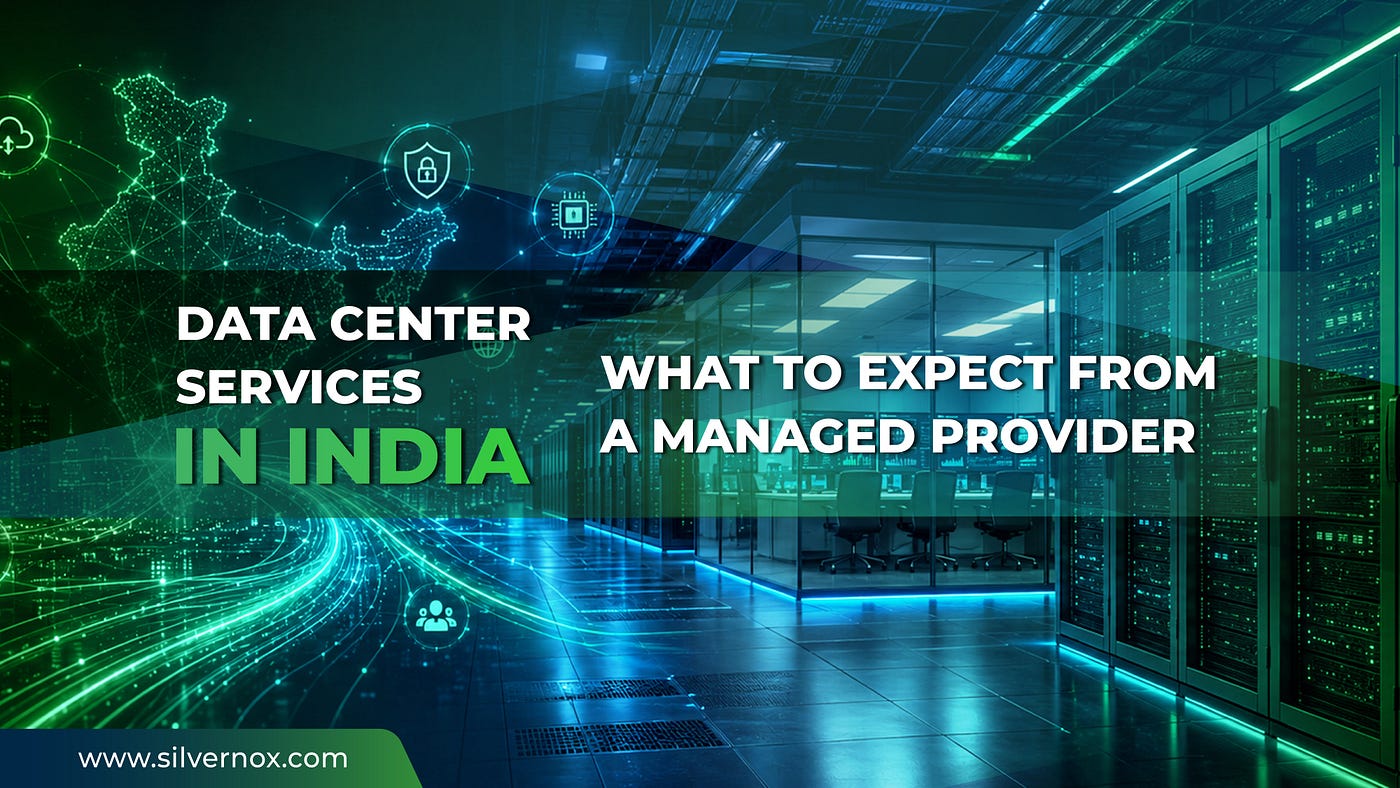
Data Center Services in India: What to Expect from a Managed Provider
Data Center Services in India: What to Expect from a Managed Provider
Data Center Services in India: What to Expect from a Managed Provider
Data Center Services in India: What to Expect from a Managed Provider
Many enterprise technology leaders believe that choosing an infrastructure partner in India is a simple exercise in sourcing physical rack space, power densities, and basic network connectivity.
In reality, your infrastructure choice is an explicit commitment to an operational strategy. It dictates your long-term business resilience, your digital transformation speed, and your regulatory compliance posture.
The digital ecosystem in India has reached a critical inflection point. Driven by intense enterprise cloud adoption, the massive data-residency impacts of the Digital Personal Data Protection (DPDP) Act, and the sharp rise of GPU-dense artificial intelligence (AI) workloads, the country’s operational data center footprint is exploding surpassing 1.6 GW of active capacity and on track to cross 2 GW by the end of this year.
For a CIO or CTO, navigating this fast-evolving, multi-billion-dollar landscape means looking past basic real estate metrics. Moving your workloads to an external provider is not just about offloading physical hardware; it is about choosing a partner capable of executing complex, automated operations under extreme stress.
What Are Data Center Services?
Historically, data center services were treated as an extension of corporate real estate. A provider built a secure shell, provided a stable drop of power, stabilized the temperature, and left the enterprise to manage its own fate.
That hands-off model is completely inadequate for modern digital applications. Today, comprehensive data center services represent a highly integrated operational and software layer that runs directly on top of world-class physical facilities.

When you partner with a premium provider, you are securing a comprehensive infrastructure ecosystem. This model wraps together resilient physical colocation, carrier-neutral network ecosystems, specialized structural cooling, and automated day-to-day configuration management.
It transforms physical infrastructure into an agile, highly programmable asset that directly accelerates your development velocities and protects your bottom line.
Core Services Offered by Modern Data Center Providers
To evaluate a data center company india, decision-makers must understand the distinct operational pillars that constitute an enterprise-grade service catalogue.
Advanced Colocation Services
This is the foundational layer of physical deployment. It must deliver clean, highly flexible spatial configurations ranging from isolated secure cabinets to custom private cages backed by high-density electrical engineering. Modern setups should comfortably scale up to 20 kVA or 30 kVA per rack to support modern high-performance computing clusters and containerized applications without requiring structural retrofits.
Managed Infrastructure Services
A modern infrastructure strategy offloads low-level administrative friction. Managed data center india solutions include automated operating system patch management, bare-metal server monitoring, firmware optimization, storage array scaling, and virtualization-layer maintenance. This ensures your internal teams remain entirely focused on software delivery rather than physical hardware maintenance.
Network and Cross-Connect Services
The baseline value of an infrastructure provider is heavily tied to its carrier density. A premium facility acts as a carrier-neutral hub, housing direct, low-latency fiber links to multiple Tier-1 telecommunications providers and regional internet exchanges within a secure, dedicated Meet-Me-Room (MMR). This ecosystem should offer immediate, software-defined physical cross-connects and direct, low-latency on-ramps to major public clouds.
Disaster Recovery and Operational Support
True resilience demands a comprehensive business continuity strategy. Providers must offer automated data replication engines, geographically distributed backup architectures, and seamless failover execution frameworks. This setup must be actively supported by a 24/7/365 on-site team of L1/L2 engineering experts capable of handling physical hardware updates or unexpected system anomalies the moment they occur.
Managed vs. Unmanaged Data Center Services
Enterprise buyers are often faced with a critical choice: should we opt for traditional unmanaged colocation or transition into a fully managed services model? The choice depends on your internal capabilities and long-term business goals.
The Traditional Colocation Model (Unmanaged)
In a pure colocation arrangement, the provider is strictly a landlord for your hardware. They contractually guarantee the environmental conditions providing stable ambient cooling, continuous 2N power, and physical perimeter security but stop entirely at the server door.
Your internal engineering team retains total responsibility for monitoring system logs, swapping out failed components, configuring firewalls, and managing software updates. This approach offers maximum granular control but consumes significant internal engineering bandwidth and leaves you fully exposed to operational human error during late-night emergencies.
The Managed Services Model
A managed data center india approach integrates the provider directly into your operations loop. The vendor’s on-site technical team takes over monitoring the overall health of your physical hardware, managing routine system patches, executing storage upgrades, and handling physical server engineering tasks on your behalf.

This model dramatically lowers internal overhead, simplifies capacity planning, and significantly reduces your Mean Time to Recovery (MTTR) by having certified hands instantly available at the rack the moment a component signals an anomaly.
The Hybrid Compromise
Many scaling enterprises choose a blended approach. They leverage unmanaged colocation for stable legacy applications where they want to retain tight, hands-on control, while using fully managed services for complex multi-region rollouts or high-density analytics platforms where scaling quickly without expanding internal headcount is a strategic priority.
SLA and Uptime Expectations
In the data center industry, a Service Level Agreement (SLA) is often viewed as a simple financial contract. For an enterprise technology leader, however, it is the ultimate measure of a provider’s engineering confidence. When auditing an SLA, look past the basic marketing numbers and evaluate the explicit operational terms.
A standard Tier III Data Center commitment must deliver at least 99.982% availability, which translates to a maximum allowable downtime of less than 1.6 hours per year. Premier providers frequently push this baseline further, offering a 100% uptime SLA for power and cooling paths by utilizing completely redundant 2N electrical distribution chains.
However, you must look closely at the hidden terms. Ensure your provider’s SLA defines downtime from the exact moment an interruption occurs, rather than when a manual ticket is opened.
Furthermore, verify that the agreement outlines clear, immediate financial remedies and lease termination paths for chronic performance breaches, ensuring the data center operator has clear financial skin in the game.
Security and Compliance Considerations
For any highly regulated enterprise particularly within the banking, financial services, and insurance (BFSI) or healthcare spaces physical and logical security is a major corporate liability. Your infrastructure must serve as a hardened, fully compliant environment.
Physical defense requires a multi-layered, zero-trust perimeter strategy. Top-tier facilities utilize an aggressive “defense-in-depth” design containing anti-tailgating mantraps, multi-factor biometric screening at every internal gateway, and continuous CCTV coverage with long-term data archiving.
This physical security must be backed by an ongoing operational discipline. Ensure your provider regularly provides clean, independent third-party audit reports across core frameworks, including ISO 27001 for information security, SOC 2 Type II for long-term operational control validation, and PCI-DSS for transactional safety.
Inheriting these facility-level compliance certifications directly condenses your own corporate audit scope, saving your risk teams hundreds of hours of manual compilation work during external regulatory reviews.
How to Evaluate a Data Center Provider
When building your shortlists for data center services india, use this structured framework to score each potential provider across eight core vectors:
● Infrastructure Reliability: Audit the physical engineering. Verify true 2N path redundancy for electrical systems and at least N+1 configurations for mechanical cooling loops.
● Operational Maturity: Review the provider’s history. Ask for documented proof of their historical uptime performance and historical incident response logs over the past three years.
● Security Posture: Validate the physical perimeter controls, zero-trust visitor tracking protocols, and automated access logging systems.
● Support Quality: Test the technical depth of the on-site team. Ensure the facility is staffed 24/7/365 by L1/L2 data center engineers, not on-call general facilities contractors.
● Scalability: Verify the availability of contiguous rack space and flexible power provisioning paths to handle sudden growth surges.
● Geographic Presence: Look for providers with an interconnected footprint across major coastal connectivity hubs (like Mumbai and Chennai) and core inland computing hubs.
● Financial Stability: Ensure the operator has the long-term capital backing required to continuously invest in facilities upgrades and equipment lifecycle management.
● Compliance Readiness: Confirm that current, clean SOC 2 Type II and ISO 27001 certifications are readily available for your legal team’s review.
Why India Is Emerging as a Strategic Data Center Hub
The explosive expansion of data center services in India is driven by a powerful combination of major market forces and targeted policy initiatives.
First, the enforcement of the Digital Personal Data Protection (DPDP) Act has fundamentally reshaped how businesses handle data, making physical data residency a non-negotiable architectural priority for any company processing Indian consumer information. This regulatory push is further reinforced by strict data-localization mandates from the Reserve Bank of India (RBI) and SEBI for all transactional and financial records.

Second, the Union Budget has introduced powerful financial incentives, establishing a multi-decade tax holiday for foreign cloud providers utilizing India-based data infrastructure for global workloads.
Combined with the arrival of massive new international subsea fiber cables landing directly in coastal hubs like Mumbai and Chennai, India has evolved from a local hosting option into a premier global hub for high-performance cloud and AI infrastructure.
Key Questions Every Enterprise Should Ask Before Choosing a Provider
Save this checklist for your next infrastructure evaluation session to quickly filter out under-engineered facilities:
- Is the facility design certified by the Uptime Institute, or is it simply “built to equivalent standards” without formal validation?
- Can your facility support high-density configurations of 20+ kVA per rack if we deploy advanced modern software or AI clusters?
- Are the different network carriers entering the building through physically separate entry conduits, or do they share a single entry bottleneck?
- What is your average response time and resolution time for Smart Hands support tickets during an unplanned weekend incident?
- Does your billing framework support transparent, metered power usage, or are we locked into paying for maximum circuit capacity regardless of actual draw?
- Can your facility provide a direct, unedited log of all physical entries into our specific server cages to satisfy our internal compliance audits?
Conclusion
Choosing a managed data center india partner is a high-stakes decision that extends far beyond a simple facility lease. It sets a hard baseline for your application performance, protects your operations against unexpected disasters, and defines your long-term capacity to scale without friction.
As digital systems grow more complex and regulated, relying on legacy on-premise spaces or unmanaged, disconnected facilities introduces an unacceptable layer of risk to your business.
True operational agility is built on an infrastructure foundation that prioritizes absolute resilience, proactive automation, and deep connectivity ecosystems.
At Silvernox, we build and manage our infrastructure platform to meet the demanding reliability and security standards that modern enterprise entities expect. Our top-tier, certified Tier III Data Center facilities are engineered to deliver robust 2N power redundancy, carrier-neutral connectivity, and continuous compliance readiness.
By combining industrial-grade facilities with responsive, 24/7 Managed Infrastructure support, we help organizations optimize their technology spend and scale with complete confidence. Connect with our senior advisory team to review your infrastructure strategy and discover how SilverNox can accelerate your digital future.
메타데이터
- post_id
- af80d754f05d
- slug
- data-center-services-in-india-what-to-expect-from-a-managed-provider-af80d754f05d
- url
- https://medium.com/@silvernox_dc/data-center-services-in-india-what-to-expect-from-a-managed-provider-af80d754f05d
- canonical_url
- https://medium.com/@silvernox_dc/data-center-services-in-india-what-to-expect-from-a-managed-provider-af80d754f05d
- author_url
- https://medium.com/@silvernox_dc
- status
- ok
- fetched_at
- 2026-07-07 06:42:44