LLMs, RAG, Agents, and MCP: The AI Evolution You Need to Understand
We did not build four different kinds of AI. We kept solving the next limitation.
LLMs, RAG, Agents, and MCP: The AI Evolution You Need to Understand
We did not build four different kinds of AI. We kept solving the next limitation.
A few years ago, the architecture was easy to draw.
User → LLM → Answer
Then someone asked the model about a private company document.
We added retrieval.
Then someone asked it to do something instead of merely explain something.
We added tools and agents.
Then every tool needed its own custom integration.
We added MCP.
This is the part I think many people miss. LLMs, RAG, Agents, and MCP are not four competing technologies. They are four layers in the same architectural evolution.
Each appeared because the previous layer could do something impressive, but not quite enough.
The easiest way to understand modern AI is to follow that evolution one problem at a time.
It Started With a Model That Could Talk
At the center of almost every modern AI application is a Large Language Model, or LLM.
The simplest architecture looks like this:
┌──────────┐        Prompt         ┌──────────┐
│          │ ────────────────────> │          │
│   User   │                       │   LLM    │
│          │ <──────────────────── │          │
└──────────┘        Response       └──────────┘
You ask:
“Explain Kubernetes networking in simple terms.”
The model receives your prompt and generates an answer.
That sounds simple because, architecturally, it is.
An LLM has learned patterns from enormous amounts of training data. Given a sequence of text, it predicts what should come next. At scale, that produces behavior that feels remarkably capable: explanation, summarization, translation, coding, analysis, and conversation.
But the first limitation appears quickly.
Ask the model:
“What is our company’s production database recovery procedure?”
The model has a problem.
It may understand databases.
It may understand disaster recovery.
But it has never seen your internal runbook.
The knowledge you need is outside the model.
User
  │
  │ "What is our recovery procedure?"
  ▼
┌──────────┐
│   LLM    │
│          │
│ Knows:   │
│ General  │
│ patterns │
└──────────┘
     X
     │
     │ Cannot see
     ▼
┌────────────────────┐
│ Internal Runbooks  │
│ Wikis              │
│ Private Documents  │
│ Current Data       │
└────────────────────┘
This is the first gap.
An LLM can generate, but it does not automatically know your world.
That gap gave us the next layer.
RAG Gave the Model Something to Read
The idea behind Retrieval-Augmented Generation, or RAG, is surprisingly simple:
Before asking the model to answer, find useful information and give it to the model.
That changes the flow:
Question
   │
   ▼
┌─────────────┐
│   Search    │
│  Knowledge  │
└─────────────┘
   │
   ▼
Relevant Information
   │
   ▼
┌─────────────┐
│     LLM     │
└─────────────┘
   │
   ▼
Grounded Answer
The original RAG research combined a model’s learned, or parametric, knowledge with external non-parametric memory. The practical idea has since become a common way to connect generative models to information outside their training data.
Suppose an employee asks:
“How many days of parental leave do I get?”
Without RAG:
Question
   │
   ▼
  LLM
   │
   ▼
Possible answer based on general knowledge
With RAG:
Question
   │
   ▼
Search HR documents
   │
   ▼
Find parental leave policy
   │
   ▼
Add relevant policy text to prompt
   │
   ▼
  LLM
   │
   ▼
Answer based on company policy
The model did not suddenly learn your HR policy.
The application found the relevant information and placed it in the model’s working context.
That distinction matters.
The model is still the generator
RAG does not replace the LLM.
It gives the LLM better material to work with.
A typical RAG system has two broad flows.
The ingestion flow
Documents
    │
    ▼
Extract Text
    │
    ▼
Split Into Chunks
    │
    ▼
Create Embeddings
    │
    ▼
Store in Search Index
The query flow
User Question
      │
      ▼
Search for Relevant Chunks
      │
      ▼
Retrieve Context
      │
      ▼
Question + Context
      │
      ▼
     LLM
      │
      ▼
    Answer
The architecture looks elegant on a slide.
Production is less polite.
A poor chunking strategy can separate an answer from the context that gives it meaning. A weak retrieval query can find the wrong documents. A stale index can return old policy. A system can retrieve information the user was never authorized to see.
That last problem is especially important.
User Permission
      │
      ▼
Retrieval Authorization
      │
      ▼
Allowed Documents Only
      │
      ▼
      LLM
The security boundary should exist before retrieval, not after generation.
If an employee cannot open the CFO’s compensation document directly, the AI application should not retrieve that document and hope the model keeps quiet.
RAG solved the knowledge problem.
But another limitation remained.
The model could tell you what to do.
It still could not necessarily do it.
Agents Gave the Model Hands
Consider two requests:
“Explain how to restart a failed Kubernetes deployment.”
and:
“Find the failed deployment, inspect the logs, identify the cause, and restart it if safe.”
These are very different tasks.
The first needs an answer.
The second needs a sequence of actions.
That is where agents enter the picture.
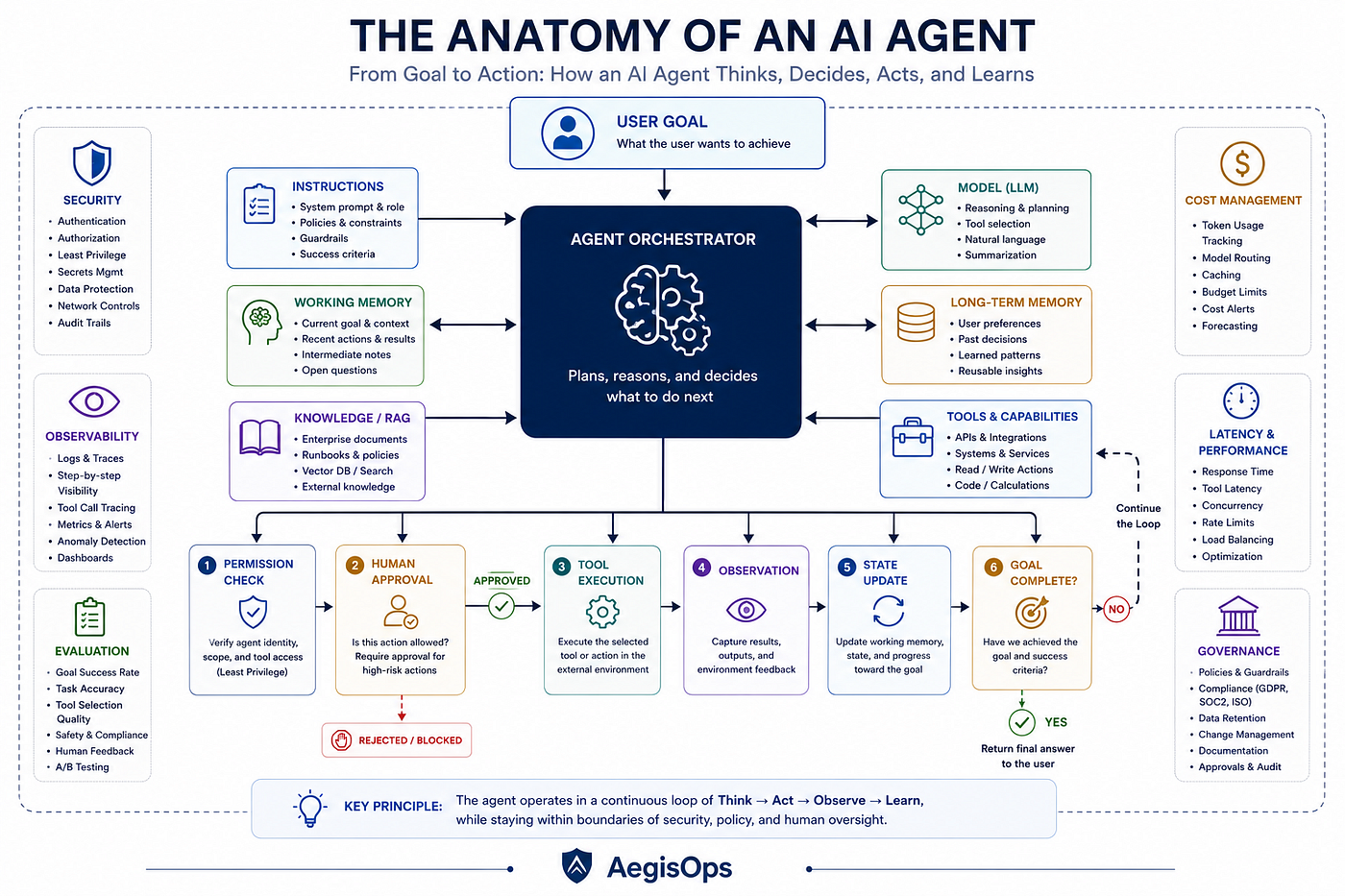
              ┌──────────────┐
              │     Goal     │
              └──────┬───────┘
                     ▼
              ┌──────────────┐
         ┌──> │    Agent     │ ──┐
         │    │ Decide Next  │   │
         │    │    Step      │   │
         │    └──────┬───────┘   │
         │           ▼           │
         │    ┌──────────────┐   │
         │    │  Use a Tool  │   │
         │    └──────┬───────┘   │
         │           ▼           │
         │    ┌──────────────┐   │
         └─── │ Check Result │ <─┘
              └──────┬───────┘
                     │
                Goal complete?
                     │
                     ▼
                   Stop
The important word here is not chat.
It is loop.
A normal LLM interaction often looks like this:
Input → Generate → StopAn agentic system can look more like this:
Goal
  ↓
Reason about next step
  ↓
Choose tool
  ↓
Execute action
  ↓
Observe result
  ↓
Decide what to do next
  ↓
Repeat until finished
This loop is central to practical agent systems, though implementations vary widely. Current guidance from both OpenAI’s practical guide to building agents and Anthropic’s guide to effective agents emphasizes tool use, feedback loops, clear success criteria, and keeping architectures as simple as the task allows.
Imagine a hypothetical operations agent investigating a failed deployment.
It might:
- Query the cluster for failed workloads.
- Retrieve the deployment status.
- Read recent logs.
- Check recent configuration changes.
- Compare the evidence.
- Decide whether a safe remediation exists.
- Ask for human approval if the action is high risk.
- Execute the approved action.
- Verify the result.
Now the AI is no longer producing only text.
It is participating in a system.
And that changes the risk model completely.
The Moment AI Can Act, Permissions Become the Architecture
A chatbot with bad output can confuse someone.
An agent with excessive permissions can change production.
That is a different class of problem.
                 ┌─────────────┐
                 │    Agent    │
                 └──────┬──────┘
                        │
              What is it allowed
                   to do?
                        │
          ┌─────────────┼─────────────┐
          ▼             ▼             ▼
     Read Logs      Restart Pod    Delete Data
      Low Risk       Medium Risk     High Risk
          │             │             │
       Allow?         Approve?       Deny?
The conversation about agents often jumps straight to autonomy.
I would start with authority.
Before asking:
“How smart is the agent?”
Ask:
“What can this agent touch?”
A production agent needs boundaries around:
- which tools it can discover,
- which tools it can call,
- what credentials those tools use,
- what data it can read,
- what actions require approval,
- how actions are logged,
- what happens when the model makes a bad decision.
This is why human approval is not merely a user-interface feature. For sensitive operations, it can be part of the control plane.
Agent Decision
      │
      ▼
Risk Evaluation
      │
   ┌──┴──┐
   │     │
 Low    High
 Risk   Risk
   │     │
   ▼     ▼
Execute  Human Approval
             │
        ┌────┴────┐
        ▼         ▼
      Approve    Reject
        │
        ▼
      Execute
Agents solved the action problem.
Then the integration problem arrived.
Every Agent Needed Tools. Every Tool Became an Integration Project.
Suppose I am building an engineering agent.
It needs access to:
- source code,
- tickets,
- databases,
- cloud services,
- monitoring systems,
- internal documentation,
- local files.
Without a common integration layer, the architecture can become a nest of custom adapters:
                ┌──────────────┐
                │  AI Agent A  │
                └──────┬───────┘
                       │
        ┌──────────────┼──────────────┐
        ▼              ▼              ▼
  Custom Git      Custom DB      Custom Ticket
  Integration     Integration    Integration

                ┌──────────────┐
                │  AI Agent B  │
                └──────┬───────┘
                       │
        ┌──────────────┼──────────────┐
        ▼              ▼              ▼
  Another Git     Another DB     Another Ticket
   Adapter         Adapter         Adapter
The intelligence may be sophisticated.
The plumbing is exhausting.
This is the problem MCP addresses.
MCP Standardized the Connection Layer
The Model Context Protocol, or MCP, is an open standard for connecting AI applications to external systems. Its official documentation describes it as a way for AI applications to connect to data sources, tools, and workflows through a standardized interface.
The simplest mental model is:
Before MCP

AI App ──Custom──> System A
AI App ──Custom──> System B
AI App ──Custom──> System C

With MCP

AI App ──MCP──> MCP Server ──> System A
                MCP Server ──> System B
                MCP Server ──> System C
But I would be careful with one common misunderstanding.
MCP is not the agent.
It does not decide your business goal.
It does not automatically make the model intelligent.
It does not remove the need for authorization.
It does not make every tool safe.
MCP standardizes how an AI application can discover and interact with external capabilities.
A useful simplified architecture is:
┌──────────────────────────────┐
│       AI Application         │
│                              │
│  ┌─────────┐   ┌──────────┐  │
│  │   LLM   │   │  Agent   │  │
│  └─────────┘   └────┬─────┘  │
│                     │        │
│              ┌──────▼──────┐ │
│              │ MCP Client  │ │
│              └──────┬──────┘ │
└─────────────────────┼────────┘
                      │
                 MCP Protocol
                      │
          ┌───────────┼───────────┐
          ▼           ▼           ▼
     ┌────────┐  ┌────────┐  ┌────────┐
     │  MCP   │  │  MCP   │  │  MCP   │
     │ Server │  │ Server │  │ Server │
     └───┬────┘  └───┬────┘  └───┬────┘
         ▼           ▼           ▼
       Files       Database     APIs
The agent decides that it needs a capability.
The MCP layer provides a standard way to expose and invoke that capability.
The underlying system still does the real work.
The Whole Evolution Fits Into One Picture
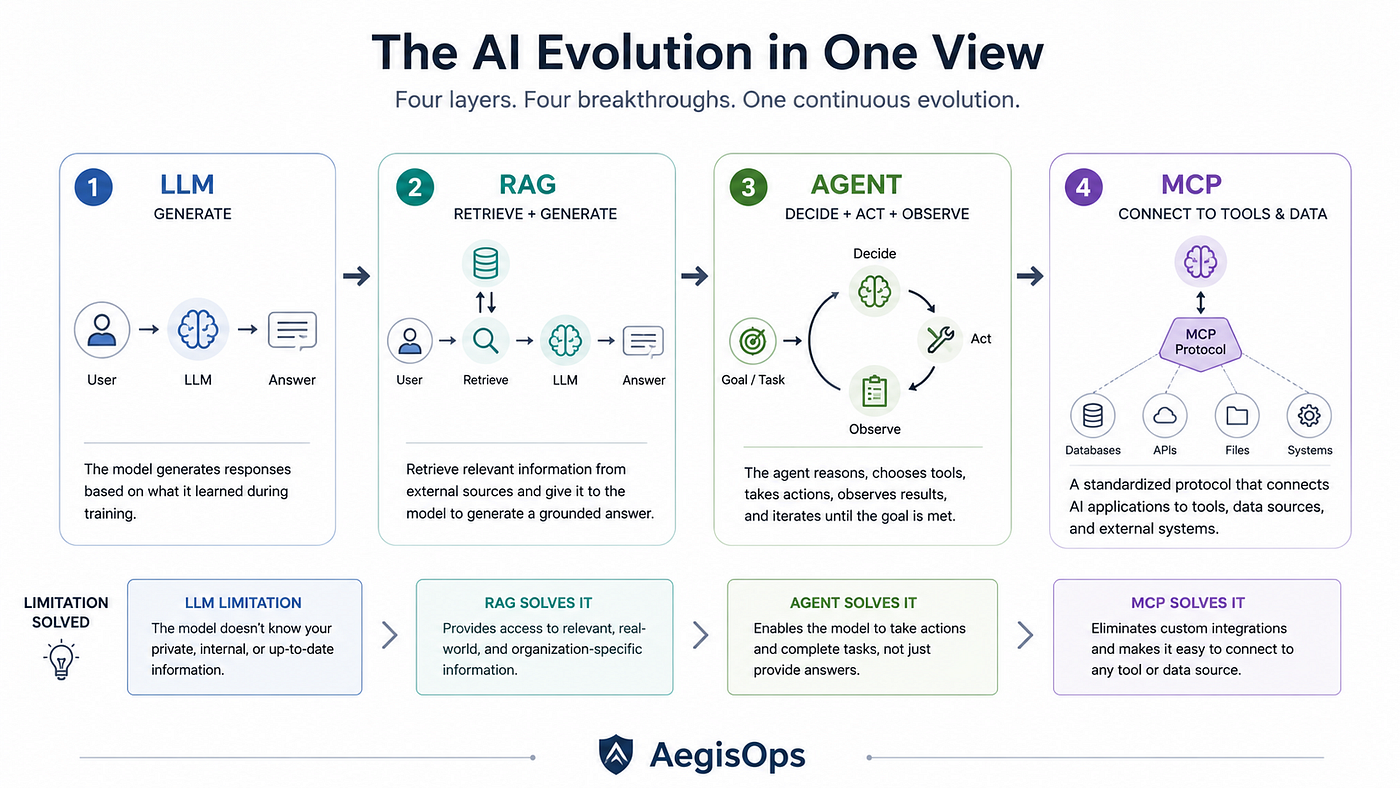
Here is the progression I find most useful:

┌─────────────────────────────────────────────────────────┐
│                     AI EVOLUTION                        │
└─────────────────────────────────────────────────────────┘

1. LLM
   "I can generate."
   User → LLM → Answer

2. RAG
   "I can answer using external knowledge."
   User → Retrieve → Context → LLM → Grounded Answer

3. AGENT
   "I can decide, use tools, observe, and continue."
   Goal → Reason → Act → Observe → Repeat

4. MCP
   "I can connect to external capabilities through
    a standard protocol."
    Agent → MCP → Tools / Data / Systems
Now combine all four:
                          USER GOAL
                              │
                              ▼
                     ┌────────────────┐
                     │     AGENT      │
                     │ Decide & Plan  │
                     └───────┬────────┘
                             │
                ┌────────────┼────────────┐
                ▼            ▼            ▼
          Need Knowledge?  Need Action?  Need Reasoning?
                │            │            │
                ▼            ▼            ▼
              RAG          MCP Tools      LLM
                │            │            │
                ▼            ▼            │
         Internal Data   External Systems │
                │            │            │
                └────────────┴────────────┘
                             │
                             ▼
                         OBSERVE
                             │
                             ▼
                     Continue or Stop
This is the architectural relationship:
The LLM provides reasoning and generation.
RAG provides relevant knowledge.
The agent provides a decision-and-action loop.
MCP provides a standard connection layer to external capabilities.
They are not replacements for one another.
They solve different gaps.
One Request, Four Layers
Consider a hypothetical request to an IT operations assistant:
“Check why the payment API is failing and create an incident if necessary.”
Step 1: The agent interprets the goal
Goal:
Investigate payment API failure
The LLM helps reason about the task.
Step 2: RAG retrieves operational knowledge
Search:
- Payment API runbook
- Known failure patterns
- Escalation policy
Now the system has company-specific context.
Step 3: The agent chooses actions
1. Check service health
2. Query recent alerts
3. Inspect logs
4. Compare findings with runbook
Step 4: MCP exposes external capabilities
Agent
  │
  ├── MCP → Monitoring
  ├── MCP → Log Platform
  ├── MCP → Incident System
  └── MCP → Documentation
Step 5: The agent observes the results
Suppose the logs show repeated database connection failures.
The agent checks the runbook and finds that this pattern requires escalation.
Step 6: The risk policy controls the action
Read logs             → Allowed automatically
Read runbook           → Allowed automatically
Create draft incident  → Allowed automatically
Restart production DB  → Human approval required
That is a much better picture of modern AI than “a chatbot with more features.”
It is an architecture composed of reasoning, context, action, integration, identity, and controls.
The Architecture Diagram Still Hides the Hard Part
Put LLM, RAG, Agent, and MCP into one diagram and the system looks beautifully complete.

Then production starts asking rude questions.
What happens if retrieval returns confidential data?
What happens if a tool description is misleading?
What happens if the agent retries a destructive action?
What happens if an MCP server is compromised?
What happens if the model chooses the correct tool with the wrong arguments?
What happens if the agent keeps looping and burning tokens?
What happens if nobody can reconstruct why it took an action?
The difficult parts are not always inside the boxes.
They are often the arrows between them.
LLM ─────> Agent
     Can reasoning be trusted?

Agent ───> Tool
     Is this action authorized?

Tool ────> System
     What is the blast radius?

System ──> Agent
     Can the result be trusted?

RAG ─────> LLM
     Was the user allowed to see this context?
That is why modern AI engineering is increasingly about more than prompts.
It is about context engineering, tool design, evaluations, permissions, observability, and failure handling. Recent practitioner guidance also emphasizes that context is finite, tool quality directly affects agent performance, and evaluations are essential for making behavioral failures visible before production.
You May Not Need All Four
This is where architecture can get unnecessarily expensive.
A simple question-answering feature may need only an LLM.
User → LLM → AnswerAn internal policy assistant may need LLM + RAG.
User → RAG → LLM → AnswerA controlled workflow that must perform actions may need an agent.
Goal → Agent → Tools → ResultAn ecosystem with many AI applications and external systems may benefit from MCP.
AI Applications → MCP → Shared CapabilitiesDo not build the final architecture merely because all four technologies are popular.
Start with the problem.
Add the next layer only when the current one has a limitation you actually need to solve.
That principle matters because every new capability creates a new failure surface.
RAG adds retrieval quality and data authorization problems.
Agents add behavioral uncertainty and action risk.
MCP adds another integration and trust boundary.
More capability means more responsibility.
The Shift Is Bigger Than Chatbots
The evolution can be summarized in four sentences:
LLMs made AI conversational.

RAG made AI knowledgeable about your data.

Agents made AI capable of pursuing goals and taking action.

MCP made external capabilities easier to connect through a common protocol.
But the deeper shift is this:
From:  "What can the model say?"

To:    "What information can it access?"

Then:  "What actions can it take?"

Now:   "How do we connect, govern, observe,
         and secure the entire system?"
That last question is where the next generation of serious AI engineering will live.
The model may be the most visible box in the diagram.
It is no longer the whole architecture.
If you enjoy practical explorations of AI, Cloud, DevOps, Security, and modern engineering, follow AegisOps for more.
AI #GenerativeAI #AIAgents #RAG #MCP #LLM #AgenticAI #ArtificialIntelligence #AIArchitecture #ModelContextProtocol
메타데이터
- post_id
- af83503ebc0c
- slug
- llms-rag-agents-and-mcp-the-ai-evolution-you-need-to-understand-af83503ebc0c
- url
- https://medium.com/aegisops/llms-rag-agents-and-mcp-the-ai-evolution-you-need-to-understand-af83503ebc0c
- canonical_url
- https://medium.com/aegisops/llms-rag-agents-and-mcp-the-ai-evolution-you-need-to-understand-af83503ebc0c
- author_url
- https://medium.com/@cloudsignal
- status
- ok
- fetched_at
- 2026-07-10 14:51:46