Google’s New TPU Chips Explained: Is This The End of GPUs?
From basics to why it might change AI computing
Google TPU | AI Hardware and Computing | AI Chips
Google’s New TPU Chips Explained: Is This The End of GPUs?
From basics to why it might change AI computing
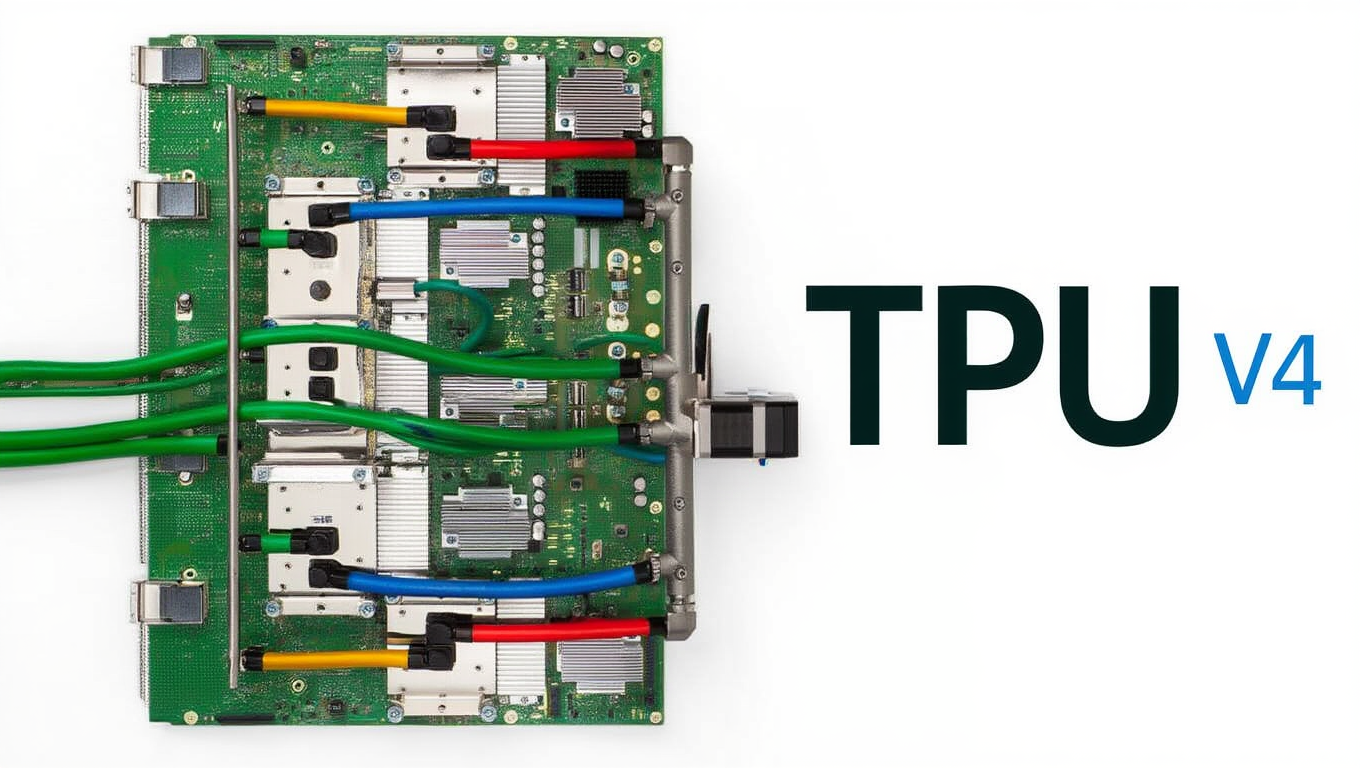
Google TPU (Image created by Author)
Read here for FREE
Anthropic, the company behind Claude, just committed to buying up to one million of Google’s custom AI chips instead of sticking with the industry standard, and that decision alone speaks louder than any marketing campaign about what’s shifting in AI hardware.
For the first time, Google is splitting its chip design into two specialized machines.
The TPU 8t handles model training, delivering 2.7 times better performance per dollar than the previous generation. The TPU 8i specializes in running models after they’re built, promising 80 percent better cost-per-request. If you’ve used ChatGPT, Claude, or Gemini, you’ve experienced inference in action. These aren’t incremental updates. They’re purpose-built machines that say something important about where compute is heading.
What Is a TPU, Anyway?
Let’s start with the basics. A Graphics Processing Unit, or GPU, was invented for a specific job: rendering pixels on a screen. Back in the early 2010s, researchers realized that the architecture behind GPUs was perfect for something else entirely: the matrix multiplications that power neural networks.
That accident of design gave NVIDIA a decade-long monopoly in AI infrastructure.
Google, being Google, decided to stop renting someone else’s hardware. In 2013, Jeff Dean, Google’s chief scientist, calculated that if everyone on Earth spoke to Google for three minutes a day, the company would need to double its data center capacity at a cost of tens of billions of dollars.
That math problem led to the first Tensor Processing Unit.
A custom chip designed from scratch to do one thing incredibly well: run machine learning models. TPUs are application-specific integrated circuits, or ASICs. This means they’re not flexible like GPUs. They can’t render graphics. They’re not built for general computing.
But that limitation is actually their strength.
Because they only do tensor operations, they do it with extraordinary efficiency. They consume between 120 to 250 watts per chip compared to GPUs that can draw 400 watts. They deliver performance-per-watt that’s genuinely difficult to beat.
Training vs. Serving: The Split That Matters
You need to understand one fundamental difference to grasp why Google’s new chips matter. AI has two distinct computational phases:
Training Building the model.
You feed data in, adjust billions of parameters, and slowly improve the system’s ability to predict or reason. This happens once per model generation and is computationally expensive.
Inference Using the model.
Every time you send a message to Claude or ask ChatGPT something, you’re running inference. It happens millions of times per day. The demands are completely different.
For years, Google built general-purpose TPUs that handled both reasonably well. But the market split hard. Companies wanted specialized tools. Google listened and built differently this time.
The TPU 8t is built for training massive models. It focuses on throughput. You want to process as much data as possible in parallel. Speed matters more than responsiveness.
The TPU 8i is built for inference. It prioritizes latency and efficient reasoning. When someone hits your API, you want the answer now, not eventually.
This isn’t a small distinction. Inference consumes about 75 percent of AI compute by 2030, according to industry projections. If you optimize inference hardware differently, you change everything about the cost structure of running large language models.
Why Anthropic’s Decision Signals a Real Shift
When Anthropic announced it was committing to one million TPU chips in October 2025, the industry took notice.
Anthropic had trained Claude primarily on NVIDIA GPUs. The company had years of experience with GPU infrastructure. They knew the ecosystem inside out. They had no reason to switch unless the fundamentals had changed.
Then they decided to buy approximately one gigawatt of Google TPU capacity for 2026 alone. That’s enough power to supply a small city. More gigawatts are coming in 2027 through an agreement with Google and Broadcom.
Why the switch?
Anthropic said it plainly: better price-performance and efficiency. Running the math, training large models on TPUs costs less per unit of compute. Inference costs drop even more dramatically. For a company with billions of dollars of revenue running on customer queries, that math compounds fast.
Anthropic didn’t abandon other chips. They still use Amazon Trainium and NVIDIA GPUs for different workloads. But the TPU commitment sends a message that’s hard to ignore. A major AI company deemed Google’s custom silicon more cost-effective than the incumbent standard.
This matters because it shows switching is actually possible.
The Numbers Tell a Real Story
TPU 8t delivers 2.7 times better performance per dollar for training than Google’s previous-generation Ironwood chip.
TPU 8i delivers 80 percent better performance per dollar for inference.
These aren’t marginal improvements. These are the kinds of differences that reshape infrastructure decisions.
Energy efficiency compounds this advantage:
- Ironwood TPU is 30 times more energy-efficient than Google’s first public TPU
- TPU 8t and 8i promise roughly double the performance-per-watt of Ironwood
- TPU v4 pods deliver approximately 1.1 exaflops with inference latencies as low as 10 milliseconds for certain models
- When running inference millions of times daily, power consumption directly hits your bottom line
Real cost savings look like this: Snap’s internal analysis showed 55 percent lower total cost of ownership for TPU-based inference versus comparable GPU infrastructure. That’s not speculation. That’s a major company running the same workloads on both systems and seeing a concrete difference.
What This Means for NVIDIA’s Market Position
NVIDIA dominates the AI hardware market with roughly 80 percent share. That’s not changing tomorrow. The company is too entrenched.
OpenAI, Microsoft, Meta, and most of the industry still rely heavily on NVIDIA GPUs.
But the end of absolute monopoly is beginning.
Google controls a major cloud platform. Amazon has Trainium chips. Intel, AMD, and startups are all building alternatives. Anthropic’s billion-TPU deal suggests that switching costs aren’t as high as everyone assumed. If your models can run on multiple platforms, you choose based on price and performance.
NVIDIA remains profitable because GPU software and ecosystems are mature. PyTorch, TensorFlow, and CUDA have years of optimization. Developers know GPUs. Moving to TPUs requires retraining teams and adapting workflows.
That friction is real.
But Google is removing it strategically. TorchTPU lets you run PyTorch models on TPUs with minimal code changes. TPUs can now access bare metal, meaning less overhead. These are the practical moves that turn theoretical alternatives into viable replacements.
Companies can now build on TPUs without a complete engineering rewrite.
The Multi-Cloud Reality
Here’s what’s actually happening in the real world:
Anthropic runs Claude on three different chip platforms simultaneously. They use Google TPUs, Amazon Trainium, and NVIDIA GPUs. Each platform handles specialized tasks. Training on one system. Inference on another. Research on a third.
This approach has concrete advantages:
- Better price negotiation through optionality
- Reduced risk from single-vendor dependency
- Workload optimization without architectural constraints
- Faster iteration through specialized hardware
This is the infrastructure reality that large AI companies are moving toward.
It’s not about picking one winner. It’s about picking the right tool for each job.
Is This The End of GPUs?
No. But it’s probably the end of GPU exclusivity.
For certain workloads at certain scales, TPUs deliver better economics. Large-scale training and high-volume inference benefit most. Smaller projects, research, edge deployment, and specialized tasks still favor GPUs.
NVIDIA will keep growing. The market is big enough for multiple winners.
What has actually changed is choice. Companies can now evaluate hardware like any other infrastructure decision: performance, cost, power consumption, and ecosystem fit.
They don’t have to accept the default anymore.
What Happens Next
The TPU 8t and 8i represent Google finally showing that custom silicon can outcompete general-purpose alternatives on practical, economic grounds. That’s not revolutionary. It’s actually how specialized hardware is supposed to work.
The real shift is that Anthropic, a frontier AI company, moved billions in compute spending based on that economics.
When the companies building the future of AI vote with their infrastructure budget, the industry listens.
We’re likely to see more companies follow this path. Not because TPUs are universally better, but because companies are waking up to the fact that they have real alternatives. NVIDIA’s near-complete dominance in AI compute is probably over.
What replaces it won’t be another monopoly. It will be competition based on what actually works best for your specific problem.
That’s the change Google’s new chips represent.
메타데이터
- post_id
- afa16bf86bef
- slug
- googles-new-tpu-chips-explained-is-this-the-end-of-gpus-afa16bf86bef
- url
- https://medium.com/the-ai-studio/googles-new-tpu-chips-explained-is-this-the-end-of-gpus-afa16bf86bef
- canonical_url
- https://medium.com/the-ai-studio/googles-new-tpu-chips-explained-is-this-the-end-of-gpus-afa16bf86bef
- author_url
- https://medium.com/@coustom.no.03
- status
- ok
- fetched_at
- 2026-06-09 15:37:30