The 4 Best Pitching Prospects Currently in Triple A
4. Carlos Lagrange, RHP, 23, New York Yankees
The 4 Best Pitching Prospects Currently in Triple A
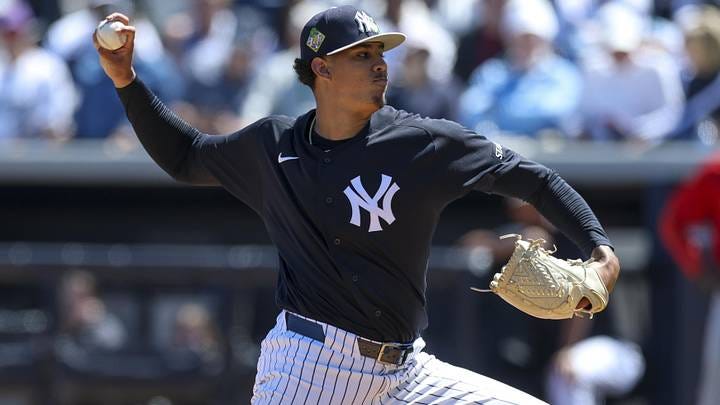
Lagrange Throwing a Pitch during Spring Training
4. Carlos Lagrange, RHP, 23, New York Yankees
Elmer Rodriguez isn’t the only Yankees pitching prospect turning heads. Carlos Lagrange burst onto the scene during Spring Training, and it’s easy to see why. A fastball that touches 103 MPH will do that. But Lagrange isn’t just a flamethrower.
If velocity was all he had, the Yankees would likely be developing him strictly as a reliever. Instead, they continue to give him opportunities as a starter because they believe there’s more here than just elite arm strength. Lagrange possesses a four-pitch mix that all project as average or better offerings: a 70-grade fastball, 60-grade slider, 55-grade cutter, and 55-grade changeup. At 6-foot-7, 250 pounds, Lagrange is physically imposing and generates exceptional movement on his pitches. Like many pitchers with his combination of size, velocity, and movement, command remains the biggest question mark. But the promise is undeniable. Last season was Lagrange’s true coming-out party.
2025 (A+ and AA) 120 IP, 3.53 ERA, 1.20 WHIP, 168 K, 62 BB, .191 BAA, 82 H, 8 HR
The strikeout numbers immediately jump off the page. He overpowered hitters at two levels while limiting opposing batters to a sub-.200 average. So far in 2026, Lagrange has logged 61.1 innings with a 3.96 ERA, 1.29 WHIP, 80 strikeouts, 31 walks, a .210 batting average against, 48 hits allowed, and 10 home runs surrendered. The strikeout ability is still evident, but some of the underlying concerns have shown up as well. The walk rate remains elevated, and he’s allowed more hard contact this season, as reflected by the increase in home runs allowed. That’s why a little more seasoning in Triple-A could be exactly what he needs before making his Major League debut. Still, Lagrange is firmly on the right trajectory.
Add him to the growing list of starting pitchers the Yankees have successfully developed in recent years. New York’s ability to identify, acquire, and improve pitching talent has become one of the organization’s greatest strengths, and Lagrange looks like he could be next in line. The question now becomes how the Yankees choose to deploy him. Will there be room in the rotation? Could his elite stuff allow him to impact the Major League bullpen in a high-leverage role as early as this season? Or could he become a centerpiece in a deadline deal if the Yankees decide to pursue offensive help? No matter which path unfolds, one thing is becoming increasingly clear: Carlos Lagrange is carving out a future for himself at the Major League level.
Hagen Smith Throwing a Pitch During Spring Training
3. Hagen Smith, LHP, 22, Chicago White Sox
Hagen Smith entered the 2024 MLB Draft after a decorated college career at the University of Arkansas, where he set numerous records and took home SEC Pitcher of the Year honors. The White Sox selected him 5th overall, and with the amount of talent that came off the board shortly after, they may already be wondering if they made the right choice. Just look at some of the names drafted after Smith:
- Jac Caglianone
- JJ Wetherholt
- Konnor Griffin
- Cam Smith
- Braden Montgomery
- Trey Yesavage
- Carson Benge
The 2024 Draft class was loaded, and that naturally raises expectations for a pitcher selected inside the top five. What’s unfortunate for Smith is that he’s actually developed at a relatively impressive rate, especially for a pitcher. Yet because of the talent around him, his progress has gone somewhat under the radar. Smith is already pitching in Triple-A less than two full seasons after being drafted. That’s an aggressive development path. What’s even more interesting is that reports surfaced in 2025 suggesting his velocity and overall stuff had taken a step back. Despite that, he finished the year strong in Double-A and hasn’t looked back since. In his debut professional season, Smith threw 75.2 innings to the tune of a 3.57 ERA, 1.30 WHIP, and a .166 batting average against. He struck out 108 batters while allowing just 42 hits and 5 home runs. So far this season, the results have been a little more inconsistent:
2026 52 IP, 4.67 ERA, 1.40 WHIP, 77 K, 36 BB, .200 BAA, 37 H, 8 HR
The ERA doesn’t look great, but what stands out to me is the stuff. Smith primarily relies on a two-pitch mix, but both the fastball and slider generate plenty of swings and misses. Just look at the strikeout numbers and batting average against. Even while pitching in Triple-A, hitters still aren’t squaring him up consistently. The inflated ERA is largely a product of more hard contact and a few more mistakes ending up over the fence, which isn’t exactly uncommon for a young pitcher facing advanced hitters. His strikeout rate has remained strong, and the swing-and-miss ability is still very much intact.
The biggest thing Smith needs right now is refinement. The raw ingredients are there. The White Sox don’t need him to reinvent himself; they just need him to continue polishing his command and execution against more experienced hitters. Don’t be surprised if Smith finds himself in Chicago at some point this season. The numbers may not be perfect, but the talent is still obvious, and his development remains firmly on track.
Wei-En Lin Throwing a Pitch for Chinese Taipai during the World Baseball Classic
2. Wei-En Lin, LHP, 20, Las Vegas Athletics
Wei-En Lin is a much different prospect than some of the other names on this list, but he’s just as impressive.
The Taiwanese left-hander was signed as an international free agent in 2024 and has remarkably progressed all the way to Triple-A in just his second professional season. That’s an aggressive timeline for any pitcher, let alone an international signing still adjusting to professional baseball. What makes Lin unique is that his fastball doesn’t stand out. It’s a 50-grade pitch that typically sits 92–94 MPH and touches 96. In today’s game, those numbers aren’t exactly going to turn heads. What does stand out, however, is his diverse pitch repertoire and his ability to command it with ease.
Lin features a 55-grade curveball, 55-grade slider, and a 50-grade changeup. His control is currently graded at 55, but I’d argue it’s closer to a 60 or even 65. He consistently fills up the strike zone while still limiting quality contact, which isn’t an easy combination to find. Check out what he’s done so far this season:
2026 (51.1 IP AA, 1.2 IP AAA) 3.23 ERA, 1.00 WHIP, 54 K, 17 BB, .189 BAA, 36 H, 2 HR
The numbers tell the story.
Lin’s two greatest strengths are his ability to limit hard contact and his ability to attack the strike zone. That’s a difficult balancing act, especially for someone who doesn’t rely on overpowering velocity. Many pitchers can throw strikes. Many pitchers can miss bats. Very few can consistently do both while keeping hitters from squaring the baseball up.
The Athletics believe there’s still room for Lin to add velocity and eventually reach average-to-above-average territory with the fastball. Whether that happens or not, he’s already established himself as one of the more intriguing pitching prospects in their system. As a true pitching geek, there’s nothing like watching a real pitcher such as Lin. Today’s game is full of throwers. Guys who can light up the radar gun but don’t always know how to meticulously pick apart the strike zone. Lin is different. He understands how to sequence, command, and execute. He pitches with intent, confidence, and a clear plan every time he takes the mound. That ability separates pitchers from throwers, and it’s one of the reasons Lin has climbed through the farm system so quickly.
He’s also known as a fierce competitor who exudes confidence and energy on the mound. When you combine that mentality with his command profile and advanced feel for pitching, it’s easy to understand why he’s already reached Triple-A. Will we see Wei-En Lin in the Major Leagues during 2026? Only time will tell. But if his development continues at this pace, the Athletics may not have much reason to keep him in the minors for long.
Thomas White Throwing a Pitch for the Beloit Skycarp
1. Thomas White, LHP, 21, Miami Marlins
Similar to Hagen Smith, Thomas White entered the 2023 MLB Draft as the top left-handed pitcher available. Unlike Smith, however, White slid all the way down to the 35th overall pick, where the Miami Marlins were more than happy to scoop him up. So far, that selection looks like a steal. White has developed at a rapid pace through the Marlins system, and a big reason why is his natural stuff. He currently features three pitches, all of which grade as 60 or better on the 20–80 scouting scale.
His fastball sits 94–96 MPH and touches 99. He transformed his curveball into a wipeout slider that has become arguably his best pitch. The offering generates tremendous sweep and depth, making it a nightmare for hitters on both sides of the plate. His changeup has also progressed significantly since being drafted. The more he’s incorporated it into his arsenal, the better it’s become. It’s now a legitimate plus offering that plays extremely well off his fastball.
Simply put, White has the arsenal of a frontline starter. He’s also built like one. At 6-foot-5 and 240 pounds, White possesses the type of frame organizations dream about when developing starting pitchers.
Before reaching Triple-A, White dominated nearly every level of the minor leagues. Check out his stats from last season.
2025 (High-A, Double-A, Triple-A) 89.2 IP, 2.31 ERA, 1.18 WHIP, .174 BAA, 55 H, 145 K, 51 BB
The strikeout numbers are absurd, but what jumps off the page even more is the batting average against. Opposing hitters simply struggled to square him up. So far in 24.2 innings at Triple-A this season, White owns a 4.01 ERA with 35 strikeouts, 15 walks, 21 hits allowed, 4 home runs surrendered, and a .236 batting average against. The ERA has climbed, but Triple-A is often where pitching prospects finally face hitters capable of punishing mistakes. The encouraging part is that the strikeout ability remains intact. In many ways, White is very similar to Carlos Lagrange.
Both pitchers are physically imposing. Both generate elite movement. Both miss bats at an exceptional rate. And both have one developmental hurdle standing between them and stardom: control. I just believe White has a higher ceiling.
His walk rate has actually gotten worse as he’s climbed the ladder, but that isn’t entirely surprising. When you’re generating that much movement and throwing with the type of power that he does, consistently repeating your delivery becomes more difficult. The pace at which White develops his control will ultimately determine his destiny. White could still be a very good Major League starter with below-average control because the stuff is that good. But if he can get the command to even average territory? watch out. At that point, we’re no longer talking about a mid-rotation starter. We’re talking about a pitcher with legitimate ace potential and someone who could anchor the Marlins rotation for years to come.
메타데이터
- post_id
- afa9fc362348
- slug
- my-top-4-pitching-prospects-in-triple-a-afa9fc362348
- url
- https://medium.com/@Quinsight/my-top-4-pitching-prospects-in-triple-a-afa9fc362348
- canonical_url
- https://medium.com/@Quinsight/my-top-4-pitching-prospects-in-triple-a-afa9fc362348
- author_url
- https://medium.com/@Quinsight
- status
- ok
- fetched_at
- 2026-07-13 06:23:13