Pitch for Power, Power for Pitch, a Coffee House Discussion
Recently I was invited to have a “coffee house” discussion with Dan Gryder. Unfortunately I think once the recorder was on, it was more a…
Pitch for Power, Power for Pitch, a Coffee House Discussion

Recently I was invited to have a “coffee house” discussion with Dan Gryder. Unfortunately I think once the recorder was on, it was more a bar talk or at the club chat. Amber says that this is because the moment the recorder went on, we both stopped actively listening and wanted to get our own approaches caught in the record. The moment the tape started running we each sought to be heard.

https://www.visitpensacola.com/directory/seville-quarter-live-music-nightlife-festivals-events/
https://www.youtube.com/watch?v=Ima88haD3cs
Note as I reference things in paragraphs below, I will put links below the paragraph. These may run through several links. Likely the story continues below, open the links in additional tabs and continue to scroll to read below.
So, here, I give you a coffee house open mic contribution. With such, don’t expect a standard paper with a thesis to prove. Instead I give you multiple threads of thought that may relate and interweave or may not instead being completely independent. Hopefully they’ll inspire a little curiosity and make impetus for a future conversation. Coffee house conversations ramble. I hope this one ends in a pretty and tight knot even as it takes a while to tie. For those reading not pilots nor of an aviation bent, I think the read will still be worthwhile as much will have transferability and more broad applicability.
I thought about not publishing this piece. I think we have come to a resolution on the DMMS-AOA debate.
https://www.youtube.com/watch?v=wxYMVZRqjYw
Yet in this I also used this as a bus to carry the introduction of other ideas. There is a name for a larger story carrying smaller stories, but I can’t think of it at the moment. Perhaps someone can re-educate me? This doesn’t carry the full smaller stories, yet hopefully enough to create interest in them. They generally tend to get toward decision making and risk. DMMS-AOA is about energy. Many of our risk approaches use energy as analogy or are built to shield against energy. This is a good way to approach risk though we also need to add ecology as analogy. This latter helps to better catch and understand confluence of events. Our decision making really needs to do better catching both an energy approach and an ecology approach. The more interconnections we have and the tighter their coupling, the more we can be surprised.
“That was a great debate. I get that Aoa is probably better but it’s back to the vhs /betamax. BOTH OF YOU AGREED ON ONE PIOINT — you need a line. Everyone should use a line whether it be on a speed indicator or AOA. EVERYONE so if you don’t have an AOA get a line on your airspeed indicator. A great debate must have knowledgeable debaters and it’s great to hear that in the both of you.” — BY-hj5qh
“An excellent topic! Maybe we could agree that AOA equipment and training is our first choice. In lieu of that, we both recommend DMMS reminders for all light planes?” — Dan Gryder
I completely agree.
And now, with the second video in the air, BY-hj5qh again comes in with what I think will be this video’s golden comment,
“Rarely will you learn anything new from someone you agree with. It’s someone who disagrees with you where the probably cause becomes greater understanding. The greatest learning comes from free speech. Instead of being judgmental people should be far more open minded and engaged in respectful debate and the result maybe even becoming friends. Maybe you will lose some as well but to me no debate is worth losing friends over. Agree to disagree and then move onto happier topics. Keep up the great great great work you do Dan. No doubt you have saved lives and getting AQP into GA will only save plane loads more.”
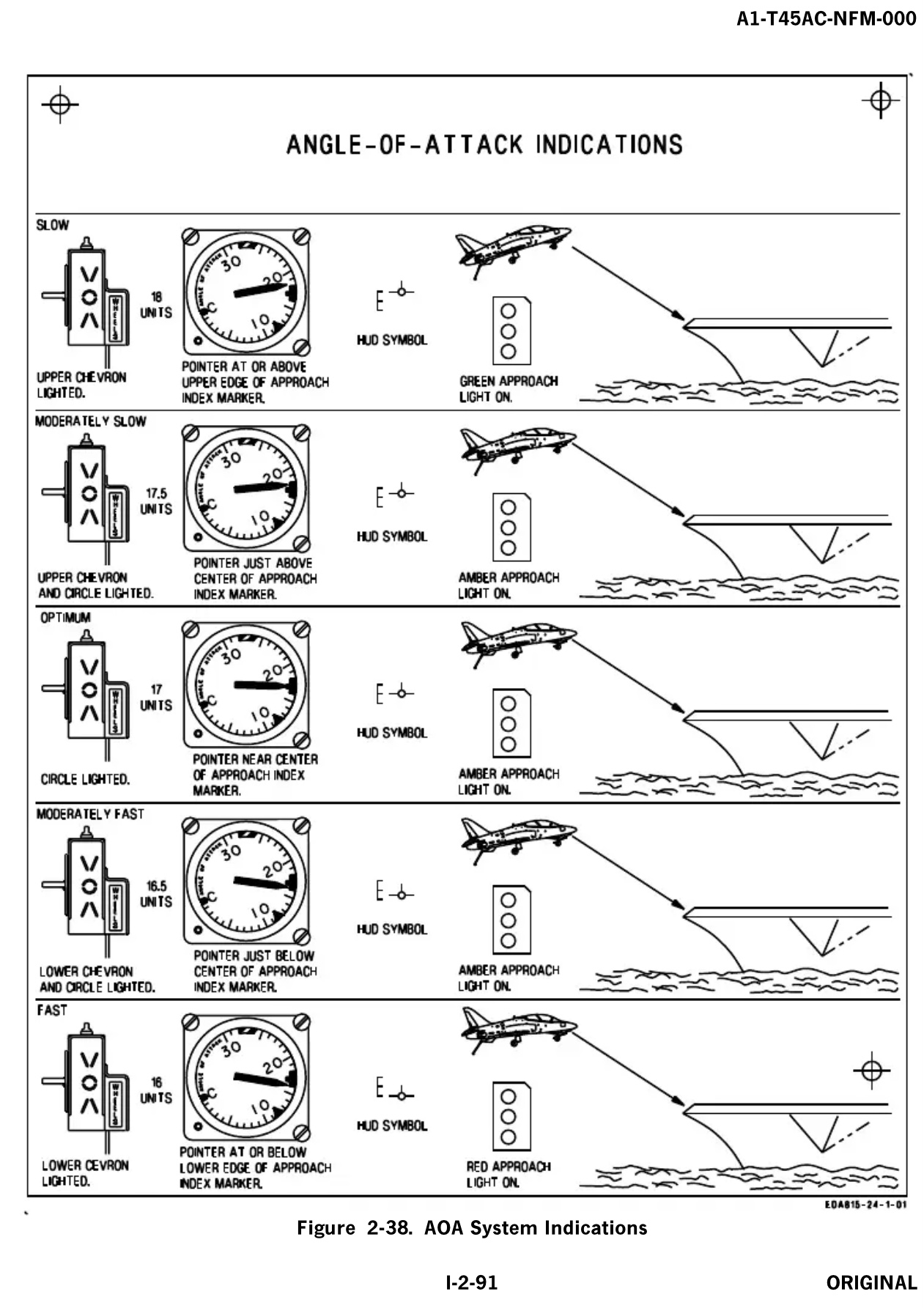
Oh, and yes, I do have a “PhD,” that is a public high school diploma P-H-D. (If this doesn’t make sense, see the debate video. (You can skip to the last seventeen minutes.)) With this I believe the video audio missed my saying Naval Aviators come from us. They are us. They’re not extraordinary as you may think. But this raises a question. We’re supposed to believe airlines have it best. We should emulate airlines. Yet Naval Aviators are too superior thus cannot be emulated? Does this mean we acknowledge airline flying is lowest common denominator flying? Or perhaps, airlines too, shouldn’t out of course be a model for emulation. A model for consideration definitely but not emulation. While I disagree with his particulars as to what constitutes “Jet Brain,” Rod Machado is correct that such exists. Energy management and use of angle-of-attack, however, are not jet brain. They’re actually the “easy button.”
https://rodmachado.com/blogs/learning-to-fly/jet-brain
https://www.youtube.com/watch?v=GHUECMxHRXY
Airlines shouldn’t be emulated for other reasons such as their platforms are significantly different so much so they tend to be front side pitch for path power for speed flyers not power technique pitch for AOA (or speed) power for path flyers. True backside technique is also pitch for path power for speed, it is just pitch opposite for path. As for differentiation front side and back while using power technique, it is reverse demand as opposed to reverse command. Your command inputs sense normally either side of the curve though magnitudes required change. Reverse command is when the sense changes with the direction you need to pitch to get effect when doing non-power front vs back side techniques.
“For the potato farmer flying out there,” you’d be surprised at the intelligence and ingenuity of farmers. Especially when they’re not suppressed by lack of right to repair. Yet AOA is one simple line, the ‘on-speed’ line. This line is ‘the thirty percent’ margin as it correlates to 1.3 stall speed at current load. It is always 1.3 stall at current load always adjusting with load.
https://www.youtube.com/watch?v=Vgw8AawCuYM
From the “debate” video you’d believe airlines use speed without regard for AOA. Yet, “Angle-of-attack sensors have been flagged as having problems more than 50 times on U.S. commercial airplanes over the past five years, although no accidents have occurred over millions of miles flown, according to reports made to the Federal Aviation Administration’s Service Difficulty Reporting database. That makes it a relatively unusual problem, aviation experts said — but also one with magnified importance because of its prominent role in flight software.” How would they flag AOA problems if they’re not using angle of attack?
https://www.heraldnet.com/nation-world/not-just-the-737-angle-of-attack-sensors-have-had-problems/
To be fair, they’re probably getting flagged from secondary problems matriculating in flight control systems as crew aren’t taught AOA procedure and likely don’t view AOA except should both a particular plane have a display provided and crew have previous likely military experience with AOA. While statutory hurdles exist, airlines could readily and easily adapt to AOA for procedures and such would give them significant advantages. But lobbying costs and subsequent training costs are prohibitive. And such could only be done for airframes to which all of that kind within an airline have updates to display AOA.
Consider a moment the matter of the discussion at hand really is about energy. It isn’t Defined Minimum Maneuvering Speed (DMMS) vs Angle of Attack (AOA) techniques, rather ultimately it is about energy. DMMS and AOA are different means to managing energy. We should also note that turning takes energy; typical turns are pitch rates. We turn with our elevators. Ailerons and rudders set conditions to do so, but elevators make turns happen and these take energy to do it. Now, you can do rudder turns such that you’re not using pitch rate, but these too take energy as they add lots of drag. This energy must come from somewhere. All turns involve forces as all turns are accelerations. Energy is the capacity to do work while work is force applied over distance. Note with pitch rates, you have a rate, and you can have a rate of rates, that is an acceleration of accelerations, or a “jerk.” Perhaps I am going to be that jerk to your thinking?
https://www.youtube.com/watch?v=GeMNGdgN7ns
https://medium.com/@jamesmcclaranallen/improve-your-landings-with-aoa-power-techniques-04601584fb3a
With this I like to pause a moment and think about the expression “there is more than one way to skin a cat.” Does this count as an idiom? I don’t know. ‘Idiom’ is on my mind as I was recently watching West Wing reruns which included lacking or understanding idioms as important to understanding messaging. Anyway, it conveys an important concept. Yet it also isn’t fully there as it is singular in execution. While there may be more than one way to skin a cat, you’re going to pick only one way to skin this cat. This raises a concern to which we fall afoul. We seek “best practices.” For a given task we believe there is one way that is best to do it. Often this is false. We have sets of good practices. But we tend to think we must pick one. Sometimes they are mutually exclusive and we must make a choice, yet other times they don’t inhibit each other and you can use multiple practices. Will you always use multiple if available, no, you still have your own capacity with which to do things, yet you could take more than one. With some you can divide some ways into parts and take some of the parts to apply with other ways.
DMMS ok. AOA ok. DMMS and AOA ok. No AOA indication available? Try DMMS with constant AOA turns. Constant AOA turning is a technique of AOA flying but it does not require indication of AOA to execute. DMMS adds margin though this gets cut into through turns if traditional constant airspeed turns. Assuming normal turns, you have excess margin compared to non-DMMS normal ops. You have more to cut but you still cut. AOA maintains a constant margin regardless of turn. There is no cut. Hence why if you have AOA there is no need for DMMS. Adding constant AOA turns to DMMS means the extra margin is preserved uncut.

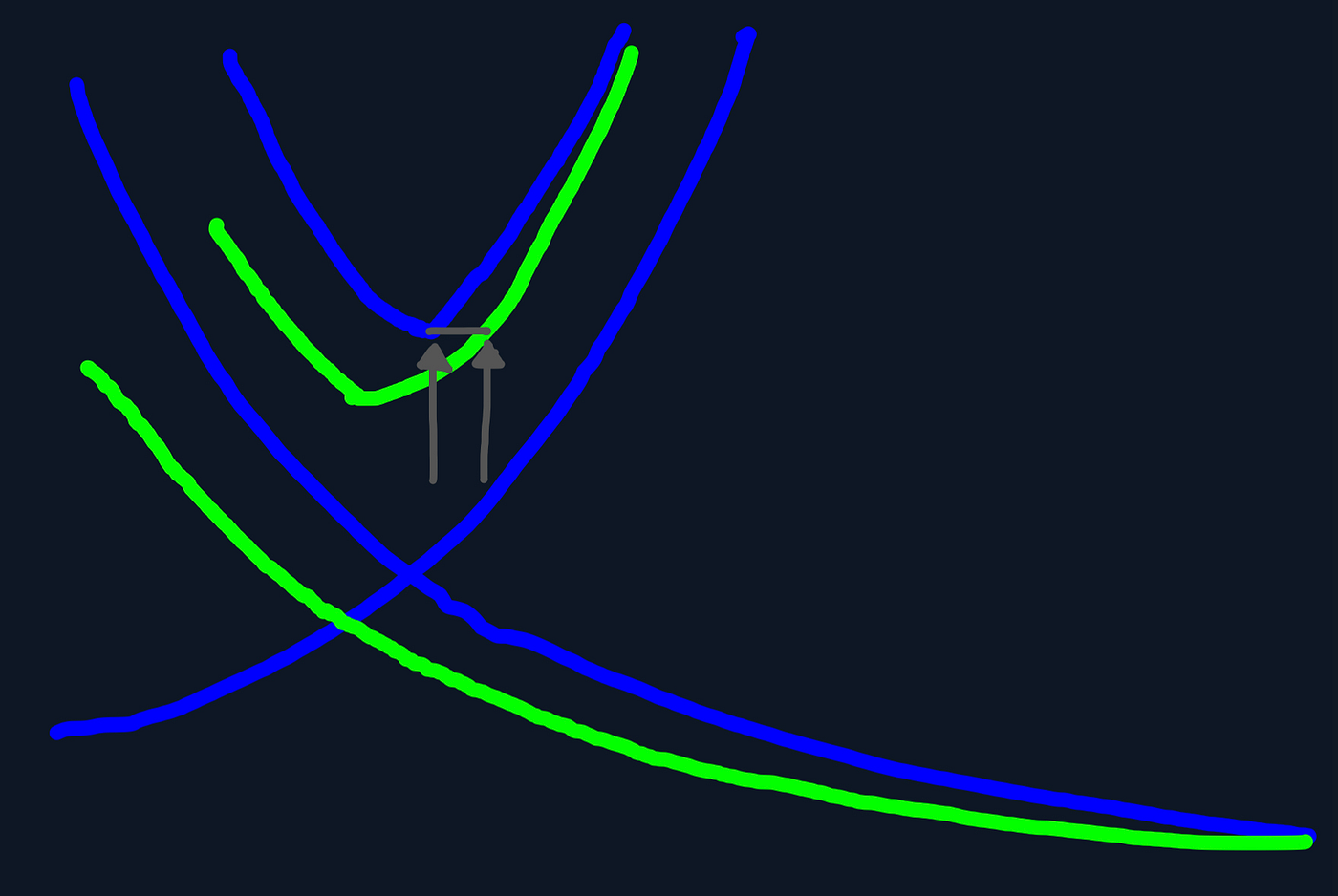
Vn modified from Fly Onspeed Organization RV-4 highlighted Vn; note curves are AOAs fanning from zero-zero
To be blunt here, the specifics above are DMMS-AOA but the intent is analogy for getting the idea sets of good practice as opposed to one best practice.
Having said this, questions still linger about “constant AOA turns.” They are exactly as named, fly the turn at constant AOA meaning you allow small speed increases during the turn.
To fly AOA turns, let the AOA trim setting stay constant. Don’t add back stick (or yoke) to your turns. Instead let the airframe pick up a few knots speed as it naturally holds the AOA. This could be by letting the nose down letting it “mini-dive” for it, or it could be you adding power so as to control the VVI and hold altitude. Think of this as both similar to slow flight and similar to steep turns. It works in slow flight and should be practiced in slow flight though the action is seen more in steep turns. You’re already accustomed to adding power in the steep turn, now you’re adding power and a little bit more power but with no back stick pressure; don’t pull back on the yoke.
If you do DMMS and constant AOA turns, you may find later you only need constant AOA turns. Combining could be a building block to only needing one, almost as if training wheels to a bicycle.
To be fair, there are problems other than stall that arise while low. For these, I like to carry extra contingency energy. With such, you may still want to observe a DMMS like airplane. I accomplish something similar by holding a lower AOA till abeam point of landing then I work it to on-speed AOA.
With this, I like to recognize that the Fly Onspeed Organization follows a similar philosophy to Dan when Dan created DMMS in that they set a minimum energy floor. The difference is their floor is lower but as they use AOA, they don’t cut into it. Theirs is thirty percent. They take the 1.3 stall of the on-speed AOA and don’t go below it. Onspeed AOA gets treated as an absolute floor. Hence they use on-speed AOA as proxy for Vx and for minimum power required AOAs. Theirs is also aimed specifically at piston propellers; such would not make sense with jets.
An interesting observation from viewing the AOA on the Vn is that for a given speed, margin to stall reduces with load but for a given AOA, we say the margin is constant despite load. This actually isn’t true as margin to stall with a given AOA actually increases with load. This is because the AOAs all start at zero knots zero g and fan out. As they fan, they spread. Though we stick with constant despite this opening as functionally we don’t gain anything recognizing the opening while doing so would complicate our view. What we do notice with this, however, is decreasing speed sensitivity in AOA with increasing speed, but we can see this in other ways. By treating the AOA margin as constant, we also inadvertently add a puny bit of extra stall margin to our AOA v accelerated stall concerns.
Remember that P-H-D? As for AOA flying overall, it is not convoluted. It is not even complicated. Icon with the A5 teaches AOA as normal procedure to would-be sport pilots. Horizontal line is the optimum line for landing. One line. Simple. (Thanks “BY-hj5qh”)

https://www.iconaircraft.com/wp-content/uploads/2024/05/ICA016024-A_POH-A5-ALL-CHAPTERS-ISSUE-A.pdf
Note a technicality here, tractor propellers will increase their AOA with increased prop wash and this will be proportional to the amount of power increase. Craft with off axis propulsion will also have AOA deviations. In the case of the A5, the engine is mounted above cg, so adding power will result in nose down pitch and a faster lower trimmed AOA balance point. Reducing power will shift the A5’s balance point higher slower.

https://www.iconaircraft.com/a5/
We also have gliders using side strings for AOA aka “alpha” just as they use yaw strings for “beta,” that which you usually use a ball to coordinate and eliminate.

https://www.youtube.com/watch?v=4hc98LC--Yc

https://www.youtube.com/watch?v=zx620DiNkSI
Side note: stacking two yaw strings longitudinally makes for more precise yaw awareness. No need for side strings and AOA, just want AOA markers for important values stall, minimum sink, maximum glide.

https://www.youtube.com/watch?v=DkiMDF0bKIg
Consider if we have gliders using AOA, and we have the Icon using AOA, and we have Hornets using AOA, we have now bracketed the spectrum. Everyone else’s perspective is an interpolated one. We are also bracketing technology as we go from strings the Wright brothers used to airframe distributed embedded pressure differential sensors of the B-2 bomber. Yes, the B-2 uses AOA. As did the F-117.
DMMS or AOA? Better DMMS and AOA. Dan knows this. He created a false dichotomy to get ratings. You might call this wily or crafty meaning in this context strategic. Maybe even Machiavelli. These words despite our perceptions of negative context are actually neutral. Intent behind them is what makes them good or bad. Intent here is to generate more awareness of both and that is good.
https://www.goodreads.com/book/show/36236113-be-like-the-fox
With best practice vs good practices, I’ve another few points worth discussing. We tend to seek best practice, yet we learn best through accumulating sets of bad practice. This gets to Twersky and Kahneman and flies in the face of the FAA’s silly instructional concept of “Primacy.” Primacy is bunk. Think about it, let the toddler touch the hot pan. The toddler learns. This wasn’t by doing it right the first time. Of course there is a problem with this in an aviation context; you have to survive in order to learn. Amos Twersky and Daniel Kahneman found Recency and Intensity are what matter most to our recall hence our available set of learned material. Exercise, recency, and intensity are your big three for learning.
They also found what we now call behavioral economics. We are risk avoidant more-so than we are reward seeking. However, we are also particularly bad at recognizing what is risky. Different consequences here, we make “stupid decisions” not because we’re stupid but because we aren’t good at recognizing the risks. At this, risk is not a wholly knowable set. Jordan Ellenberg can help here a little bit with How Not To Be Wrong. Gary Klein’s “pre-mortem” and “double-barreled pre-mortem” also help. Being risk avoidant more than reward seeking means we learn better by acquiring sets of bad practice so as to understand things to avoid. Negative consequences teach us be it experienced or vicarious. This means the FAA has Effect wrong too as negative effect creates better recall than positive.
https://www.goodreads.com/book/show/35631386-the-undoing-project
https://www.goodreads.com/book/show/11468377-thinking-fast-and-slow
Kahneman’s book receives attention in the Aviation Instructor’s Handbook, but the FAA didn’t understand Kahneman. The FAA thinks System One is lazy. System One is always on always going and does the lion share of work. System Two is the lazy system, System Two easily gets distracted, System Two “has a sweet tooth.” The FAA thinks awareness of biases means you can avoid them; Kahneman specifically said such is impossible. The FAA thinks System Two is logical with implication System One is not. System Two is required for reasoning but this is not synonymous with being logical. System Two often makes illogical decisions. It is true System Two is required for calculation, comparison and contrast, optimization. Though it only does such with the options available to it to recall for comparison. Important to realize Kahneman states that awareness of our biases does not help us avoid errant biases within ourselves. The FAA mistakenly assumes these can be educated away. There is slight good news in that we can help others avoid errant biases while others can help us avoid ours. It is this I cover you, you cover me that formed the basis of CRM development. Such is not a sure thing, we’re still susceptible to group think. The first to speak does set an anchor for all others. To help such, Mandela would have the junior most member speak first with subsequent speakers going in reverse seniority order. Time permitting, collecting everyone’s thoughts independently in writing then discussing helps. But remember, our biases evolved through survival selection and as more often than not, they’re correct.
“Primacy — When an error occurs pouring a concrete foundation for a building, undoing and correcting the job becomes much more difficult than doing it right the first time. Primacy in teaching and learning, what is learned first, often creates a strong, almost unshakable impression and underlies the reason an instructor needs to teach correctly the first time.” — Aviation Instructor’s Handbook
https://www.goodreads.com/book/show/18693884-how-not-to-be-wrong
https://podcasts.apple.com/us/podcast/the-thinking-leader/id1569718670?i=1000616585751
https://www.psychologytoday.com/us/blog/seeing-what-others-dont/202507/double-barreled-pre-mortems
Furthermore, you are not a visual learner:
https://www.youtube.com/watch?v=rhgwIhB58PA
Certain subjects, however, better lend themselves to visual learning.
Speaking of things the FAA gets wrong — Lateral Stability. Lateral stability merely means tendency to roll away from side wind. Think of it as rolling to align the load vector to the butt vector. Now, how you get it is correctly described as dihedral though how it works is better discussed with John Denker. The FAA’s teaching is wrong though can be made functional by considering the roll away to be airplane centric not earth centric merely rolling to align load to butt. Once we view it as plane centric, the FAA’s how is still wrong but it is functional. This is ok as all models are wrong while some are useful.
The FAA’s discussion when looking at maneuvering speed versus weight is also wrong. Forces break things, accelerations don’t. Maneuvering speed only decreases with weight when something other than the lifting structure is the critical limiting factor. The lighter you get, however, the more likely something other than lifting structure will be critical. The FAA’s approach to this is ok as we don’t know when something else becomes critical. But their technical errors here are really annoying.
I’m pausing to grab another thread for our airport environment energy discussion. Recently Ed Wischmeyer made a presentation to the upper Midwest’s FAAST weekly Saturday Morning Coffee and Wings. In this presentation he showed that not all our takeoff, departure, arrival, traffic pattern, approach accidents are loss of energy. Roughly a quarter to a third, despite being day visual meteorological conditions (VMC), are spirals. We typically think spiral for inadvertent instrument meteorological conditions (IMC). However, distraction and task saturation, Ed shows, can lead to stick or yoke usage being isolated to roll or pitch but not both. DMMS won’t help against these accidents. AOA, however, will as using AOA techniques means you’re only using this control input for roll. In the presentation, Ed questions if a side stick may aggravate the concern. I don’t think so. I’ve flown the Viper and the Cirrus, it is not an issue. The Viper did have a different issue, however, with lack of movement of the stick. The Cirrus had an issue with the trim as it aligns with the plane fore and aft while your thumb trimming despite you thinking fore and aft actually pulls and pushes slightly to the side, hence trimming pitch typically results in also adding inadvertently bits of aileron trim. Best to trim the pitch then immediately check and correct aileron. Such uncorrected trim could help contribute to spiral tendencies with a task saturated and distracted pilot.
https://www.youtube.com/watch?v=Aod9im8aW0g
Regarding the Viper, I have less than a couple couple hands’ fulls of flights in it and about twenty total hours. I am not a Viper pilot. I’ve merely had exposure. Though I do have a couple bad practices to share from myself, and a story of the very first Viper flight of Viper One, which was event flight zero.
Nearly every time I took off in the Viper, I would find myself climbing with the wings rocking. It would take me a bit to recognize why and resolve it. This resulted simply from trying to hold the stick. Remember the stick has little movement, as initially designed it had no movement, and its control input is not by stick displacement but by sensed pressure force applied.
One time, maybe the fifth or sixth of my Viper events, I found myself in a healthy PIO while coming in to land. This was not your normal PIO entry however. It resulted from my trying to trim for on-speed AOA upon dropping the gear. Hornet habit. Yes, the Viper auto-trims to on-speed AOA for approach to landing. It flies AOA. The pilots fly AOA. As for the old Hornet you either trim yourself or you cheat. To cheat, you engage the auto-throttle and engage (barometric altitude) BARO Hold with the autopilot while flying downwind. Give it a few seconds and paddle off the autopilot, it will be trimmed to the on-speed AOA. Note while up and away, the Hornet auto-trims but generally it does so to g force not AOA. It only goes to AOA if flaps are half or full or if the AOA gets high. You can trim to adjust the g baseline to which it will hold else it seeks 1 g. Naval Aviators fly constant AOA through their pattern through touchdown and even maintain it through touch-and-go, immediate rejected landing (landings rejected well after touchdown will have slowed and thus resemble takeoffs), as well as in a “bolter” when the hook fails to catch a wire on shipboard landing attempt. My Viper flight was a case of negative transference as I had reverted to Hornet habit having not flown the Viper for a long period of time and for not having many total Viper flights and for flying multiple events in other normally trimming planes between these Viper flights. The jet was being over-trimmed as both it tried to trim and I tried to trim and being over-trimmed in the subsequent corrections. Letting go of the stick and letting it settle was the answer. Took me an excessive up, an excessive down, and another excessive up and yet another cycle of down and up before I got to letting go. I never trimmed a Viper while looking to land again, but I had not trimmed the first few flights either. So much for Primacy. I did it right the first Viper flight. Intensity and Recency rule. This one was sufficiently intense.
As for the YF-16 first flight, if you watch it, you will see some serious pilot induced oscillation (PIO). Except I don’t believe these to be PIO, rather I see it as system induced oscillation. You will also note the pilot initially sought to abort but due to a different error in the jet, it was still accelerating as the jet merely reduced power to flight idle not ground idle. Hence the pilot “rejected the landing” of the abort as it was not slowing rather it was getting faster. There are some who claim this incident shows even the mighty Viper fell victim to being insufficiently powered at high AOA on the severe back side of the power curve. Such is false, it was neither at high AOA nor was it under powered. It was also the technology demonstrator meaning it was lighter than a production jet of a jet that has a better than one-to-one thrust to weight ratio. As for “high AOA,” when it comes to the Viper and the Hornet, what is high is relative. What others consider high they see as medium or even low. The problem was the sensitivity of the side stick was too much and the stick itself was stationary unmoving during control input.
https://www.youtube.com/watch?v=qAp4RtGKbHE
Regarding bad practices, we have truly a best practice in sharing our “so there I was” and “true confessions” stories. We help others learn with these and grow everyone’s known set of bad practices. “Pro-tips” and “flight insights” have a place though more learning occurs sharing the negative. Here are a couple of mine:
https://medium.com/@jamesmcclaranallen/true-confession-respect-the-helicopter-9aa794ce82a4
Speaking of pro-tips, I’d like to share one from Sean Brodeur of Mike Goulian Aviation. This one speaks to a value of AOA flying though not the full set of values to such. While Sean’s name is on it, he was the one to publish it, Mike Goulian himself actually wrote the paragraphs of significance.
As another aside, and this one is going to bring controversy, Ed has studied stabilized approaches extensively. I myself have looked into this subject. My conclusion is the approach and landing accident reduction (ALAR) task force prescribed criteria are bunk. All you need, especially in small craft, is to remember “fast is slow, slow is smooth, and smooth is fast” as well as “don’t be a jerk and jolt it.” You may need to look up ‘jerk’ and ‘jolt.’ (If you fly DMMS to final, you don’t meet ALAR defined stabilized approach criteria. I’m ok with this. Contingency energy is good.)
https://medium.com/@jamesmcclaranallen/stabilized-approach-shenanigans-e4ba656b9a85
https://www.youtube.com/watch?v=glBn5NDOHPg
Sets of practices goes to decision making which I think an area worth several conversations. Note I did not use Aeronautical Decision Making (ADM). This is because I think ADM is bunk. It doesn’t exist. Rather instead there is Decision Making applied in an Aeronautical context (DM-A). This is good for us as it means we can study decision making outside of aviation. DM crosses all fields and all domains with no negative transference and no losses. Any difficulties are merely in understanding context of other fields. This also means DM you learn for aviation is readily applicable to any other endeavor to which you apply yourself. Good for us as pilots spend a lot of time trying to improve decision making.
DM and focus to it takes me to another tangent, while we like scenario based training and training incorporating DM, we really need to recognize rote and drill are not lesser things. They are foundational. They are the base. For instruction consider them as such not as something of less value. View the Instructor’s Handbook graphic as a structural one:

With this tangent, I like to consider both Richard Rumelt with Good Strategy, Bad Strategy and Jeff Sutherland with his Scrum book including his “Shu Ha Ri” anecdote.
“A man I know only as PJ lives on the East Cape of Baja California, about thirty miles north of San Jose del Cabo, on the Sea of Cortez. He is now a surfer and fisherman, but PJ was once a helicopter pilot, first in Vietnam, and then in rescue work. The land in Baja California is unspoiled by shopping malls, industry, paved highways, or fences. Sitting on a hilltop in the warm winter we could see the gray whales jump and hear their tails slap on the water. Making conversation, I offered that ‘helicopters should be safer than airplanes. If the engine fails, you can autorotate to the ground. It’s like having a parachute.‘ PJ snorted. ‘If your engine fails you have to pull the collective all the way down, get off the left pedal and hit the right pedal hard to get some torque. You have about one second to do this before you are dropping too fast.’ He paused and then added, ‘You can do it, but you better not have to think about it.’ ‘So, everything has to be automatic?’ I asked. ‘Not all,’ he replied. ‘When an engine fails you have a lot to work out. You have to concentrate on where you are going to land and on maintaining a smooth sliding path down to the flare. That stuff takes a lot of concentration. But the basic act of controlling the helicopter, yes, that has to be automatic. You can’t concentrate on the crisis if flying isn’t automatic.’ PJ opened another Corona and then expanded on his point. ‘To fly a helicopter you’ve got to constantly coordinate the controls: the collective, the cyclic, and the pedals, not to mention the throttle. It is not easy to learn, but you’ve got to get on top of it. You’ve got to make it automatic if you’re going to do more than just take off and land. After you can fly, then you can learn to fly at night — but not before! After you can fly at night with ease, maybe then you’re ready to learn to fly in formation, and then in combat.’ As he spoke, PJ spread his fingers, overlapped his thumbs, then swooped this miniature formation around to illustrate his point. ‘Master all that — make it automatic — and you can begin to think about landing on a mountain in high wind in the late evening, or landing on a rolling, pitching deck of a ship at sea.’”
https://www.goodreads.com/book/show/11721966-good-strategy-bad-strategy
“In the martial arts you learn a concept called Shu Ha Ri, which points to different levels of mastery. In the Shu state you know all the rules and the forms. You repeat them, like the steps in a dance, so your body absorbs them. You don’t deviate at all. In the Ha state, once you’ve mastered the forms, you can make innovations. Put an extra swing in your step down the dance floor. In the Ri state you’re able to discard the forms, you’ve truly mastered the practice, and you’re able to be creative in an unhindered way, because the knowledge of the meaning of aikido or the tango is so deeply embedded in you, your every step expresses its essence.”
https://www.goodreads.com/book/show/19288230-scrum
Regarding Richard Rumelt and his book, he has another wonderful story within it regarding the Moon Shot highlighting that such was not stretching for the extraordinary but rather based in predetermined feasibility during hard-nosed Cold War realism. Having said this, I do warn that he credits Jack Welch type thinking too much hence he needs to be balanced with both Simon Sinek’s Infinite Game and John Lewis Gaddis’ On Grand Strategy. I call out Dan Ward with Lift as his is the history of flight research and development prior to the Wright brothers. Such shows both learning from failure thus again rejecting primacy, and it shows flight really was achieved in the face of hard nosed realism and awareness to feasibility despite the impressions of seeking grandeur we may have both to flight and to the moon shot. Feasibility is a crucial piece in Rumelt, Sutherland, and Gaddis. Feasibility should be a focal point to our decision making. As for AOA, AOA flying is readily feasible.
https://www.goodreads.com/book/show/38390751-the-infinite-game
https://www.goodreads.com/book/show/35746278-on-grand-strategy
https://www.goodreads.com/book/show/51211249-lift
James Stavridis’ Sailing True North and To Risk It All both tie with these references as does Rupert Smith’s Utility of Force.
https://www.goodreads.com/book/show/44028643-sailing-true-north
https://www.goodreads.com/en/book/show/58885774-to-risk-it-all
https://www.goodreads.com/book/show/211972.The_Utility_of_Force
As I’ve mentioned Simon Sinek, his other works Start with Why and Leaders Eat Last are also worth the effort. I find Sinek is a bit of a node or nexus between Dale Carnegie of How to Win Friends and Influence People and John Boyd. More on Boyd in a bit. He’s going to close our circle.
https://www.goodreads.com/book/show/7108725-start-with-why
This goes to the importance of intent inside “Mission Command.” (For instructors at zero knots one g during ground instruction and briefs, we really should start with the Why of things then the What and How.) Mission Command is in contrast to “Command-in-Detail.” Mission Command seeks to distribute and delegate down execution decision making authority as low as possible. Don’t tell them ‘How,’ tell them ‘Why’ and let them figure it out. Such enables initiative and creates more rapid action. Tied with Mission Command is the Navy’s “Command by Negation” in which lower echelons broadcast to adjacent and higher what they are seeing and what they are going to do, then they go do it. No waiting for a ‘yes,’ only stopping if a ‘no’ comes back down.
With this we could look at restrictive prohibitive approaches versus authorizing approval approaches. The latter stymies initiative and creativity. The latter stilts adaptability and flexibility. The latter ingrains delay and stagnation. The latter also takes more to write. It tells you what you can do and tends to tell you how to do it. The former tells you what not to do leaving an open set for you to decide what best matches your situation. In Destruction and Creation, John Boyd told us delay and stagnation are tantamount to death.
“I have a hypothesis about such attachment stemming from the FAA having stemmed from the Air Force (first director was an AF general) which stemmed from the Army which was and is vastly different than the sea services… Army and more-so AF play lip service to Mission Command while Navy, Marines, Coast Guard epitomized such before the concept was even named and recognized; with that, FAA, AF, Army are low trust organizations with prescriptive rulesets (which automatically prohibit that not specifically addressed) as opposed to the sea services proscriptive rulesets which leave an open set of possibilities only inhibiting that specifically restricted. Prohibitive rules favor initiative while prescriptive drive ‘mother-may-I.’ There is more to how such evolved and it relates to the admiralty not regularly sailing with the ships yet before telegraph and rail, generals always went with the army, and that the lowest divisible unit in the army is a soldier but in a navy it is a ship. Directive orders to untrusted soldiers versus intent and generalized more open orders to ships that would be out of touch for long periods of time. Sailors may have been just as untrusted, but they weren’t individual actors. Circumstance prevented prescriptive rules. Most important part of an order in Mission Command is Intent.”
https://vansairforce.net/threads/close-call-in-the-pattern-cirrus-on-straight-in-approach.237137/
Admittedly, over two decades of Army centric Joint Force operations, the Naval Services have been polluted and have been shifting toward the authorizing approval insanity.
https://www.goodreads.com/book/show/16144853-leaders-eat-last
Vice Admiral Donegan made a good point regarding rest, who should have more rest? Leaders. This sounds counter to leaders eat last, but, despite possibility of a “strategic corporal” instances, consequences of leaders’ errors tend to carry more consequences. You want rested leaders.
https://www.goodreads.com/book/show/4865.How_to_Win_Friends_Influence_People
As we’ve been differentiating between best practice and good practice, this starts to get us toward making distinction between Complicated and Complex. Complicated things are deterministic things. In Complexity, however, results vary though patterns can help us. With this, I highly recommend the Scott Page Complexity lectures. I also recommend Dave Snowden’s Cynefin. More on his in a bit.
https://www.thegreatcoursesplus.com/understanding-complexity
Recognizing complexity, Sidney Dekker and Todd Conklin come to the fore. They both have made significant works in safety and this generally has to do with decision making. Conklin has written a few books though he is also host of The Pre-Accident Investigation podcast. One of many episodes that I really like discusses Swiss Cheese and how we all actually misunderstood James Reason’s analogy. It also happens to pair really well with an episode from a British produced Command and Control podcast regarding tight coupling and errantly seeking synchronization. I like to highlight the Command and Control podcast as they focus upon Mission Command which John Boyd really brought to modern “western” usage (to include Japan, South Korea, Singapore, Australia, New Zealand, and NATO). Study of Command and Control provides an excellent study for both safety and DM.
https://goodreads.com/book/show/376964.The_Field_Guide_to_Understanding_Human_Error
https://podcasts.apple.com/us/podcast/preaccident-investigation-podcast/id962990192
https://podcasts.apple.com/us/podcast/command-and-control/id1689408449
https://podcasts.apple.com/us/podcast/preaccident-investigation-podcast/id962990192?i=1000702329202
https://podcasts.apple.com/us/podcast/command-and-control/id1689408449?i=1000670357181
The colloquial understanding of Swiss cheese is one of energy. It has value for us. Yet Reason’s initial formulation of Swiss cheese is one of ecology. It too has value for us. Consider redundancy and mitigation can introduce alternate means of failure and risk. As example, consider a multi-engine plane offers redundancy for island hopping though introduces asymmetry concerns and also yields twice the opportunity for failures when flying around mountains. While the mountains may seem similar to island hopping, due to density altitude, they’re not the same, lose an engine and all you have is an extended glide not means to continue to a suitable field. A barrier creates a new threat. You might even call the second engine example of a tighter coupling.
“… consider Kobayashi Maru. Horns of a dilemma (while seeking a third way is admirable, not all have such and of those that do, not all have time for you to find such). Threats don’t occur in isolation while you may need to work for least bad outcomes as opposed to good. Consider the game Bagh-Chal aka Tigers and Goats. While first learning to play, it seems the Goats never win. It is an asymmetrical game. But once you learn it, you realize Goats have asymmetrical advantage, as Tiger you can play perfectly being error free and you will lose except should the Goats make a mistake. Threats can bite without error… Adding more barriers actually can cause more holes to be torn into the cheese due to friction in layers (or chunking of cheese). There is a goldilocks zone for barriers, think about your drag curve. In this, the minimum drag is still not zero… TEM seeks to ‘break the chain.’ The problem is we don’t have chains, we wear chain mail. Break one chain and you put tension upon some, slack upon others. Appropriate tension and slack have goldilocks zones too… On a recent thread at Van’s Air Force, I mentioned ‘if you have a procedure that commonly gets goofed up and you try to educate and correct those gooning it away, yet it still regularly gets fouled, perhaps you should try something different. Procedures should account for the people not the other way around… Consider something different, something more adapted and more accommodating to natural human errors and blind spots, something with more margin for making fixes when issues arise. The problem isn’t with the people, it is with the procedure. Sometimes you need to try differently as opposed to trying to do better. Procedure should fit people. Forcing people to fit procedure is a failing recipe.’ … I came to a realization put more succinctly as ‘often we fail to follow rules not because we think we’re better than them but rather because we’re too incompetent for them.’ … ‘Edgar Morin has argued for an idea he calls the ‘ecology of action’: As soon as a person begins any action whatsoever, the action starts to escape from his intentions. It enters into a sphere of interactions and is finally grasped by the environment in a way that may be contrary to the initial intention. Ecology of action means taking into account the complexity it posits, meaning random incidents, chance, initiative, decision, the unexpected, the unforeseen, and awareness of deviations and transformations.’ … Reason’s Cheese model getting flipped in its understanding is an example of exactly this ecology of action escape happening.”
https://www.linkedin.com/pulse/some-thoughts-threat-and-error-management-training-green-fraes-aktle
https://medium.com/@jamesmcclaranallen/turds-eating-manure-tem-c6337af9574c
Dave Snowden with Cynefin speaks and writes of five domains which are really four with two being sub-domains. These are Clear and Complicated which are subdomains of Ordered aka cause-and-effect deterministic, Complex, Chaos, and Confused or confounded which really isn’t a domain but a place where you are uncertain to which domain you are actually inside. If you’re unaware that you are unaware, you are confused. Confused means you are in one domain but think you’re in another and act as if you are in that other. If, however, you realize you are unaware, then you are “Aporetic” and, assuming the luxury of time, can observe determining later where you are. If Aporetic but lacking time, then best to presume Complex. These are important as how you should function is domain dependent. In the Clear, previously named Obvious, we seek best practice. In the Complicated we are in the land of expertise while good practices are the means. In Complexity expertise can’t exist (though you can lean on cross-functional teams of differing expertise developed in Complication), trial and error dampen the bad amplify the good Emergence is the name of the game. In Chaos, Act! You don’t know if it will be good or bad, but delay is worse. In Chaos, channel your inner Patton.
A couple lesser known names worthy of reading here are Ron Butcher and Houda Boulahbel. Ron worked in safety for decades though wasn’t an academic. He understands complexity and the limit of rules; he preaches “survival first, survival over safety.” Houda was a PhD cancer researcher (a real PhD!) who got tired of the tyranny of seeking singular solutions. She introduces us to an adaptation of ‘Ashby’s Law’ that Snowden also often cites. “Only variety can defeat variety” adapted from “if a certain quantity of disturbance is prevented by a regulator from reaching some essential variables, then that regulator must be capable of exerting at least that quantity of selection.” This is to say that you must have at least as many controls available as you do possible effects or outcomes, otherwise you cannot control the system nor can you predict the outcome. As having many controls is not feasible, total control and ability to predict are impossible. You can influence but you cannot determine. Hers reminds me of The Atlantic’s Pandemic Death Spiral with its reference to serial monogamy of solutions seeking. In Complexity, Snowden, Boulahbel, and The Atlantic all suggest multiple parallel efforts.
https://houdaboulahbel.medium.com/looking-for-the-missing-pieces-in-the-cancer-puzzle-c943393f332
Thinking on Ashby makes me think of Clausewitz contemporary Henri Jomini, “The means were not fortunate; for war and aggression are inappropriate measures for arresting an evil which lies wholly in the human passions, excited in a temporary paroxysm, of less duration as it is the more violent. Time is the true remedy for all bad passions and for all anarchical doctrines. A civilized nation may bear the yoke of a factious and unrestrained multitude for a short interval; but these storms soon pass away, and reason resumes her sway. To attempt to restrain such a mob by a foreign force is to attempt to restrain the explosion of a mine when the powder has already been ignited: it is far better to await the explosion and afterward fill up the crater than to try to prevent it and to perish in the attempt.” — also a good way to think about PIO.
My own The Contrarian Aviator Sometimes Turns Right delves into Cynefin in an aviation context. I initially wrote it in Daily Kos though transferred it to Medium. I recommend reading the Medium piece as it has been tweaked and has better pictures though recommend the comments section of the Daily Kos. Note in these comments a point with the radar story — we don’t fail to follow rules because we think we’re better than them. We fail to follow rules because we lack capacity to follow them. The biggest lack in capacity comes from rules themselves conflicting and/or circumstance and context putting us in situation such that we cannot adhere to the rules.
https://www.dailykos.com/stories/2022/6/16/2104524/-The-Contrarian-Aviator-Sometimes-Turns-Right
https://medium.com/@jamesmcclaranallen/the-contrarian-aviator-sometimes-turns-right-89da7d61d132
Gary Wong worked with the British Airline Pilots Association (BALPA) seeking to integrate Cynefin into their approaches to safety. Similarly, there is an excellent article produced by some flight test engineers using an earlier model of Cynefin. These tie to ICAO work in document 10151 Human Performance.
https://www.youtube.com/playlist?list=PLfT8Esoh7ZYdAf-hfoFMhbBpFBPxNk_Mf

In the original video with the “coffeehouse debate,” Dan asked in a segment prior to the debate, how could AOPA be contributing to safety if they don’t know what is working. I believe Michael Lewis can help with that while looking at the Santa Barbara case studies in The Premonition, “Charity never would know which of the measures she took had controlled the disease; she knew only that all of them together had. To her, all that really mattered was that the disease had been contained. The job of the public-health officer — or at least her job as the public-health officer — was a series of intense firefights. There was no standard operating procedure for many of the situations in which she found herself: usually, they were sufficiently different from anything that had ever before happened. If she waited until she had enough evidence to publish in a scientific journal, the battle would be over, and she’d have lost. Kids would lose limbs, or die. The decisions she was forced to make were less like, say, those made by a card counter at a blackjack table, and more like the ones made by a platoon leader in combat. She never had all the data she wanted or needed when making her decisions… In theory, the CDC sat atop the system of infectious-disease management in the United States. In practice, the system had configured itself to foist the political risk onto a character who had no social power. It required a local health officer to take the risk and responsibility, as no one else wanted to. Charity could see that the CDC’s strategy was politically shrewd. People were far less likely to blame a health officer for what she didn’t do than what she did. Sins of commission got you fired. Sins of omission you could get away with, but they left people dead. The health officer’s job was to choose, all by herself, the direction in which to err: do too much, or too little?”
https://www.goodreads.com/book/show/56790170-the-premonition
The Premonition gets it all, Complexity, Cascade, DM in the absence of determinism. The Fort Dix story within is also particularly worthwhile.
This is part of the ecology approach; we don’t know all the interactions and likely won’t be able to know them. Now, there is a “combined arms” analogy applicable here but I don’t yet fully have a grasp of it. So I mention it but don’t yet discuss it.
With this I like to consider the Dao story in the Cynefin Weaving Sense-Making anthology:
“Gun, to devise a system for controlling the floods. Gun spent a decade constructing an elaborate system of dams along the river. Gun’s approach was described as Confucian, emphasizing control, governance and order. However, all the barriers failed as the current of the Yellow River refused to be controlled. Gun’s son, Yu the Great, was assigned to take over the task when he became an adult and adopted a markedly different approach. Instead of dams which seek to control the flow of water by applying a rigid boundary, Yu decided to ‘follow the water as his master… and followed the way of the water.’ He worked with agriculture masters, slept, and ate with common folk and sought to understand the context and landscape. Yu worked with them to construct an intricate system of irrigation canals. This system consisted of many dikes that ran parallel to the Yellow River and relieved flood water into agricultural fields. The overflow fed rice paddies and aquaculture. Working with the natural energy of the river’s current, he solved a flooding problem and created a surplus!”
Note Dao is oppositional to Confucian order while both Confucius and Stoic thought actually serve to preserve the current power establishment seeking to get you to accept and tolerate oppression in the extreme and willful error at the least. They also violate Boyd’s warning to avoid stasis.
This invites a look to the Hindu as resonant with Destruction and Creation, adapted in my own Laugh Right:
- Punching down destroys — Shiva
- Punching up creates — Brahma
- But it also preserves — Vishnu
Brahma — Punches up.
- The function of laughter, according to Bergson, is to assimilate the individual into society such that the risible vagaries of antisocial behavior become the centre of attention. This social function of laughter thus becomes one of discipline and correction: ‘always rather humiliating for the one against whom it is directed, laughter is, really and truly, a kind of social “ragging”.’
- … but it will be argued that the burst from nothing is equally a burst of creation, a quasi-secular sovereign moment that has ethico-political ramifications at the ontological level. Laughter bursts out in surprise and propels being to another place, even or perhaps especially, towards a future.
Vishnu — Punches up & down; associated with Conservatives
- … when nothing else from today has a future, our laughter is the one thing that does!’ (F Nietzsche, Beyond Good and Evil)
- Goodrich brings our attention to the distinction between two types of satire. The first is Horatian satire, a Roman form that ultimately seeks to maintain the established order through ‘deriding poor morals, religious lapses, foreign borrowings, linguistic error, bad taste, and the vices and follies of their day.’
Shiva — Punches down yet associated with Liberals
- Laughter is in a sense antithetical to law and this makes it ideal as a means of legal critique.
- Without doubt the most comprehensive and incisive analysis of the use of laughter in legal critique is Peter Goodrich’s ‘Satirical Legal Studies’ … What he ends up with he calls Satirical Legal Studies, defined as ‘the humorous pillorying of the pretensions of law and lawyers.’ While associating Satirical Legal Studies closely to leftist critiques of law, he also stresses that it extends across a much broader field of reference, from the philosophers of Ancient Greece to the modern texts of the most sombre doctrinal law. As a genre, Satirical Legal Studies is characterized by personal attacks, the desire for something new (either renewal of an old order or its overturning), derision through ridicule (puns and the like) and, finally, criticism…
- Horatian satire crosses the boundaries so as to eventually bring one back behind them. The second is Menippean satire, an Ancient Greek form inspired by the Cynic Menippus of Gadara. As one would expect, Menippean satire is much more subversive and dangerous. It shoots out political invective, ridicules, and deflates social hierarchies, all so as to change the existing order and to usher in the new…
- One of the earliest proponents of this idea was Kant who, in no less a text than his Critique of Judgement, formulates it thus: ‘Laughter is an affect that arises if a tense expectation is transformed into nothing.’
Such is seen with Brigadier Shimon Naveh of Israel, “you have to destroy in order to create.” Such is baked in due to the Laws of Thermodynamics.

Bill Watterson, Calvin and Hobbes
https://www.youtube.com/watch?v=NLaCV7fMDIg
Similarly, “Impermanence is a major principle in Buddhism”
https://www.dailykos.com/stories/2024/12/10/2290617/-Impermanence

Bill Watterson, Calvin and Hobbes
Snowden has also produced a form of Sense-Making which is excellent and has a thought process “Estuaries.” In Estuaries, we have water flows, in planning and action, we have energy flows. Estuaries takes time to complete versus effort to complete. If both be high, feasibility is low. Both low are your “low hanging fruit.” With one high and the other low, now you’re starting to pick and choose. Yet Estuaries isn’t just for positive decision making, it also helps with risk. Remember risk is the combination of likelihood and severity of consequence. Likelihood for mechanical systems can be calculated by engineers with component, part, system probabilities of failures. But most our stuff is rough order of magnitude guessing. Time versus energy (effort) for an event to occur help us better see likelihood. Estuaries helps focus effort toward feasible tasks while also focusing effort to better placed defenses.
When it comes to making decisions, we don’t like spending energy aka effort. Something has to trip us to apply effort and expend energy. This includes investigating risk.
Snowden also looks at risk propagating in Pareto not Normal distributions. This is because normal distributions linked such that the current is dependent on the previous through several iterations yield Pareto. Degradation and cascade?
See the circle closing?
John Boyd created Energy-Maneuverability theory. Snowden’s works really resonate with Boyd’s. To learn more about Boyd, see Robert Coram and T. Hammond. Hal Sundt’s Warplane also touches here.
https://www.goodreads.com/book/show/38840.Boyd
https://www.goodreads.com/book/show/572546.The_Mind_of_War
https://www.goodreads.com/book/show/79743104-warplane
Boyd wrote The Aerial Attack Survey. It was his first major work. He later followed this up with Energy-Maneuverability which we’ll close in a minute. He discovered the OODA loop — Observe, Orient, Decide, Act. We make all our actions via OODA whether we are witting of such or not. Back to Kahneman System One, these are unwitting OODA loops. System Two can go either way, you may know about OODA but you don’t necessarily consciously apply it to your reasoning as deliberate OODA. You may do so, however, and such is the basis of not only our military planning but also our “ADM.” Operational Risk Management (ORM), you’re running OODA loops. Crew Resource Management (CRM), you’re integrating Twersky/Kahneman… and OODA loops. “Anticipate-Verify-Act,” that is OODA. “Perceive-Process-Perform” is OODA. Even “Anticipate-Recognize-Recover” of Threat Error Management (TEM) is OODA. Granted, they’re all gross oversimplifications of OODA.
https://www.code7700.com/pdfs/john_boyd/aerial-attack-study-1964_john_boyd.pdf
https://www.flyonspeed.org/_files/ugd/3c039a_86c0e7a150fa434889684860b7e74b32.pdf
https://www.coljohnboyd.com/static/documents/1976-09-03Boyd_John_RDestruction_and_Creation.pdf

The FAA Risk Management Handbook also has in recent years included “Naturalistic Decision Making.” Such weaves Gary Klein’s work with Kahneman System One and unwitting OODA. Klein showed we are “first fit pattern matchers” that don’t work for optimum solutions rather take the first option we consider that we deem feasible. You can see such as the top route of the OODA. But such needs to be trained, back to that rote, drill, and subsequent experience development both broadening and deepening. Shu Ha Ri.
Naturalistic DM shows Rote can skip straight to Correlate. Consider how you can find yourself in a situation to which you cannot articulate what you need to do and why but you just know it is what needs to be done. Or, even further, you cannot express what needs to be done, you simply do it. In the Klein podcast, note his discussion regarding firefighters perception of not making decisions when they’re making decisions. Yes, they have Understanding and Application to many decisions, but the ones happening “automatically,” these are Rote straight to Correlation. Understanding and Application are System Two functions. Rote seeks to train and ingrain System One while Correlation happens in both One and Two. System One doesn’t understand things. System One presumes things. Rote helps build better cache of experience for better presumptions. This is especially true when the drills for rote get tweaked so as to vary conditions. Veritasium, one of my favorite channels, has an episode that plays here:
https://www.youtube.com/watch?v=5eW6Eagr9XA
Though to be fair, I have crapped on Tetlock:
https://www.dailykos.com/stories/2020/10/13/1986056/-SuperForecasting-A-Steaming-Pile-of-Shit
Everyone should read Destruction and Creation. And Boyd’s Conceptual Spiral. With them you realize we are inside our own systems and therefore cannot see whole of system; we cannot accurately and precisely predict because we don’t know what is in the system. Full systems are unknowable. We are blinded by sight horizons. This is Sidney Dekker looking at localized rationality. When investigating, ask “Why did what they did make sense to them to do at the time they did it?” Realize “work as described does not match work as done which doesn’t match work as reported and this fails to match work as assessed.” This also means we cannot drive our failure to manage energy related accident rate to zero, such is a Sisyphean task.

Field Guide to Understanding Human Error, Sidney Dekker

Field Guide to Understanding Human Error, Sidney Dekker
With this I draw attention to Madeline Young who made a presentation to the New England FAASTs regarding DM. I believe you can find it on Social Flight. It is really really worth it. I’d link it but I’m not on Social Flight as I find the app and the site themselves too noisy. If you’re on it, however, go find hers.
I’m pausing here a moment to tell about my introduction to Dan Gryder. It started one warm late morning when a new client of mine landed in a Bristell. He was there to get Cirrus transition training and to receive Instrument Instruction. I went to meet him at his Bristell and was happy to see he had an AOA indication. He also had a box with switches that served as his checklist (a rather good Japanese technique). Though I was curious as had a sticker tape at the top of his dash “DMMS = XX,” sorry, I don’t remember what the digits for XX actually are. So I asked and he told me of Dan Gryder. In the next day or two, I looked up Dan’s YouTube. One of the first videos I found involved a crash at Oshkosh. This crash had been receiving a lot of blame the pilot attention but Dan put the onus on the FAA. This hooked me as I am a big fan of The Atlantic’s article The Deadly Myth Human Error Causes Most Car Crashes. Dan, and the Atlantic, and Dekker, Conklin, and Young all resonate here. Other things that play with this are cascades which can be seen in Wired’s The West’s Infernos and Google’s Cascading Failures, as well as in The Expanse series both books and streaming. They resonate with the role of luck in Veritasium’s work. But, while human error may not be the real fault, Veritasium makes a good point that you should approach your flying as if your human error is to blame.
https://www.wired.com/story/west-coast-california-wildfire-infernos/
https://sre.google/sre-book/addressing-cascading-failures/
https://www.goodreads.com/series/281756-the-expanse-chronological
https://www.imdb.com/title/tt3230854
https://www.youtube.com/watch?v=3LopI4YeC4I
Veritasium has a more recent and adjacent video worthwhile
https://www.youtube.com/watch?v=HBluLfX2F_k
Boyd further gave us A Discourse on Winning and Losing which contains things like Patterns of Conflict. But here now we are concerned with Energy-Maneuverability. Boyd did not bring energy to aviation, rather he brought maneuverability as concern for energy. We know this as Boyd was preceded by Edward Rutowski who looked not at optimum rate of climb but rather optimum energy rate climb.
With this, given a supersonic interceptor, can you fly higher than absolute ceiling? I’ll give you a paragraph and more to think.
https://www.airuniversity.af.edu/Portals/10/AUPress/Books/B_0151_Boyd_Discourse_Winning_Losing.PDF
Wolfgang Langewiesche’s Stick and Rudder discussed “the law of the roller coaster,” and this is straight up energy management. He also discussed managing AOA despite not seeing indication of AOA as how to do it. As for the Wrights, you better believe they were well aware of energy and managing it. The Wrights were well aware of AOA too using a string in the 1903 flyer while later making an alternate AOA instrument.
https://goodreads.com/book/show/680115.Stick_and_Rudder
Boyd also gave us “fast transients.” Fast transients means being capable to rapidly lose and rapidly gain total mechanical energy. Such is a meeting of Energy-Maneuverability and OODA. With such, a pilot can rapidly change the conditions presented to an adversary. Such renders the opponent’s observations and orientation obsolete. This is the meaning of “get into one’s loop.” Such has expanded to cover most competitive endeavors.
Many misinterpret OODA in competitive scenes as “be faster through your OODA.” This really isn’t so. “Get inside your opponent’s OODA” can mean to disrupt theirs, it need not be you running your own tighter hence fit inside such. While we may not be looking at a competitive sense here in safety, we still can have our OODA disrupted. Think about the distraction that interrupts your flow, the checklist halted, the insert checks for maintenance check, the odd abnormal request outside expectations.
https://thestrategybridge.org/the-bridge/2020/3/17/the-ooda-loop-and-the-half-beat
OODA nest. This is to say, a larger longer OODA may contain one or more smaller OODA within it and these may contain further smaller faster OODA within them. This creates an issue as the smaller should inform the larger as part of the larger observations. But the larger can drive orientation of the smaller. Consider US Cold War policy. Such was a large single iteration OODA based on Kennan’s Long Telegram from Moscow, yet several layers of OODA nested underneath. It is such driven orientation that makes for “mission mindset” or “get-it-done” risk blind action aka “get-home-itis.”
OODA have another issue in that they are susceptible to high frequency noise. They’re also susceptible to signal aliasing. This is to say that should a subsequent OODA’s observations occur before the prior OODA’s actions have had time for effects to propagate, it will appear as if the prior OODA had not occurred at all; such drives pilot induced oscillation.
https://www.dailykos.com/stories/2020/9/1/1974278/-Wait-For-Feedback-OODA
An interesting thought regarding OODA is their interrelationship with fast transients and energy-maneuverability. While all three work in aerial combat, so too do they in all forms of combat. They do in all competitive adventures. And they all can be used as approaches to safety. Something else we can derive from combat is the notion that the penultimate mover gains angular or positional advantage while the ultimate mover sets the flow. I like to simplify this to be the first mover gains positional advantage while the second mover sets flow. How would this apply for safety? We increase our advantage positionally when we consider hazards left of the bang. The bang itself puts us to a disadvantage though right of the bang our decisions determine follow-on flow.
John Boyd was a voracious reader. He definitely knew of Carnegie. Likely too he read Barbara Tuchman, Norm Dixon, J. William Fulbright. All of these show us deterioration, cascade, and maybe, just maybe, “plan the flight, fly the plan” isn’t all it is cracked up to be.
This is not to say don’t plan. Do plan. But realize what planning actually does for you. Planning is like a game of “what if.” You won’t get all the what ifs. But you might get some valuable transference from the what ifs you do. You can help answer known unknowns making them just knowns. For the others, you create options for adapting to when you find their values. While you will not resolve unknowable, you may even catch a few unknown unknowns making them fully known or at least known unknown. Don’t count on getting all of these, you’ll only get ones of a deterministic yet unappreciated nature. And you won’t get all of these. But in group settings there is even more value in planning. With planning you do team building. You establish roles and responsibilities such that you know things you need to do and with whom you can ask should you be unable. You gain insight into what others should do such that if, for whatever unforeseen reason they’re not able to do, you can step up and cover down. Eisenhower, “the plan is nothing, planning is everything.”
Do watch for the unknown knowns. These are the things you should know but don’t. The common traps lie in these. These are the things you may have forgotten or skipped in a rush. These are the things if instructing novices you should emphasize. These are things that should just be known. These are the things that drive Dan Gryder’s Advanced Qualificiation Program (AQP). But realize while they get the common and should generate generally standardized answers, they won’t help and could actually hinder with the unknown unknowns and unknowable. Planning should catch and prevent unknown knowns. Planning also provides common frame of reference, common language, easier communication.
https://www.goodreads.com/book/show/10302.The_March_of_Folly
https://www.goodreads.com/book/show/471077.On_the_Psychology_of_Military_Incompetence
https://www.goodreads.com/book/show/1355548.The_Arrogance_of_Power
While published after Boyd’s time, he certainly would have enjoyed Blackett’s War and likely did study the same operations research outfits of WWII. Such enabled feedbacks of those required for larger scale deliberate OODA run among many persons and not internally within just one person. With this I also give you another piece of mine concerning effectiveness over performance.
https://www.goodreads.com/book/show/15849559-blackett-s-war
Yes, you can get higher than absolute ceiling. That is assuming no one redefines absolute ceiling. What you do is get to a higher energy state than the ceiling and then zoom it up. Such puts you well above where Vx and Vy meet. Though you will settle to this point of absolute ceiling after the fact. But you have to be able to go supersonic to achieve this.
https://www.youtube.com/watch?v=RKmp4SVqHcI
https://www.engineeringpilot.com/post/how-to-climb-and-why
Surprisingly there is a gamer with a YouTube channel that does a good job explaining Energy-Maneuverability:
https://www.youtube.com/watch?v=BmyyTUOfzlI
https://www.youtube.com/watch?v=iBExzLDKWOI
https://www.youtube.com/watch?v=jfu6z8eGZ5E
This brings me to a common point of mine, we really should differentiate zoom from climb and dive from descent. Zooms and dives are energy redistributions with constant total mechanical energy while climbs and descents as well as accelerations and decelerations are changes to total mechanical energy. Turns are accelerations. Turns cost energy, turns are maneuvers, energy-maneuverability. Zooms and dives and accelerations and decelerations alter AOA (and speed), climbs and descents do not. Climbs and descents maintain constant kinetic energy. Accelerations and decelerations alter kinetic energy with constant potential. Turns have two flavors, instantaneous and sustained. Instantaneous get more umpf in the turn but bleed kinetic energy, they’re like zooms. Sustained hold steady kinetic energy with steady rate of turn, they’re like climbs.

Airplane Flying Handbook

US Navy T-45C Goshawk Basic Fighter Maneuvers Flight Training Instruction

https://www.flyonspeed.org/post/applied-aoa
Airspeed tells us our absolute kinetic energy but Angle of Attack tells us our kinetic energy state relative to the point of insufficient kinetic energy. Airspeed falls short as it has no idea where our range of sufficiency lies and as our range of sufficiency changes with conditions. And ultimately decision making suffers for inertia yet flows with energy.
With this, the tangents, divergents, and completely unrelated threads are woven in tapestry and our circles closed. DMMS or AOA? DMMS and AOA.
As our energy is running out for this coffee house session, I have another commonly understood aviation consideration to which I think we should peek. It happens to be a low energy situation happening near a peak. True or false, in a deep stall, one experiences reverse sensing to aileron input, this is to say stick or yoke right rolls left.
The correct answer is true though the right answer is false. If anyone faces such a question in a “written” test, select true. If in an oral, you could start with true then if needed get into details, or you could give a more proper “it depends” answer. In this way you’d start with correct then read the audience to see if sufficient. If not, move to explaining how the correct might be wrong or lacking then move to right. If executing or functioning in life, however, I’d lean more toward being right than correct. Yet chances are others more likely know the correct not necessarily what is right, hence expect to take flak.
While we could get to the actual aerodynamics here as to why correct differs from right, such is a bit esoteric as only an aerobaticist or fighter pilot has need. We can definitely look at it another time. My view here, however, was to look at correct versus right. They are not synonymous. Sometimes they completely agree. Sometimes they’re mutually exclusive. Sometimes one is a subset of the other. There is issue here as legal concern seeks correct but safety seeks right.
Any threads inspire interest for future conversations?
— — — — — — —
I do have some particularly interesting cases for which DMMS will significantly reduce issues while proper AOA use will eliminate the concerns. They are platform specific though they impact multiple platforms. Some of these were highlighted in a comment I made to Dan’s video which brought about our “debate” and the video of our conversation linked at the top of this piece. Unfortunately I completely botched the concerns in my comment there. You could think my error similar to swapping a sign plus to minus. It is what I get for fast typing while not going back to review the concerns before typing. I think I will save more robust discussion here for another article if at all. Partly because I want to give it dedicated and thorough time. And partly because I’m still not fully around it as seen by botching the concepts in the comment. Though you deserve a synopsis now. DMMS for Dimwits did touch on this as did a different comment in Vans Air Force.
https://www.youtube.com/watch?v=1uPFPP07UPo
The platforms mentioned in the comment were the Cirrus SR22, S22T, the Cessna 177RG, and as a juxtaposition, the T-38.
Consider the published no flap stall speed of the SR22 is 74 kts. Vref for no flaps is given as 90 kts while best glide is 92 kts. Yet 1.374=96. As comparison, 90/74=1.22 while 92/74=1.24 while we want 1.3 as our normal stall margin to landing. What is going on here? The thirty percent over stall standard is for normal landing configurations. No flaps is not a normal landing configuration and need not meet the standard. A “twenty percent margin” though less than standard may seem ok but you need to remember the rate of decay is not linear. As the Fly Onspeed Organization says, “the slower you are the faster you go slow.*”
Twenty percent speed over stall is actually quite small. You lose your final twenty percent much more rapidly than you do you initial twenty percent. As comparison, consider the Zoom potential of 350 to 300 vs 100 to 50. They’re both fifty knots yet one carries considerably more energy. The other takes up many more degrees AOA. The point two in 1.2 isn’t two-thirds the point three in 1.3. You’re not stalling at 1.2 but you’re really near it. You’re more than a third closer to it than you were at 1.3.


This opens up a trap. If you’re flying no flaps, you may expect the normal margins provided by a Vref thirty percent over stall, but you have smaller margins than you expect. You’re now faster relative to the ground hence more susceptible to overshooting final as your radius will be bigger and rate slower in the base to final turn. Meanwhile you have less capacity to correct as while faster overall, you are relatively slower to your no-flap critical point. Meanwhile, during an overshoot, you have more risk of task saturation and distraction with potentially wrapping up the turn hence you’re less likely to scan your speed or AOA. You may also load up the turn by digging into the turn seeking more pitch rate. AOA can save you here as AOA usage preserves your margin whatever margin you have. Now, it is true you need to scan AOA just as you do airspeed. But many AOA systems include tones. Tones provide feedback without need for visual scan. Just need mental awareness to the sound. Indexers are meant to be mounted up near or on the dash, scanning is easier. They’re typically in three sections color coded, your eyes need not focus on them to read them, you can decipher through peripheral vision. Though, likely if using AOA, you’ll also add margin as you will take the AOA to a 0.6 normalized value which correlates to 1.3 stall. With a good gauge, you don’t even need to look for this value, you simply need to see needle’s position. DMMS helps you as it essentially returns you to your normal margin. And, similarly, you scan needle versus line not reading numbers as you marked the number previously. Extra margin for configured cases, slightly above normal margin for the no flaps case. But with DMMS you still eat into your margin in the turn, you just have more to eat, and you need just a little more effort to scan the DMMS.


No Flap DMMS vs “Vref” no flap vs 1.2 abnormal landing Vref
If you’re in a glide the trap is even worse. The set of airplanes with a glide trap is larger than the set of airplanes with the no flaps but power available trap. The no flap set is wholly included in the glide trap set. Squares and rectangles.
Fortunately most plane pilots have not been taught how to optimize their glides. They have been taught to nearly optimize the straight legs though not really the turns. An optimized gliding turn is forty-five degrees angle of bank at minimum power required AOA, which is 1.189 times straight ahead weight adjusted minimum power speed or propeller maximum endurance speed. Light GA pilots typically don’t adjust for weight hence carry a little extra margin to stall at minor cost to glide range. They unwittingly accept sub-optimum turns gaining a bit more safety margin. Unfortunately for those knowing how to optimize the glides, stall in these platforms is near perceived optimum gliding turn leaving no margin for atmospherics, error in control, or for inadvertent digging. AOA will allow you to see and/or hear optimum gliding turn. With AOA, you can detect the hazard and optimize the turn. In these platforms, attempting to optimize yet incorporating DMMS will put you at the edge of stall at optimum gliding turn. No DMMS and no AOA, you’re one minor error away from stall while some platforms may stall before reaching the optimum turn. A minor updraft or a small excess pitch rate errantly digging for tighter radius in a “low yo-yo” fashion could put you over critical with DMMS and almost certainly will without. DMMS has you start further from the trap but you still move toward the trap. If you’re overweight or your cg is forward of limits, stall is faster and your margins further reduced. AOA compensates for such though DMMS does not.
If you lack AOA information, how do you know if you can optimize your turn? The glide speed is 1.2 or greater than the maximum endurance speed or minimum sink speed. 1.2 is pilot math for 1.189. If glide is less than 1.19 endurance, you are stall limited and cannot safely maximize gliding turns without having AOA feedback. Rumble, buffet, wind noise can be such feedback though not every platform has adequate feel or noise. Most don’t. Even if they have such things, it isn’t strong enough for reliable adequate perception of it. You can, however, accept less than optimum turn and maintain the AOA you had for L/Dmax in the optimum still air straight ahead glide. Use constant AOA turning technique accepting suboptimal larger radii gliding turns. If you have no AOA feedback, you really should use both DMMS and constant AOA turns. With such you can go to full 45 degree optimal gliding turn bank though at speed faster than optimal for the turn. Let the nose drop so as to maintain constant AOA. Or you can use DMMS and limit bank angle. Either way, you’re choosing suboptimal turns by so doing. You could combine all, DMMS, constant AOA turns, and limited bank angle turns. If, however your plane is better than 1.2 in the ratio best glide vs max endurance, then you have margin and can fly constant airspeed turns, which ironically enough, will put you closer to optimizing turns. If your ratio is better than 1.2, you can use straight DMMS. A ratio of 1.2 with constant speed turns makes for optimal straight glide and optimal turning at best glide speed adjusted for weight in still air.
Why the difference in straight vs optimal turns? Because straight is based on L/Dmax AOA while optimal turns occur at minimum power required AOA (and at forty-five degrees angle of bank). As you turn if holding speed constant, L/D AOA shifts away from you while minimum power required AOA shifts towards you. But the minimum power required can start too close and shift past you while critical angle stall AOA also shifts toward you.
So, some platforms have a hidden hazard in no flap patterns while these same platforms plus some more have hazard if trying to maximize glide performance. It is worth a quick comparison of your no-flap stall versus best glide to see if you’re susceptible. It is also worth comparing to know if you should limit your turns in one fashion or another. If you use AOA, however, you avoid these concerns. Do also compare your no-flap Vref to stall.
In other locations you may see I’ve referenced to 1.55. Such takes the 1.189 speed increase required versus straight minimum power required speed for optimum turn but with the Fly Onspeed Organization floor of thirty percent margin incorporated. It is Vref at forty-five degrees bank. Fly Onspeed recommends using onspeed AOA as proxy for both Vx and minimum power required. I think such is a good suggestion. Minimum power required is our maximum sink time and our propeller craft best sustained turn and maximum endurance.

What about the T-38? The T-38 is an interesting and unique animal. It has a poor history of approach turn stalls and circling approach stalls. Its high speed aggravates the circling, which can be seen in a good video.
https://www.youtube.com/watch?v=huYvrZm_Y_M
It is interesting that they added AOA display to the T-38 for these reasons, yet the Air Force still teaches speed based patterns. It would be interesting to see comparable A-4 and T-45 vs T-38 statistics as the Navy used the A-4 then T-45 for similar phase of training yet taught AOA.
But generally these are in the T-38 normal landing configurations. This is where I think the T-38 makes an interesting juxtaposition. The normal landing T-38 is more hazardous in turns. Yet the no flaps T-38 has a much better ratio stall to glide. Meanwhile our stall to glide no flaps aircraft of concern are generally considered good pattern flyers though patterns are typically in normal configuration. I’m not willing to say this is showing signs of an inverse relationship, configured handling to clean handling, but it is an interesting observation. Is it enough to be a yellow flag to gentle pattern flyers should you find yourself going no flap? The better test is to see at what normalized AOA is your glide. If faster than, that is less than, 0.6 you’re probably ok. Those larger than or slower than 0.6 need to worry. You can check these values even if you don’t have an AOA display.
Normalized AOA = (Vs / Vbg) ^2
Much better to accept suboptimal gliding while maintaining control of the aircraft and maneuvering for a safe spot to put it down. Such is true whether or not your specific platform has this trap susceptibility. Get the nose down toward best glide but don’t waste time and effort seeking perfection. Instead maneuver for your selected point and keep track, is it staying steady in the window? Is it rising? If so, pick a new spot or then if you must optimize. Note, you need to go faster into headwind, slightly slower with tail helps. Is the point descending relative to your view? If so, you’re good.
https://www.youtube.com/watch?v=OcD4LK9GR_o
You can apply this same test to your powered no-flap plane using the same metric, bigger than 0.6, look out
Normalized AOA = (Vs / Vrefnf) ^ 2
메타데이터
- post_id
- afbf2fb7b5f8
- slug
- pitch-for-power-power-for-pitch-a-coffee-house-discussion-afbf2fb7b5f8
- url
- https://medium.com/@jamesmcclaranallen/pitch-for-power-power-for-pitch-a-coffee-house-discussion-afbf2fb7b5f8
- canonical_url
- https://medium.com/@jamesmcclaranallen/pitch-for-power-power-for-pitch-a-coffee-house-discussion-afbf2fb7b5f8
- author_url
- https://medium.com/@jamesmcclaranallen
- status
- ok
- fetched_at
- 2026-06-16 19:09:56