Forward-Deployed Engineers: The New Bridge Between AI Strategy and Real-World Implementation
Why the future of AI adoption needs engineers who work closer to the business problem
Forward-Deployed Engineers: The New Bridge Between AI Strategy and Real-World Implementation
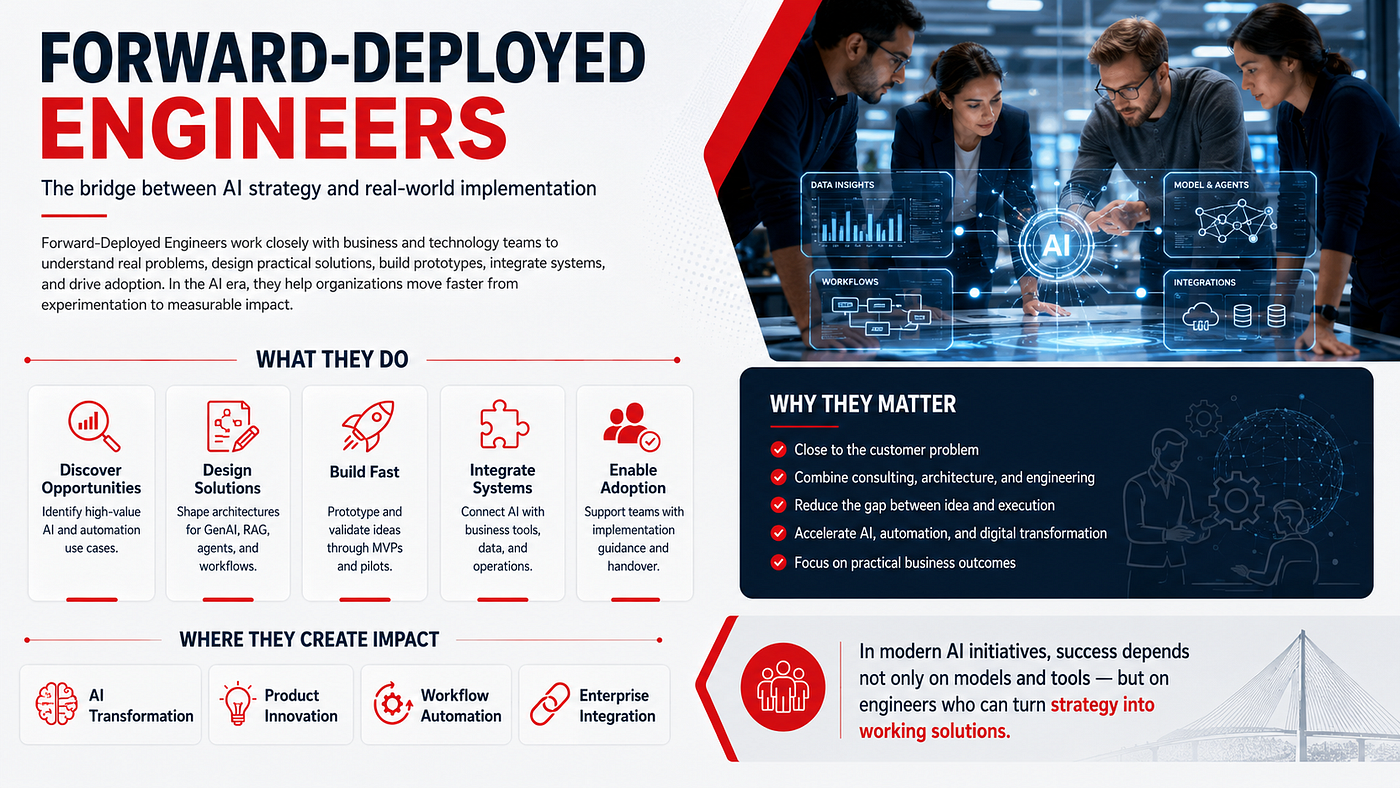
Why the future of AI adoption needs engineers who work closer to the business problem
Artificial Intelligence has moved from boardroom discussion to business priority. Almost every software company, product team, and technology-driven business is now asking the same question:
How do we use AI in a practical, measurable, and scalable way?
The challenge is no longer awareness. Most companies already know AI is important.
The real challenge is implementation.
Many organizations have experimented with GenAI, copilots, chatbots, RAG systems, workflow automation, and AI agents. But a large number of these initiatives remain stuck at the demo or proof-of-concept stage. The gap between AI ambition and working business solution is still wide.
This is where the role of the Forward-Deployed Engineer becomes highly relevant.
A Forward-Deployed Engineer, often called an FDE, is an engineer who works close to the customer’s real environment, business process, data, users, and operational constraints. The role was strongly popularized by companies like Palantir, where forward-deployed software engineers are embedded with customers to solve pressing challenges directly.
Today, the model is becoming even more important in the AI era. OpenAI describes forward deployed engineering as a way to bring AI into production for complex, real-world use cases, partnering with teams to solve high-impact problems and build scalable systems.
What is a Forward-Deployed Engineer?
A Forward-Deployed Engineer is not just a developer assigned to a client project.
An FDE is a hybrid role that combines:
- engineering capability
- solution thinking
- customer understanding
- product mindset
- consulting approach
- implementation ownership
Traditional engineering teams often work from requirements. Forward-Deployed Engineers work closer to the problem itself.
They ask:
What is the business trying to achieve? Where is the actual workflow pain? What data, tools, and systems are involved? Can AI genuinely improve this process? What can be built quickly to validate value? How can this be moved from prototype to production?
This makes the FDE role especially powerful for AI adoption, because AI solutions usually cannot be built successfully from generic requirements alone. They need deep context.
Why Forward-Deployed Engineers Matter in the AI Era
AI implementation is different from traditional software development.
In traditional software projects, the problem is often more clearly defined. In AI projects, the problem itself may need discovery. The team may not know whether they need a chatbot, a RAG pipeline, an automation workflow, an AI agent, a copilot, or simply better data access.
This uncertainty creates a need for people who can move between business understanding and technical execution.
That is the exact space where Forward-Deployed Engineers operate.
Recent market signals also show that the role is becoming more important. Business Insider reported that forward-deployed engineer job postings increased sharply, driven by enterprise AI adoption and the need to integrate AI tools into real business operations.
The Scope of a Forward-Deployed AI Engineer
A Forward-Deployed AI Engineer can contribute across the full AI adoption lifecycle.
1. AI Opportunity Discovery
The first role of an FDE is to understand where AI can create real value.
This includes identifying:
- repetitive business workflows
- document-heavy processes
- manual decision-support activities
- knowledge search problems
- customer support bottlenecks
- internal productivity gaps
- reporting and summarization needs
- automation opportunities
A good FDE does not force AI into every problem. Instead, they identify where AI is truly useful.
2. Solutioning and Architecture
Once the opportunity is clear, the FDE helps design the right solution.
This may include:
- GenAI solution architecture
- RAG architecture
- AI agent design
- workflow automation design
- tool integration
- data flow planning
- security and access control
- human-in-the-loop design
- evaluation and monitoring approach
This is where the role becomes different from ordinary development. The FDE must understand not only how to build, but also what should be built and why.
3. Rapid Prototyping
AI projects need fast validation.
A Forward-Deployed AI Engineer can quickly build prototypes or MVPs to test whether the idea has practical value.
Examples include:
- an internal document assistant
- a Copilot Studio agent
- an n8n automation workflow
- a RAG-based knowledge assistant
- a customer support automation flow
- an AI agent that performs a defined business task
- a Power Automate workflow connected to enterprise tools
The goal is not just to create a demo. The goal is to validate whether the solution can solve a real business problem.
4. Implementation and Integration
Many AI ideas fail because they remain isolated from real systems.
Forward-Deployed Engineers help connect AI solutions with the actual business environment:
- databases
- APIs
- internal tools
- document repositories
- CRMs
- ERPs
- Microsoft 365
- SharePoint
- Teams
- workflow platforms
- cloud services
This integration layer is critical. AI value is created when the system works inside the business workflow, not outside it.
5. AI Enablement
A Forward-Deployed Engineer also helps client teams become more capable.
This may include:
- training internal teams
- explaining AI solution architecture
- mentoring developers
- helping teams use AI tools properly
- creating documentation
- defining operating practices
- supporting adoption after implementation
This is important because AI transformation should not create dependency. It should build capability.
Forward-Deployed Engineer vs Consultant vs Developer
The FDE role sits between consulting and engineering.
A consultant may advise. A developer may build. A Forward-Deployed Engineer does both, while staying close to the customer’s problem.
Role Primary Focus Consultant Strategy, advice, assessment Developer, Build based on requirements, Solution Architect Design, technical solution. Forward-Deployed Engineer Understand problem, design solution, build, integrate, and enable adoption
This makes the FDE model highly suitable for AI transformation, where business context and technical execution must move together.
Why Software Companies Need FDEs
Software companies are under pressure to add AI capability to their products, services, and internal operations.
But many of them face practical challenges:
- lack of experienced AI engineers
- unclear AI use cases
- difficulty moving from demo to production
- limited understanding of agentic AI
- weak RAG implementation capability
- uncertainty around tools and platforms
- lack of AI governance and evaluation practices
- pressure from clients asking for AI features
Forward-Deployed AI Engineers can help these companies accelerate AI adoption without waiting to build a large internal AI team from scratch.
They can work with existing teams and bring the missing AI expertise, architecture thinking, and implementation support.
Why Businesses Need FDEs
The relevance of FDEs is not limited to software companies.
Businesses in sectors such as legal, finance, healthcare, HR, consulting, education, manufacturing, and operations are also exploring AI.
But their teams may not know how to convert business problems into AI solutions.
For example:
- A legal firm may need a document intelligence assistant.
- An HR team may need a policy assistant.
- A consulting firm may need an internal knowledge assistant.
- A sales team may need proposal automation.
- An operations team may need workflow automation.
- A software company may need GenAI features inside its product.
In all these cases, the FDE model is valuable because it starts from the business problem and moves toward practical implementation.
The Relevance of FDEs for Agentic AI
Agentic AI increases the importance of Forward-Deployed Engineers even further.
AI agents are not just chat interfaces. They may need to:
- call tools
- access enterprise data
- make decisions within boundaries
- trigger workflows
- collaborate with other agents
- escalate to humans
- remember context
- operate under governance
Designing such systems requires deep understanding of both business workflows and technical architecture.
A Forward-Deployed AI Engineer can help organizations avoid the common mistake of building flashy AI demos that cannot operate safely in real environments.
What Makes a Good Forward-Deployed AI Engineer?
A strong FDE needs more than coding skill.
Important capabilities include:
- strong software engineering foundation
- understanding of GenAI and LLMs
- RAG design knowledge
- AI agent architecture awareness
- workflow automation experience
- API and integration capability
- cloud-native thinking
- communication skills
- business analysis ability
- rapid prototyping mindset
- production-readiness awareness
- ability to work directly with client teams
The best FDEs are comfortable in both technical discussions and business conversations.
OB360’s View: Forward-Deployed AI Engineering as a Practical AI Adoption Model
At OB360, we see Forward-Deployed AI Engineering as one of the most practical ways to help software companies and businesses become AI-native.
Our approach is built around a simple belief:
AI adoption needs more than tools. It needs people who can understand the problem, design the solution, build the system, and enable the team.
OB360 brings a pool of Forward-Deployed AI Engineers, consultants, architects, automation experts, and AI practitioners who work closely with client teams across:
- AI consultation
- solutioning and architecture
- GenAI implementation
- RAG systems
- agentic AI workflows
- n8n automation
- Copilot Studio solutions
- Power Automate workflows
- AI enablement
- rapid prototyping
- implementation support
This model helps clients move faster from AI ambition to practical implementation.
The Future of Forward-Deployed Engineering
The FDE model is likely to become more relevant as AI adoption matures.
In the coming years, businesses will not only ask:
Which AI tool should we use?
They will ask:
Who can help us apply AI to our real business workflows? Who can help us move from prototype to production? Who can help our teams become AI-ready?
Forward-Deployed Engineers will play a major role in answering these questions.
They represent a shift from distant delivery to embedded problem-solving.
They bring engineering closer to the business.
And in the AI era, that closeness may be the difference between experimentation and transformation.
Final Thought
Forward-Deployed Engineers are not just a new job title.
They represent a new delivery model for the AI age.
A model where engineers are closer to customers, closer to workflows, closer to business outcomes, and closer to real implementation.
For companies serious about AI adoption, this model can reduce uncertainty, improve execution speed, and create measurable business impact.
The future of AI transformation will not be driven only by models and tools. It will be driven by people who can deploy intelligence where it matters most.
메타데이터
- post_id
- afc995b07f5a
- slug
- forward-deployed-engineers-the-new-bridge-between-ai-strategy-and-real-world-implementation-afc995b07f5a
- url
- https://medium.com/@onboard360/forward-deployed-engineers-the-new-bridge-between-ai-strategy-and-real-world-implementation-afc995b07f5a
- canonical_url
- https://medium.com/@onboard360/forward-deployed-engineers-the-new-bridge-between-ai-strategy-and-real-world-implementation-afc995b07f5a
- author_url
- https://medium.com/@onboard360
- status
- ok
- fetched_at
- 2026-06-09 15:37:30





