Why Hotels Need a Business Strategy Beyond Occupancy and ADR
Introduction 🏨
Why Hotels Need a Business Strategy Beyond Occupancy and ADR
Introduction 🏨
For many hotel owners and managers, two numbers dominate the performance dashboard: occupancy and Average Daily Rate (ADR). Occupancy shows how many available rooms have been sold, while ADR indicates the average amount earned from occupied rooms.
Both metrics are important. However, neither one provides a complete picture of whether a hotel is building a healthy and profitable business.
A property can achieve high occupancy through aggressive discounts while generating weak margins. Similarly, a hotel can maintain a high ADR but struggle with unsold inventory, poor distribution, weak guest retention, or inefficient operations. Looking at individual metrics without considering the broader business can therefore lead to decisions that improve one number while weakening the overall performance of the property.
This is why a well-defined hotel business strategy is becoming increasingly important.
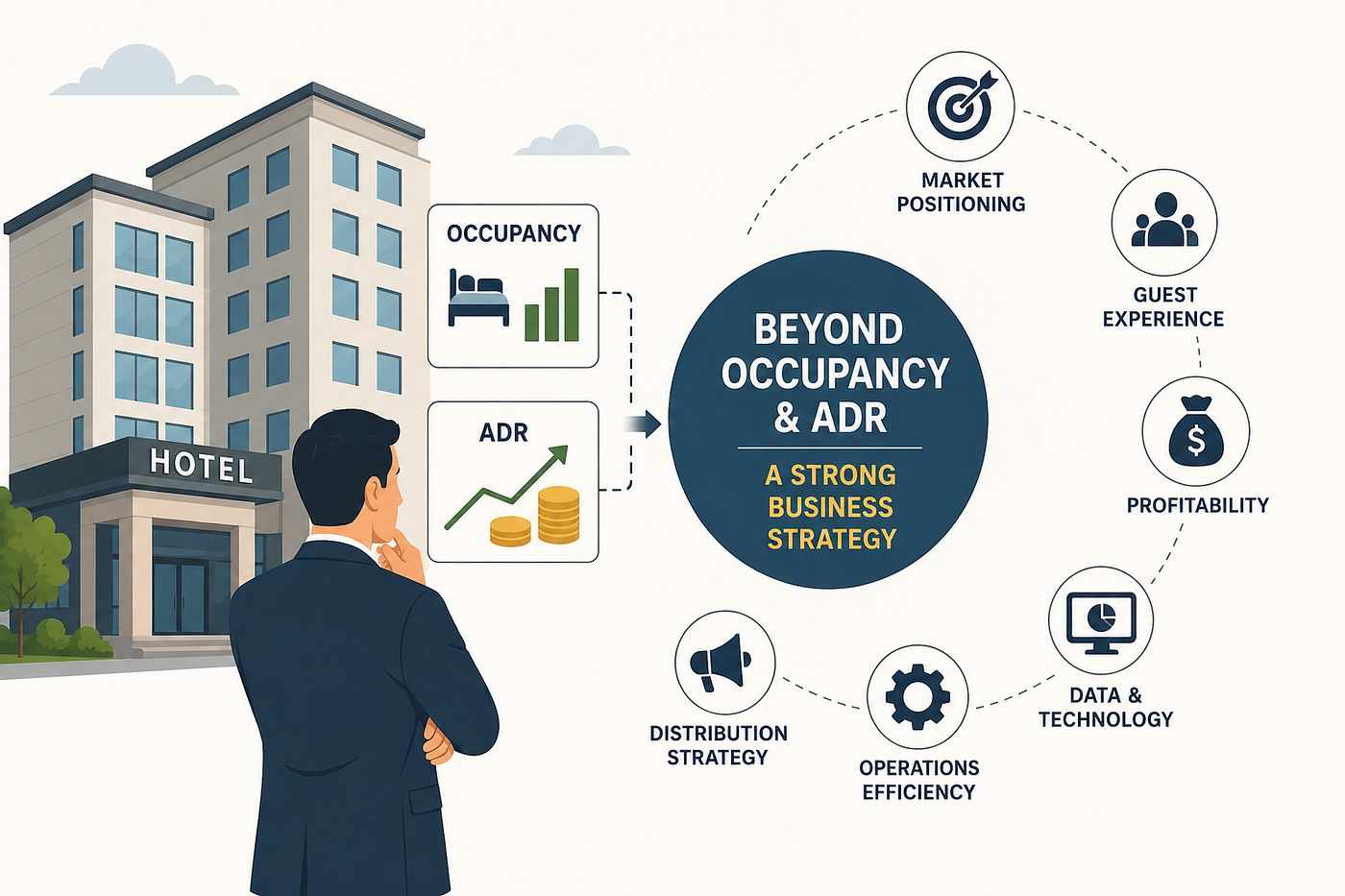
A strategic approach considers revenue, profitability, guest experience, operations, market positioning, distribution, technology, costs, and long-term growth together. Occupancy and ADR remain valuable indicators, but they should be treated as components of a larger performance framework rather than the final objectives.
Why Occupancy Alone Is Not Enough 📊
Occupancy measures the percentage of available rooms that are occupied during a specific period. It is useful for understanding demand and evaluating how effectively room inventory is being sold.
However, high occupancy does not automatically mean high profitability.
Consider two hypothetical hotels.
Hotel A operates at 90% occupancy with an ADR of ₹3,000. Hotel B operates at 70% occupancy with an ADR of ₹4,500. Hotel B has fewer occupied rooms, but its stronger rate can generate greater room revenue per available room.
This is one reason revenue professionals use RevPAR, or Revenue Per Available Room, to evaluate the relationship between occupancy and ADR. RevPAR essentially combines these two metrics and provides a broader view of room revenue performance.
But even RevPAR does not tell the entire business story.
A hotel needs to consider the cost of generating revenue, distribution expenses, staffing, utilities, maintenance, food and beverage performance, marketing costs, and other operating factors.
The real question should therefore move from:
“How full is the hotel?”
to:
“How effectively is the hotel converting demand into sustainable profit?”
The Limitations of ADR as a Standalone Metric 💰
ADR is another essential hotel performance indicator. It tells management how much revenue is generated on average from each occupied room.
However, a high ADR can create a misleading impression when viewed independently.
Suppose a hotel increases its rates significantly but experiences a sharp decline in bookings. The ADR may look impressive, but the hotel could still be leaving substantial revenue opportunities untapped.
Pricing decisions need to consider demand, seasonality, competitor positioning, booking pace, guest segments, room types, events, distribution channels, and market conditions.
A strong hotel business strategy does not attempt to maximize ADR at all times. Instead, it determines when the hotel has pricing power and when targeted strategies may be necessary to stimulate demand.
The objective is not simply to charge more. It is to establish the right balance between rate, demand, occupancy, revenue, and profitability.
Moving From Revenue Metrics to Business Performance
Occupancy and ADR primarily focus on rooms. A hotel, however, is much more than its room inventory.
A guest may generate revenue through:
- Restaurants and bars
- Room service
- Banquets and events
- Meetings and conferences
- Spa and wellness services
- Transportation
- Activities and experiences
- Upgrades
- Additional guest services
This means hotel management should evaluate total revenue rather than concentrating exclusively on room revenue.
For example, a hotel with moderate occupancy may still perform strongly if its restaurant, events, banquet, and other departments generate significant additional revenue.
This broader perspective helps management understand where the property is genuinely creating value and where opportunities remain unexplored.
Profitability Should Become a Strategic Priority 📈
Revenue growth is not the same as profit growth.
A hotel may increase bookings while simultaneously increasing acquisition costs, OTA commissions, staffing expenses, utilities, housekeeping requirements, and promotional spending.
As a result, more revenue does not necessarily mean more money retained by the business.
This is why profitability-related measures can provide additional insight beyond occupancy and ADR. Metrics such as GOPPAR — Gross Operating Profit Per Available Room — attempt to connect hotel performance with operating profitability.
A strategic hotel business should therefore ask questions such as:
- Which booking channels generate the strongest contribution?
- Which guest segments are most profitable?
- Which promotions actually produce incremental demand?
- Which departments generate the highest margins?
- Where are operational costs increasing?
- Are staffing levels aligned with demand?
- Is the hotel discounting unnecessarily?
- Are technology investments producing measurable improvements?
These questions move management from simply tracking performance to actively managing it.
The Importance of Market Positioning 🎯
A hotel cannot develop an effective strategy without understanding its position in the market.
A business hotel, boutique property, resort, budget hotel, and luxury property may operate in the same city but serve very different customer segments.
Their pricing, marketing, service standards, distribution strategies, staffing models, and revenue opportunities will therefore differ.
A hotel business strategy should define what makes the property relevant to its target audience.
This involves understanding:
- Target guest profiles
- Competitive properties
- Local demand patterns
- Travel purposes
- Seasonal demand
- Customer expectations
- Price sensitivity
- Distribution channels
- Brand positioning
For hotels operating in competitive markets such as Chennai, understanding local demand patterns and customer segments can help management make more informed decisions rather than relying solely on historical occupancy figures.
Guest Experience Is Part of the Business Strategy ⭐
Revenue metrics cannot fully capture guest loyalty.
A hotel may achieve strong short-term occupancy through competitive pricing, but repeated poor experiences can damage reviews, referrals, repeat bookings, and long-term brand value.
Guest experience should therefore be incorporated into strategic planning.
Important areas include:
- Service consistency
- Check-in and check-out experience
- Cleanliness
- Room quality
- Response times
- Food and beverage quality
- Digital convenience
- Personalization
- Complaint resolution
A stronger guest experience can support repeat business and positive word-of-mouth, which can reduce dependence on constant discounting.
The objective is not simply to acquire another booking. It is to create a customer relationship that contributes to sustainable business performance.
Distribution Strategy Matters Too 🌐
Where a booking comes from can be almost as important as how much the guest pays.
Hotels commonly use a combination of direct bookings, online travel agencies, corporate accounts, travel agents, group bookings, and other channels.
Each channel can have different costs, customer profiles, and strategic value.
For example, a room sold through an OTA may generate a certain amount of gross revenue but involve commission costs. A direct booking may have different acquisition costs and provide the hotel with a stronger opportunity to build a direct customer relationship.
Therefore, hotel managers should evaluate both revenue and net contribution.
A strong distribution strategy should answer questions such as:
- Which channels generate the most profitable bookings?
- Which channels provide valuable new customers?
- When should OTA promotions be used?
- How can direct demand be strengthened?
- Are corporate and group segments being developed?
- Is the hotel’s channel mix appropriate for its market?
This is another area where strategic planning goes beyond simply monitoring occupancy.
Technology and Data Are Becoming Strategic Assets 💻
Modern hotels have access to more information than ever before.
Booking data, guest preferences, competitor rates, channel performance, demand patterns, reviews, operational information, and financial data can all contribute to better decision-making.
However, collecting data is not enough.
The real value comes from converting information into actionable decisions.
A hotel might know that occupancy is declining, but management needs to understand why.
Is demand declining across the entire market?
Is a competitor offering a stronger value proposition?
Has the hotel’s online reputation changed?
Are rates too high for the current demand level?
Is the property targeting the wrong guest segment?
Are potential guests struggling to book?
A strategic approach connects these pieces of information instead of examining each data point independently.
Why Strategic Planning Matters During Low-Demand Periods 📉
A hotel’s strategy becomes particularly important when demand weakens.
During low-demand periods, the immediate reaction is often to reduce prices. While discounts can sometimes stimulate demand, excessive discounting can weaken ADR, brand positioning, and profitability.
A more comprehensive strategy may consider:
- Targeted packages
- Corporate partnerships
- Local events
- Long-stay offers
- Group business
- Weekend campaigns
- F&B promotions
- Experience-based packages
- Direct booking initiatives
- Alternative customer segments
The right solution depends on the property’s market and demand conditions.
Hotels operating in Chennai, for example, may experience different demand patterns depending on whether their primary customer base consists of corporate travelers, leisure guests, medical travelers, event visitors, or other segments.
The important principle is that low demand should trigger strategic analysis rather than automatic discounting.
Business Strategy Helps Align Different Hotel Departments 🤝
Another major benefit of a comprehensive strategy is departmental alignment.
Revenue management, sales, marketing, operations, finance, front office, housekeeping, and food and beverage teams can sometimes operate with different priorities.
For example:
- Revenue management may prioritize rate optimization.
- Sales may prioritize volume.
- Marketing may prioritize customer acquisition.
- Operations may prioritize service efficiency.
- Finance may prioritize cost control.
- Front office may prioritize guest satisfaction.
All of these objectives are important, but they must support a common business direction.
A clearly defined hotel business strategy creates that alignment.
Instead of asking each department to optimize its own performance independently, management can establish shared objectives around profitability, guest satisfaction, market positioning, and sustainable growth.
The Role of Hospitality Consultants 🧠
Developing a comprehensive business strategy can be challenging, particularly for independent hotels and properties operating in highly competitive markets.
Hospitality consultants can provide an external perspective by examining different aspects of a property’s performance and identifying opportunities for improvement.
This can include areas such as:
- Revenue optimization
- Business development
- Market positioning
- Operational improvement
- Performance analysis
- Strategic planning
- Guest experience
- Distribution
- Growth opportunities
Organizations such as THE IVAR focus on hospitality consulting and business development, making this type of strategic perspective relevant for hotels looking beyond individual performance metrics.
The purpose of consulting is not simply to increase one KPI. It is to understand how different areas of the business interact and identify strategies that can support stronger overall performance.
Building a More Complete Hotel Performance Framework 🏨
Hotels do not need to stop monitoring occupancy or ADR. Instead, these metrics should become part of a larger framework.
A comprehensive performance framework can include:
1. Demand
Monitor occupancy, booking pace, cancellations, seasonality, and market demand.
2. Pricing
Evaluate ADR, rate positioning, dynamic pricing, and competitor pricing.
3. Revenue
Track RevPAR, total hotel revenue, departmental revenue, and channel contribution.
4. Profitability
Examine operating costs, contribution margins, GOP, and profitability-related KPIs.
5. Guest Experience
Monitor reviews, satisfaction, complaints, repeat bookings, and loyalty.
6. Operations
Evaluate productivity, service delivery, staffing, and resource utilization.
7. Market Position
Understand competitors, target segments, brand positioning, and market opportunities.
8. Growth
Identify opportunities for partnerships, new segments, additional services, repositioning, or expansion.
Together, these areas create a much stronger foundation for decision-making than occupancy and ADR alone.
Frequently Asked Questions ❓
Is occupancy still important for hotels?
Yes. Occupancy remains an important indicator because it shows how effectively available room inventory is being utilized. However, it should be evaluated alongside pricing, revenue, costs, and profitability rather than treated as the sole measure of success.
Is ADR more important than occupancy?
Neither should automatically be considered more important. ADR and occupancy influence room revenue together. Their relationship is commonly reflected through RevPAR, while profitability requires an even broader view of revenue and operating costs.
What is a hotel business strategy?
A hotel business strategy is a structured plan for achieving the property’s commercial and operational objectives. It can cover revenue, pricing, guest experience, market positioning, distribution, operations, cost management, business development, and long-term growth.
Why should hotels focus on profitability instead of revenue alone?
Revenue represents money generated by the business, while profitability considers what remains after relevant operating costs. A hotel can generate substantial revenue while experiencing weak margins if expenses and distribution costs are too high.
How can hotels improve performance beyond occupancy and ADR?
Hotels can examine RevPAR, total revenue, profitability, channel contribution, guest satisfaction, operational efficiency, market positioning, repeat business, and departmental performance. Combining these factors provides a more complete view of the business.
Conclusion 🏆
Occupancy and ADR will always remain important hotel performance indicators. They help management understand demand, pricing, and room revenue performance.
But modern hospitality businesses need to look further.
A hotel can have excellent occupancy and ADR figures while still facing problems with profitability, distribution costs, guest retention, operational efficiency, market positioning, or long-term growth.
That is why a strong hotel business strategy should connect revenue management with the broader objectives of the property.
The most successful approach is not simply about filling rooms or increasing room rates. It is about understanding the entire business, identifying where value is created or lost, and making coordinated decisions that improve performance over the long term.
For hotels seeking to develop a more structured approach to revenue, business development, and overall hospitality performance, professional hospitality consulting can provide valuable strategic direction.
For hotels looking to strengthen their overall business strategy and improve long-term performance, consulting support can be explored in Chennai.
메타데이터
- post_id
- afc9abe09a9e
- slug
- why-hotels-need-a-business-strategy-beyond-occupancy-and-adr-afc9abe09a9e
- url
- https://medium.com/@katrina052026/why-hotels-need-a-business-strategy-beyond-occupancy-and-adr-afc9abe09a9e
- canonical_url
- https://medium.com/@katrina052026/why-hotels-need-a-business-strategy-beyond-occupancy-and-adr-afc9abe09a9e
- author_url
- https://medium.com/@katrina052026
- status
- ok
- fetched_at
- 2026-08-19 02:33:20