When Chessboards Have No Edges
Imagine a chessboard where the left and right edges are joined together — or even all four edges disappear. Suddenly, familiar moves create…
When Chessboards Have No Edges
Imagine a chessboard where the left and right edges are joined together — or even all four edges disappear. Suddenly, familiar moves create unexpected patterns and entirely new chess problems. This essay explores that fascinating world through original compositions and classical mathematical puzzles.
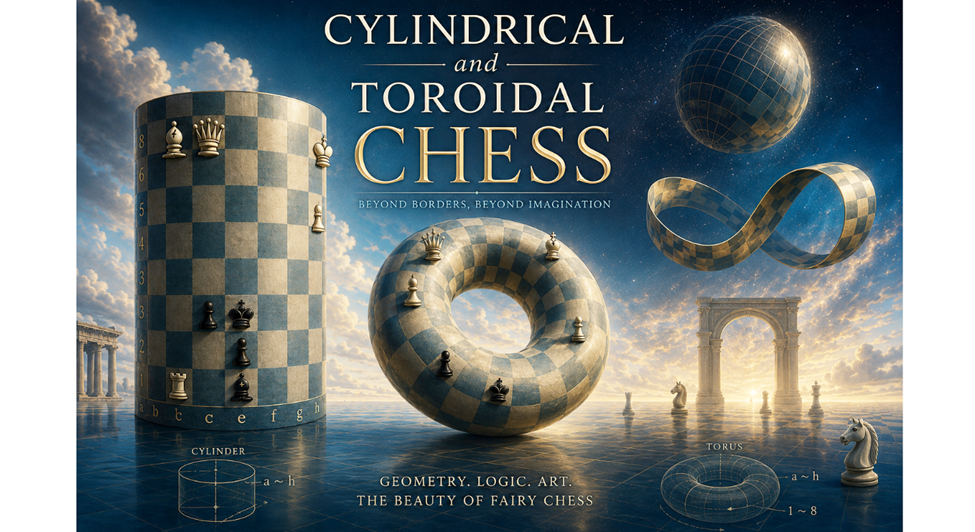
Created by ChatGPT 5 by the author’s suggestions
Cylindrical and Toroidal Chess
Imagine wrapping an ordinary chessboard around a cylinder. Now bend the cylinder until its two circular ends meet, forming a torus. With these two remarkably simple geometric transformations, the familiar world of chess is transformed into something entirely unexpected.
Cylindrical chess is obtained by joining one pair of opposite edges of the standard chessboard. This can be realized in two equivalent ways. In the more familiar vertical cylinder, illustrated on the left of Figure 1, the left and right edges (files a and h) are identified, allowing pieces to reappear on the opposite side after crossing the boundary. Equally natural is the horizontal cylinder, obtained by joining the bottom and top edges (ranks 1 and 8).

Fig. 1 Vertical cylindrical chessboard (left); toroidal chessboard (right)
Toroidal chess extends this idea one step further by joining both pairs of opposite edges simultaneously, transforming the board into a torus (Figure 1, right). The resulting playing surface has neither borders nor corners, allowing chessmen to move continuously in both directions without ever reaching an edge.
These deceptively simple geometric transformations profoundly alter the behaviour of the pieces. Long-range pieces acquire surprising wrap-around powers, familiar mating patterns disappear, and entirely new strategic and artistic possibilities emerge. Distance, direction, and even the relative values of the pieces often have to be reconsidered.
Since the pioneering work of Thomas Rayner Dawson and his contemporaries, cylindrical and toroidal boards have provided an ideal meeting place of geometry, topology, and artistic imagination. Because successful compositions in these variants demand both originality and exceptional technical precision, they remain relatively rare and are regarded among the most sophisticated achievements in fairy chess.
Notations:
K — king; Q — queen; R — rook; B — Bishop; N — Knight
: capture
- check
? mistake or dubious move (?!)
! excellent move
# checkmate
e.p. en passant
The following examples illustrate the concepts of cylindrical and toroidal chess. The first two are original compositions by the author of this essay, each requiring White to mate in two moves on a vertically cylindrical chessboard. The presented solutions uses Notation given above.
Two Original Problems by the Author on a Vertically Cylindrical Chessboard

Fig. 2 M. Petković: Vertical cylinder — Mate in 2; Fig. 3 M. Petković: Vertical cylinder — Mate in 2
Solutions:
Problem Fig. 2 White plays 1. Bh5 — d1 !! along the diagonal h5 — a4 — b3 — c2 — d1. After 1… K x d1, the White mates with 2. Qb1. If 1… e x d1 follows 2. Qf1 #. Any the black Knight move is met by 2. D:e2 # .
Problem Fig. 3 The first move is 1. Rb1 — e1 !! — the White rook reaches square e1 by taking advantage of the cylindrical connection along the first rank **b1 — a1 — h1 — g1 — f1 — e1.
There are three variants:
(I) 1… d x e1 2. B x e1 # (the White bishop controls squares c1 and d2 along the diagonal a7 — h6 — g5 — f4 — e3 — d2 — c1**);
(II) 1… K x d3 2. De4 #;
(III) the Black bishop plays arbitrary move, then 2. Qb1 #. After 1. Nc5 (e5, f4, f2), the Black has a defense by attacking the White king by 1… Be2+ along the diagonal e2 — d3 — c4 — b5 — a6 — h7. Notice that the White pawn on h6 prevents the Black bishop from attacking the White king.
Checkmating on a Toroidal Chessboard

Fig. 4 Z. Mah: Mate in 4 moves on a toroidal board
Solution (Fig. 4):
1. Qh7! ;
(a) 1… Kf8 (the rest of the squares are controlled by the king) 2. Qg6 Ke7 3. Ke1 Kd7 4. Qe8 # ;
(b) 1… Kd8 2. Qc7+ Ke8 3. Kh6! Kf8 4. Qe1 # .
Universal Chess Composition
A remarkable chess problem is W. H. Reilly’s “universal” chess composition (1934). The same initial position yields three different mate-in-two solutions depending on whether the game is played on a standard chessboard, a vertically cylindrical chessboard, or a toroidal chessboard. It is a striking demonstration of how changing only the geometry of the board fundamentally alters the logic of the solution. Its importance was recognized by Nenad Petrović (ex-Yugoslavia), the world’s first Grandmaster for Chess Composition, who included it in his influential 1949 book Chess Problem.

Fig. 5 W. H. Reilly: Mate in 2 a) standard board 8 x 8; b) vertical cylinder; c) torus
Solutions (Fig. 5):
a) Standard board 8 x 8: 1. a4
b) Vertical cylinder: 1. Kd7! and 2. Rh5 # (1. a4? falls is refuted by h4 — a3 e.p. !).
c) Torus: 1. Tg2! and 2. Rg5 mate through g1 (1. Kd7? falls because of 1… h1Q! 2. Rh5 Q x h5! .
The Eight Queens Problem on a Cylindrical Board
The eight queens problem — place 8 queens on the 8 x 8 chessboard so that no queen can be attacked by another — on the standard 8 x 8 chessboard has 92 solutions. There is a vast literature on this well-known problem. Now we consider the following challenging problem: Solve the problem of non-attacking queens on a cylindrical chessboard that is formed of an 8 x 8 chessboard.

Fig. 6 E. Gik’s solution: The eight queens problem on a cylindrical board
Solution: There is no solution of the eight-queens problem on the cylindrical chessboard of the order 8! We present the proof by Evgeny Gik (1943–2016), the outstanding chess journalist and chess-master (given in Matematika na shahmatnoi doske (in Russian), Moscow, Nauka, 1976).
Let us consider an ordinary chessboard, imagining that its vertical edges are joined (“vertical cylindrical chess”). Let us write in each of the squares three digits (i,j,k), where

present column, row, and diagonal (respectively) {of} the traversing square (Figure 6). Assume that there is a replacement of 8 nonattacking queens and let

be the ordered triples that represent 8 occupied squares. Then the numbers

are distinct and belong to the set {1,…,8}, whence there follows

The same holds for the numbers from the sets

Therefore, the sum

of all 24 digits written in the squares occupied by the queens is equal to

Since the sum

of the digits on each of the squares is divided by 8 (see Figure 6), it follows that the sum of the mentioned 24 digits must be divisible by 8. But 108 is not divisible by 8 — a contradiction, and the proof is completed.
The mathematical elegance of the chess world, of which this essay has presented only a small glimpse, has fascinated fairy chess composers for more than a century. Nothing essential has been added to the game — only the geometry has changed. Yet this single topological idea opens an entirely new universe of strategies, paradoxes, and artistic possibilities, reminding us once again that even the smallest mathematical transformation can profoundly reshape the familiar world of chess.
Thank you for reading. Don’t forget to clap the article if you find it insightful.
메타데이터
- post_id
- afcf822a07c3
- slug
- when-chessboards-have-no-edges-afcf822a07c3
- url
- https://medium.com/@miodragpetkovic_24196/when-chessboards-have-no-edges-afcf822a07c3
- canonical_url
- https://medium.com/@miodragpetkovic_24196/when-chessboards-have-no-edges-afcf822a07c3
- author_url
- https://medium.com/@miodragpetkovic_24196
- status
- ok
- fetched_at
- 2026-08-15 19:32:53