Behind Closed Doors: Europe’s Secret Winter Plan to End the Ukraine War
Russia isn’t collapsing, Ukraine isn’t surrendering, and Europe is preparing for negotiations that could redefine the continent’s future
Behind Closed Doors: Europe’s Secret Winter Plan to End the Ukraine War
Russia isn’t collapsing, Ukraine isn’t surrendering, and Europe is preparing for negotiations that could redefine the continent’s future

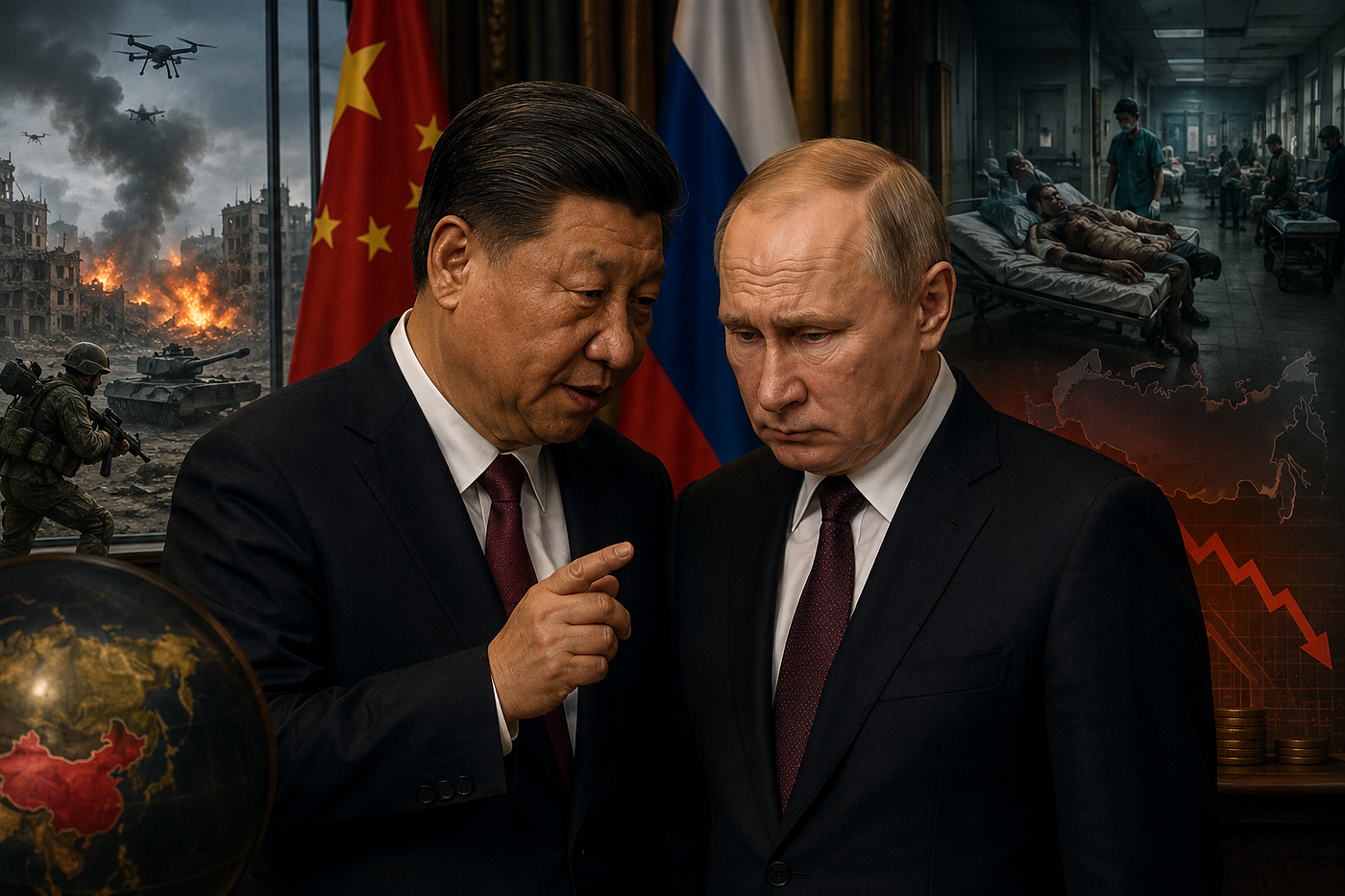
The Shrinking Imperative Image Credit: GeminiAI
Russia is not losing the war right now, but it is also not in the position that Putin had imagined. Because, as Russia is failing to achieve its war goals in Ukraine, Putin needs a way to get out.
The people who were saying “Ukraine will lose” from 2023 to 2025 (especially Trump and his supporters) are now being proven wrong.
Russian analysts and even experts considered close to the Kremlin have started openly saying that Putin’s original war goals now appear quite far from reality.
On the battlefield, Russia is still advancing in some areas, but its progress is very slow, and it is paying a very high price for it.
In recent months, Russia has increased the intensity of missile and drone attacks on Ukrainian cities. This is not only an act of revenge, but also a reaction to increasing pressure.
When any side does not get the expected success on the battlefield, it often tries to increase pressure through other methods.
The situation has now reached a point where capturing the Donetsk region has become Putin’s minimum goal. If he achieves it, then he can present it as a victory at the domestic level and move towards some kind of talks.
But the problem is that full control over Donetsk is still not in Russia’s hands. And until this goal is completed, ending the war may be politically difficult for Putin.
On the other hand, the longer the war continues, the more the economic and military pressure keeps increasing.
I think that if Putin needs a way to save his honor (save his reputation), then he should declare to the Russian public: “We tried to save Ukraine from the Nazis, but they are not grateful for it, and we are not ready to sacrifice ourselves and our soldiers for this great goal.” Therefore, now we should get out of there.
This is not true, and it will not erase the crimes he has committed, but at least he can officially end the war without admitting surrender.
But if we look at reality, this is never going to happen. Putin is not retreating because of his ego, and he is pushing Russian soldiers into the mouth of death (Meat Grinder).
The Russian leadership does not care about the lives of its soldiers (as happened in World War II). Putin knows that if he retreats without winning, then there will be a coup against him inside Russia, or he will lose his life.
If we look at today’s time, the situation of Putin and Trump sitting in the White House has become similar.
Both started their preferred wars on the foundation of lies and a huge pile of ego, thinking that their armies were unbeatable, but they failed badly.
Now they are stuck in such a swamp where they cannot control the outcome without fully accepting defeat.
Perhaps now the time has come for European countries to develop the power to understand that if Ukraine alone can hold Russia in a stalemate (equal fight) for three years, then just imagine how weak Russia will prove to be in front of a European alliance.
Even if Putin makes military threats to NATO countries, Russia cannot stand against them on the economic front.
Where the total economic power of NATO countries is $45 trillion, Russia’s economy will shrink to only $2.9 trillion this year. In the first quarter of 2026, Russia’s GDP shrank by 0.2% instead of growing.
Saint Petersburg
This week, Russia carried out a very big attack on Ukraine’s capital, Kyiv, in which more than 600 drones and hypersonic missiles were fired, and dozens of ordinary citizens lost their lives.
But what happened today was even more interesting. Ukrainian drones targeted a large oil terminal near Saint Petersburg at the time when preparations for the annual economic conference known as “Putin’s Davos” were going on there.
The purpose of this conference is to attract investors from around the world to Russia. This oil terminal handles about 90 million barrels of oil every year and is only 10 miles away from the conference venue.
This attack happened near Saint Petersburg in Russia’s north-western part, which is very far from Ukraine’s border.
Ukrainian drones covered a long distance of 1,100 kilometers while dodging Russia’s air defense system, which shows Ukraine’s growing technical capability and the power of its long-range attacks.
In modern war, distance is not just a number. The greater the distance, the more layers of air defense, radar networks, and electronic warfare systems have to be crossed.
Therefore, if the drones really reached the target and succeeded in causing damage, then this will be considered another important progress in Ukraine’s long-range attack capability.
The Ukrainian army entered the Kronstadt naval base and targeted the Russian warship “Boyky”.
Kronstadt has historically been considered an impregnable “fortress city” of Russia that protects its Baltic navy. An attack on a ship standing in the dry dock is a big failure for the Russian Navy.
After the recent drone attack on Saint Petersburg’s port, Vladimir Putin’s visit to the ‘St. Petersburg International Economic Forum (SPIEF) may now be in danger.
Information is also coming on social media networks that this economic forum may be completely cancelled, or its opening may be postponed to some other date.
Peace Talks
Amid all this, Marco Rubio gave a statement that it is possible that Russia may never be able to achieve militarily the objectives that it is demanding in the talks (negotiations) at this time.
For example, permanent control over some areas of Ukraine, influence on Ukraine’s security and military policies, or other political conditions — achieving them in the future only through military force is becoming increasingly difficult for Russia.
In recent months, Ukraine has not only defended itself but has also succeeded in stopping Russian pressure in some areas and achieving limited counter-successes.
Although the war is still extremely difficult and expensive, Russia is not able to make the fast progress that it had hoped for.
The second and perhaps more important reason is Ukraine’s long-range attack capability.
In the early phase of the war, Russia considered most of its strategic industrial and economic centers relatively safe.
But now Ukrainian drones and other long-range systems are reaching targets hundreds and sometimes thousands of kilometers away.
This is the reason why many diplomats and policymakers repeatedly say that the final solution to the war will not be military, but political.
No side can completely destroy the other; therefore, ultimately, some form of talks will have to happen.
This is why, now in some European capitals, this thinking is emerging that the war cannot be run indefinitely only through weapons and aid. At some point, a political process will have to be started.
According to Bloomberg’s report, officials from Germany, France, and the United Kingdom are discussing whether such a framework can be prepared that could eventually bring Russia and Ukraine to the negotiating table.
Since America’s attention is currently diverted towards other wars in the world (such as Iran or the Middle East crisis), Europe has now taken the command of this security crisis into its own hands.
In recent years, there has been a growing threat by Russia against Ukraine’s power and heating systems, as well as its civilian infrastructure, during the winter months.
The continued threat of such an attack could result in Europe facing another challenging winter, when millions of Ukrainian citizens will be at risk for lack of access to basic services like electricity, heat, etc.
That is why some European leaders want to see if a political process can be started before winter arrives.
However, one extremely important point is being repeatedly emphasized in this entire discussion that they will not force Ukraine into any agreement.
The final decision will be Kyiv’s, and the right to decide when and on what conditions to start talks with Russia will remain with President Volodymyr Zelenskyy.
But the biggest question still remains the same one that has existed for the past three years — will Russia and Ukraine be ready to back down enough from their original demands so that real talks can begin?
Until the answer to this becomes clear, peace will still remain a difficult and uncertain goal despite diplomatic opportunities appearing.
메타데이터
- post_id
- afe428b5aa22
- slug
- behind-closed-doors-europes-secret-winter-plan-to-end-the-ukraine-war-afe428b5aa22
- url
- https://medium.com/@rajk100/behind-closed-doors-europes-secret-winter-plan-to-end-the-ukraine-war-afe428b5aa22
- canonical_url
- https://medium.com/@rajk100/behind-closed-doors-europes-secret-winter-plan-to-end-the-ukraine-war-afe428b5aa22
- author_url
- https://medium.com/@rajk100
- status
- ok
- fetched_at
- 2026-06-15 20:49:13