City-Making Is Probably Close to Karma
On the joy and responsibility of finding value in a place
City-Making Is Probably Close to Karma
On the joy and responsibility of finding value in a place
Not long ago, I wrote that no town is truly empty. It is just not being seen.
What looks like “nothing” is often not absence, but unread value: everyday life that has become too ordinary to notice, small businesses that have blended into the background, a river, a road, a recurring evening light, a way people keep just the right distance from one another. The problem is not that value is missing. The problem is that the questions we bring are often too shallow to let that value appear.
I still believe that.
In fact, I believe it more strongly now. A town is never made only of obvious symbols that can be listed from the outside. It is made of topography, water, memory, habits, commerce, atmosphere, and embodied experience. It is made of layers.
But recently I have been thinking about something that comes after that realization.
Finding value in a place is not innocent.
To notice value, name it, structure it, edit it, communicate it, and connect it to a project or strategy — these are necessary acts. But they are not neutral acts. The moment we do them, we are already touching the place. We are already beginning to alter how it will be seen, spoken about, and acted upon.
That is why I have started to think that city-making is probably close to karma.
Not in the sense of fate. Not in the sense of pessimism. But in the sense that it is both work and consequence. It is a professional act whose effects remain in the place long after the meeting, plan, or project has ended.
That is what interests me.
City-making is work. But it is never only work.
Of course, city-making is a form of work.
It involves research, facilitation, design, coordination, strategy, implementation, negotiation, and budgets. It requires professional skill. It lives in institutions, timelines, and practical constraints. It is not pure idealism, and it should not be.
But it is not only work.
When we identify value in a place, we do not simply document what is already there. We also reorganize perception.
We decide what matters. We decide which memories become visible. We decide which local practices become “assets.” We decide which stories are translated into a form that institutions, developers, governments, or visitors can understand.
This is why “discovering value” is a phrase that is too clean.
What actually happens is closer to selection, emphasis, editing, and translation.
And once selection begins, something is always left out.
That is the first reason city-making feels karmic to me. It is a professional act that accumulates consequences.
The desire to improve a place is always slightly dangerous
People who work in city-making tend to see possibility.
They notice what has not yet been named. They sense that a place contains more than its current image. They believe that relationships between people, place, time, and experience can be activated, deepened, or better connected.
And once that possibility is seen, it becomes difficult to walk away.
This impulse is not bad. In many cases, it is exactly where good practice begins.
But the impulse to improve can become dangerous the moment it fuses with certainty.
We want to protect. We want to revitalize. We want to communicate. We want to preserve. We want to open things up.
All of these desires may be sincere. But sincerity is not immunity.
Good intentions can still flatten a place. Careful language can still create pressure. A well-designed intervention can still shift the local balance in ways we did not intend.
This is why city-making cannot be discussed only as a field of hope. It also has to be discussed as a field of responsibility.
To find value is also to choose value
In planning and urban practice, people often say they want to “find the hidden value” of a place.
But to find value is already to frame it.
Which landscape do we elevate? Which local business becomes representative? Which memory becomes part of the official narrative? Which voice becomes central? Which layer of the town gets translated into strategy?
These are not passive acts.
A quiet way of life becomes a “resource.” A long-running neighborhood shop becomes a “local attraction.” An informal relationship becomes “community strength.” A subtle atmosphere becomes a “brand.”
Sometimes this translation is necessary. Without language, certain values remain invisible to institutions. Without articulation, some local realities cannot be defended or funded. Without framing, fragile qualities can disappear under the pressure of more measurable priorities.
So I am not arguing against articulation.
I am saying that articulation always changes the thing it articulates.
That is why the work must be done carefully.
We should not let people say “there is nothing here.” But we should not define a place too aggressively either.
In my previous essay, I argued that when residents say, “There is nothing here,” they are usually not stating an objective truth.
What they are expressing is something more subtle: value has become too close, too ordinary, too embedded in daily life to be recognized as value. And often, the questions asked from outside are too crude to let richer answers emerge.
That is why city-making must help undo local self-negation.
A town should not be forced to see itself only through the metrics of visibility, attraction, scale, or spectacle. A place should not need a landmark, a tourism hook, or a development icon in order to count as meaningful.
But there is another danger here.
If we react too strongly against self-negation, we may start speaking for the place too forcefully.
We say: “This town has this value.” “This district is defined by this character.” “This local culture is its true identity.”
And suddenly, a place that was once dismissed as “empty” becomes trapped by a new certainty.
Its complexity is reduced. Its contradictions are cleaned up. Its ambiguity is turned into branding. Its living reality becomes a narrative too neat to breathe in.
So the task is double.
We must refuse the sentence, “There is nothing here.” But we must also resist the temptation to over-fix what the place “really is.”
We have to restore dignity without freezing identity.
That, too, is part of the burden of city-making.
From the perspective of Sensibility Urbanism, city-making is not first about adding things. It is about reading layers.
This is where my framework of Sensibility Urbanism becomes important.
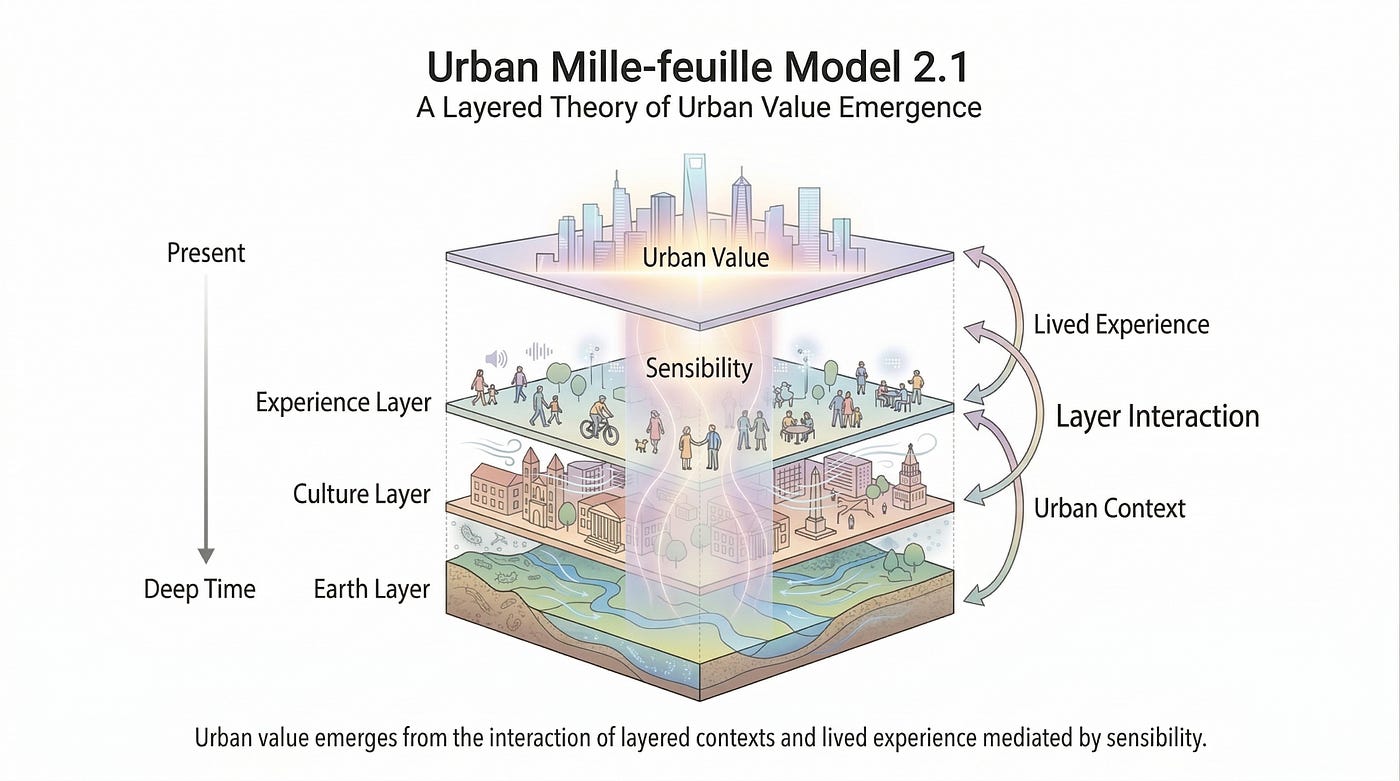
Sensibility Urbanism does not treat a city as a flat arrangement of facilities, functions, and flows alone. It asks how a place is felt, inhabited, remembered, and socially experienced. It treats the city as a layered body rather than a single surface.
That is also why I use what I call the Urban Mille-Feuille Model.
A town is composed of overlapping layers:
- everyday life and human rhythms
- small commerce and recurring acts of care
- roads, routes, and social connections
- memory, history, and inherited stories
- topography, climate, and local ground
- water, ecology, and more-than-human presence
Seen this way, the role of city-making changes.
It is no longer primarily about inserting something new into an empty container. It becomes the practice of reading what is already there, linking layers without crushing them, and translating local thickness into social, civic, or strategic language without over-determining it.
This is less flashy. It is harder to turn into simple KPIs. But it is closer to what many places actually need.
City-making, in this sense, is not first a matter of adding. It is first a matter of reading.
You can explore this perspective further here:
Before we “make” a place, we have already touched it
The phrase city-making is useful. But it is also too strong.
In most cases, we are not creating a place from zero. The place is already there. People are already living there. Time has already accumulated. Relationships already exist. So do tensions, routines, memories, silences, and forms of pride.
To enter such a place is not first to create. It is first to touch.
And once we touch it, something changes.
Change the questions, and you change how the town is spoken about. Change the language, and you change how it is perceived. Change the perception, and you change what kinds of actors, investments, and comparisons begin to gather around it.
That is why city-making is not simply the work of production. It is also the work of contact.
We touch other people’s lives, inherited time, local dignity, and unresolved discomforts. That is why the practice must remain humble. That is why our own desire to intervene must itself be examined.
Karma is not a dark word here. It is a word of remaining responsibility.
When I say city-making is close to karma, I do not mean doom.
I mean that it is a field where actions remain.
A project ends, but its language stays. A framework is introduced, but its consequences stay. A spatial intervention changes behavior. A public narrative changes self-perception. A local value, once named, begins to circulate in new systems.
Some of that may be good. Some of it may create pride, recognition, continuity, or care.
But some of it may also create simplification, pressure, competition, or displacement in subtler forms.
So the point is not to withdraw from practice. The point is to remember that what we do does not disappear when the professional process is over.
That is why city-making is never just a job.
It leaves traces.
How do we make this burden a little more bearable?
There is no perfectly correct way to intervene in a place. But there are ways to become less crude.
The first is to improve the quality of our questions.
Do not begin with: “What is your local attraction?” “What can bring people in?” “What is your selling point?”
Begin instead with questions like:
Where does the evening light become beautiful? Which road does everyone use, and why? Which store has quietly supported everyday life for years? What would be missed if it disappeared? What do people rarely mention, but deeply rely on? Where does the place feel most like itself?
These questions do not extract instant answers. They invite thickness to surface.
The second is not to decide too quickly.
Even when value becomes visible, do not turn it into a final definition. Do not close a town inside a single story. Leave room for plurality, contradiction, and unfinishedness.
The third is to never underestimate how much intervention changes the field.
A well-intended project may alter movement patterns. A compelling narrative may shift expectations. A newly visible value may enter new circuits of competition and comparison.
To ignore this is not optimism. It is carelessness.
Still, we have to stay involved
Even after saying all of this, I do not think the answer is to stop.
Quite the opposite.
If we want to insist that no town is empty, then we need people willing to read the thickness of place. If we want to connect that thickness to public conversation, strategy, policy, or development in a better way, then we also need people willing to translate.
The question is not whether to act. The question is how to act without becoming too certain of our own goodness.
City-making is probably close to karma.
We see. We get involved. We cannot fully walk away. And each time we act, we leave something behind.
That is why what is needed is not just passion, but literacy. Not just strategy, but restraint. Not just design, but the capacity to keep doubting the innocence of one’s own intervention.
In that sense, city-making is not the act of giving value to a place from above. It is the difficult practice of standing before a place that already contains value, trying not to damage its depth, trying not to define it too quickly, and still attempting to connect it to a shared future.
That is burdensome work. But it is also meaningful work.
Which is why I keep thinking the same thing:
City-making is probably close to karma.
메타데이터
- post_id
- afe7277916ef
- slug
- city-making-is-probably-close-to-karma-afe7277916ef
- url
- https://medium.com/@heartfull_drab_deer_542/city-making-is-probably-close-to-karma-afe7277916ef
- canonical_url
- https://medium.com/@heartfull_drab_deer_542/city-making-is-probably-close-to-karma-afe7277916ef
- author_url
- https://medium.com/@heartfull_drab_deer_542
- status
- ok
- fetched_at
- 2026-07-10 14:51:46