Prologue
October 2025- as I started to organize material to write about my practice-based research, I paused to reflect on how incongruous it felt…
Prologue
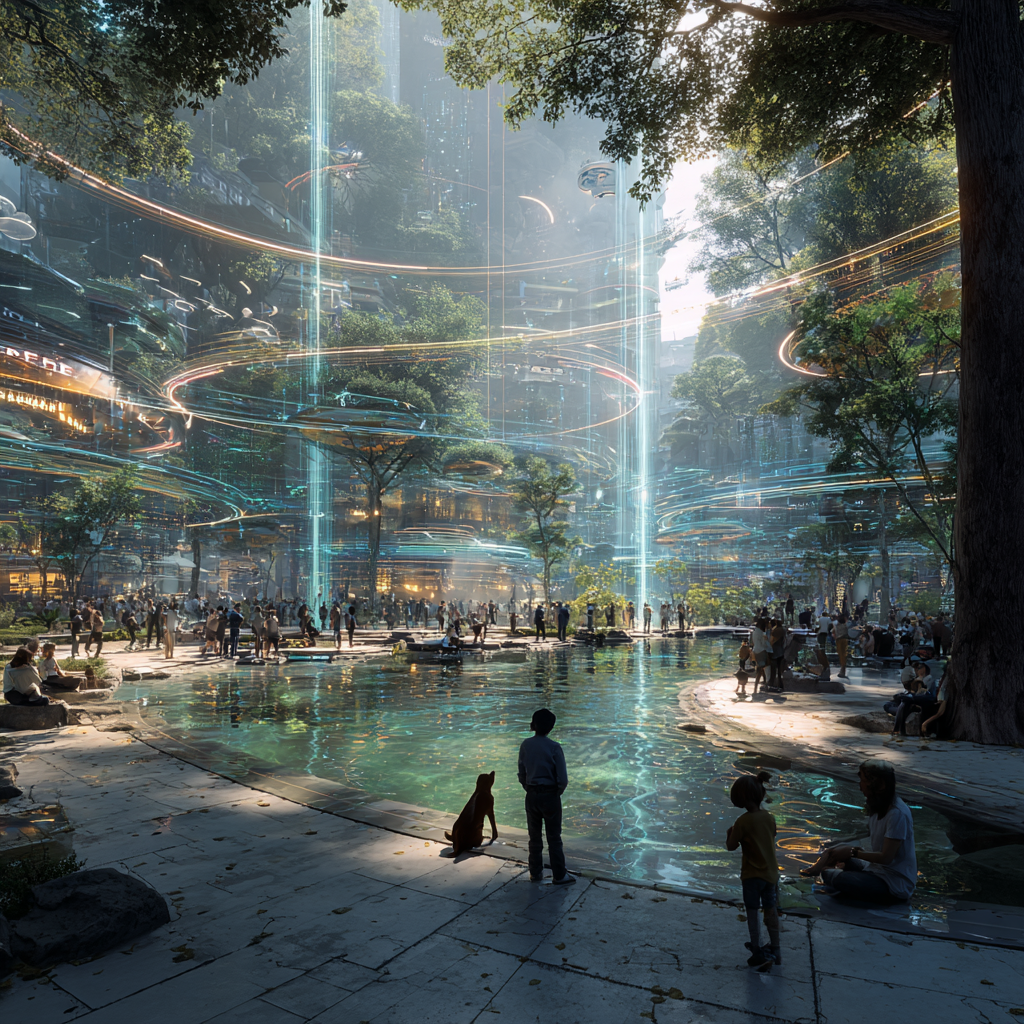
Generated with Midjourney
October 2025- as I started to organize material to write about my practice-based research, I paused to reflect on how incongruous it felt to write about what’s considered a niche topic in today’s context without any explanation or backstory. So, here I am finishing up a prologue of sorts to my forthcoming blog posts.
Writing an optimistic, forward-looking piece about the metaverse definitely feels off-key. Given the current socio-economic, political climate, riddled with fear, threat, and feeling of doomsday closing in on us, most of us feel exhausted. The last two years have profoundly impacted us, broken our spirits, and made us feel helpless as we bore witness to a livestreamed genocide. Then there is Artificial Intelligence (AI) and the existential threat its superintelligence would bring to humanity. Add to the mix the impending climate collapse, exacerbated by more greed and lack of empathy for the suffering of millions of species, and the existential threat seems multifold. While I know we have had similar moments in history and we have made it out of there just fine, the emphasis needs to be on “similar” and not “same”. Our current situation is a combination of war, climate crisis, and unstoppable development of an exceedingly powerful entity like AI that we could not control if we wanted to, in the future. The recipe feels distinct from the past ones in that, a lot is beyond our control.
At this juncture, I return to my original intent for the blog post. That is, to reflect on my own role in today’s society as a designer, artist, and architect. It was important for me to situate myself within today’s context and worldview, to be able to depart from those imagined end-states and present new ones. It is more important now than ever to envision narratives for futures that incorporate indigenous knowledge, design better applications of technologies, or imagine ecosocialist¹ futures. To insist on predicting such futures where we don’t merely survive this ordeal, but flourish as future generations despite today, feels like an act of resistance.
¹https://www.e-ir.info/2024/12/12/eco-socialism-,,an-introduction/
Last August, I made a hard decision to discontinue my creative-practice-based Ph.D. at the University of Auckland, New Zealand. Since then, even though I have pivoted to non-academic work, I continue to investigate the same topic through my research-based studio, xr//follies here in London. The blogs will be based on the same research, where I explore the integration of metaverse technologies into public open spaces (squares, plazas, sidewalks, courtyards, etc.), with a focus on design. Metaverse technologies such as extended reality (XR), Computer Vision (CV), and AI, along with cyber-physical systems (CPS), Internet of Things (IoT), and more, when integrated into built architectural and landscape elements such as urban furniture, park benches, water fountains, and canopies, transform them into dynamic thresholds bridging physical and virtual worlds. I develop 1:1 scale functioning prototypes, with a particular interest in exploring social aspects like shared encounters (Fischer and Hornecker, 2012) between strangers around the installations, human-machine collaboration in co-creating safe, non-binary XR public spaces that are inclusive, open, and accessible to all.
The term xr//follies for my studio encapsulates my intent to create something extending beyond our physical reality (XR) through follies in the urban environment. The term folly originates from the 16th-18th-century European landscapes, where these ornamental architectural structures were built for aesthetics and pleasure, rather than specific functions. However, over time, the term evolved within the architectural discourse, starting with Bernard Tschumi’s Parc de la Villette in 1984. Tschumi redefined follies with his abstract red structures as conceptual frameworks to test spatial ideas, rather than utility. Later, with projects like Gwangju Folly² (which started in 2011 and is still ongoing), designers and architects are invited to design public art installations, as a means to rejuvenate the city’s public spaces and promote the city’s art and culture. In the post-pandemic context, follies represent the exploration of joy, experimentation, and socio-cultural connection (Aleixo, 2021). Today, follies could mean spatial devices, physical, digital, or hybrid, through which imagination resists utility, inviting new encounters between material, social, and technological worlds.
² https://gwangjufolly.org/index_en.php
So, through my research at *xr//follies*, I am interested in investigating the potential of these hybrid follies in today’s context, to go beyond architectural experimentation, to hold space for connection, empathy, and collective imagination for our desired metaverse futures.
References
Aleixo, S., ‘The return of the follies from traditional to digital’, UOU scientific journal, (02). 2021. https://revistes.ua.es/uou/article/view/21423
Fischer, Patrick Tobias, and Eva Hornecker. “Urban HCI: Spatial Aspects in the Design of Shared Encounters for Media Façades.” Proceedings of the SIGCHI Conference on Human Factors in Computing Systems, 2012. https://doi.org/10.1145/2207676.2207719.
메타데이터
- post_id
- affe8370c91d
- slug
- prologue-affe8370c91d
- url
- https://medium.com/@manojnaacharya/prologue-affe8370c91d
- canonical_url
- https://medium.com/@manojnaacharya/prologue-affe8370c91d
- author_url
- https://medium.com/@manojnaacharya
- status
- ok
- fetched_at
- 2026-06-09 15:37:30




