Cyborg Cockroaches: The Bio-Hybrid Breakthrough Redefining Espionage and Disaster Response
A German startup has transformed living insects into programmable reconnaissance tools
Cyber BioTech
Cyborg Cockroaches: The Bio-Hybrid Breakthrough Redefining Espionage and Disaster Response
A German startup has transformed living insects into programmable reconnaissance tools
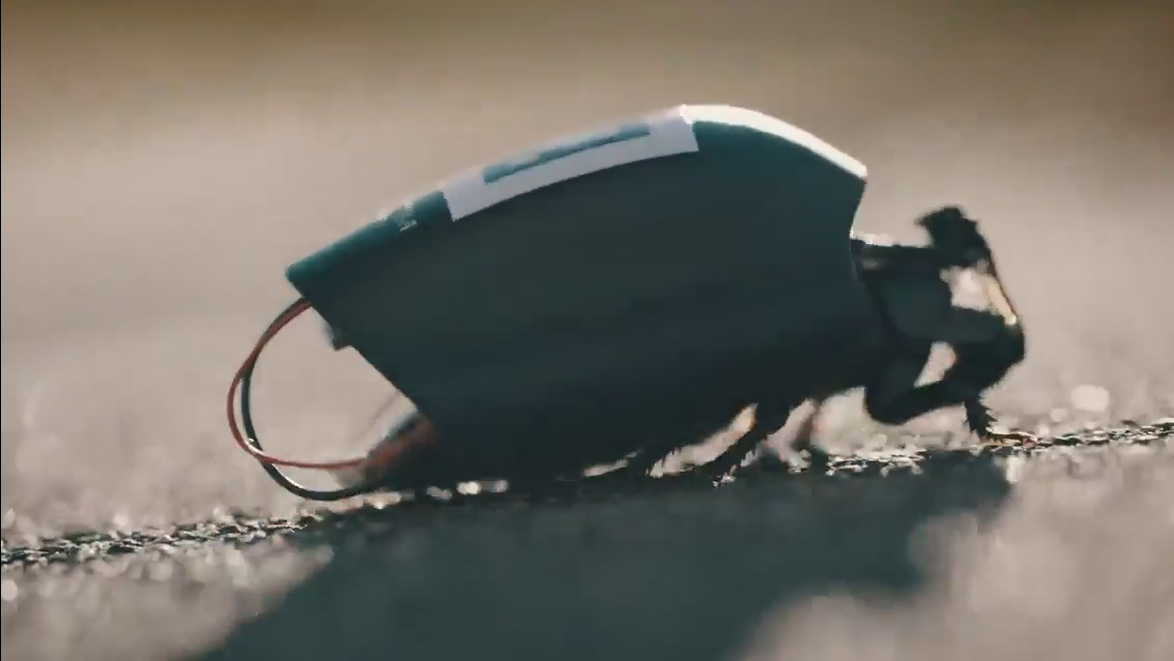
Video screenshot of Madagascar Hissing Cockroach loaded for recon. Credit:Rowan Cheung
The integration of biological organisms into technological systems is a significant shift in contemporary engineering. While traditional robotics faces limitations regarding power efficiency and environmental navigation, the cockroach offers a biological platform refined by millions of years of evolution.
These insects possess an inherent resilience that mechanical systems struggle to replicate. They are capable of surviving extreme radiation, high-pressure environments and significant physical trauma.
Their musculoskeletal structure allows for movement through narrow apertures and across irregular terrain that would immobilise a wheeled or tracked micro-robot. The cockroach is not merely a vessel for hardware but a self-powering, self-navigating kinetic entity that requires only minimal external stimulus to perform complex tasks.
The primary advantage of using a living insect over a purely synthetic machine is the energy requirement. A mechanical robot must expend battery power for every movement, whereas a cockroach derives its kinetic energy from organic matter. This allows the biological component to maintain mobility for days or weeks without an external power source.
The technological requirement is then reduced to the maintenance of the control interface, which consumes considerably less electricity than traditional motors. Furthermore, the sensory capabilities of the insect, including its ability to detect chemical changes and vibrations, provide a foundational data set that enhances the utility of the bio-hybrid system in complex environments.
The insect already possesses the internal architecture for stability and obstacle avoidance, which removes the need for the high-level computational processing typically required for robotic balance.
In the context of defence and disaster response, the reliability of a system is measured by its ability to function in unpredictable settings. Synthetic micro-drones often suffer from mechanical failure when exposed to dust, moisture or debris.
The biological systems of an insect are equipped with natural self-cleaning and self-repairing mechanisms that allow for continued operation in environments that would cause electrical shorts or physical blockages in a robot.
By utilising the cockroach, engineers are essentially outsourcing the most difficult aspects of robotics — locomotion and power management — to a system that has already been optimised by the process of natural selection. This approach allows for the deployment of thousands of units at a fraction of the cost and energy expenditure of an equivalent mechanical fleet.
The Madagascar Hissing Cockroach is the chosen vehicle for the technology. It is certainly not small, being up to 3 inches (7.5 cm) long when mature.

Juvenile Madagascar Hissing Cockroach. Wikipedia
Engineering the swarm: backpacks, neural control and edge AI
The transformation of a standard insect into a controlled reconnaissance tool involves the application of a micro-electronic backpack. This device is affixed to the thorax and interfaces directly with the nervous system of the creature.
By delivering precise electrical impulses to the antennae, the system simulates the presence of physical obstacles. This induces a navigational response in the insect, allowing a remote operator or an autonomous algorithm to direct its movement with high accuracy.
The stimulation of the cerci, the sensory organs at the rear, can also be used to initiate forward movement. This method of control does not override the entire motor system of the insect but rather hijacks its natural reflexes to guide it toward a specific destination.
Recent advancements in miniaturisation have allowed for the inclusion of edge artificial intelligence within these backpacks.
This enables the processing of data locally on the insect rather than requiring a constant high-bandwidth connection to a central server. These systems can identify specific thermal signatures or acoustic patterns associated with human life, which is essential during search and rescue operations in collapsed structures.
The integration of mesh networking allows individual insects to communicate with one another, forming a decentralised swarm. This collective intelligence ensures that if one unit is lost or destroyed, the remaining members of the swarm can redistribute their search parameters to maintain coverage of the target area. The decentralised nature of the swarm ensures that there is no single point of failure in the reconnaissance mission.
The engineering challenges associated with these backpacks involve balancing weight with functionality. Every additional milligram of electronic components impacts the speed and endurance of the insect. Current designs utilise flexible printed circuits and ultra-thin lithium-polymer batteries to minimise the physical load.
The edge AI components are programmed to filter out irrelevant environmental data, transmitting only high-value signals to the base station. This conservation of data transmission further extends the battery life of the control unit. (Edge AI is AI deployed at the point of data collection, not ‘back at the office’.)
Additionally, the development of energy-harvesting technologies, such as piezoelectric materials that generate electricity from the movement of the insect’s wings or legs, is being explored to create indefinite operational windows.
Twelve months that changed reconnaissance
The rapid development of this technology within a one-year timeframe is a result of accelerated military funding and the convergence of multiple scientific disciplines. Initial prototypes focused on basic directional control, but the current iteration deployed for evaluation involves a sophisticated interface that allows for semi-autonomous exploration. The transition from laboratory experiments to functional field tools occurred through rigorous testing in simulated disaster zones.
These trials demonstrated that bio-hybrid swarms could map internal layouts of buildings where GPS and traditional radio signals are often degraded or unavailable. The speed of development was facilitated by the use of off-the-shelf components and the adaptation of existing neuro-stimulation techniques originally developed for medical research.
The strategic interest from organisations such as NATO stems from the need for low-cost, expendable reconnaissance assets. Traditional drones are often detectable by radar or acoustic sensors, but a cockroach is difficult to distinguish from local fauna.
This provides a level of covertness that is difficult to achieve with purely mechanical platforms. The ability to deploy hundreds of these units simultaneously allows for a density of data collection that was previously impossible. The speed of this technological evolution indicates a prioritisation of bio-convergence in modern defence strategies, moving away from the heavy mechanisation of the twentieth century towards more fluid and integrated biological solutions. This twelve-month period has seen the technology move from a niche academic curiosity to a core component of future tactical planning.
The rapid implementation of these systems was also aided by the creation of modular software platforms. These platforms allow different sensors — such as radiation detectors, gas sniffers or microphones — to be swapped onto the insect backpacks depending on the mission requirements.
This versatility was demonstrated during NATO exercises where swarms were used to identify chemical leaks in industrial zones and to locate mock casualties in urban ruins.
The ability to iterate on both the hardware and the software in real-time has allowed the German startup at the centre of this breakthrough to bypass the traditional decades-long procurement cycles typical of military technology. The focus on biological integration has created a new paradigm for rapid prototyping in the aerospace and defence sectors.
The ethical tightrope of living machines
The use of living organisms as programmable tools introduces complex ethical considerations regarding the treatment of non-human animals and the boundaries of biological manipulation.
Critics of the technology argue that the implantation of electrodes and the override of natural instincts represent a fundamental violation of the biological integrity of the insect. Although cockroaches are often viewed as pests, the systematic control of their nervous systems for human objectives raises questions about the moral status of invertebrates. There is a concern that the normalisation of such technology could lead to the exploitation of more complex organisms in the future.
The reduction of a living being to a mere component in a machine creates a precedent for how biology is valued in an industrial context.
But we already do it with dogs and dolphins don’t we?
And there was even a time when we sent children down coal mines. And in some places we still see child slave labour making clothing.
There are also significant legal and safety concerns regarding the deployment of these swarms. The dual-use nature of bio-hybrid insects means that while they are effective for finding survivors in earthquakes, they could also be used for invasive surveillance or the delivery of harmful substances.
The lack of international regulation specifically addressing bio-hybrid systems creates a vacuum where deployment could occur without oversight. The potential for these modified insects to escape into the wild and interact with local ecosystems is another point of contention. While the backpacks are designed to be retrieved or to fail-safe, the long-term impact of introducing electronic components and neural-altering devices into the natural environment remains unquantified.
The debate also extends to the transparency of the organisations developing these tools. When a startup operates under military contracts, the level of public scrutiny regarding animal welfare and ethical standards is often limited. There is a need for a clear ethical framework that defines what constitutes acceptable use of biological organisms in technological applications.
What this means for tomorrow’s conflicts and rescues
The future of disaster response and defence will likely be defined by the seamless integration of biological and synthetic systems. In humanitarian contexts, the deployment of bio-hybrid swarms could drastically reduce the time required to locate individuals trapped under debris.
By providing real-time data from environments too hazardous for human rescuers or dogs, these tools increase the probability of successful outcomes in the ‘golden hour’ following a disaster. The cost-effectiveness of these systems also makes them accessible to regions that may not have the resources for expensive robotic programmes. The ability of these swarms to cover vast areas with minimal human supervision allows for a more efficient allocation of rescue resources during large-scale emergencies.
In the context of defence, the presence of ‘living’ sensors changes the nature of urban operations. The ability to infiltrate secure facilities or monitor troop movements without detection provides a distinct informational advantage. This technology shifts the focus of reconnaissance from large, detectable platforms to small, ubiquitous agents.
Long-term projections suggest that the data gathered by these swarms will play a critical role in the training of autonomous systems. The movements and responses of the insects provide a template for biological intelligence that can be replicated in future synthetic designs. However, until mechanical systems can match the efficiency of a living organism, the bio-hybrid will remain the superior tool for low-power, high-resilience missions.
The next phase of this technology may well involve the integration of synthetic biology to engineer insects with specific traits, such as increased lifespan or enhanced sensory organs. This progression will continue to challenge the definitions of life and machine, requiring a constant dialogue between engineers, ethicists and policymakers to ensure that the benefits of bio-hybrid breakthroughs are realised without compromising fundamental moral principles.
So there you have it. Maybe there is some truth in all these rumours about biolabs.
[embed]
https://www.nature.com/articles/s41598-024-52341-w
https://www.frontiersin.org/articles/10.3389/fbioe.2023.1123456/full
https://www.science.org/doi/10.1126/robotics.abe3450
https://www.nato.int/cps/en/natohq/topics_167242.htm
https://www.ethicscentre.org.au/the-ethics-of-animal-robot-hybrids/
메타데이터
- post_id
- b007634abd2d
- slug
- cyborg-cockroaches-the-bio-hybrid-breakthrough-redefining-espionage-and-disaster-response-b007634abd2d
- url
- https://medium.com/the-dock-on-the-bay/cyborg-cockroaches-the-bio-hybrid-breakthrough-redefining-espionage-and-disaster-response-b007634abd2d
- canonical_url
- https://medium.com/the-dock-on-the-bay/cyborg-cockroaches-the-bio-hybrid-breakthrough-redefining-espionage-and-disaster-response-b007634abd2d
- author_url
- https://medium.com/@james-marinero
- status
- ok
- fetched_at
- 2026-06-21 12:17:11