Magento Website Development Mistakes That Hurt Sales
Discover the Magento website development mistakes that silently reduce conversions, damage customer experience, and slow business growth
Magento Website Development Mistakes That Hurt Sales
Discover the Magento website development mistakes that silently reduce conversions, damage customer experience, and slow business growth
Many ecommerce businesses assume that if their Magento store is live and functional, everything is working properly.
Products are visible. Customers can browse. Orders are coming in.
So naturally, the store feels successful.
But heres the problem many businesses eventually discover:
A Magento store can technically work while still losing sales every single day.
Not because the products are bad. Not because the marketing failed.
But because of development mistakes hidden inside the store experience.
These mistakes often go unnoticed at first because they don’t always cause obvious failures.
Instead, they quietly affect:
- Customer trust
- Website speed
- Checkout experience
- Mobile usability
- Conversion rates
And over time, those small issues create a much bigger business problem.
Lets look at the most common Magento website development mistakes that silently hurt ecommerce sales and growth.
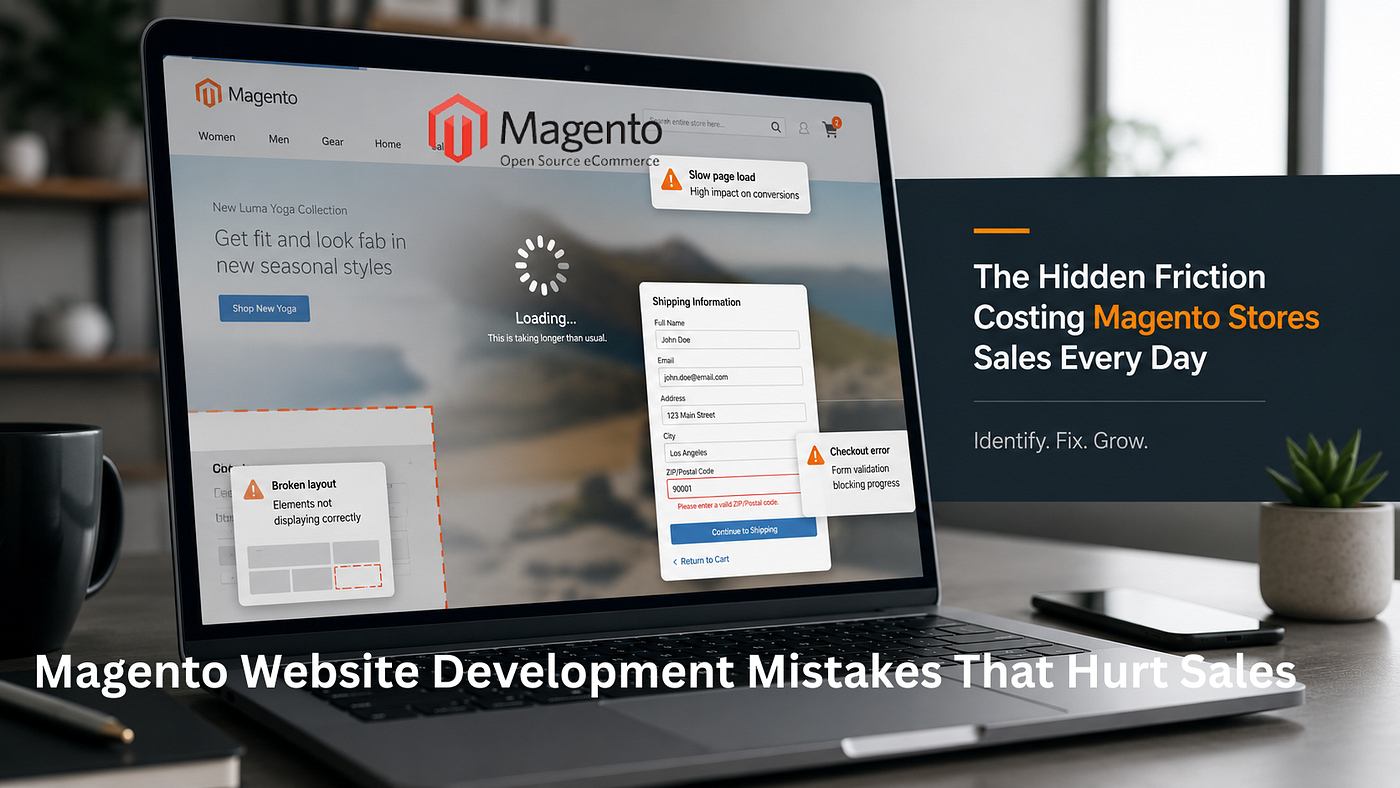
Magento development hurt sales
1. Slow Website Performance
This is one of the biggest sales killers in ecommerce.
Modern customers expect websites to load quickly.
If your Magento store feels slow:
- Visitors leave faster
- Product browsing decreases
- Checkout abandonment increases
And most importantly: Customers lose patience very quickly.
Many Magento performance problems come from poor development decisions such as:
- Heavy custom code
- Too many extensions
- Poor database optimization
- Missing caching configuration
At first, businesses may only notice slight delays.
But as traffic grows, those delays become more visible across:
- Product pages
- Search functionality
- Checkout process
The result is simple: A slow store creates friction, and friction reduces sales.
2. Poor Mobile Experience
A large percentage of ecommerce traffic now comes from mobile devices.
But many Magento stores are still developed primarily for desktop layouts.
This creates problems like:
- Difficult navigation
- Slow mobile loading
- Broken layouts
- Tiny buttons or forms
Customers browsing on mobile expect:
- Fast interaction
- Simple navigation
- Smooth checkout
If the experience feels frustrating, users leave immediately.
And unlike desktop users, mobile users are even less patient with delays or usability problems.
Poor mobile optimization quietly damages:
- Conversion rates
- Engagement
- Search rankings
Because Google also prioritizes mobile friendly experiences.
3. Complicated Checkout Process
Many Magento stores unintentionally make checkout harder than necessary.
This often happens because businesses continuously add:
- Extra fields
- Additional steps
- Unnecessary validations
- Multiple scripts during checkout
The result? Customers abandon their carts before payment completion.
Common checkout mistakes include:
- Slow payment loading
- Forced account creation
- Confusing coupon sections
- Too many form fields
Checkout should feel fast and simple.
Every additional delay or complication increases the chance of losing the customer entirely.
4. Overloading the Store With Extensions
Magento extensions are useful tools.
But many businesses rely on too many of them.
At first, adding extensions feels convenient:
- One for SEO
- One for speed
- One for filters
- One for checkout
Eventually, the store becomes overloaded.
Too many extensions create:
- Performance issues
- Conflicts between modules
- Heavy server usage
- Stability problems after updates
And sometimes businesses do not even realize extensions are causing problems because the issues appear gradually over time.
A clean Magento store focuses on:
- Stability
- Performance
- Controlled functionality
not endless plugin accumulation.
5. Ignoring Scalability During Development
One of the biggest Magento mistakes is building the store only for launch not for future growth.
In the beginning, everything may seem manageable because:
- Traffic is smaller
- Product catalogs are limited
- Integrations are fewer
But growth changes the technical demands completely.
Without scalable development:
- Performance declines under traffic
- Admin operations slow down
- Integrations become unstable
And eventually, growth itself starts creating technical problems.
Many businesses only realize this after successful marketing campaigns expose performance limitations.
6. Poor Search and Navigation Experience
Customers should be able to find products easily.
But poorly developed Magento stores often create confusing browsing experiences:
- Slow search results
- Broken filters
- Complicated navigation structures
- Inconsistent category organization
When users cannot quickly find products:
- Browsing time decreases
- Frustration increases
- Purchase intent drops
Customers rarely spend time struggling to navigate an ecommerce website.
They simply leave and buy elsewhere.
7. Weak Integration Handling
Modern ecommerce stores rely heavily on integrations such as:
- Payment gateways
- Shipping providers
- ERP systems
- Inventory management tools
Poor Magento development often creates unstable integration handling.
This can lead to:
- Failed payment confirmations
- Inventory mismatches
- Delayed order updates
- Shipping synchronization errors
Even occasional failures damage customer trust.
And operational problems internally create additional stress for the business.
8. Ignoring Core Web Vitals and SEO Performance
Many businesses focus only on visual design while ignoring technical SEO performance.
But Magento development directly affects:
- Page speed
- Layout stability
- User interaction responsiveness
These factors influence:
- Google rankings
- Organic traffic
- User experience
Poor optimization can reduce visibility even when content and products are good.
This creates a hidden traffic problem where the store struggles to compete organically.
9. Poorly Structured Custom Development
Custom functionality is often necessary in Magento.
But poorly planned customizations create serious long term problems:
- Update conflicts
- Security risks
- Difficult maintenance
- Performance bottlenecks
Many businesses experience situations where:
- Small changes break unrelated areas
- Developers hesitate to update features
- Debugging becomes complicated
Over time, the codebase becomes harder to maintain and scale.
And this directly affects how quickly the business can evolve.
10. Focusing Too Much on Design Instead of Usability
A visually attractive store is important.
But design alone does not guarantee conversions.
Some Magento stores focus heavily on:
- Animations
- Complex layouts
- Heavy visual effects
While ignoring:
- Speed
- Navigation simplicity
- Checkout efficiency
The result is a beautiful looking store that performs poorly in real customer behavior.
Good ecommerce design should improve usability not slow it down.
11. Delaying Maintenance and Optimization
Magento stores require ongoing maintenance.
Ignoring:
- Updates
- Performance reviews
- Security improvements
creates long term instability.
Over time, small unresolved issues accumulate into:
- Larger technical failures
- Performance decline
- Compatibility problems
Many businesses only react when serious issues appear.
But proactive maintenance is far less expensive than emergency fixes later.
The Biggest Problem: Businesses Often Do not Notice Sales Losses Immediately
One reason these mistakes are dangerous is because the impact usually happens gradually.
Businesses may notice:
- Slightly lower conversion rates
- Higher bounce rates
- Reduced repeat purchases
but not immediately connect them to development quality.
The store still functions.
Orders still happen.
So the deeper structural problems remain hidden.
Meanwhile:
- Customers leave faster
- Checkout friction increases
- User experience declines
And sales potential quietly decreases over time.
When Businesses Usually Seek Professional Help
Many ecommerce businesses initially try solving problems using:
- Additional plugins
- Temporary fixes
- Server upgrades
- Quick performance tweaks
Sometimes these help temporarily.
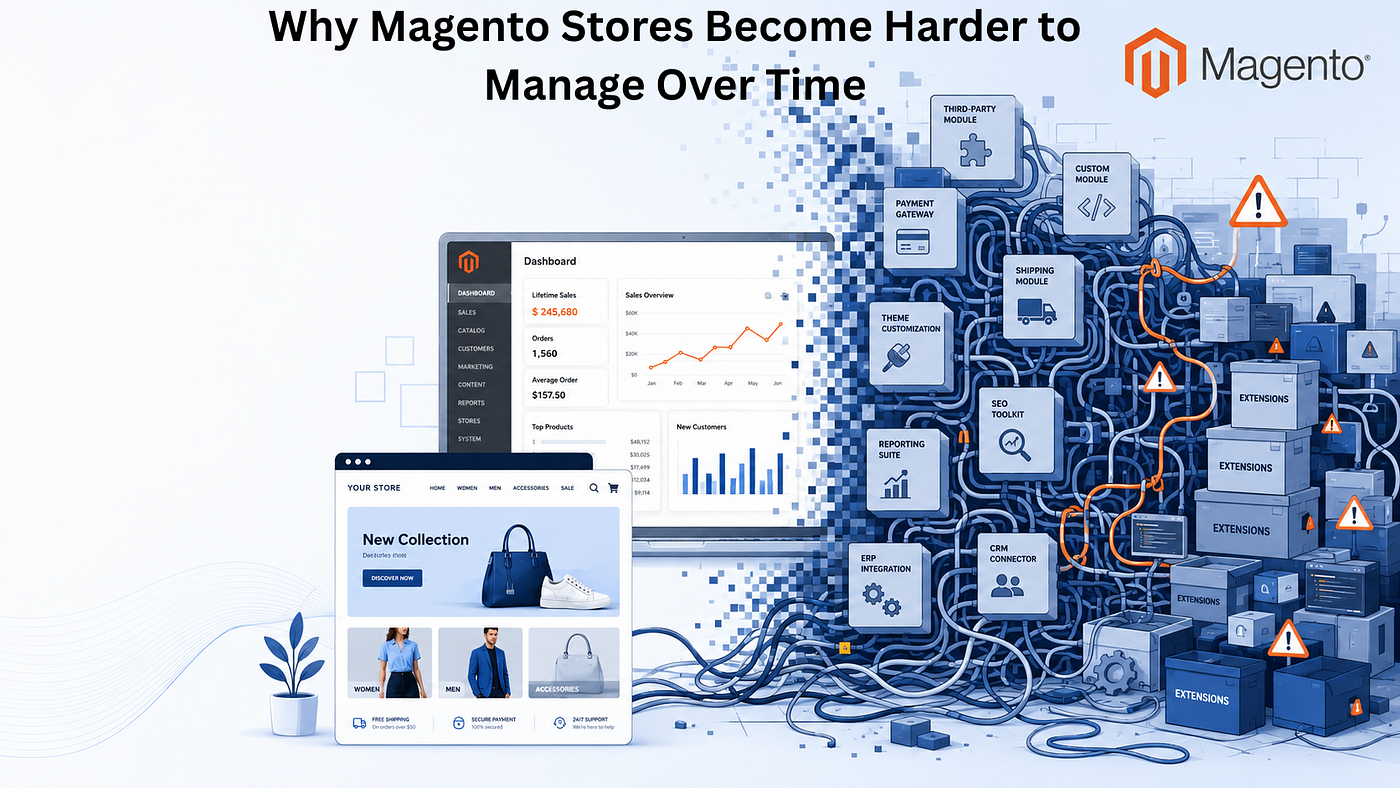
But when recurring performance issues, checkout instability, poor scalability, and customer experience problems continue affecting sales growth, businesses usually realize they need a stronger long term foundation. This is when many companies turn to professional **Magento Website Development Services** to optimize store performance, improve scalability, stabilize integrations, and create a smoother ecommerce experience.
What Proper Magento Development Should Actually Achieve
A properly developed Magento store should:
- Load quickly
- Handle traffic growth smoothly
- Deliver stable checkout performance
- Support mobile users effectively
- Simplify product discovery
- Maintain integration reliability
Most importantly, the store should support sales growth instead of silently creating obstacles for customers.
Final Thoughts
Magento is a powerful ecommerce platform capable of supporting serious business growth.
But poor development decisions can quietly reduce sales and create operational stress over time.
Many businesses focus heavily on marketing and advertising…
but forget that technical experience directly affects whether visitors actually complete purchases.
A store that:
- Loads slowly
- Feels difficult to use
- Creates checkout friction
- Struggles under growth
will always lose potential sales regardless of marketing efforts.
Thats why Magento website development should never focus only on making the store look finished.
It should focus on creating a fast, stable, scalable ecommerce experience that supports long term business growth and customer satisfaction.
Because in ecommerce, small technical frustrations often become big revenue losses over time.
메타데이터
- post_id
- b00ab55c8a33
- slug
- magento-website-development-mistakes-that-hurt-sales-b00ab55c8a33
- url
- https://medium.com/@madhublogger/magento-website-development-mistakes-that-hurt-sales-b00ab55c8a33
- canonical_url
- https://medium.com/@madhublogger/magento-website-development-mistakes-that-hurt-sales-b00ab55c8a33
- author_url
- https://medium.com/@madhublogger
- status
- ok
- fetched_at
- 2026-06-09 15:37:30