Fluid Intelligence: Thinking beyond Experience.
Have you ever solved a problem you’d never seen before, using logic alone, and wondered where that spark came from?, A child looks at a…
Fluid Intelligence: Thinking beyond Experience.
Have you ever solved a problem you’d never seen before, using logic alone, and wondered where that spark came from?, A child looks at a broken toy and fixes it with a paperclip. An expert stares at the same problem and freezes. That’s fluid intelligence in action. Imagine walking into a room full of unfamiliar puzzles — no instructions, no past experience to guide you — and yet your brain begins finding solutions before you even realize it’s thinking. Everything you’ve learned might be useless — unless you also know how to think beyond it.

Figuring It Out from Scratch
Fluid intelligence is the brain’s natural ability to think logically, identify patterns, and solve completely new problems without relying on previous knowledge or formal education. Unlike memorized facts, formulas, or learned experience, fluid intelligence represents the mind’s raw processing power — the capacity to reason in unfamiliar situations where no ready-made solution exists.

In a rapidly changing world driven by technological disruption, artificial intelligence, renewable energy transitions, and complex global systems, fluid intelligence has become one of the most valuable human abilities. It is what allows engineers to diagnose unseen technical failures, entrepreneurs to adapt during market collapse, scientists to develop revolutionary ideas, and innovators to create solutions that have never existed before.
A person with strong fluid intelligence is not simply “knowledgeable.” Instead, they are mentally adaptable. They can connect unrelated concepts, detect hidden relationships, and develop strategies under uncertainty. This ability is especially important in industries such as engineering, technology, and other fast-evolving industries where professionals constantly face unpredictable technical and operational challenges.

Thinking Beyond Experience
Understanding the Core Concept of Fluid Intelligence
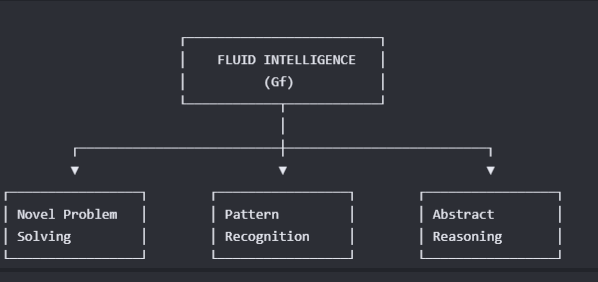
Fluid intelligence can be understood as the mind’s ability to “think beyond experience.” Imagine being placed in a situation where there are no instructions, no textbook references, and no prior examples to imitate. The ability that helps you logically navigate that situation is fluid intelligence. This cognitive capacity includes several interconnected functions:
● Novel Problem Solving — handling situations never encountered before.
● Pattern Recognition — identifying relationships or hidden structures in unfamiliar information.
● Abstract Reasoning — mentally manipulating concepts that may not be directly visible or measurable.
● Adaptability — changing strategies rapidly when existing systems fail.
For example, consider an engineer during a sudden industrial plant shutdown. Suppose a software-control malfunction occurs that has never previously been recorded in the system database. Since there is no manual or historical solution available, the engineer must rely on immediate logical deduction, system analysis, and causal reasoning to isolate the fault. In this moment, success depends primarily on fluid intelligence rather than memorized knowledge.
This distinction is extremely important. Knowledge alone cannot solve every problem. In environments characterized by uncertainty and innovation, the ability to reason dynamically becomes more valuable than simply recalling stored information.
Knowledge alone cannot solve every problem.
The Neurological Foundation of Fluid Intelligence
Fluid intelligence is not merely a philosophical idea; it is rooted in measurable neurological processes within the human brain. Several brain regions cooperate during fluid reasoning tasks:
-
Dorsolateral Prefrontal Cortex (DLPFC) : This region controls executive functions such as attention management, decision-making, and working memory. It acts as the brain’s command center during complex reasoning.
-
Anterior Cingulate Cortex (ACC) : The ACC monitors conflict, detects errors, and identifies novelty. When a situation appears unusual or contradictory, this area becomes highly active.
-
Parieto-Frontal Network: This network integrates sensory information and helps construct abstract relationships between different pieces of data.
Together, these systems create the neurological infrastructure required for advanced reasoning.
Cognitive Drivers Behind Fluid Intelligence
Fluid intelligence depends heavily on three major cognitive mechanisms:
- Working Memory Capacity ( functioning like a temporary mental workspace)
- Processing Speed ( how rapidly neural signals travel across the brain)
- Attention control ( allows individuals to ignore distractions and maintain focus)
Fluid Intelligence vs. Crystallized Intelligence
One of the most influential theories in psychology is the Cattell-Horn-Carroll (CHC) Model, which separates intelligence into two broad categories:
Fluid Intelligence (Gf): This is raw reasoning ability — the capacity to solve unfamiliar problems without prior learning.
Crystallized Intelligence (Gc): This refers to accumulated knowledge, vocabulary, technical expertise, and learned skills gained through education and experience.
The relationship between these two forms of intelligence is fundamental. Fluid intelligence acts as the engine that builds crystallized intelligence. A student uses fluid reasoning to understand advanced mathematics for the first time. Over years of repetition and application, that understanding becomes permanent expertise. In other words:
Fluid intelligence creates knowledge; crystallized intelligence stores it.
An experienced engineer may rely heavily on crystallized intelligence when applying known equations or safety procedures. However, during unexpected process failure or novel system behavior, fluid intelligence becomes dominant again.
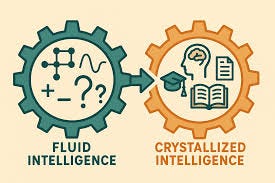
Fluid intelligence vs Cystalized intelligence
Lifespan Development and Biological Decline
Research suggests that fluid intelligence typically peaks during late adolescence and the early twenties. After this period, gradual biological decline begins due to several neurological factors, including reduced processing speed and myelin degradation (wearing down of the insulating material surrounding nerve fibers).
Crystallized intelligence, however, often continues increasing throughout adulthood because knowledge accumulates over time. This explains why older professionals may possess extraordinary expertise and judgment even if raw processing speed declines slightly. Their vast knowledge systems compensate through experience. For innovators and future founders, this relationship carries an important lesson:
Use periods of high fluid capacity early in life to build deep expertise that remains valuable for decades.
Real-World Applications of Fluid Intelligence
Fluid intelligence plays a critical role in nearly every high-level professional field.
- Engineering and Technology: Engineers frequently encounter system failures, unexpected interactions, and design limitations. Fluid reasoning allows them to improvise solutions when standard procedures fail.
- Entrepreneurship and Business Strategy: During economic disruption, successful etrepreneurs rarely survive by repeating old methods. Instead, they pivot strategically, identify hidden opportunities, and redesign business models under uncertainty.
- Scientific Innovation: Scientific breakthroughs often occur when researchers recognize relationships that others fail to notice. This requires advanced abstract reasoning and conceptual flexibility.
- And other Professional Field
The Apollo 13 Case Study: Fluid Intelligence Under Extreme Pressure
No checklist, no simulation, no precedent — just three astronauts, a crippled ship, and a team on the ground who had to invent solutions in real time.

Solving what nobody had ever solved before.
On April 13, 1970, an oxygen tank exploded aboard Apollo 13. The mission immediately shifted from lunar landing to survival. The problem was entirely Strange, ever anticipated, never trained for. Every standard procedure was useless.
That’s when fluid intelligence took over.
Engineers at Mission Control had to figure out how to fit a square carbon dioxide filter into a round hole using only duct tape, a plastic bag, a sock, and a flight manual cover. No one had ever done this before. There was no expert to call. They reasoned from first principles, seeing new functions in old objects.
“Houston, we’ve had a problem” became the moment crystallized intelligence (existing knowledge) ended and fluid intelligence (novel problem-solving under pressure) began.
Apollo 13 proves that fluid intelligence isn’t just a lab concept. the ability to solve unseen problems with available tools is what saves the day when experience fails.
Measuring Fluid Intelligence
Psychologists attempt to measure fluid intelligence using non-verbal assessments designed to minimize educational or cultural bias.
Raven’s Progressive Matrices
Participants identify missing patterns in sequences of geometric shapes. Example:
● Triangle Up → Triangle Right → Triangle Down
● Square Up → Square Right → ?
A person using fluid reasoning identifies the hidden rotational pattern and predicts “Square Down.”
These tests focus on pattern recognition and logical transformation rather than factual recall.
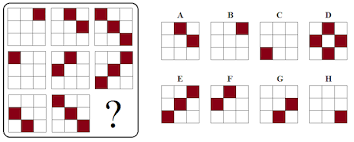
multiple choice intelligence tests measuring abstract reasoning and general cognitive abilities.
Closing Reflection
Fluid intelligence is the foundation of adaptability, innovation, and advanced reasoning. It is the cognitive force that allows humans to navigate uncertainty, solve unprecedented problems, and create entirely new systems of thought.
While crystallized intelligence represents what we already know, fluid intelligence determines how effectively we can respond to what we do not yet understand. In the modern world — especially in fields such as renewable energy, battery technology, artificial intelligence, and entrepreneurship — success increasingly depends on the ability to reason dynamically under changing conditions
Thank you for Reading
메타데이터
- post_id
- b00bbdc26cc2
- slug
- fluid-intelligence-thinking-beyond-experience-b00bbdc26cc2
- url
- https://medium.com/@egbewolesamuel350/fluid-intelligence-thinking-beyond-experience-b00bbdc26cc2
- canonical_url
- https://medium.com/@egbewolesamuel350/fluid-intelligence-thinking-beyond-experience-b00bbdc26cc2
- author_url
- https://medium.com/@egbewolesamuel350
- status
- ok
- fetched_at
- 2026-07-10 06:10:56