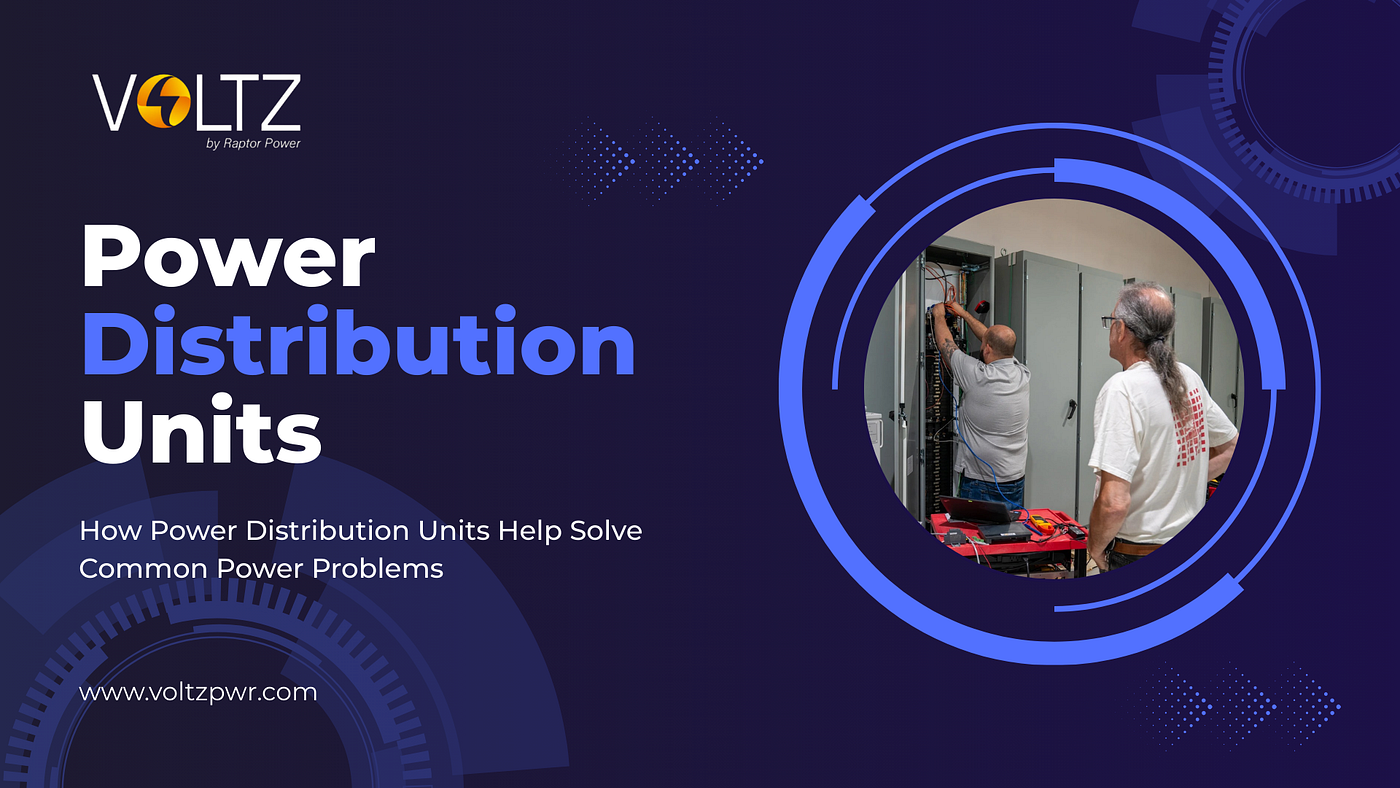
How Power Distribution Units(PDUs) Help Solve Common Power Problems
Power is the most important thing in any modern data center or server room. But just having power isn’t enough. The real test is how that…
How Power Distribution Units(PDUs) Help Solve Common Power Problems
Power is the most important thing in any modern data center or server room. But just having power isn’t enough. The real test is how that power is handled, shared, and kept safe. As rack densities increase and hardware becomes more sensitive, the “dumb” power strips of the past are no longer sufficient.
This is where **Power Distribution Units (PDUs)** come into play. A PDU is far more than a glorified extension cord; it is a sophisticated management tool designed to solve the complex electrical hurdles that keep IT managers awake at night. At Voltz, we believe that understanding these challenges is the first step toward building a resilient infrastructure.
In this guide, we’ll break down the most common power distribution problems and show you exactly how Power Distribution Units (PDUs) provide the solution.
1. The Challenge of “Invisible” Power Consumption
One of the biggest risks in a data centre is not knowing how much power you are actually using until a breaker trips. Without granular data, IT managers often play a dangerous game of guesswork when adding new servers to a rack.
The Problem: Circuit Overloads
When a rack reaches its limit, adding even one small switch can push the current draw over the threshold. This leads to an immediate shutdown of the entire rack, causing downtime and potential data corruption.
The Solution: Real-Time Metering
Modern Power Distribution Units (PDUs) act as a digital fuel gauge for your rack. Metered and Monitored PDUs provide real-time displays of Amps, Volts, and Watts. You can see exactly how much “headroom” you have left when you use Voltz solutions with built-in monitoring. This lets you spread loads out over different phases and stop them from happening before they do.
2. Taking care of equipment in places that are far away or don’t have people around
As edge computing grows, more and more server racks are being put in branch offices, retail closets, and other places where there isn’t any IT staff on-site. When a server hangs or a switch freezes, sending a technician just to “unplug it and plug it back in” is expensive and slow.
The Problem: Costly “Truck Rolls”
The time spent traveling to a site to perform a simple hard reboot can result in hours of downtime for that location.
The Solution: Remote Outlet Control
Switched Power Distribution Units (PDUs) allow you to toggle individual outlets on and off via a web interface from anywhere in the world. If a piece of gear becomes unresponsive, you can perform a remote power cycle in seconds. This feature also allows you to keep unused outlets turned off to prevent unauthorized equipment from being plugged in, which could unexpectedly drain your power capacity.
3. The Nightmare of Messy Cables
Standard power cords are often longer than they need to be, which makes the wiring in the back of the rack look like spaghetti. This isn’t just a matter of looks; it’s also a matter of function.
The Problem: Blocked Airflow and Unintentional Disconnects
Big groups of cables block the air that comes out of servers, which makes the temperature rise and the fans work harder. Furthermore, in a cluttered rack, it is incredibly easy to accidentally snag and pull out the power cord of a mission-critical server while working on a different unit.
The Solution: Organized Form Factors
Power Distribution Units (PDUs) are designed to fit the “0U” vertical space in the back of a rack. This keeps the outlets right next to the equipment inputs, allowing for shorter cables and a much cleaner environment. Many Voltz PDUs also feature locking outlets or retention clips that ensure a plug stays seated even if the cable is tugged, providing physical security to your power chain.
4. Inconsistent Power Quality
Utility power is rarely perfect. It can suffer from “dirty” signals, including voltage spikes, sags, and high-frequency noise caused by large industrial motors or nearby lightning strikes.
The Problem: Hardware Degradation
Sensitive server power supplies (PSUs) can be damaged over time by small, repetitive power surges. A UPS takes care of the “big” outages, but the “last mile” of distribution needs to be clean to keep the hardware working well for a long time.
The Answer: Integrated Power Conditioning
Advanced power distribution units (PDUs) often come with built-in surge protection and EMI/RFI filtering. This “cleans” the power at the point of delivery, making sure that your expensive processors and storage arrays get a steady, smooth sine wave. People often blame software for “ghost errors” and system glitches, but bad electricity is really to blame. PDUs filter out electromagnetic interference to stop these problems.
5. Planning for future growth in capacity
Data centers are always changing; they are not static. If you don’t know your historical power trends, you can’t accurately plan for next year’s budget or hardware refresh.
The Problem: Stranded Capacity
Without data, many facilities over-provision power, meaning they pay for more electricity and cooling than they actually need. Conversely, under-provisioning leads to emergency upgrades that are twice as expensive.
The Solution: Data-Driven Analytics
Intelligent Power Distribution Units (PDUs) collect historical data on power usage. By integrating these units into your Building Management System (BMS) or DCIM software, you can run reports to find “zombie servers” (units that are on but doing no work) and identify racks that are underutilized. This insight helps you optimize your existing space and delay expensive facility expansions.
Conclusion: Why PDUs are Non-Negotiable
In the modern IT landscape, the risk of downtime is too high to leave power distribution to chance. Power Distribution Units (PDUs) solve the fundamental problems of visibility, control, and organization. Whether you are running a single rack or a global network of data centres, investing in high-quality PDUs is the most cost-effective way to protect your uptime.
At **Voltz**, we specialize in providing the “intelligent backbone” for your infrastructure, ensuring that your power is always a tool for success rather than a source of stress.
Frequently Asked Questions (FAQs)
1. What’s the difference between a “Basic” PDU and a “Intelligent” PDU?
A basic PDU only sends power to a few outlets and doesn’t have any features for monitoring. An Intelligent PDU, which can be metered, monitored, or switched, tells you how much power you’re using and often lets you control it from a distance and keep an eye on the environment.
2. Is it okay to use a regular power strip instead of a PDU in a server rack?
A power strip will technically give you power, but it’s not a good idea to use one in a server room. Standard power strips don’t have the industrial-grade parts, high-amperage ratings, or mounting options that are needed for servers to run all the time. They also don’t have the circuit protection that would keep a single piece of equipment from bringing down the whole strip.
3. How do PDUs help with cooling?
By utilizing a vertical (0U) mounting style, Power Distribution Units (PDUs) stay out of the way of the server’s hot air exhaust. This improves the overall airflow within the rack, allowing the cooling system to work more efficiently and reducing the energy costs associated with fans and air conditioning.
4. What are NEMA and IEC outlets, and why do they matter?
These are the standard shapes of the plugs and sockets. Most servers use IEC (C13/C19) connectors because they are global standards and often feature locking mechanisms. Choosing the right outlet configuration on your PDU ensures you don’t need a mess of adapters to plug in your gear.
5. Do I need a PDU if I already have a UPS?
Yes. A UPS (Uninterruptible Power Supply) provides battery backup and protects against total power loss, but it usually only has a few outlets. A PDU takes that protected power from the UPS and distributes it to the 20, 30, or 40 individual devices inside your rack.
6. Can PDUs monitor temperature and humidity?
Many intelligent PDUs feature ports for external sensors. This allows you to monitor the environment at the rack level (top, middle, and bottom) and receive alerts if the rack gets too hot or too humid, which can be a precursor to hardware failure.
메타데이터
- post_id
- b02c7fa2f36a
- slug
- how-power-distribution-units-pdus-help-solve-common-power-problems-b02c7fa2f36a
- url
- https://medium.com/@voltzpwr/how-power-distribution-units-pdus-help-solve-common-power-problems-b02c7fa2f36a
- canonical_url
- https://medium.com/@voltzpwr/how-power-distribution-units-pdus-help-solve-common-power-problems-b02c7fa2f36a
- author_url
- https://medium.com/@voltzpwr
- status
- ok
- fetched_at
- 2026-07-13 16:16:37