Why Your AI Can’t Just “Read” the Law (Yet)
We’ve all been there: you have a massive PDF of a new government Act, and you think, “I’ll just feed this to an AI, and it’ll tell me…
Why Your AI Can’t Just “Read” the Law (Yet)
We’ve all been there: you have a massive PDF of a new government Act, and you think, “I’ll just feed this to an AI, and it’ll tell me exactly how to stay compliant.”
It sounds like the future. Unfortunately, right now, it’s a bit of a recipe for a regulatory headache. While AI is brilliant at summarizing your emails or writing poetry about cats, legal compliance is a different beast entirely.
Here is why we can’t just “plug and play” with PDFs, and why we need a better way to teach AI the law.
1. The “Digital Paper” Problem
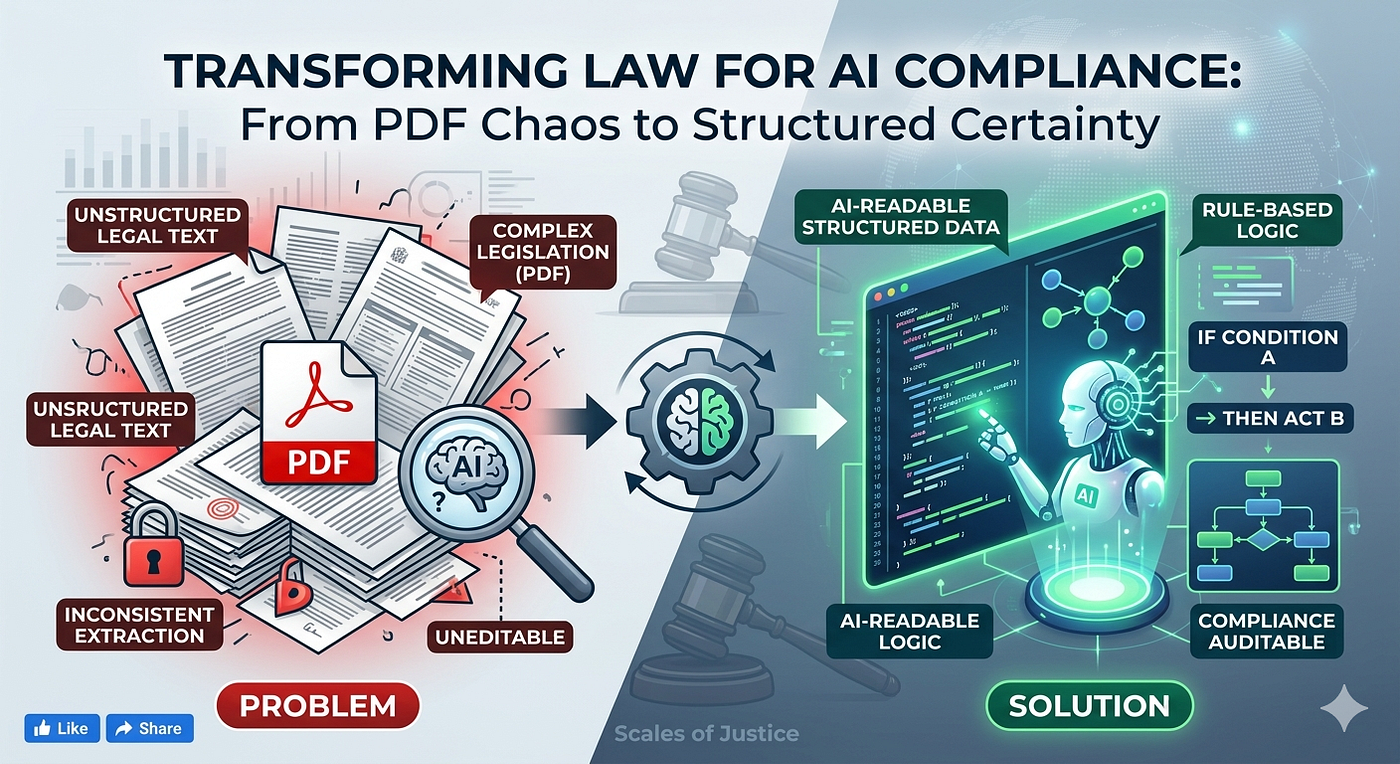
A PDF is essentially a photograph of a piece of paper. To a human, it looks organized. To an AI, it’s often a messy soup of text.
- Extraction isn’t uniform: If you pull text from a PDF and then from a Word doc of the same law, the AI might see them differently. Page numbers, headers, footers, and weird column layouts can confuse the system.
- The “Un-editable” hurdle: For regulatory purposes, a PDF is static. You can’t easily tag specific clauses or link them to internal company policies in a way that an AI can “track” reliably.
2. You Can’t Grade a “Black Box”
In the legal world, “because the AI said so” isn’t a valid defense. If you use AI to implement a new regulation, you need to show your work.
If you simply upload a 200-page Act, you lose traceability. You need to know:
- Exactly which provision was extracted.
- How that provision was interpreted.
- Where it was applied in your business processes.
Without a structured format, the AI’s logic remains a “black box.” If a regulator knocks on your door, you need to be able to point to the specific line of code or data that corresponds to a specific line of the law.
3. From “Reading” to “Implementing”
To make AI truly useful for law, we have to move away from documents and toward structured data.
Imagine converting an Act into a format that looks more like a map or a flowchart. Instead of just “reading” words, the AI sees:
IF [Condition A] is met, THEN [Requirement B] applies.
When we convert legislation into a machine-readable format (like XML or JSON), the AI isn’t just guessing based on patterns — it’s following a structured set of rules. This makes the implementation accurate, repeatable, and auditable.
The Bottom Line
Feeding a raw PDF to an AI is like giving a chef a picture of a grocery store and asking them to make dinner. They might guess what’s inside, but they can’t actually cook with it.
If we want AI to help us navigate the complex world of regulation, we first need to give it the right “ingredients”: structured, machine-readable legislation. Only then can we move from mere “chatting” to actual, reliable compliance.
메타데이터
- post_id
- b033cef6ee2a
- slug
- why-your-ai-cant-just-read-the-law-yet-b033cef6ee2a
- url
- https://medium.com/@amlguru/why-your-ai-cant-just-read-the-law-yet-b033cef6ee2a
- canonical_url
- https://medium.com/@amlguru/why-your-ai-cant-just-read-the-law-yet-b033cef6ee2a
- author_url
- https://medium.com/@amlguru
- status
- ok
- fetched_at
- 2026-06-12 18:14:10