AI Shiny Object Syndrome: Why Enterprises Chase Hype, Deliver Nothing
From Capability Demonstration to Enterprise Readiness
AI Shiny Object Syndrome: Why Enterprises Chase Hype, Deliver Nothing
From Capability Demonstration to Enterprise Readiness
Abstract
Many AI proof-of-concepts (POCs) succeed technically yet fail to transition into production. The dominant reason is not model inadequacy — it is a mismatch between technical capability and enterprise operating readiness.
A POC demonstrates value in a controlled environment. Production demands durable data pipelines, workflow integration, governance, observability, compute strategy, and accountable ownership.
Industry analysts consistently reinforce this shift:
- Forrester emphasizes that AI is transforming the CIO role from delivery oversight to governing outcomes at scale.
- Deloitte highlights observability, trust, and human oversight as foundational for sustainable AI operations.
- Gartner warns that up to 60% of AI projects lacking AI-ready data and governance will be abandoned through 2026.
Despite this, enterprises continue to misread early success. A pilot works, stakeholders are impressed, and the organization assumes it is “AI-ready”. Organizations celebrate the win, then race to launch 10 more pilots, assuming AI solves everything. That assumption is usually wrong.
What appears as progress is often proof of capability — not proof of operational readiness.
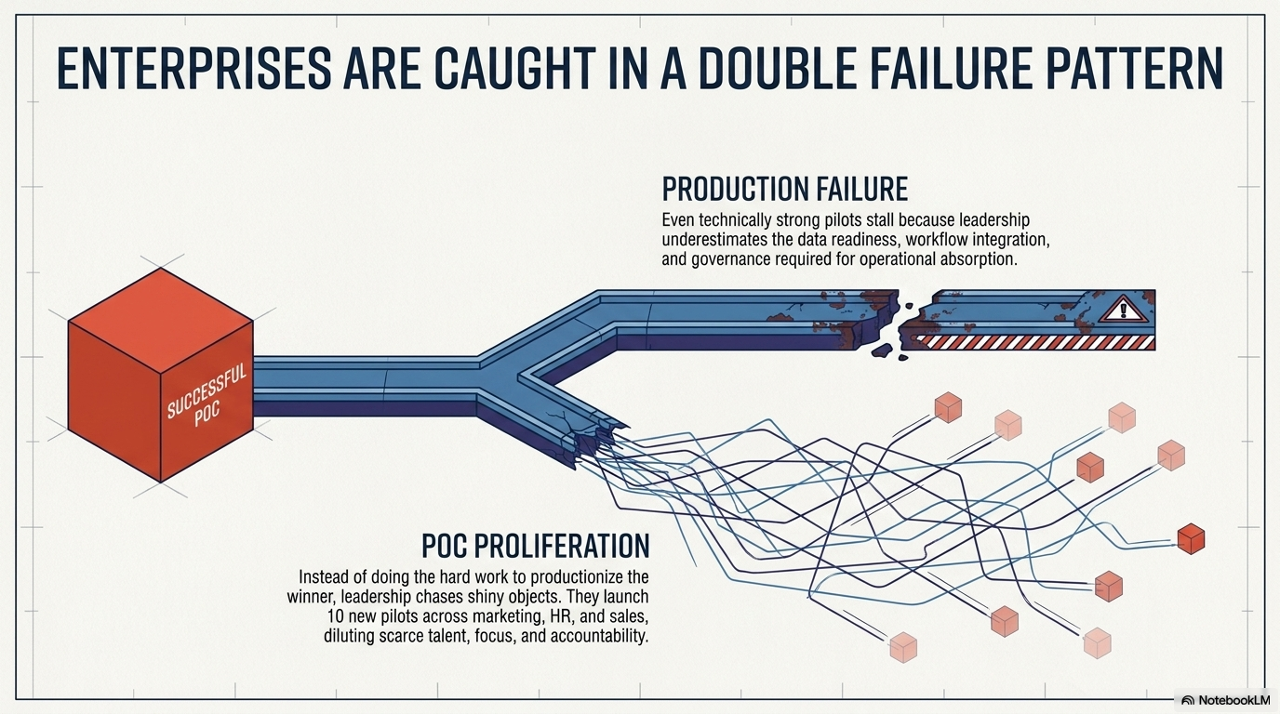
Executive Insight: The Double Failure Pattern
Enterprises today face a dual trap:
1. Production Failure A strong POC fails to scale due to missing operational foundations.
2. POC Proliferation Success leads to more pilots instead of productionization, diluting focus and ownership.
Industry observation suggests:
- Only 10–15% of AI pilots successfully scale to production (Forrester-aligned estimates)
- Up to 85% of AI initiatives fail due to poor data quality and readiness
- Organizations overinvest in experimentation while underinvesting in operationalization discipline
The result: A portfolio of impressive demos, but no systems delivering sustained enterprise value.
1. Problem Statement
A POC validates capability under controlled conditions.
Production requires reliability under real-world complexity:
- Data variability
- Workflow dependencies
- Regulatory scrutiny
- System integrations
- Evolving business context
This introduces five distinct dimensions:

Most enterprises solve only the first — and stall on the remaining four.
2. The Pilot Illusion
A successful POC answers a narrow question: “Can the model do something useful?”
It may:
- Summarize documents
- Classify tickets
- Generate responses
- Retrieve insights
But production introduces a fundamentally different question:
“Can the enterprise rely on this system — consistently, safely, and at scale?”
This is where most pilots fail.
As Deloitte notes:
- High-performing teams using AI (78%) outperform others (54%)
- Yet performance gains come from trust, governance, and human integration — not technology alone
AI moves to production only when teams are ready to work with it, not when models are ready.
3. Core Failure Modes

3.1 Data Is Not AI-Ready
Production AI requires:
- Region-specific data (language, regulations, behavior)
- Organization-specific data (policies, workflows, exceptions)
POCs often rely on:
- Public datasets
- Synthetic data
- Limited samples
This creates false confidence.
Industry insight:
- Poor data quality contributes to **~85% of AI project failures
- Gartner: Data readiness is the primary bottleneck to AI scale**
Reality: AI doesn’t fail because models are weak. It fails because data is misaligned with business context.
3.2 Workflow Fit Matters More Than Model Fit
A POC lives outside real workflows. Production requires embedding AI into messy real world:
- Systems of record (often includes legacy systems)
- APIs
- Approval chains
- Exception handling
- Audit trails
- Compliance controls
This often requires workflow redesign — not API integration.
Common breakdowns:
- AI output is useful, but workflows remain unchanged
- Humans still validate everything → no efficiency gain
- Legacy systems block integration
As Forrester emphasizes: AI success requires balancing democratization with governance and control.
Insight: Production AI is not about adding intelligence. It is about rewiring decision systems.
3.3 Monitoring and Retraining Are Not Institutionalized
AI systems degrade due to:
- Data drift
- Concept drift
- Changing user behavior
- Process evolution
Yet most POCs treat deployment as the finish line.
Production requires:
- Continuous monitoring (quality, latency, cost, trust)
- Drift detection
- Retraining pipelines
- Versioning and rollback
- Incident response mechanisms
Deloitte frames this as AI observability — a core enterprise capability.
Without AI Observability: A high-performing POC becomes a silent production risk.
3.4 Compute Strategy Is Frequently Misjudged
POCs often run on CPU infrastructure due to convenience.
Production reality:
- Large models
- Embedding-heavy workloads
- Retrieval pipelines
- Real-time inference
These demand GPU acceleration and architectural planning.
Mismatch leads to:
- Latency failures
- Throughput bottlenecks
- Cost overruns
Key Insight: Compute is not an infrastructure decision. It is an architectural commitment tied to workload economics.
3.5 Governance and Accountability Are Undefined
AI falls into enterprise no man’s land: No one owns the AI system end-to-end. AI is inherently cross-functional:
- Data
- Models
- Infrastructure
- Workflows
- Risk
- Business outcomes
Traditional org structures were not designed for this.
So after POC:
- Engineering says “build is done”
- Product says “value is proven”
- IT says “platform exists”
- DevOps says “deployment works”
Yet: No team owns lifecycle accountability.

This is why AI succeeds as a project but fails as a product.
Forrester advocates federated operating models to address this gap.
4. Operational Readiness Debt
When enterprises move faster on capability than governance, they accumulate:
Operational Readiness Debt
Symptoms:
- Undefined ownership
- Weak fallback mechanisms
- No clear failure thresholds
- “We’ll operationalize later” mindset
This debt surfaces only when:
- A system fails
- A regulator questions decisions
- A customer impact occurs
At that point, it is too late.
5. Required Operating Model
Scaling AI requires a dedicated operating construct.
Three-Layer Model
1. Central Platform & Governance
This layer establishes shared capabilities and common controls.
- Approved model and tooling standards.
- Security, privacy, and compliance guardrails.
- Shared observability and evaluation frameworks.
- GPU/CPU capacity planning and platform engineering.
- Central policies for release, rollback, and incident response.
2. Domain AI Operations
This layer sits close to business workflows and owns contextual reliability.
- Domain-specific evaluation criteria.
- Workflow integration and exception handling.
- Region-specific and organization-specific data refinement.
- Human review design and escalation procedures.
- Continuous prompt, retrieval, or model tuning for the use case.
3. Business Ownership
This layer determines where and how the organization is prepared to rely on AI.
- Use-case prioritization.
- Decision-rights definition.
- Acceptable-risk thresholds.
- Adoption and change management.
- Value realization and performance review
This model works best when the central layer provides standards and platforms, while domain units own operationalization inside specific workflows.
**Critical Roles
- AI Product Owner** → business value
- Model Owner (ML Owner) → model quality & drift
- AI Operations Lead → runtime reliability
- Data Steward → data quality & lineage
- Risk & Compliance Partner → governance & auditability

6. Continuous Maintenance: The Reality of Production AI
AI systems are never “done.”
A production model requires:
- Continuous monitoring
- Periodic retraining
- Workflow adaptation
- Governance reviews
Typical cadence: - Weekly → performance monitoring
- Monthly → drift & feedback review
- Quarterly → governance & risk validation
- Periodic → retraining or retuning using updated organization data, local language patterns, process changes, and new edge cases.
Architecture review cadence for CPU/GPU deployment choices, vendor dependencies, and capacity planning
As both Deloitte and Gartner emphasize: AI operations are a continuous discipline — not a deployment milestone
7. POC-to-Production Readiness Checklist
Before scaling, organizations must answer:
Data
- Is data representative and governed?
- Is organization-specific context included?
- Are quality, privacy, lineage and access controls defined?
Workflow
- Is AI embedded into real workflows?
- Are fallback and exception paths defined?
- Are the surrounding applications and APIs prepared to consume and govern the output?
Operations
- Are monitoring and retraining defined?
- Are rollback and incident response procedures in place?
- Is compute architecture validated against production load?
Governance
- Are ownership and accountability clear?
- Are acceptable failure thresholds defined?
- Is AI evidence based and defensible?
If not: You have a successful POC — but not a production-ready system.
Conclusion
The critical question is no longer: “Does the AI work?”
It is: “Is the enterprise ready to rely on it — responsibly, continuously, and at scale?”
The solution is structural: AI must evolve from a project to an operating model.
The next phase of AI maturity and scale will belong to organizations that build:
- Lifecycle ownership
- Federated governance
- Continuous monitoring discipline
Those that do not will continue producing: Impressive pilots that never become systems of record.
메타데이터
- post_id
- b0370d3e90ec
- slug
- ai-shiny-object-syndrome-why-enterprises-chase-hype-deliver-nothing-b0370d3e90ec
- url
- https://medium.com/@maruthis/ai-shiny-object-syndrome-why-enterprises-chase-hype-deliver-nothing-b0370d3e90ec
- canonical_url
- https://medium.com/@maruthis/ai-shiny-object-syndrome-why-enterprises-chase-hype-deliver-nothing-b0370d3e90ec
- author_url
- https://medium.com/@maruthis
- status
- ok
- fetched_at
- 2026-06-23 03:48:11




