I Analyzed Child Health Data for 230 Countries, Here’s What Surprised Me
I analyzed Nasa’s child mortality, water access, and sanitation data for 230+ countries. The findings are both heartbreaking and hopeful.
I Analyzed Child Health Data for 230 Countries, Here’s What Surprised Me
Photo by Muhammad-Taha Ibrahim on Unsplash
I analyzed Nasa’s child mortality, water access, and sanitation data for 230+ countries. The findings are both heartbreaking and hopeful.
The dataset covers 230+ countries from 2010 to 2022, tracking child mortality rates, water access, and sanitation infrastructure. I expected to find inequality. I didn’t expect what the data actually revealed.
Full Report: https://datastam.ai/story/the-child-health-revolution-nobody-s-talking-about-2HOiQ0yBZm Data Source: https://www.earthdata.nasa.gov/data/catalog/sedac-ciesin-sedac-nrmi-nrpchi23-2023.00
The Good News: 56% of Countries Are Making Progress
Let’s start with hope.
131 out of 232 countries improved simultaneously across all three metrics: water access, sanitation, and child survival rates (between 2010 and 2022).
That’s more than half the world moving in the right direction on multiple fronts at once.
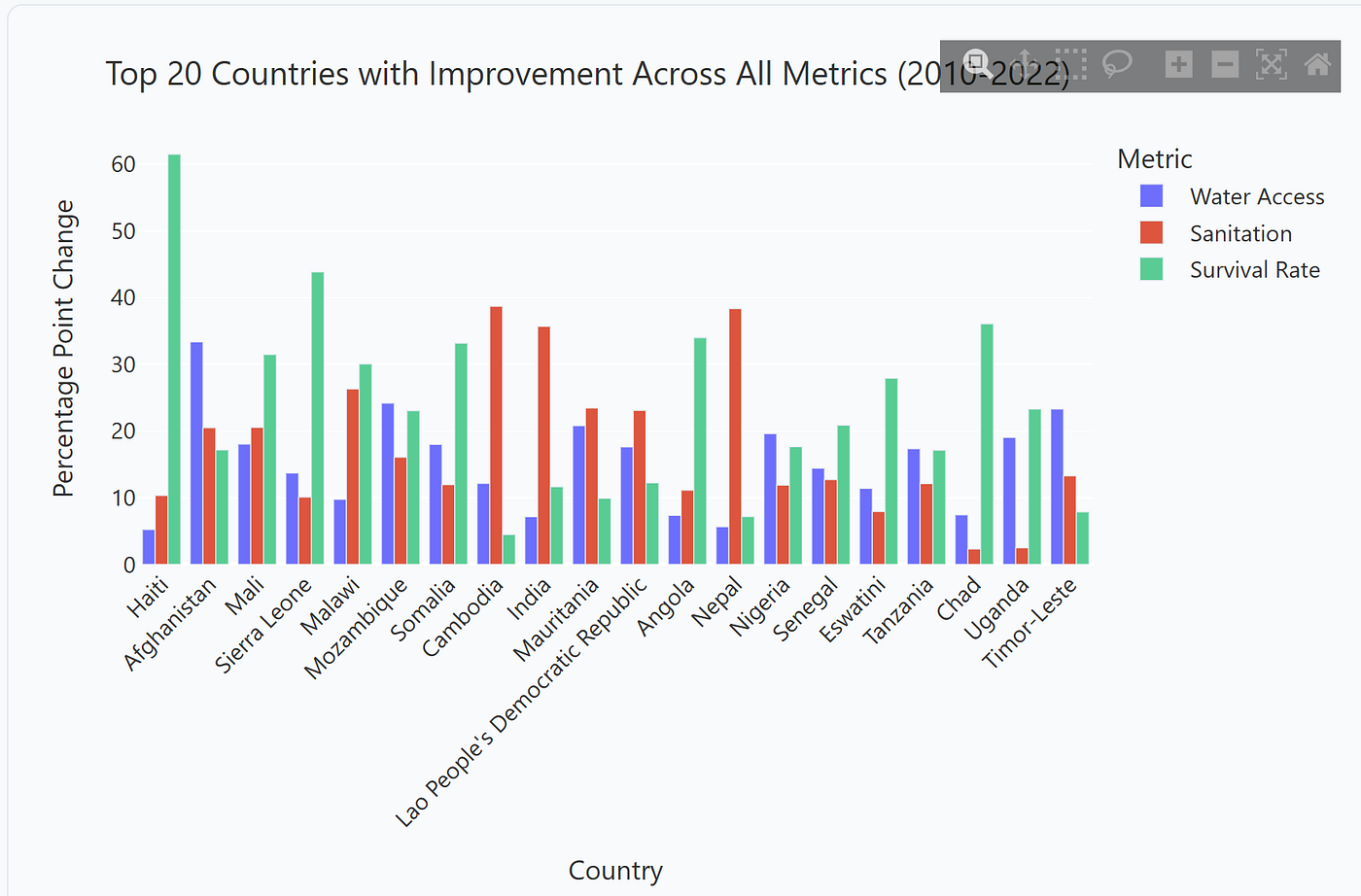
Top 20 countries ranked by their combined improvement across all three metrics

Top 5 biggest improvers
These aren’t wealthy nations with endless resources. They’re some of the world’s poorest countries, and they’re making measurable progress.
Haiti’s Remarkable Turnaround
The most striking finding: Haiti reduced child mortality by 76% in 12 years.
In 2010, Haiti’s child mortality rate was 58.23 per 1,000 births. By 2022, it had fallen to 13.85.
Context matters here. The 2010 earthquake devastated Haiti’s healthcare infrastructure, likely inflating that baseline number. But even accounting for that, the sustained improvement is remarkable for a country facing ongoing political instability and natural disasters.


Sierra Leone tells a similar story , cutting child mortality from 60.32 to 28.68 despite the 2014–2015 Ebola outbreak.
The lesson: Progress is possible even in the most challenging circumstances.
The Sanitation Revolution You Haven’t Heard About
Three countries transformed their sanitation infrastructure in just 12 years.

India’s Swachh Bharat Mission (Clean India Mission), launched in 2014, built over 100 million toilets. The data confirms it worked, sanitation access nearly doubled.
Cambodia and Nepal achieved similar gains through sustained NGO partnerships and government investment.
These aren’t incremental improvements. They’re transformational.
Now the Hard Truth: 43 Countries in Crisis
The data identified 43 countries where children face a deadly combination: high mortality rates AND limited access to clean water.

The threshold: child mortality above 8.52 per 1,000 (75th percentile) AND water access below 84% (25th percentile).
The most vulnerable:

Niger: A child mortality rate of 59.17 means roughly 1 in 17 children don’t survive. Combined with less than half the population having water access, it represents the most acute child health crisis on the planet.
These 43 countries aren’t randomly distributed. They cluster in Sub-Saharan Africa and conflict zones . The places where instability compounds infrastructure challenges.
The Water-Sanitation Gap Nobody Talks About
Here’s a pattern I didn’t expect: many countries provide clean water but can’t handle wastewater.

The largest gaps between water access and sanitation:

Ghana can get clean water to 88% of its population, but only 29% have proper sanitation.
Why the gap? Wells and water distribution are relatively straightforward infrastructure projects. Sewage systems require complex networks, treatment plants, and ongoing maintenance.
This creates a dangerous cycle. Without proper sanitation, water sources become contaminated. The investment in water access gets undermined by the lack of sanitation infrastructure.
The Health-Infrastructure Connection
The data reveals a near-perfect relationship between water, sanitation, and child health outcomes.
Water and sanitation access correlate at 0.89 — countries investing in one almost always invest in both.

More importantly: child mortality drops predictably as water and sanitation improve.

Countries with >90% sanitation access have average child mortality under 2 per 1,000. Countries with <50% sanitation access? Average mortality above 25 per 1,000. That’s not correlation — it’s causation. Clean water and proper sanitation directly prevent the waterborne diseases that kill children.
The pattern is obvious: wealth, stability, and strong healthcare systems.
The Top Performers (And What They Share)
The 10 countries with the highest child health indicator scores:

The pattern is obvious: wealth, stability, and strong healthcare systems.
But here’s what’s interesting — only 10 countries showed declining child health scores from 2010 to 2022, and the declines were tiny (less than 1.1 points).

Even wealthy countries that might have “peaked” continued making marginal improvements. The Marshall Islands (-1.10), Poland (-1.03), and Georgia (-0.34) were the only notable exceptions.
18 Countries Beating the Odds
The analysis found something unexpected: 18 countries achieved excellent child health outcomes despite below-average water or sanitation access.

These “resilient” countries include Cuba, Iran, Ecuador, and several Eastern European nations.
How? Strong primary healthcare systems, vaccination programs, and nutrition initiatives can partially compensate for infrastructure gaps.
Cuba scores 95.13 on child health with only 92% sanitation access — outperforming countries with better infrastructure. Their community-based healthcare model, focused on prevention and early intervention, makes the difference.
The takeaway: Infrastructure matters, but it’s not the only lever.
What This Data Tells Us
1. Progress is real and measurable. 56% of countries improved across water, sanitation, AND child survival simultaneously. The global trend is positive.
2. The gap is still deadly. 43 countries remain in crisis. A child born in Niger is 500x more likely to die before age 5 than one born in Andorra.
3. Sanitation is the bottleneck. Many countries solved water access but lag dramatically on sanitation. This undermines other health investments.
4. Infrastructure isn’t everything. Healthcare systems, nutrition programs, and community health workers can achieve strong outcomes even with infrastructure challenges.
5. Investment works. Cambodia, India, and Nepal prove that sustained focus on sanitation can transform outcomes in a single decade.
Explore the Data Yourself: https://datastam.ai
Full Report: https://datastam.ai/story/the-child-health-revolution-nobody-s-talking-about-2HOiQ0yBZm
If you found this analysis valuable, follow for more data-driven insights on global development, health, and making sense of complex datasets.
datascience #dataanalysis #aianalysis #ai #nasa
메타데이터
- post_id
- b037cc31b4d8
- slug
- i-analyzed-child-health-data-for-230-countries-heres-what-surprised-me-b037cc31b4d8
- url
- https://medium.com/deepdatascience/i-analyzed-child-health-data-for-230-countries-heres-what-surprised-me-b037cc31b4d8
- canonical_url
- https://medium.com/deepdatascience/i-analyzed-child-health-data-for-230-countries-heres-what-surprised-me-b037cc31b4d8
- author_url
- https://medium.com/@Adarsh4052
- status
- ok
- fetched_at
- 2026-06-12 22:02:08