Nordic 90s Fashion Portraits images in Midjourney evading the Cliché
How to recreate the real Scandinavian editorial look from the 1990s using cultural cross-references, physical anchors, and low stylization.
Nordic 90s Fashion Portraits images in Midjourney evading the Cliché
How to recreate the real Scandinavian editorial look from the 1990s using cultural cross-references, physical anchors, and low stylization.
Today I’ve decided to talk about artists and their influence on Midjourney, and how we can make the most of them. Let’s say we want to create prompts related to “1990s Nordic fashion” perhaps, if we take a broad look without getting into too many details, names like Jürgen Teller might come up, since he shares several superficial visual cues with that aesthetic, even though historically he doesn’t really belong to it.
So, we might type “Jürgen Teller style, ’90s fashion, grainy,” hoping the model will do the rest. But Midjourney has seen that combination thousands of times, and its response is predictable: a faded portrait with generic grain, soft blur, and that unmistakable AI smoothness that ruins the whole point. Anyone could have generated the image, even without using the reference.
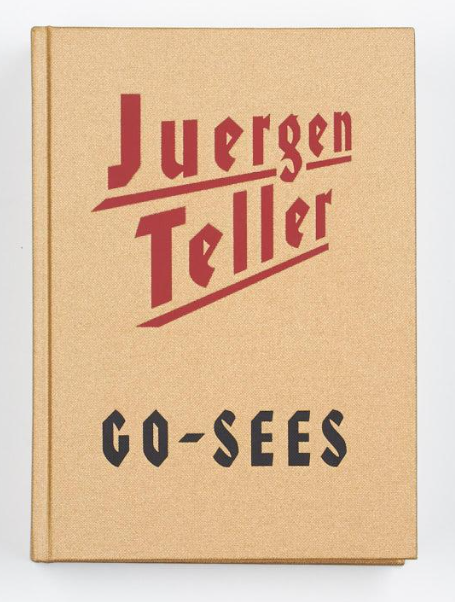
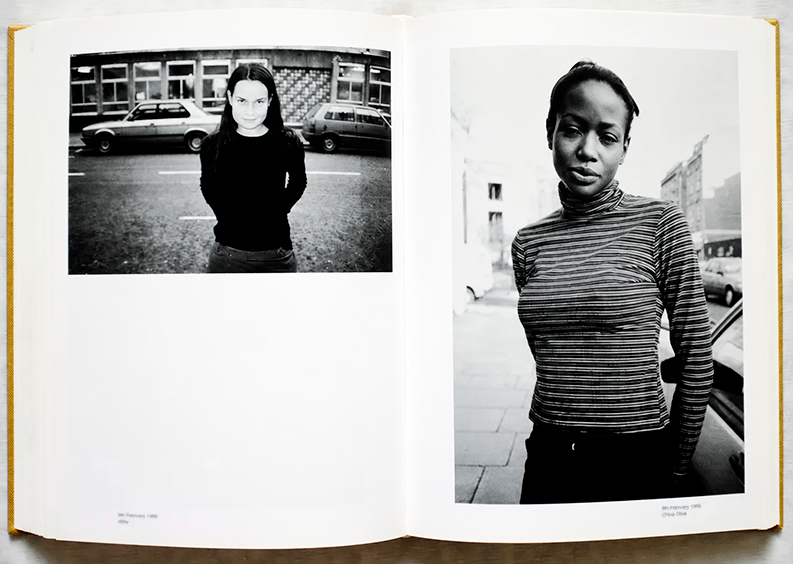
Go-sees (Juergen Teller) book — Published in 1999, the work features candid, unfiltered portraits of hundreds of aspiring models who visited his London studio over the span of a year.
The actual visual DNA of Scandinavian fashion photography in the 1990s was something else entirely. Colder. Quieter. More architectural. If you look at the editorial work coming out of Stockholm and Copenhagen in that decade, the images feel empty on purpose. The subject doesn’t dominate the frame, the space does. The light is flat, almost clinical. The grain is aggressive, not decorative. And the emotional register is not nostalgia, it’s alienation. And this is really interesting when we want to communicate that emotion.
I spent time studying this and testing combinations in Midjourney v8.1 to find a method that actually reproduces this look. What I found is that the key is not describing the aesthetic with adjectives, it’s combining specific cultural references that pull the model away from its default latent space.
Why “Juergen Teller style” fails
Before showing what works, let me show what doesn’t.
Juergen Teller is the name everyone reaches for when they think “90s fashion photography.” And it makes sense, he’s iconic. But in Midjourney, his name triggers an overfit: direct flash, washed highlights, deliberate ugliness. That’s one very specific subset of his work, and it’s the one the model knows best because it’s the most shared online. The subtlety, the compositional intelligence, the tension between beauty and discomfort, none of that comes through.
Here’s the prompt:
Prompt: fashion portrait in the style of Juergen Teller, woman in designer clothes standing in a bathroom, flash photography, candid snapshot, raw look, 90s fashion editorial — ar 3:4 — raw — stylize 300 — v 8.1
Result:
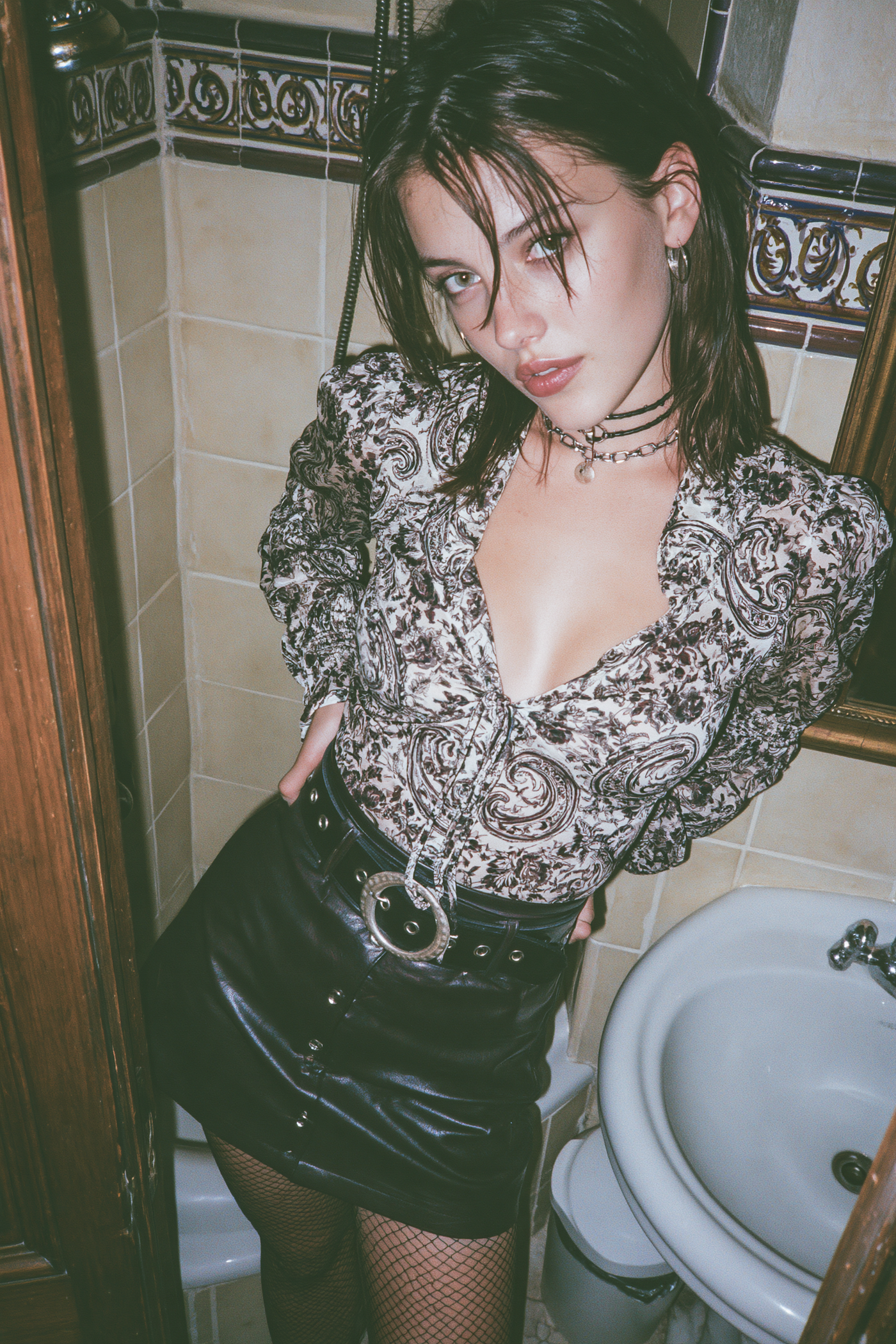
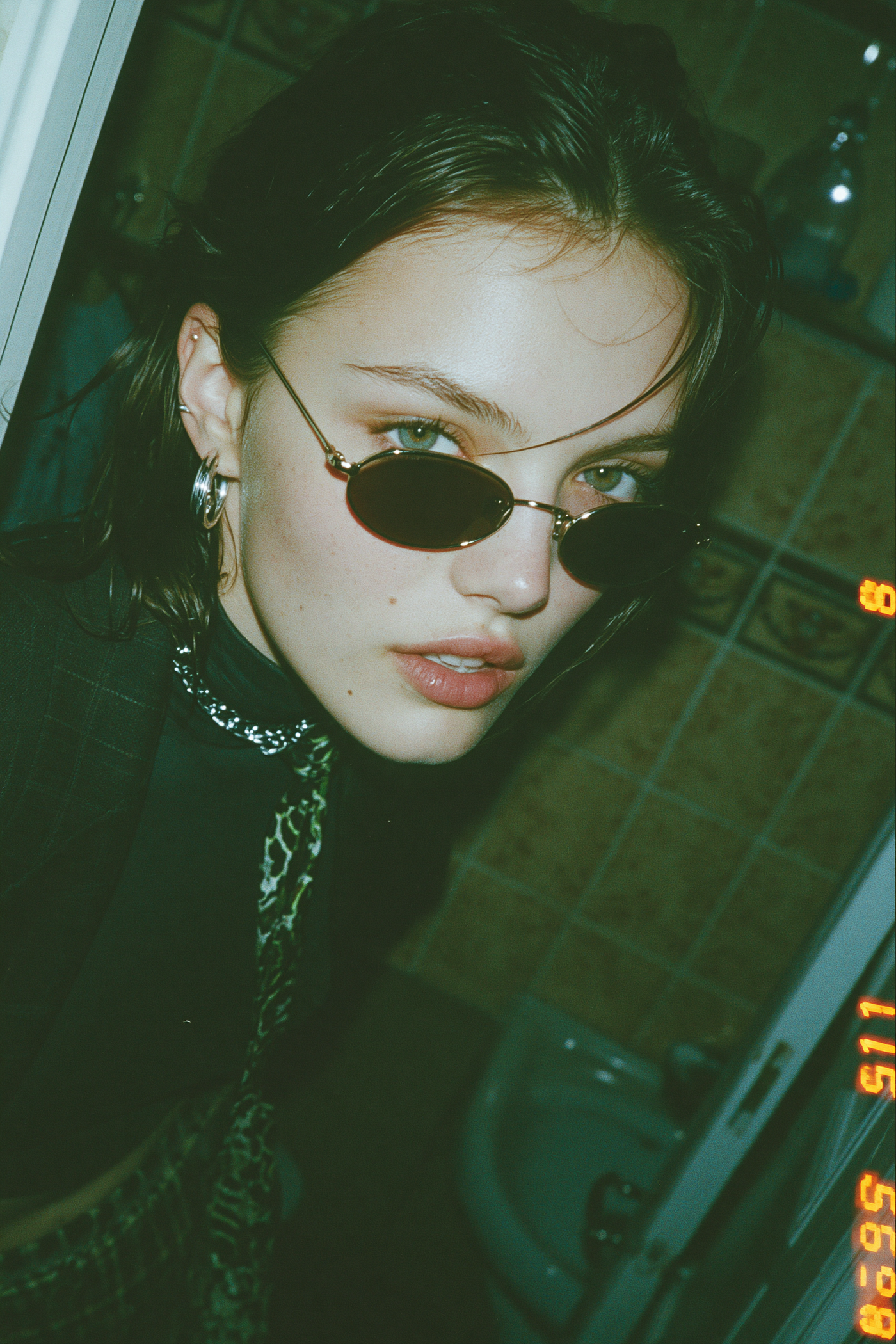
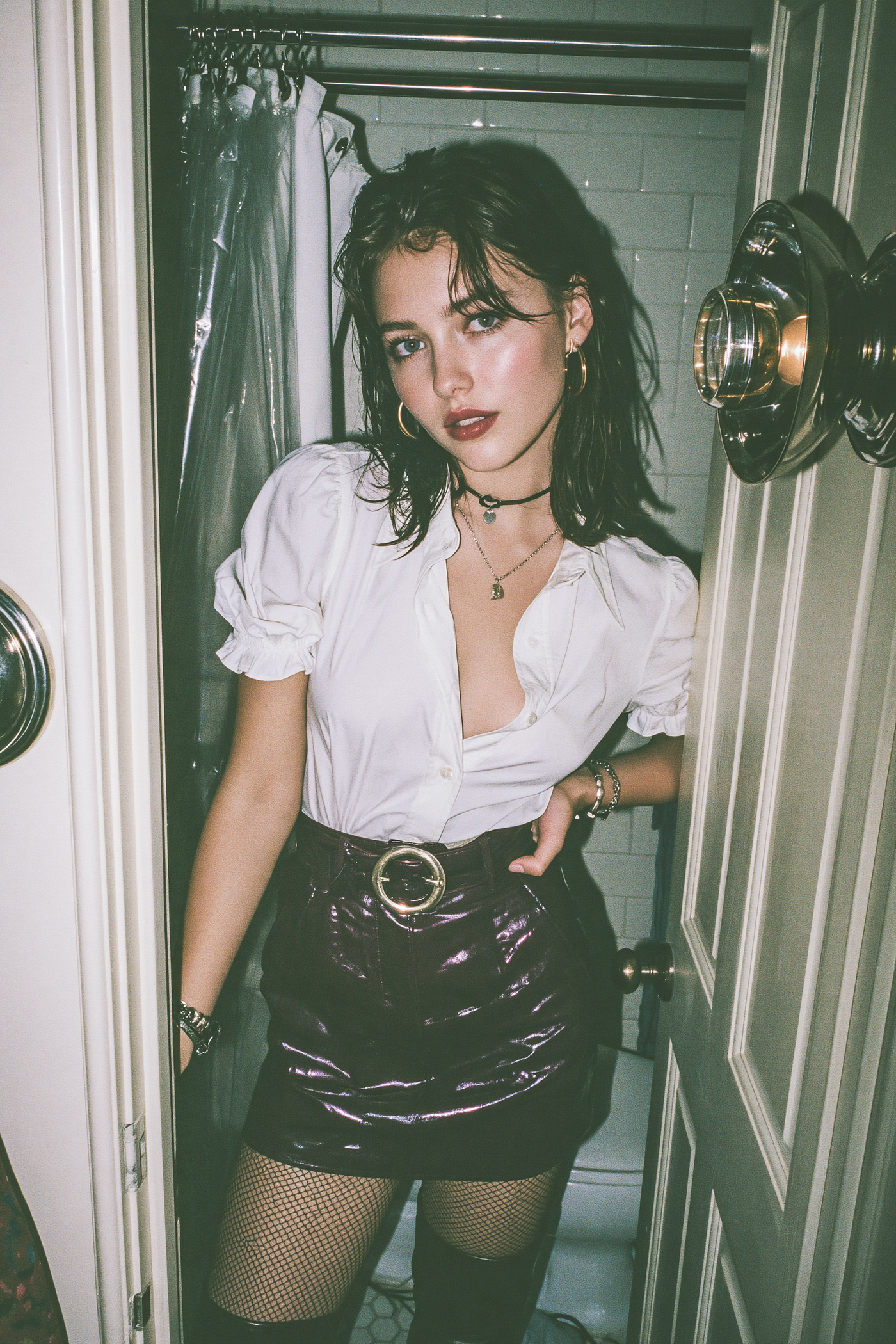
When you use only an author’s name as a reference without describing their technique and aesthetic style, you may end up with a generic Midjourney image. The Midjourney style has overshadowed the author’s name.
You’ll notice the result looks like a thousand other Midjourney images. The flash is there, the grain is there, but the soul isn’t. This is what happens when you rely on a single famous name without specifying the technical DNA underneath it. The model gives you the most probable version of that name, which is the most generic one.
When you use only an author’s name as a reference without describing their technique and aesthetic style, you may end up with a generic Midjourney image. The Midjourney style has overshadowed the author’s name.
The combination that works: Anders Petersen × Robby Müller
Instead of using an obvious fashion photographer, I went to a completely different place.
Anders Petersen is a Swedish documentary photographer known for his legendary project *Café Lehmitz, where he spent three years in the late 1960s photographing the regulars of a dive bar in Hamburg’s red-light district. His images are grainy, claustrophobic, black-and-white, shot extremely close to his subjects with an intimacy that feels almost invasive. Tom Waits used one of his photographs for the cover of [Rain Dogs](https://media.pitchfork.com/photos/67fd6f7a7e337b2e27da13bc/1:1/w_320,c_limit/Tom%20Waits:%20Rain%20Dogs.jpg)*. Petersen doesn’t make pretty pictures, he makes honest ones.
Robby Müller was a Dutch cinematographer who defined the visual language of Wim Wenders’ and Jim Jarmusch’s films, from Paris, Texas to Down by Law to Dead Man. He was called the “Master of Light” and was famous for working almost exclusively with available light, creating a naturalistic, emotionally transparent image that feels like reality caught on camera. He never lit a scene to make it beautiful, he lit it to make it true.
These two never worked together, but their visual languages share something: a refusal to embellish. When you combine them in a prompt, Midjourney gets pulled toward a very specific register, one that’s cold, grainy, intimate, and structurally honest.
But here’s the critical part: naming them is not enough. You also need physical anchors that prevent the model from falling back to its default portrait. A woman standing against a wall is Midjourney’s most generic composition. A woman pressing her forehead against a fogged bathroom mirror is not.
Prompt: medium-close grainy black and white editorial portrait of a 30-year-old Swedish woman with smudged eyeliner and damp short hair, leaning her forehead against a fogged bathroom mirror in a 1970s Stockholm apartment, photographed in the spirit of Anders Petersen, cinematography by Robby Müller, shot on 35mm Ilford HP5 400 pushed to 1600 with Nikon FM2 and 35mm f/1.4 Nikkor, single bare tungsten bulb above the mirror casting hard top-down light with deep eye socket shadows, high contrast monochrome with crushed blacks and blown highlights on the mirror fog, claustrophobic framing with heavy vignetting, cracked tile grout and condensation droplets on chrome fixtures, coarse aggressive grain structure with motion blur on the edges of the hands — ar 3:4 — raw — stylize 80 — v 8.1
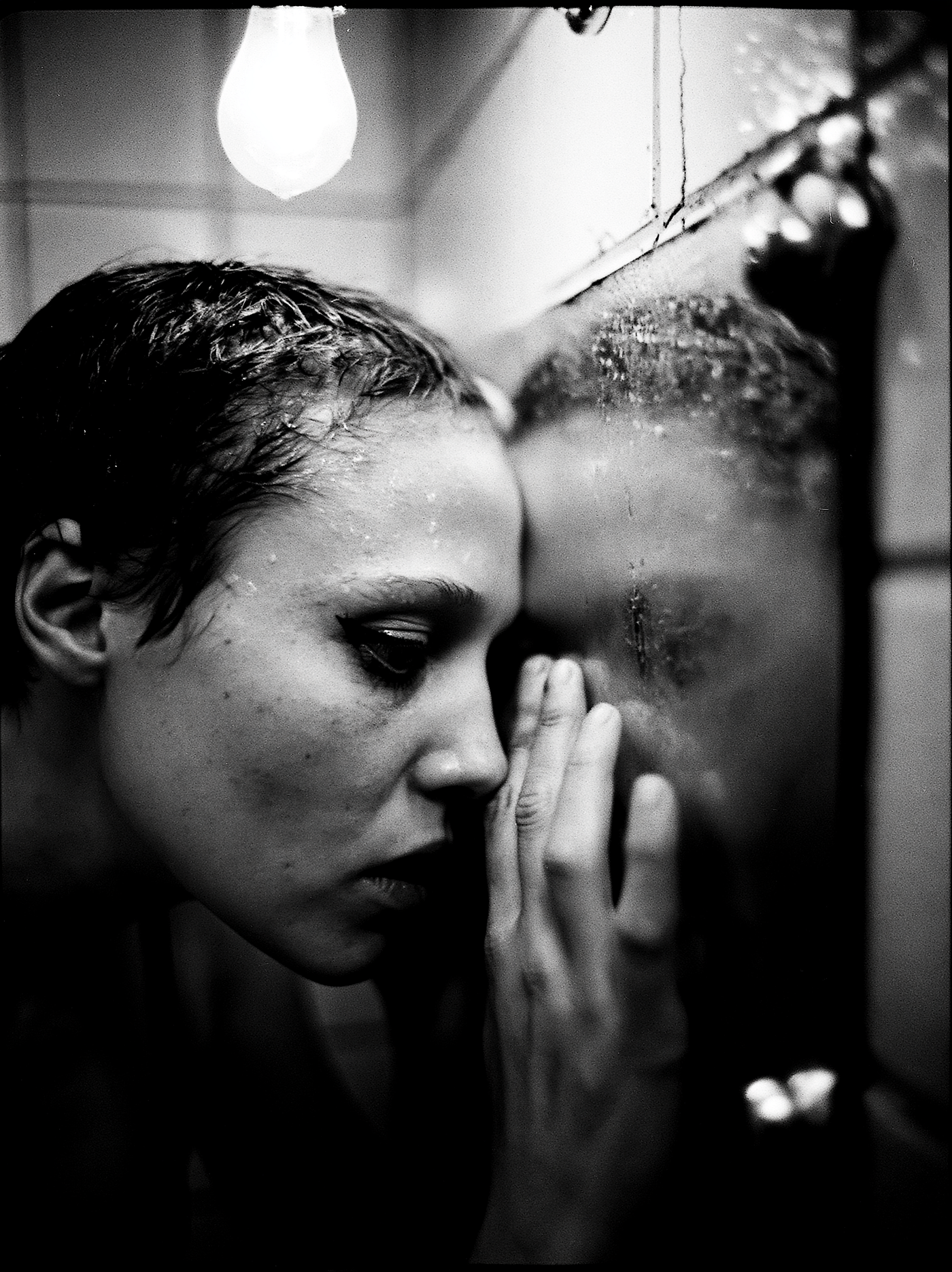
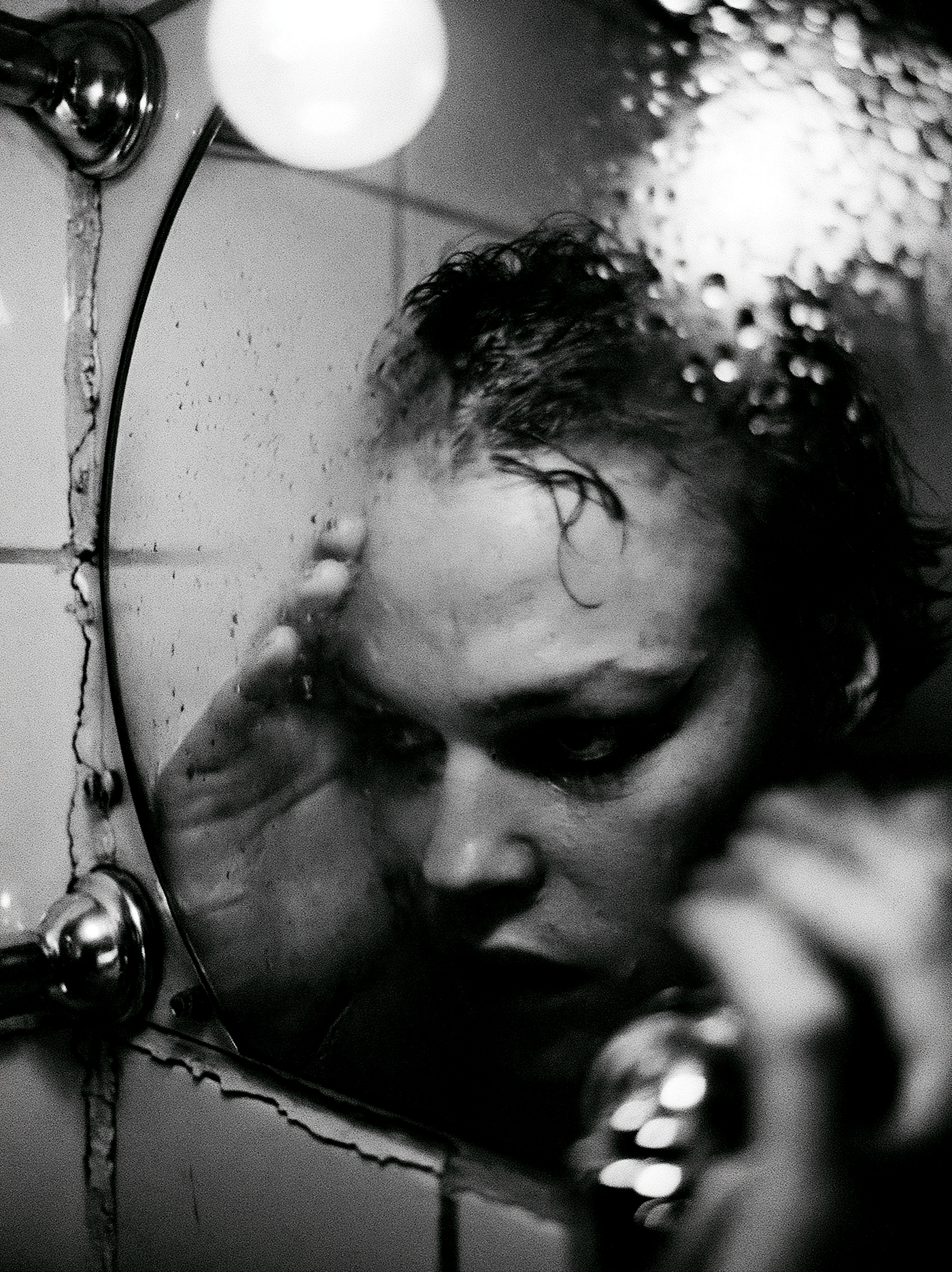
Prompt: medium-close grainy black and white editorial portrait of a 30-year-old Swedish woman with smudged eyeliner and damp short hair, leaning her forehead against a fogged bathroom mirror in a 1970s Stockholm apartment, photographed in the spirit of Anders Petersen, cinematography by Robby Müller, shot on 35mm Ilford HP5 400 pushed to 1600 with Nikon FM2 and 35mm f/1.4 Nikkor, single bare tungsten bulb above the mirror casting hard top-down light with deep eye socket shadows, high contrast monochrome with crushed blacks and blown highlights on the mirror fog, claustrophobic framing with heavy vignetting, cracked tile grout and condensation droplets on chrome fixtures, coarse aggressive grain structure with motion blur on the edges of the hands — ar 3:4 — raw — stylize 80 — v 8.1
Can you feel the difference? The fogged mirror, the condensation, the cracked tile, the bare bulb… None of these are decorative. They are structural elements that force Midjourney out of its comfort zone. And the --stylize 80 is deliberate: anything higher and the model starts smoothing the grain and softening the shadows, which is exactly what we don't want.
Negative space as Nordic signal
The second technique is compositional. Nordic fashion imagery from that era uses an enormous amount of empty space. The subject doesn’t fill the frame, the architecture does. The person becomes a small element inside a larger, colder structure.
For this I brought in the spatial influence of Lina Bo Bardi, the Brazilian architect known for her brutalist humanism, vast concrete atriums that feel both monumental and deeply human. Her spaces have a specific visual weight that Midjourney recognizes well.
Prompt: wide editorial fashion portrait of a tall Nordic model in an oversized grey wool coat standing alone at the far edge of a vast brutalist concrete atrium, compositional influence of Lina Bo Bardi’s architectural spaces, photographed in the spirit of Anders Petersen, shot on Mamiya 7 II with 65mm f/4 lens using Kodak Portra 400, soft diffused skylight filtering through raw concrete openings with no artificial fill, cold desaturated palette of cement grey, muted sage and pale skin with blue undertones, solitude and architectural stillness, 60 percent negative space above and around the figure, smooth concrete textures and distant rain on glass panels, fine organic grain with subtle halation and deep focus — ar 16:9 — raw — stylize 150 — v 8.1
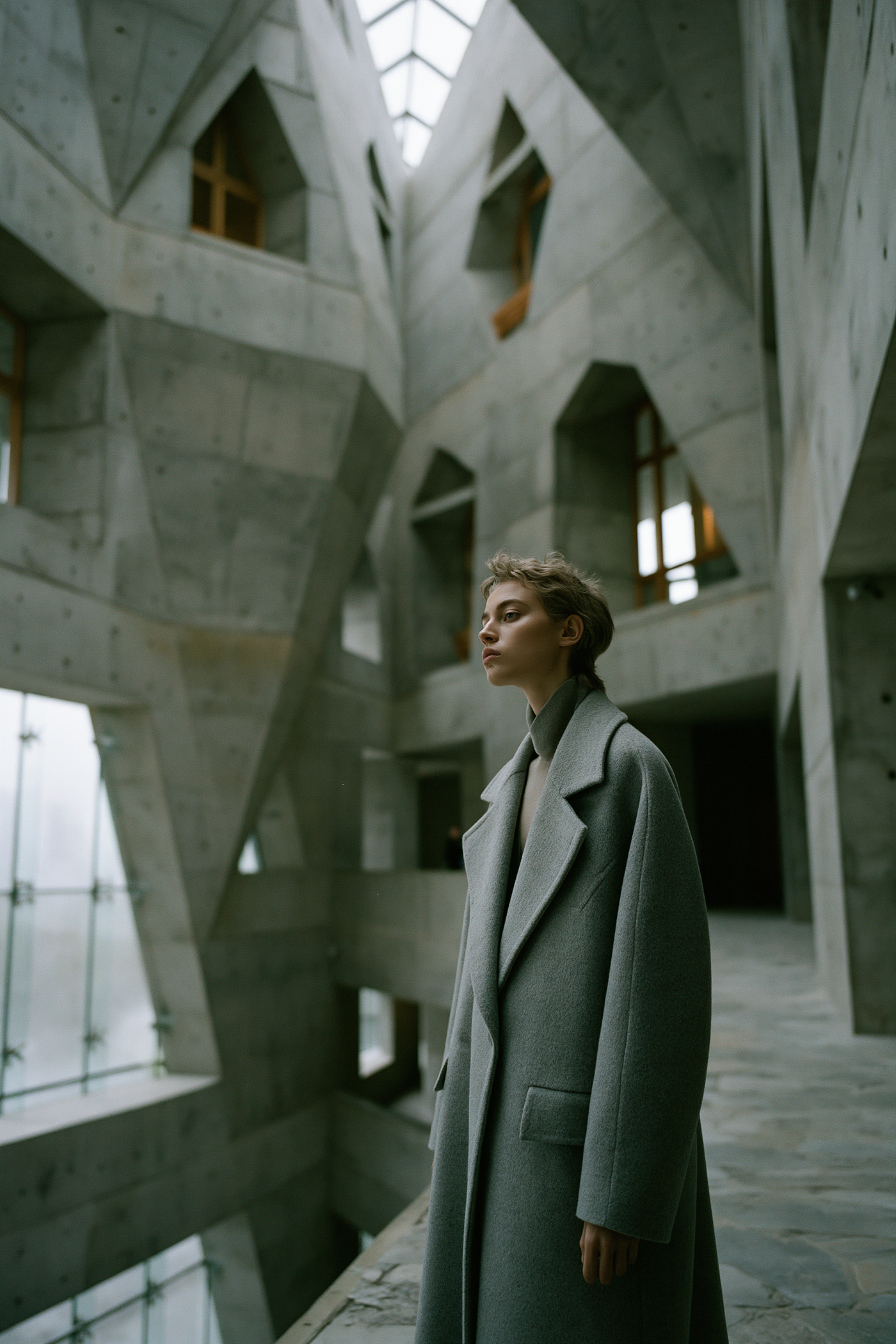
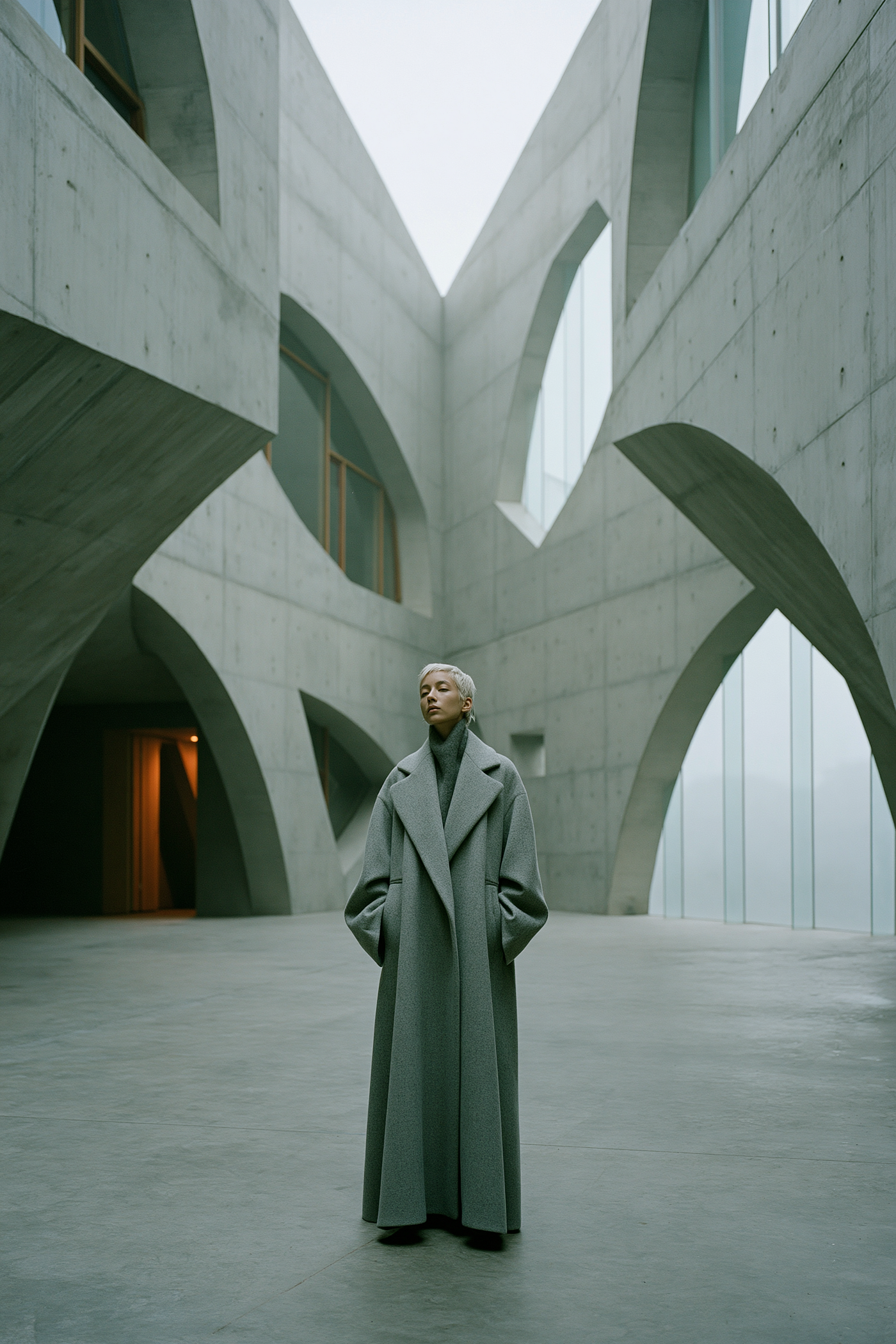
Prompt: wide editorial fashion portrait of a tall Nordic model in an oversized grey wool coat standing alone at the far edge of a vast brutalist concrete atrium, compositional influence of Lina Bo Bardi’s architectural spaces, photographed in the spirit of Anders Petersen, shot on Mamiya 7 II with 65mm f/4 lens using Kodak Portra 400, soft diffused skylight filtering through raw concrete openings with no artificial fill, cold desaturated palette of cement grey, muted sage and pale skin with blue undertones, solitude and architectural stillness, 60 percent negative space above and around the figure, smooth concrete textures and distant rain on glass panels, fine organic grain with subtle halation and deep focus — ar 2:3 — raw — stylize 150 — v 8.1
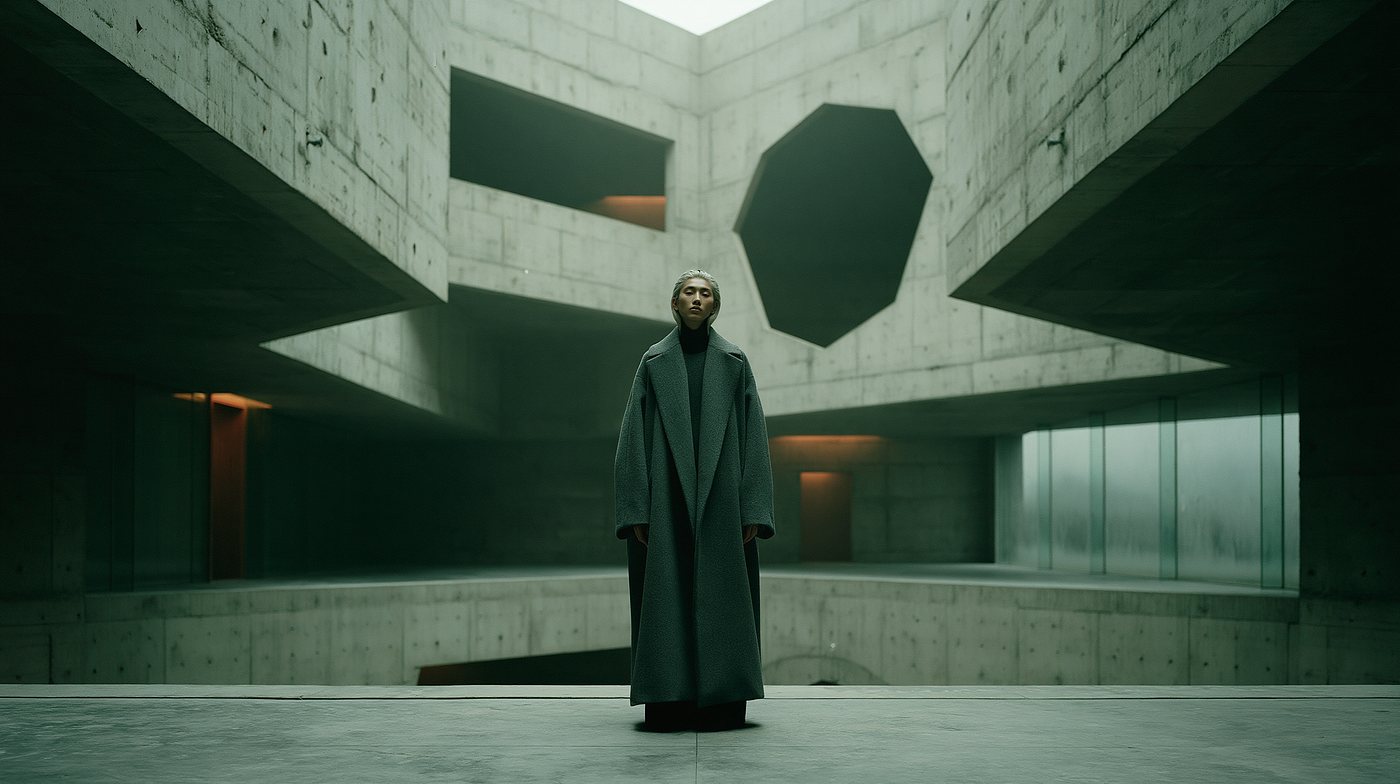
Prompt: wide editorial fashion portrait of a tall Nordic model in an oversized grey wool coat standing alone at the far edge of a vast brutalist concrete atrium, compositional influence of Lina Bo Bardi’s architectural spaces, photographed in the spirit of Anders Petersen, shot on Mamiya 7 II with 65mm f/4 lens using Kodak Portra 400, soft diffused skylight filtering through raw concrete openings with no artificial fill, cold desaturated palette of cement grey, muted sage and pale skin with blue undertones, solitude and architectural stillness, 60 percent negative space above and around the figure, smooth concrete textures and distant rain on glass panels, fine organic grain with subtle halation and deep focus — ar 16:9 — raw — stylize 150 — v 8.1
The figure occupies maybe a third of the frame. The rest is concrete, light, and silence. This is what Nordic editorial photography actually looks like when you study it carefully, and it’s almost the opposite of what Midjourney produces by default. I Love this structures, the composition of the empty spaces is captivating.
Domestic intimacy: Trine Søndergaard’s quiet register
Not all Nordic photography is cold and architectural. There’s also a domestic, intimate tradition that’s equally powerful but operates at a completely different scale.
Trine Søndergaard is a Danish photographer whose work explores quiet, contemplative portraits of women, often wearing traditional garments from the island of Fanø, including the strude, a woven veil that partially covers the face. Her images feel suspended in time, stripped of everything unnecessary. She shoots in natural light with minimal environments, and the silence in her photographs is almost physical.
The strude veil is the key physical anchor here. It’s a specific, unusual object that Midjourney doesn’t have in its default portrait vocabulary, which means the model has to work harder to construct the image, and that effort produces something distinctive.
Prompt: documentary photograph of a middle-aged woman standing motionless in a dim unheated barn on the island of Fanø, her face and head completely wrapped in a coarse hand-woven strude veil leaving only her silhouette visible, photographed in the spirit of Trine Søndergaard, shot on Mamiya 7 II with 80mm f/4 using Kodak Ektar 100, single crack of grey overcast daylight entering through a gap in the wooden planks casting a narrow blade of cold light across the veil texture, desaturated palette of weathered timber brown and damp grey wool and blue-cold skin undertones, rough hemp rope hanging from ceiling beams and dried mud on stone floor, figure positioned off-center against the darkest wall, the veil texture sharper than the background, fine controlled grain with no highlight bloom and deep unlifted shadows — ar 4:5 — raw — stylize 80 — hd — v 8.1
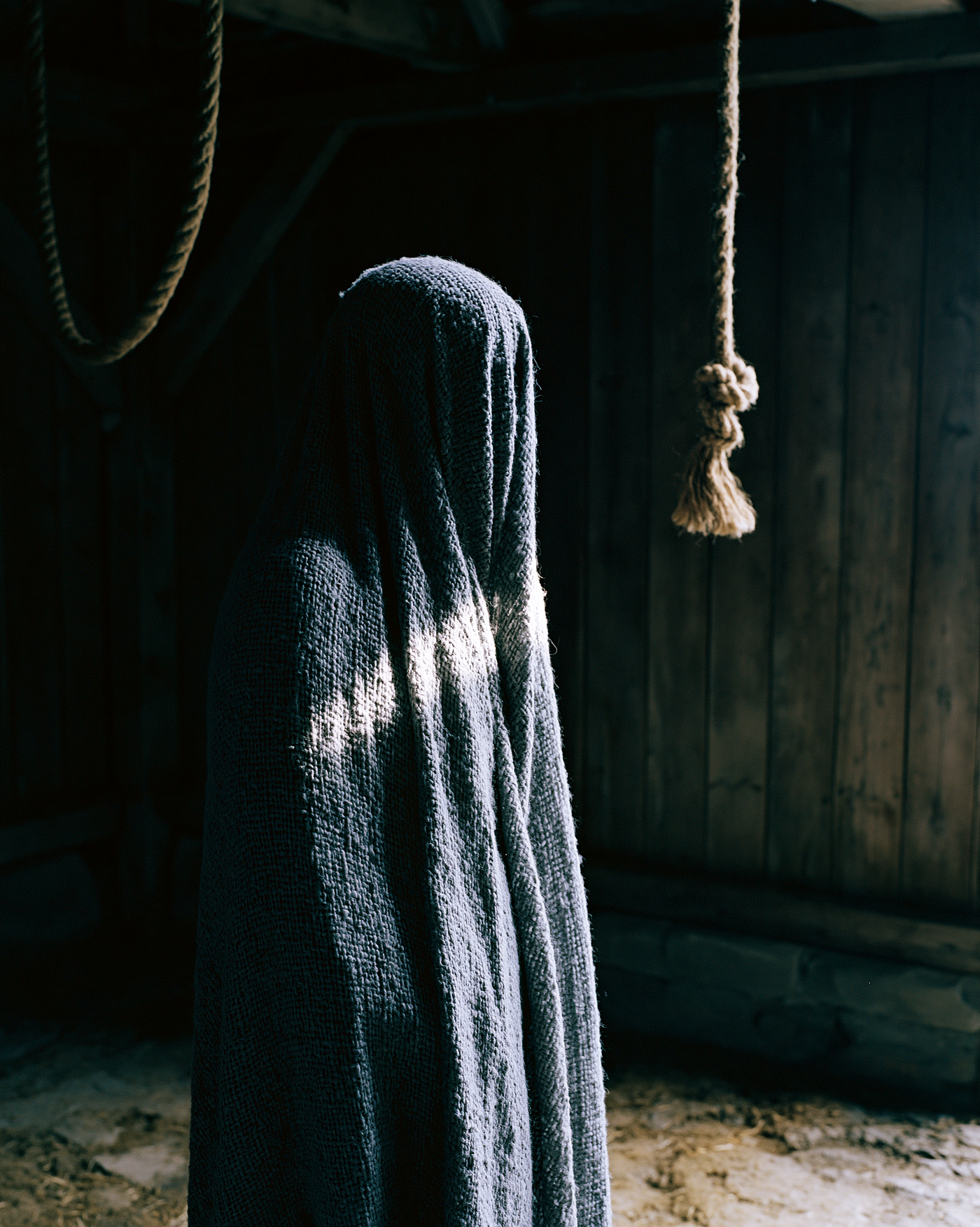
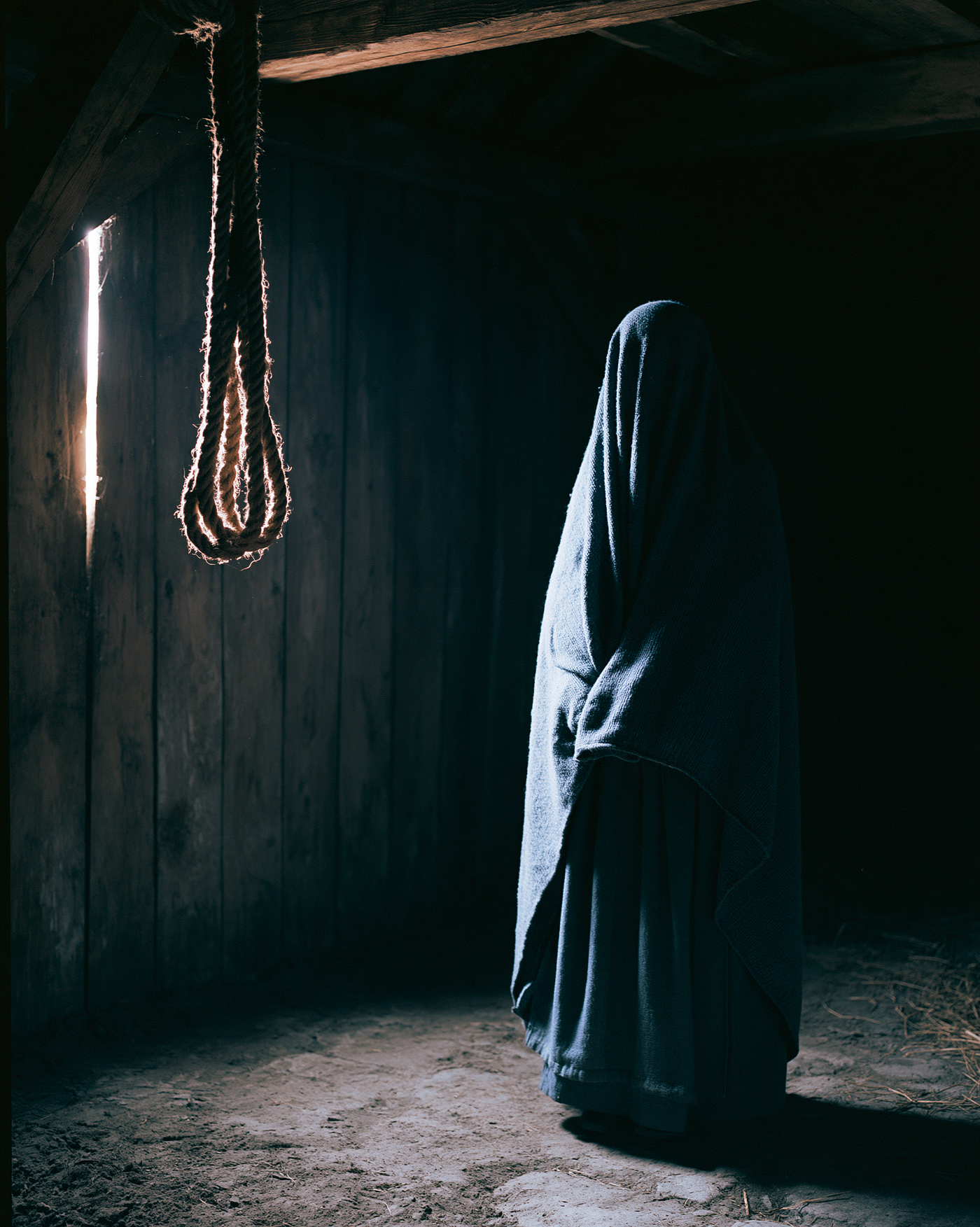
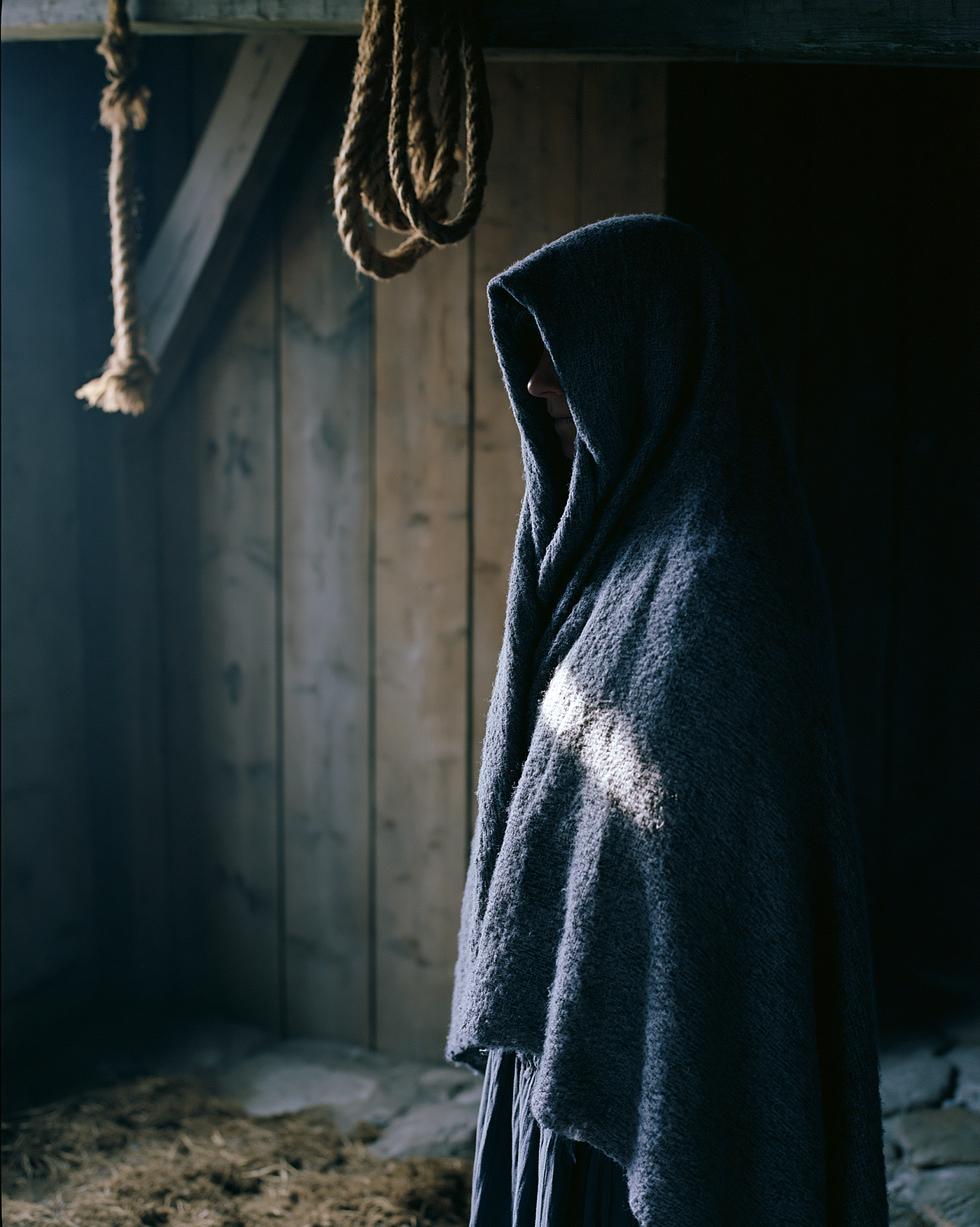
Prompt: documentary photograph of a middle-aged woman standing motionless in a dim unheated barn on the island of Fanø, her face and head completely wrapped in a coarse hand-woven strude veil leaving only her silhouette visible, photographed in the spirit of Trine Søndergaard, shot on Mamiya 7 II with 80mm f/4 using Kodak Ektar 100, single crack of grey overcast daylight entering through a gap in the wooden planks casting a narrow blade of cold light across the veil texture, desaturated palette of weathered timber brown and damp grey wool and blue-cold skin undertones, rough hemp rope hanging from ceiling beams and dried mud on stone floor, figure positioned off-center against the darkest wall, the veil texture sharper than the background, fine controlled grain with no highlight bloom and deep unlifted shadows — ar 4:5 — raw — stylize 80 — hd — v 8.1
The emotional register shifted completely. Same Nordic origin, same era, completely different feeling. This is what happens when you move from the street to the home, from Petersen’s claustrophobic intimacy to Søndergaard’s still, almost sacred quietness and disturbing.
The minimum viable Nordic prompt
All three prompts above are long and detailed. But what if you need to work faster? Can you compress the concept into something short that still works?
The answer is yes, but with a condition: you can cut words, but you cannot cut the physical anchors. The moment your prompt becomes “woman + window + black and white + grain,” you’re back in Midjourney’s most generic latent space.
Here’s the shortest prompt I found that still produces a distinctive Nordic result:
Prompt: black and white extreme close-up of a woman’s hands gripping a chipped enamel sink basin in a dark Scandinavian bathroom, her face barely visible in the fogged mirror above, 35mm Ilford HP5 pushed to 1600, single fluorescent tube flickering overhead casting green-tinted hard light, water droplets on chrome tap and cracked ceramic, crushed blacks and coarse grain with heavy vignetting — ar 3:4 — raw — stylize 80 — v 8.1
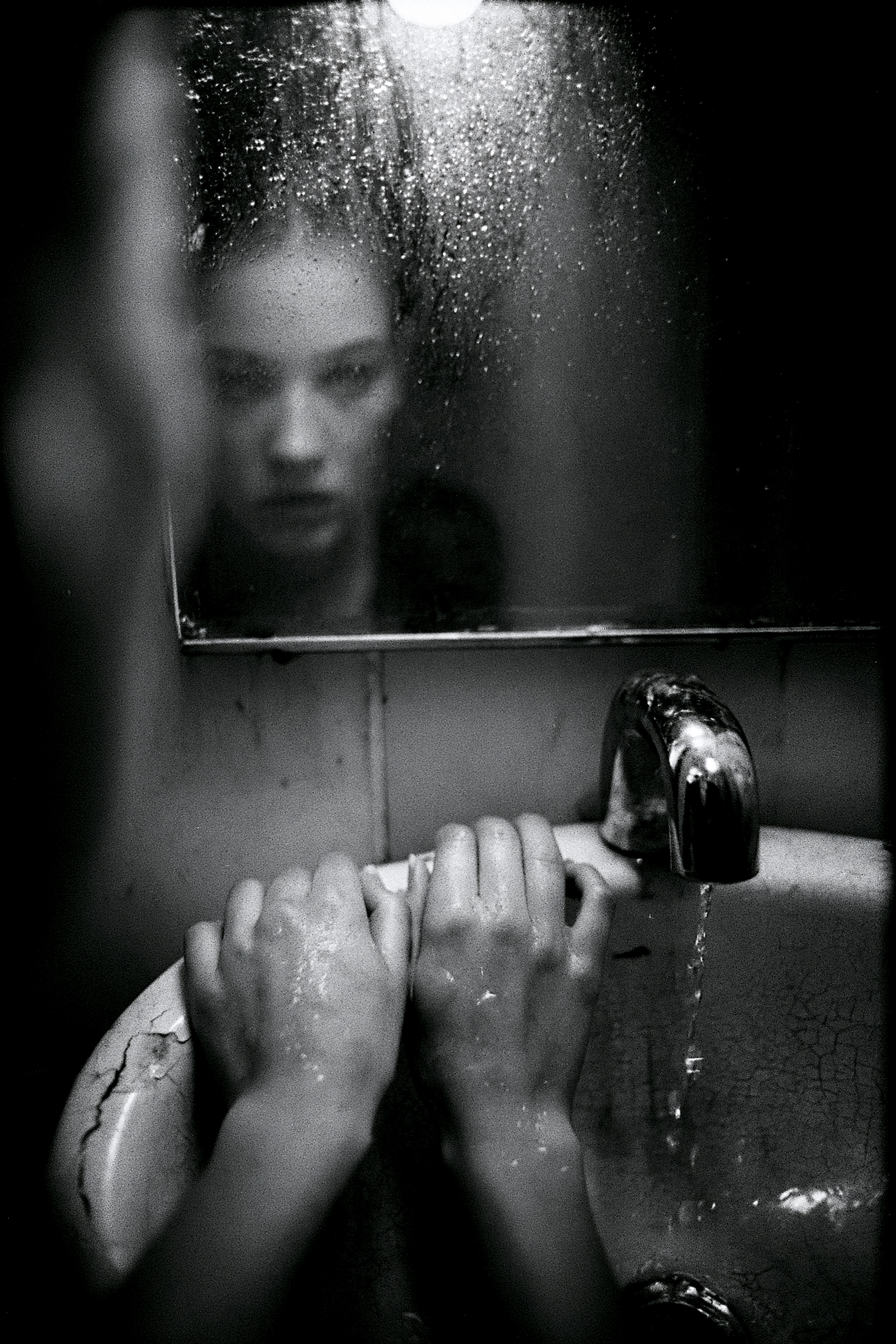
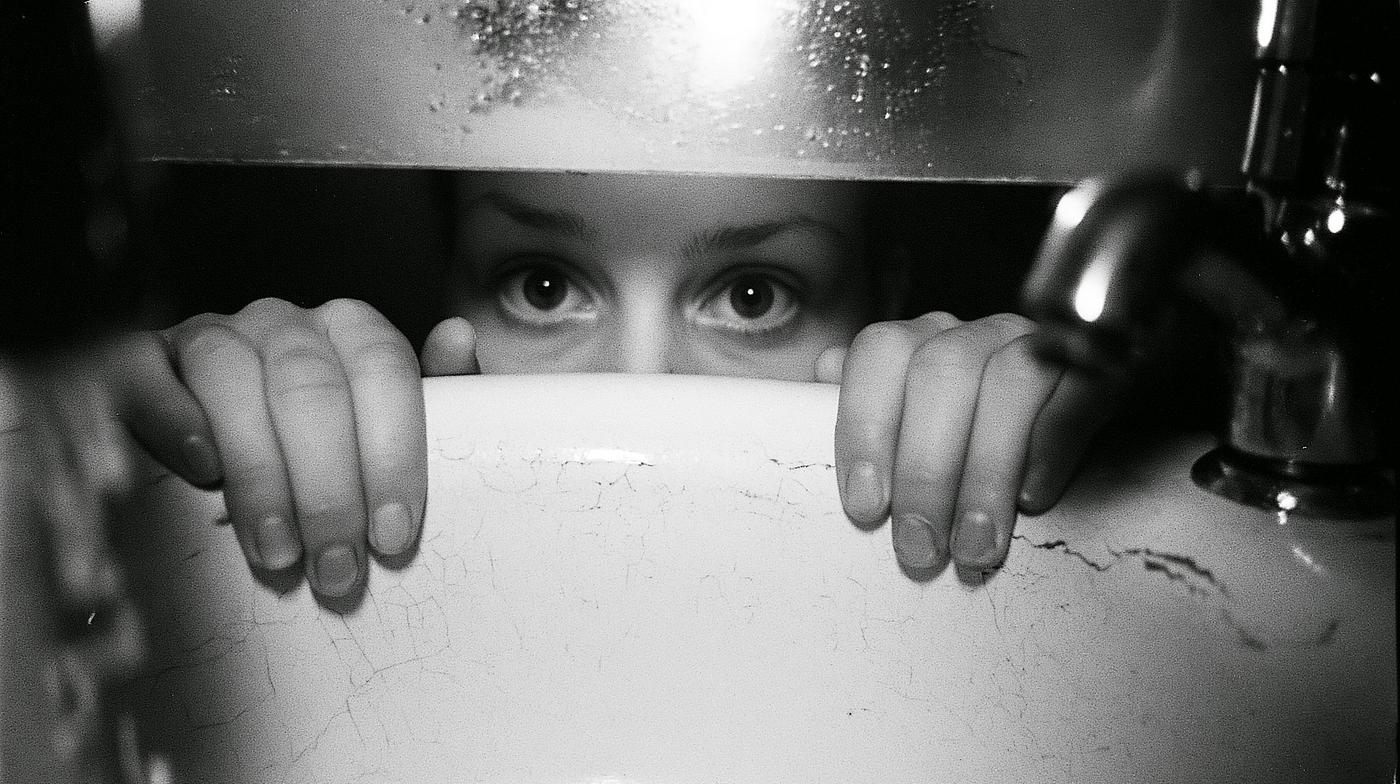
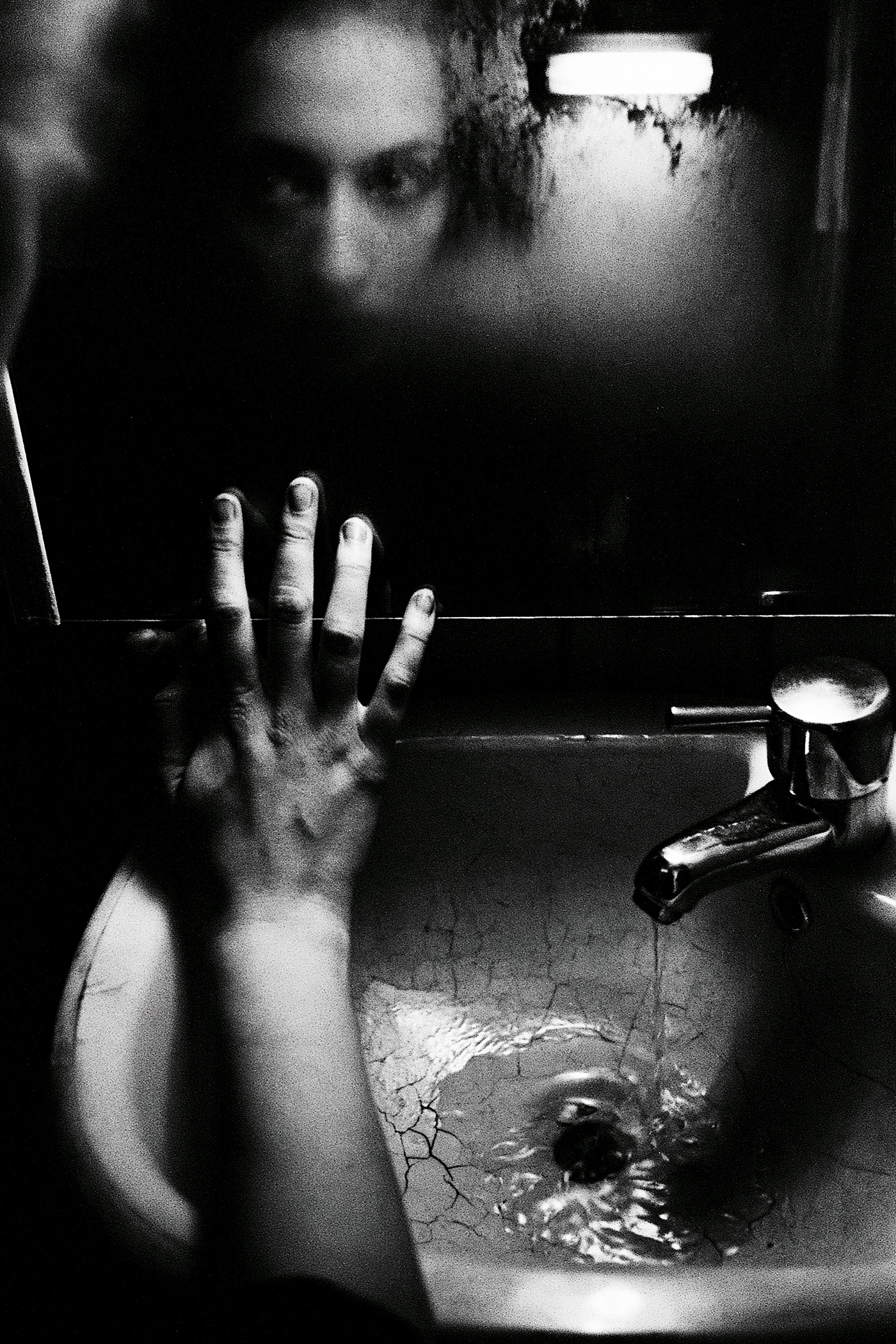
black and white extreme close-up of a woman’s hands gripping a chipped enamel sink basin in a dark Scandinavian bathroom, her face barely visible in the fogged mirror above, 35mm Ilford HP5 pushed to 1600, single fluorescent tube flickering overhead casting green-tinted hard light, water droplets on chrome tap and cracked ceramic, crushed blacks and coarse grain with heavy vignetting — ar 3:4 — raw — stylize 80 — v 8.1
No named authors. No elaborate scene description. But the chipped enamel, the hands gripping the basin, the face as a reflection, the fluorescent green tint, those are the structural bones that keep the image out of the generic zone. Remove any one of them and the result falls back to default Midjourney.
Resources
I recently discovered Josef CHL’s instagram account, which features many image posts by various artists that might serve as inspiration for you. I don’t know him personally, but I find it interesting to explore trends and works.
Conclusions
The technique for recreating Nordic 90s fashion in Midjourney comes down to three principles that apply far beyond this specific aesthetic:
Combine references across disciplines, not within them. A documentary photographer plus a film cinematographer produces something more specific than two fashion photographers combined. Anders Petersen and Robby Müller never worked together, but their visual refusal to embellish is the same, and that shared DNA is what gives the prompt its direction.
Base each description on specific physical details. Emotions and adjectives don’t always push Midjourney out of its comfort zone, but objects often do. A fogged-up mirror, a woven veil, a chipped enamel sink: that’s what makes the image your own rather than the model’s default image. The best thing to do is to combine them.
Lower the stylize value more than you think you should. For raw, gritty, or documentary aesthetics, --stylize 80-150 is where the honesty lives. Anything higher and Midjourney starts beautifying, which is precisely the opposite of what Nordic photography is about.
I hope this article helps you think differently about how to approach a visual style in Midjourney. If you enjoyed it, let me know in the comments which aesthetic you’d like me to break down next. See you in the next article.
메타데이터
- post_id
- b06fae65af4d
- slug
- nordic-90s-fashion-portraits-images-in-midjourney-evading-the-cliché-b06fae65af4d
- url
- https://medium.com/@halfjourney/nordic-90s-fashion-portraits-images-in-midjourney-evading-the-clich%C3%A9-b06fae65af4d
- canonical_url
- https://medium.com/@halfjourney/nordic-90s-fashion-portraits-images-in-midjourney-evading-the-clich%C3%A9-b06fae65af4d
- author_url
- https://medium.com/@halfjourney
- status
- ok
- fetched_at
- 2026-06-09 15:37:30