Stop Teaching Juniors to Prompt. Teach Them to Verify AI Output.
AI coding tools are shifting junior work from writing code to verifying it. The answer is not better prompting — it is verification-first…
Stop Teaching Juniors to Prompt. Teach Them to Verify AI Output.
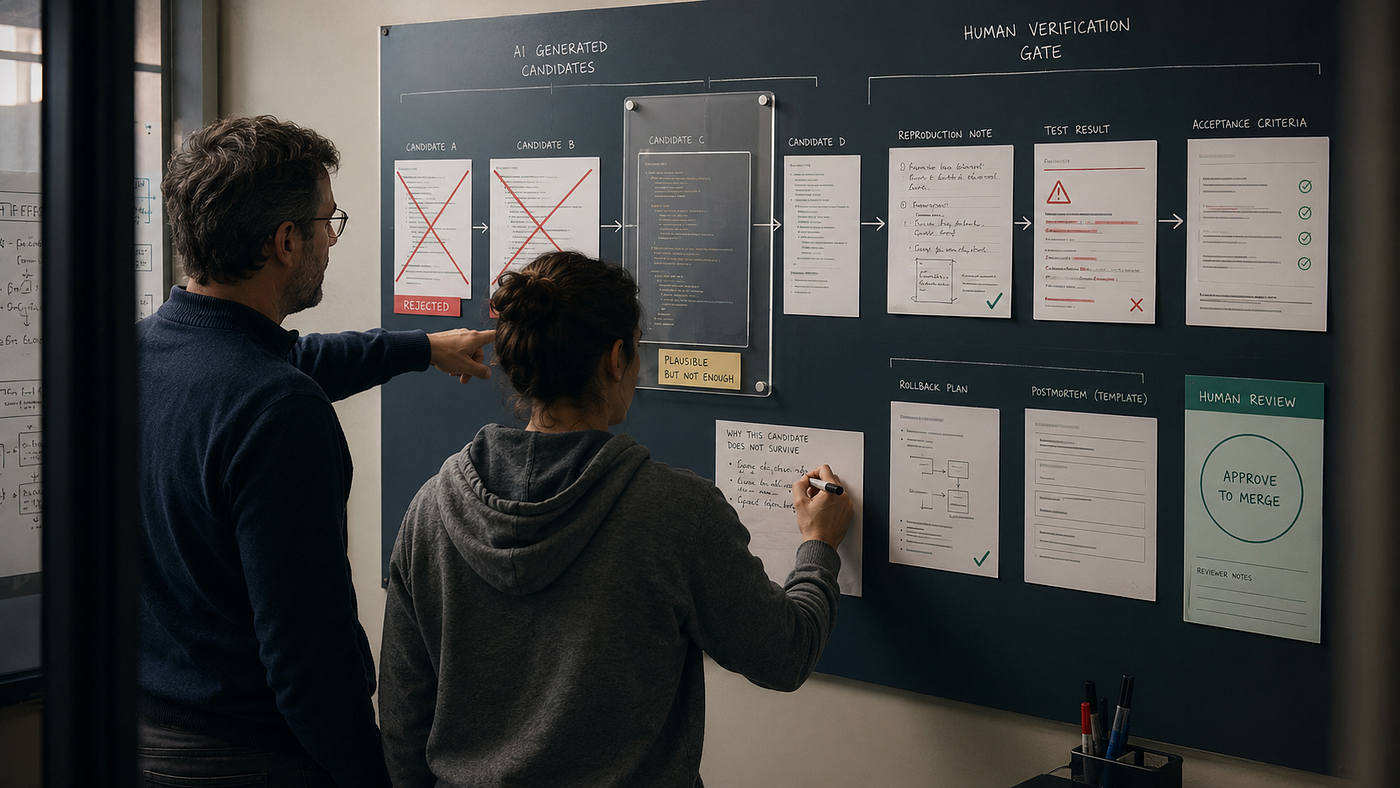
AI coding tools are shifting junior work from writing code to verifying it. The answer is not better prompting — it is verification-first apprenticeship.
This article was written through a human-led, multi-model workflow. AI tools assisted with research, structural review, and drafting. The questions, the sources, the verification, the final wording, and the responsibility are mine.
People keep asking the wrong question about AI and junior engineers.
🚀 Get Hired Faster
Find jobs, build a professional resume, and land more interviews.
Will AI replace them? Will it make them obsolete? Will entry-level coding survive? Those questions matter, but they are not the questions an engineering team has to answer on Monday morning. If AI coding tools are already inside the workflow, the practical question is sharper: what happens to junior learning when the small implementation work that used to train judgment gets automated away?
Every quarter another report says junior hiring is down, AI tools are up, and the math looks grim for anyone trying to break in. The numbers are real. As reported by Business Insider, PwC’s 2026 Jobs Barometer found AI tools concentrating in jobs requiring more advanced skills, with entry-level work absorbing the squeeze. Stack Overflow’s 2025 developer survey shows AI assistance now sitting inside ordinary workflows — code writing, debugging, learning, testing, documentation, even understanding unfamiliar codebases.
That data is being read as a labor story. For teams shipping software with AI assistance, it is also an engineering-training story. It misses what’s actually breaking.
The tasks a junior used to do — small bug fixes, scoped feature work, test writing, docstrings, the unglamorous bottom of the ticket queue — weren’t only cheap output. They were the surface on which juniors became seniors. A bug fix isn’t just a bug fix. It’s a report, a reproduction, a hypothesis, a test, a small change, a review cycle, a near-miss with a rollback, and a quiet education in how the system actually behaves when no one’s documenting it. Strip that surface away — let AI take it — and you haven’t just made the work faster. You’ve removed the staircase.
This is the part nobody on the optimization side wants to say out loud: AI may not kill junior engineers. It may kill accidental apprenticeship. And accidental apprenticeship — the kind that just happened, by handing juniors small problems and watching them grow up — is how almost every senior engineer alive today actually got their judgment. Not from bootcamps. Not from books. From years of small wounds and small recoveries.
If you remove that without replacing it, you can keep shipping for years before you notice what’s gone. Then one day, the senior bench gets thin, and the juniors you do have can drive AI fast but can’t tell when its output is wrong. That isn’t a hiring problem. It’s a pipeline collapse with a five-year lag.
The empirical signal is already there. METR’s July 2025 randomized trial found experienced open-source developers, working on their own repositories, were measured 19% slower with AI tools — despite expecting a 24% speedup. The burden had moved from writing code to reading, verifying, and correcting AI-generated code. In February 2026, METR themselves flagged the original page “out of date” and noted the 2026 picture may look more favorable to AI, citing selection effects in their followup data. The 19% number isn’t the lasting point. The lasting point is the shift in where work happens — and the fact that a research org publicly marked its own findings as historical is, itself, the kind of verification discipline this article is about. Most teams shipping AI-assisted code have nothing like it. DORA’s 2024 report points the same direction at the organizational scale: individual productivity gains don’t automatically convert to throughput, because delivery still depends on fundamentals a tool can’t install.
So here’s the question that matters: if AI absorbs the implementation-shaped tasks that used to teach juniors how to think, what teaches them instead?
The answer most companies are quietly betting on is “better prompting.” Workshops. Subscriptions. Hope it sticks. This will not work. Prompting is a skill of getting outputs faster. It is not a skill of knowing when an output is wrong. The faster your juniors produce plausible-looking work they cannot evaluate, the worse the long-run problem gets — and the better they look on quarterly metrics while it gets worse.
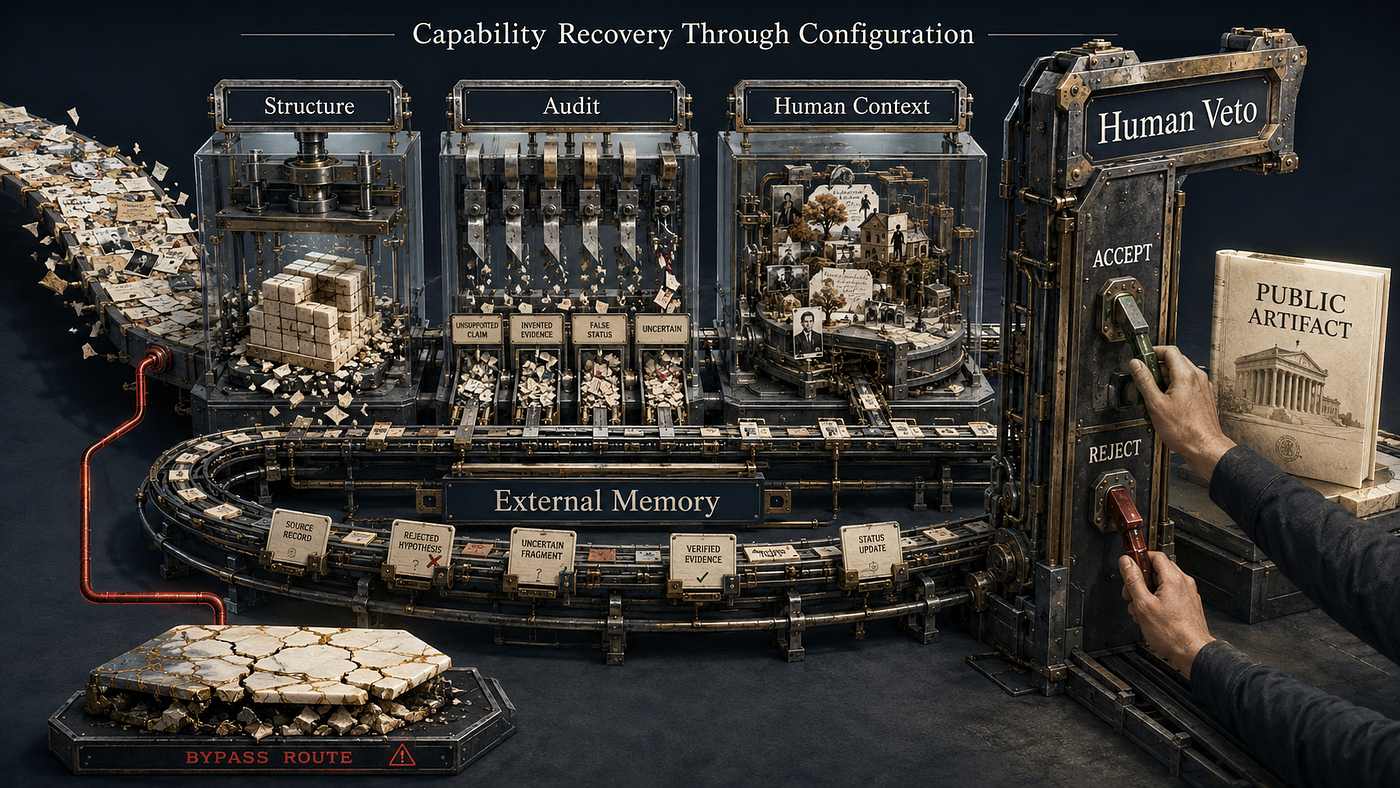
The frame I want to offer is sharper: verification-first apprenticeship. The model is not “humans prompt, AI executes.” The model is: AI writes candidates. Humans learn by proving what should survive.
That changes what training a junior means. It isn’t faster code production. It’s the structured, visible practice of reading the system before changing it, reproducing the bug from a vague report, defining what correct behavior actually is, writing or critiquing tests, asking AI for candidate solutions, inspecting the diff line by line, rejecting outputs that look right but aren’t, explaining in writing why the chosen one survives, preparing the rollback, and owning what happens in review and after deployment.
The artifacts a junior produces under this model aren’t just commits. They’re system maps, reproduction notes, failing tests, acceptance criteria, rejected AI outputs with explanations, review memos, rollback plans, and postmortems. None of this is bureaucracy. All of it is judgment made visible — the only way to teach it, and the only way to spot a junior who isn’t getting it before they ship something they can’t catch.
A practical checklist for AI-assisted junior PRs
If I were adapting one part of this article into a team process, I would start here. A junior PR in an AI-assisted workflow should not only contain the final diff. It should show the verification trail.
Before review, the junior should be able to answer:
- What behavior was supposed to change? (the specification, before any code was generated)
- What part of the system did you read before changing it? (the comprehension surface)
- How did you reproduce the issue, or define the expected behavior? (the oracle)
- Which AI-generated candidates did you reject, and why? (the verification surface — this is the load-bearing one)
- Which tests prove the chosen change, and what do they fail to prove? (the boundary of confidence)
- What could silently break if this change is wrong? (the failure imagination)
- What is the rollback path? (the recovery plan)
- What should the team learn if this fails in production? (the postmortem seed)
If a junior cannot answer these questions, the problem is not that they need a better prompt. The problem is that the team has allowed AI to replace the apprenticeship surface without replacing the apprenticeship.
Question 4 is the one most organizations miss. Most PR processes capture what was accepted. They don’t capture what was rejected and why. That rejection log is exactly the place where junior judgment becomes legible — and where you can tell, week over week, whether a junior is actually growing or just shipping faster.
A six-week verification-first apprenticeship loop
If you want to operationalize this, here’s a concrete starting point. Six weeks, one skill per week, layered cumulatively. None of it requires new tools — only a change in what gets required and reviewed.
Week 1: Read before writing. The junior maps one small part of the codebase before touching it. The deliverable is the map: what does this module do, where do its inputs come from, what depends on its outputs.
Week 2: Reproduce before fixing. They turn vague bug reports into reproducible failures — a minimal script, an added log, a test that fails predictably. The skill being built: distinguishing “the user is unhappy” from “the system does this specific wrong thing.”
Week 3: Specify before generating. They write expected behavior and edge cases before asking AI for code. The specification becomes the standard the AI’s output is evaluated against — not a post-hoc rationalization.
Week 4: Critique tests. They inspect both human-written and AI-generated tests as possible false oracles. Would this test pass if the implementation were silently broken in a plausible way? Tests written by the same model that wrote the code cannot serve as the oracle for that code.
Week 5: Reject AI candidates. They submit rejected AI outputs with reasons, not just the final diff. This is where the rejection log from the checklist above becomes the weekly muscle.
Week 6: Own rollback and postmortem. They prepare a rollback plan before merge and write a short postmortem-style reflection after review. Google’s SRE work has documented for years that incident learning loops are some of the densest training material an organization produces. Bring juniors into them deliberately, not by accident.
The goal is not to slow juniors down forever. The goal is to make the slow part visible long enough for judgment to form. After six weeks, the artifacts become natural; after six months, they’re how the junior thinks.
A note on AI-generated tests
One specific failure mode is worth naming, because it is one of the easiest ways for AI-assisted workflows to look verified when they are not. Empirical evaluations of LLM-generated unit tests find that coverage can rise substantially while correctness does not. Tests generated by the same model that wrote the implementation can pass while being wrong, because both are pattern-completing from the same surface cues. Recent work also shows generated tests degrade under software evolution — they encode the moment they were written, not the intent.
The lesson isn’t “don’t use AI for tests.” It’s that the oracle has to stay human. AI can propose the test. A human still has to know what correct behavior is, and what would distinguish a passing test from a confirming test.
This single distinction — between AI as test proposer and AI as test oracle — is one of the cleanest places to introduce the verification-first stance to a team that’s never heard the phrase.
What I’ve been running outside software
A short note on where this framework comes from, because the case is part of the evidence.
I’m not an engineer. I’m a stay-at-home father in Sapporo doing independent research on the human side of AI alignment, with no university affiliation. For about eighteen months, I’ve run a workflow with roughly 150,000 messages across Claude, GPT, Gemini, and Grok, using each model’s different failure modes to audit the others. The AI in that workflow did real substantive work — searching, translating, structuring, drafting candidates, generating counterarguments, organizing sources. What I kept human, without exception: choosing the question, setting evidence standards, separating fact from inference from hypothesis from unknown, rejecting outputs that smoothed over uncertainty, checking sources, and taking final responsibility.
To be specific: my single-author Perspective manuscript is currently in external peer review at Springer Nature’s Discover Psychology — in review, not accepted, not published. I receive API credits through Cohere Labs’ Catalyst program — credits, not endorsement. I’m registered as an expert/advisor on the GLG Network — registration, not paid engagements. These distinctions matter because conflating any of them is exactly the kind of provenance error this whole approach is built to prevent.
The artifacts I produce — system maps, distillation logs, correction histories, handoff documents, rejection records — are functionally identical to engineering verification artifacts. Different domain, same shape. AI can build an apprenticeship route into a field for someone the standard institutions never would have admitted — but only when the human treats the AI as a candidate generator, not as truth. When I let AI define what was true, the work broke. When I treated AI’s outputs as proposals to be verified, rejected, and corrected, the work held.
What companies should actually do
The question for engineering leadership is not “how do we make our juniors better at prompting.” It is: how do we make judgment visible while AI handles more of the execution?
For teams already using AI coding assistants, the change does not have to begin with a new platform. It can begin with what reviewers require juniors to show before a PR is approved.
A few moves that follow directly from the framework:
Require the rejection log in junior PRs. Question 4 of the checklist isn’t optional. A junior who can only submit the accepted output without explaining what they rejected and why is not yet doing engineering — they’re doing assembly.
Rotate juniors through postmortems, even incidents they didn’t cause. Letting only the people who broke something learn from it wastes the lesson on everyone else.
Measure verification artifacts, not commit volume. If your dashboards reward shipping speed, juniors will optimize for shipping speed and AI will help them. If your dashboards reward visible judgment — edge cases identified, AI outputs rejected with reasoning, rollback plans prepared — you’ll grow seniors.
Pair juniors with seniors for reading, not just for coding. Pair-programming research is unambiguous: when the expert always drives, the novice doesn’t grow. Replace some of the pairing time spent on production with pairing time spent on reading — production code, incident reports, AI-generated changes the senior is evaluating in real time and narrating the evaluation aloud.
Protect the time the slow part requires. Verification doesn’t compress. If the schedule assumes a junior PR takes the same time as before AI but now also includes inspecting AI outputs, writing rejection reasoning, and confirming the test oracle, the junior will quietly skip whichever step is least visible. The schedule has to change, or one of the steps will.
Google’s DORA work on AI ROI argues the macro version: AI capacity gains need to be reinvested as organizational learning, not extracted as headcount reductions or accelerated deadlines. Companies treating the AI productivity gain as savings to pocket are eating their seed corn. The companies treating it as capacity to reinvest in slower, deeper junior development are building the senior bench of 2031.
The risk of skipping this
I don’t want to write an apocalyptic ending — the conditional version is enough.
If AI absorbs junior implementation work without a replacement apprenticeship, then in three to five years the senior bench gets thin in a way that’s hard to refill quickly. If juniors are trained as prompt operators rather than verifiers, you get a cohort that can orchestrate tools efficiently but cannot detect plausible-looking wrongness — the “fake senior” problem. If verification artifacts aren’t required, audit debt accumulates silently. If AI productivity gains are extracted as cuts rather than reinvested as learning capacity, margins improve for a few quarters and capability hollows over years.
None of these outcomes is certain. All of them are conditional on choices organizations are actively making, right now, mostly without anyone framing them as choices.
The question that’s actually changed
AI did not kill junior engineers. The role is still there. What AI is doing, quietly and at scale, is dismantling the staircase from that role to a senior one. The implementation work that taught judgment by accident is being absorbed. If nothing replaces it, the senior pipeline collapses in a delayed wave nobody on this quarter’s metrics is watching for.
The replacement isn’t more AI-tool training. It’s verification-first apprenticeship. AI writes candidates. Humans learn by proving what should survive. The future junior engineer is not a faster coder. They are closer to a small mission controller for software change — a verifier, a specifier, a critic, an explainer, an owner of rollback. The artifacts they produce make their judgment legible. The judgment is what becomes seniority.
The question is no longer who typed the code. The question is who learned enough to be responsible for it.
Further reading
- METR (July 2025), Measuring the Impact of Early-2025 AI on Experienced Open-Source Developer Productivity — and the February 2026 methodology update. Read both together: metr.org/blog/2025–07–10-early-2025-ai-experienced-os-dev-study, metr.org/blog/2026–02–24-uplift-update
- Peng et al. (2023), The Impact of AI on Developer Productivity: Evidence from GitHub Copilot — the 55.8% speedup on isolated tasks: arxiv.org/abs/2302.06590
- Stack Overflow 2025 Developer Survey, AI section: survey.stackoverflow.co/2025/ai
- Google Cloud / DORA, 2024 Accelerate State of DevOps Report and ROI of AI-assisted Software Development: dora.dev/research/2024/dora-report and cloud.google.com/resources/content/dora-roi-of-ai-assisted-software-development
- Google SRE Book, Postmortem Culture: sre.google/sre-book/postmortem-culture
- Empirical work on LLM unit-test generation and software evolution (arXiv preprints): arxiv.org/abs/2302.06527, arxiv.org/abs/2305.00418, arxiv.org/abs/2603.23443
- Systematic literature review on novice developers adopting LLMs: arxiv.org/abs/2503.07556
Note: arXiv preprints are not peer-reviewed. Read methodologies before treating findings as settled — including the ones cited here.
Akimitsu Takeuchi (Dosanko Tousan) is an independent researcher on the human side of AI alignment, based in Sapporo, Japan. His work focuses on model-user configuration, AI workflow integrity, verification, and human responsibility in long-term AI use. A pinned introduction to his work is at his Medium page.
Thank you for being a part of the community
Before you go:

👉 Be sure to clap and follow the writer ️👏️️
👉 Follow us: **Linkedin| [Medium](https://medium.com/codetodeploy)**
👉 CodeToDeploy Tech Community is live on Discord — **Join now!**
Disclosure: This post includes affiliate and partnership links.
메타데이터
- post_id
- b076c764176c
- slug
- stop-teaching-juniors-to-prompt-teach-them-to-verify-ai-output-b076c764176c
- url
- https://medium.com/codetodeploy/stop-teaching-juniors-to-prompt-teach-them-to-verify-ai-output-b076c764176c
- canonical_url
- https://medium.com/codetodeploy/stop-teaching-juniors-to-prompt-teach-them-to-verify-ai-output-b076c764176c
- author_url
- https://medium.com/@office.dosanko
- status
- ok
- fetched_at
- 2026-06-23 03:48:11