Exadata X10M/X11M Cable Types
Exadata X10M and X11M servers use distinct cable classes for power, out-of-band management, service access, and — where fitted — high-speed…
Exadata X10M/X11M Cable Types
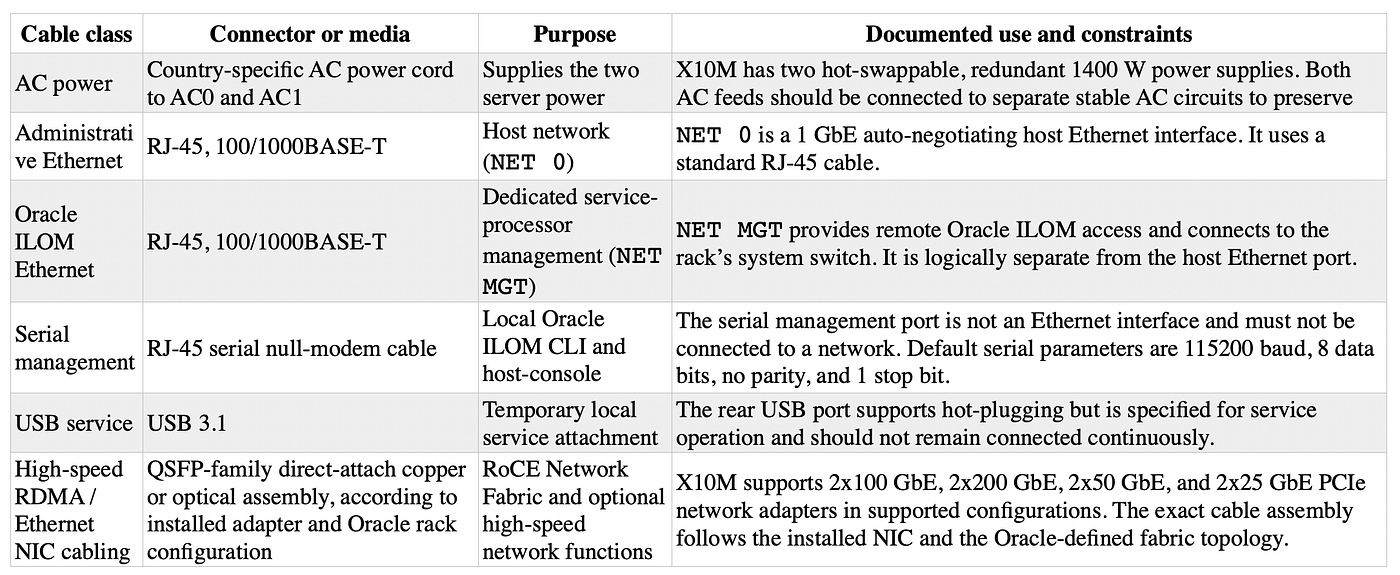
Exadata X10M and X11M servers use distinct cable classes for power, out-of-band management, service access, and — where fitted — high-speed NIC connectivity. Do not treat the physical connector alone as proof of function: cable type, connected adapter, port role, and the Oracle-qualified rack design determine the supported use.
Cable Taxonomy
Management and Service Cabling
The NET 0 and NET MGT ports are both RJ-45 1 GbE interfaces but have different ownership and operational purpose. NET 0 is the host system-domain interface; NET MGT is the dedicated Oracle ILOM service-processor interface.
SER MGT is an RJ-45 serial interface, despite sharing the same physical connector family as Ethernet. Connecting it to a network switch is incorrect and unsupported.
For X11M, Oracle documents local Oracle ILOM CLI access through a serial null-modem cable on SER MGT, remote Oracle ILOM access through NET MGT, and optional host-side remote access through NET 0.
High-Speed Fabric Cabling
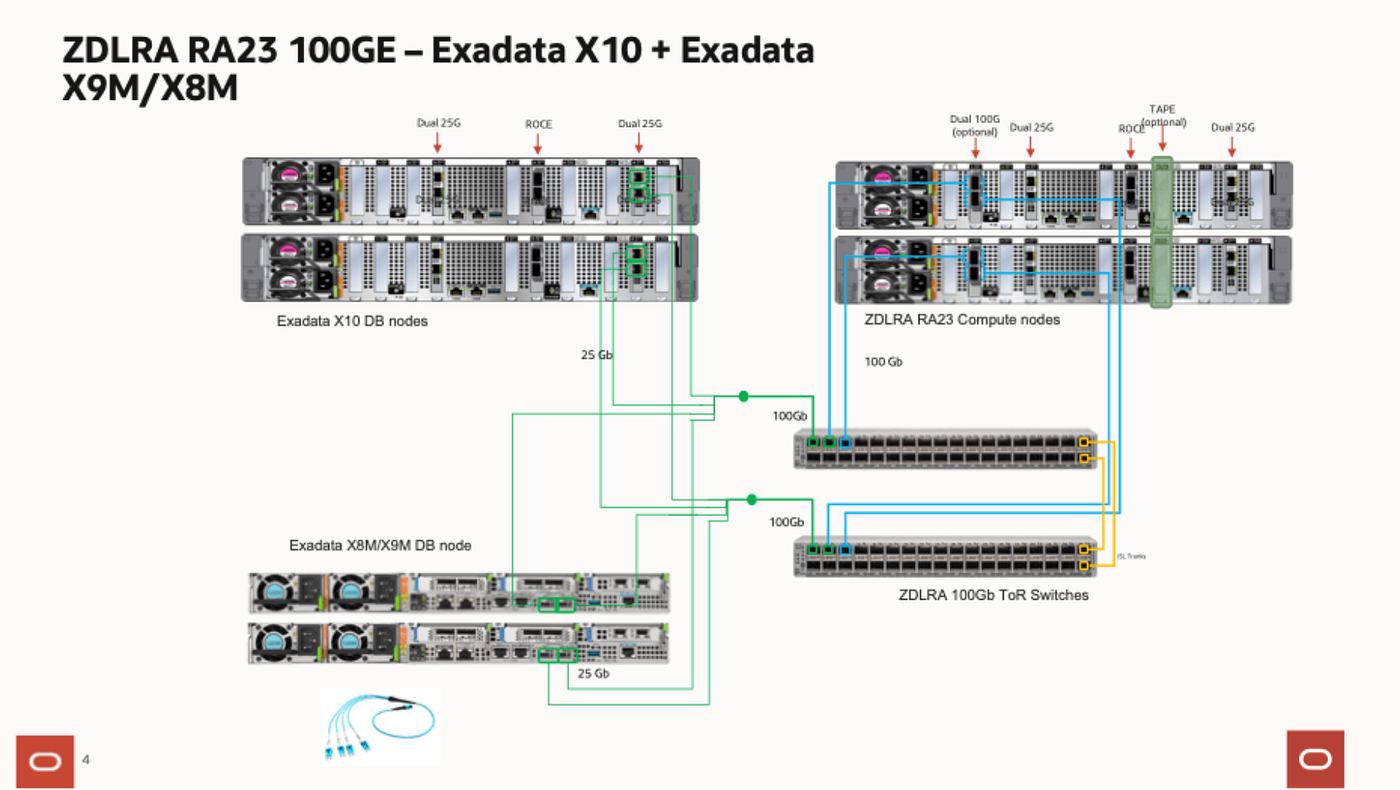
The X10M system can work with a lot of network adapter setups. For example, it supports port 25 GbE SFP28, dual port 50 GbE QSFP56, dual port 100 or 200 GbE ConnectX-6 Dx, dual port 200 GbE ConnectX-7 and also Pensando 2x200 GbE adapters. So saying that the X10M system only uses one type of QSFP cable is not correct. The X10M system is actually very flexible when it comes to network adapters. Cable selection follows the installed adapter, the port mode, and the Oracle-qualified rack topology.
For Exadata X8M and later RoCE fabrics, Oracle documentation includes 100 GbE QSFP-100G-CR4 direct-attach copper links in switch-interface status examples. This is a documented fabric instance, not a universal cable specification for every X10M configuration. These links are used between leaf switches, database servers, storage servers, and the documented inter-switch connections, depending on rack model and topology.
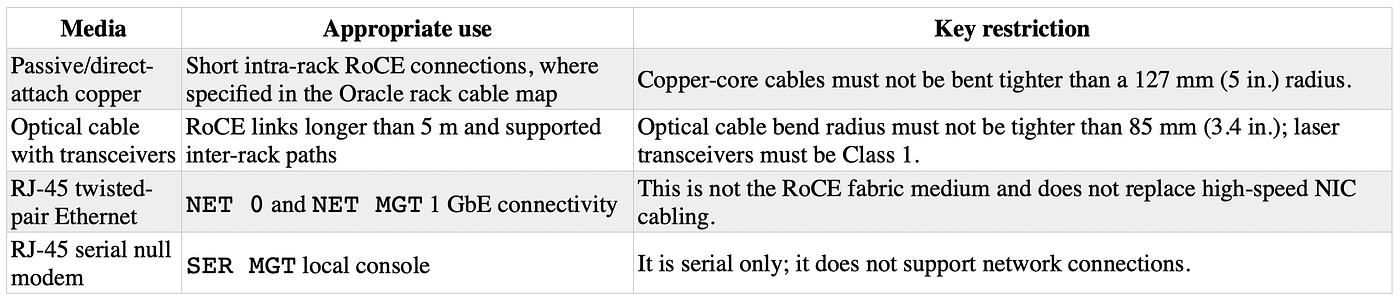
For inter-rack RoCE cabling, Oracle supports cable lengths up to 100 m. Optical cables with additional transceivers are required when the length exceeds 5 m.
The cable selection sequence is therefore:
- Identify the server generation and whether the node is a database server or storage server.
- Identify the installed physical NIC or SmartNIC and its port form factor.
- Identify whether the link is administrative Ethernet, ILOM, serial service, RoCE fabric, external backup connectivity, or another approved function.
- Use the exact Oracle cabling table and port map for the rack topology.
- Do not substitute a cable solely because its connector fits.
RoCE Copper and Optical Media
Physical Handling Rules
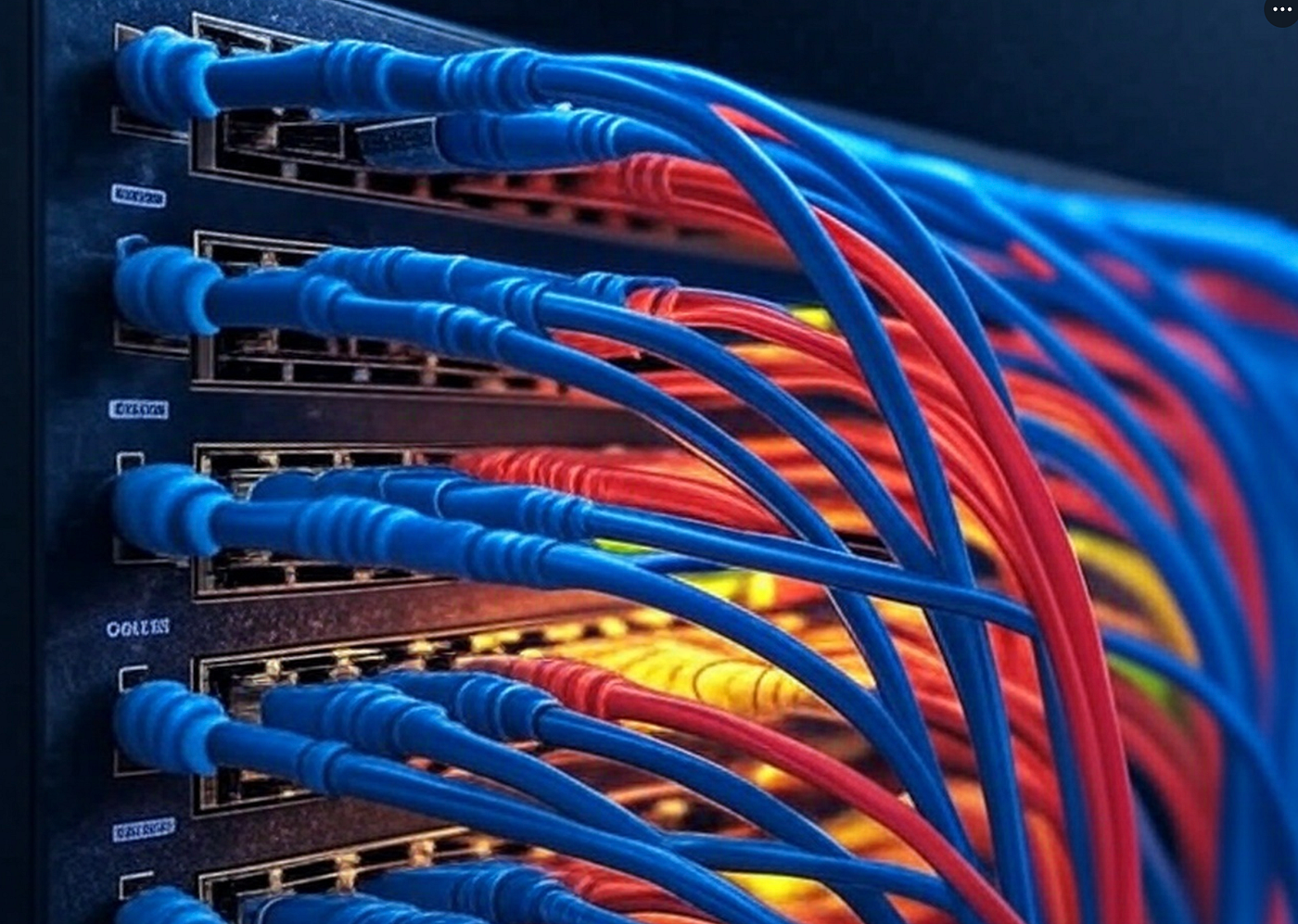
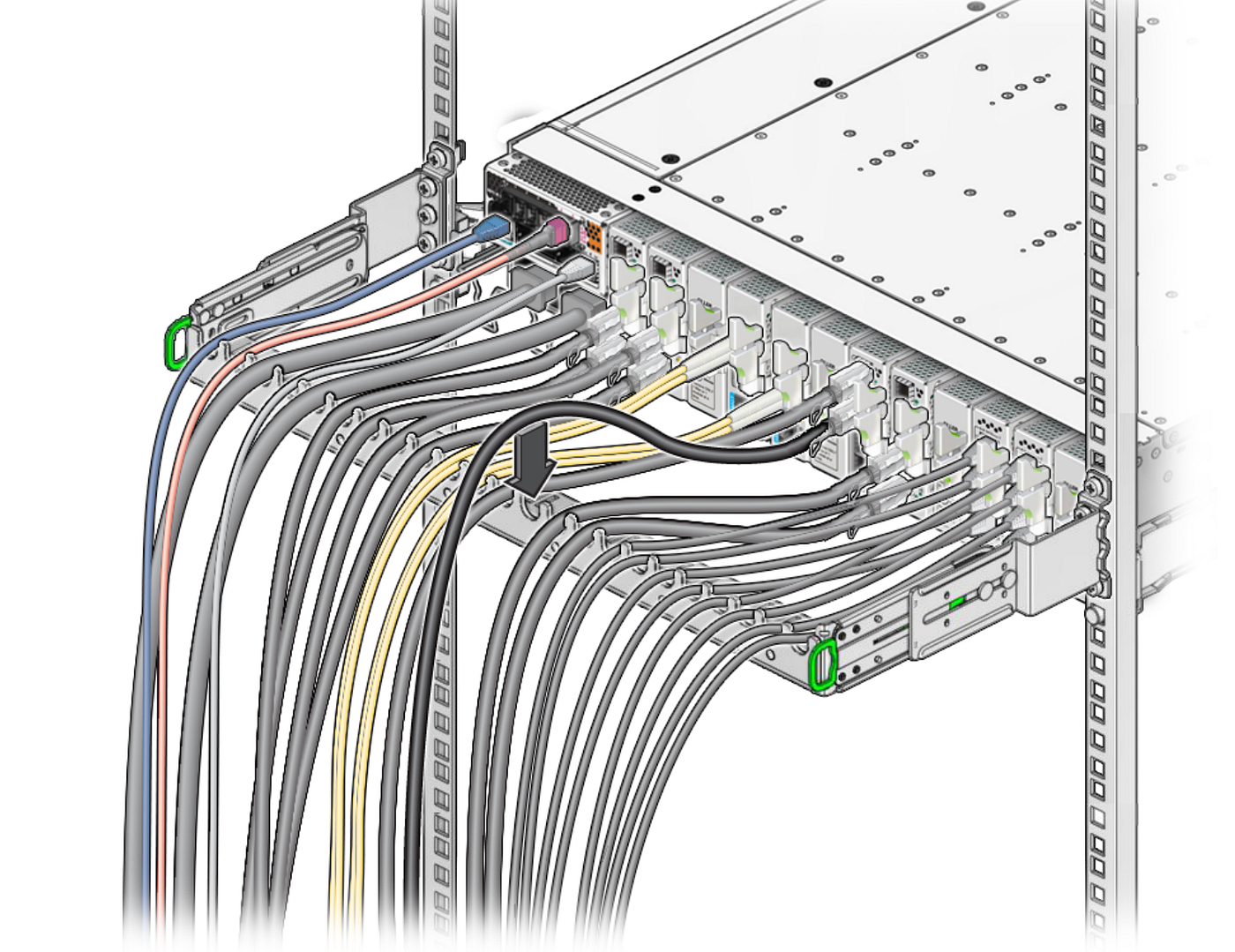
Oracle prohibits tight bends, tension, twisting, dragging, crushing, and zip ties for RDMA Network Fabric cabling. Use hook-and-loop straps instead.
Oracle recommends bundling no more than eight RDMA cables together and placing retaining straps approximately every 0.3 m (1 ft). Heavy copper splitter and C-4 cables require particular attention because their mass can stress retention straps and connectors.
For RoCE cable-management arms, Oracle specifies separate bend limits by wire gauge: 30 AWG cables require a 21 mm single-bend minimum or 45 mm for repeated bends; 26 AWG cables require 29 mm and 58 mm respectively.
Installation Discipline
Label both ends of every cable before installation, preferably using label material compliant with ANSI/TIA/EIA-606-A. Unroll and lay out cables before installation rather than pulling them from a coil during routing.
Complete data cabling before attaching AC power. Once AC power is applied, the server enters standby power and the Oracle ILOM service processor initializes.
During a fabric extension or recabling activity, confirm the exact peer and port at both ends. Oracle specifically recommends show lldp neighbors on network switches to validate each physical connection.
Verification After Cabling
For RoCE systems, Oracle documents infinicheck as the fabric validation tool, which includes RoCE device presence, policy routing, DSCP/ToS mapping, PFC and DSCP mapping, interface MTU, advertised DSCP, and database server-to-storage server connectivity checks.
For switch-side inspection, show interface status exposes port state, negotiated speed, and reported cable/transceiver type.
For X11M and X10M management access, verify the appropriate plane separately: host reachability through NET 0, Oracle ILOM reachability through NET MGT, and local serial console access through SER MGT. These are separate interfaces and faults in one do not establish the state of another.
메타데이터
- post_id
- b07ceeda1ecb
- slug
- exadata-x10m-x11m-cable-types-b07ceeda1ecb
- url
- https://medium.com/@arsalandehghanis/exadata-x10m-x11m-cable-types-b07ceeda1ecb
- canonical_url
- https://medium.com/@arsalandehghanis/exadata-x10m-x11m-cable-types-b07ceeda1ecb
- author_url
- https://medium.com/@arsalandehghanis
- status
- ok
- fetched_at
- 2026-08-04 19:32:56