Series 3: Urban Labyrinths
Blog 2: The Battle of Fallujah (2004): Non-Line-of-Sight Geometry: The Limits of ISR (Intelligence, Surveillance, Reconnaissance) Inside…
Series 3: Urban Labyrinths
Blog 2: The Battle of Fallujah (2004): Non-Line-of-Sight Geometry: The Limits of ISR (Intelligence, Surveillance, Reconnaissance) Inside Dense Structural Cover
If the previous series dissected how archaic fortifications like the Maginot or Bar Lev lines collapsed under the weight of their own static rigidity, we are now shifting our inquiry to a far more dangerous adversary. We are no longer dealing with a wall, but with the urban labyrinth — a living, breathing, three-dimensional slaughterhouse that defies the reach of conventional strategy. Building upon the autopsy of the 1994 Grozny conflict, where we identified the structural isolation that crippled heavy armor, we now turn our scalpel to the 2004 Battle of Fallujah. Here, we expose not just the failure of tanks, but the total dissolution of the “Omniscient Eye.” This is an examination of how the most advanced surveillance apparatus on the planet was rendered hollow by the non-linear, opaque physics of the city. The autopsy begins now.
The Battle of Fallujah (2004) stands not merely as a test of arms, but as a clinical forensic case study in the catastrophic failure of modern Intelligence, Surveillance, and Reconnaissance (ISR). It was the moment the “Omniscient Eye” — the high-tech, sensor-driven doctrine of the early 21st century — collided with the hard, unyielding geometry of urban reality. For the Coalition, Fallujah was supposed to be a demonstration of digital dominance. In practice, it became a lethal lesson in the limits of technological warfare. This is an autopsy of that failure, an examination of why the most sophisticated military apparatus in history was rendered blind, deaf, and paralyzed by a city that refused to be mapped, monitored, or mastered.
I. The Doctrine of the “God’s-Eye” Failure
The Coalition’s approach to Fallujah was built on the arrogant premise that urban environments could be transformed into transparent data sets. This was the era of “Satellite Arrogance,” where commanders believed that by saturating the skies with tiered ISR assets — from high-altitude surveillance drones to low-flying helicopters — they could achieve total situational awareness. This “Wedding Cake” stack of sensors was intended to provide a seamless, real-time feed of the battlefield, turning the city into a digital game board.
However, this created a dangerous “Quantitative Illusion.” Commanders equated hours of drone surveillance with true situational awareness. In the air-conditioned, sanitized environment of the Command Operations Center, the battlefield appeared manageable and predictable. But there was a lethal decoupling: the Command Center was monitoring a digital ghost, while the infantry squads were fighting a physical, tactical reality. The “God’s-Eye” view was not just disconnected; it was fundamentally incapable of processing the high-entropy reality of house-to-house urban combat. Commanders mistook the mere volume of data for actual knowledge, leading to a systemic delusion that sectors were “cleared” when they were merely transited.
II. The Physicality of the Labyrinth (NLOS Geometry)
Fallujah was not a collection of streets; it was a solid, three-dimensional fortress of reinforced concrete. The Coalition’s planning was largely 2D — mapped on grids and street plans — but the enemy operated in 3D.
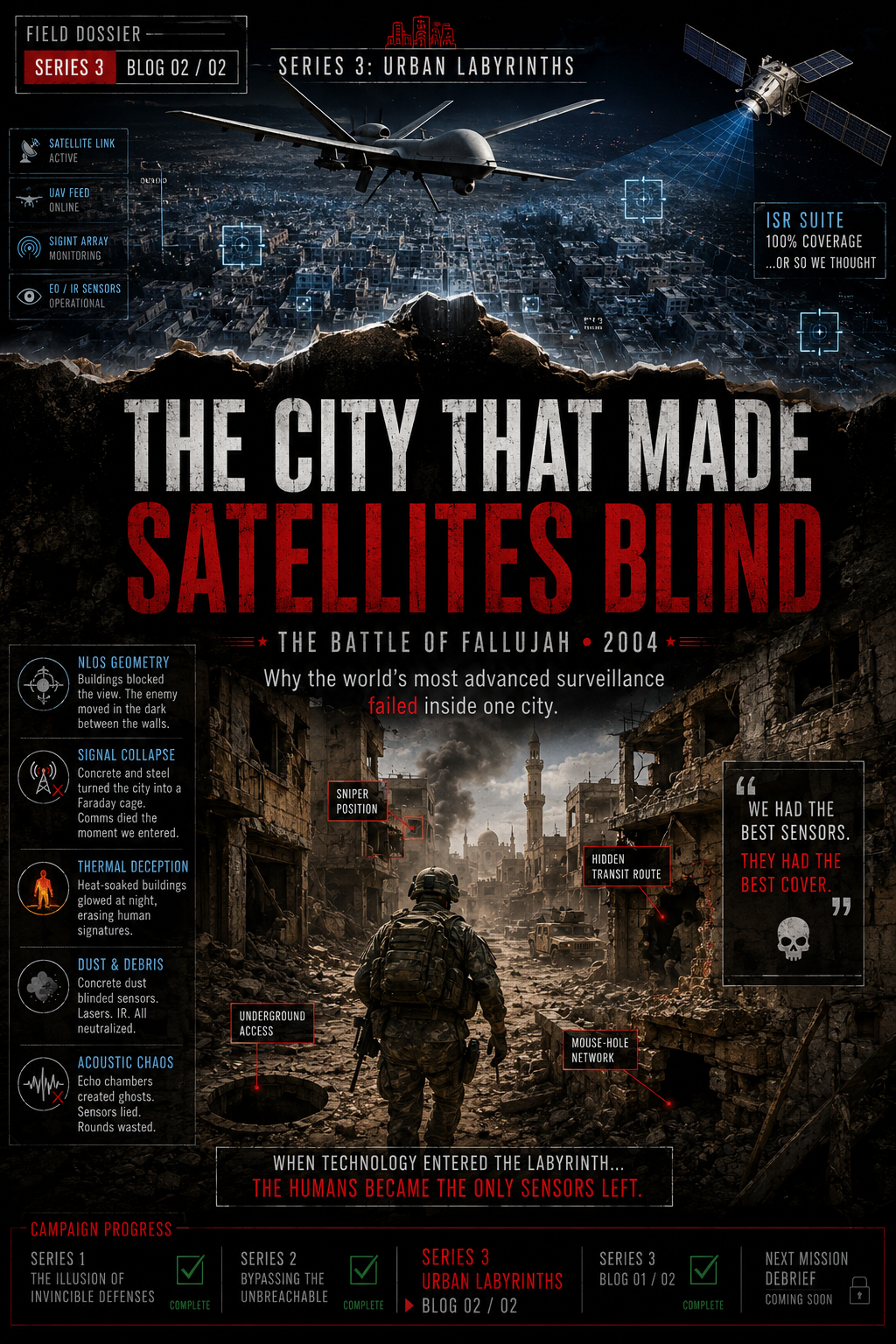
The “Urban Canyon Effect” was the first physical hurdle. The city’s dense, multi-story masonry buildings created permanent “shadow zones.” High-altitude UAV sensors, designed to track movement across open deserts, were physically blocked by these canyons, rendering Electro-Optical and Infrared (EO/IR) assets effectively useless.
Inside these structures, the insurgents employed the “Mouse-Hole Doctrine.” By punching holes through interior walls, they created a fluid, hidden transit network. They moved entire combat cells from block to block while remaining completely invisible to the “wedding cake” of sensors orbiting overhead. The city became a liquid medium; the enemy didn’t “hold” territory in the traditional sense, they flowed through the concrete, turning static infrastructure into a high-speed transit grid that rendered the Coalition’s map-based strategy a relic of a bygone era. Insurgents also utilized sub-basements and compromised structures not found on any official municipal maps, leaving the Coalition fighting a phantom infrastructure.
III. The Sensory Autopsy: The Hard Physics of Failure
The failure of technology in Fallujah was not due to poor equipment, but to the harsh, unforgiving physics of the urban environment.
The “Faraday Cage Effect” was constant. The city’s thick masonry and extensive steel rebar acted as natural shielding, degrading Radio Frequency (RF) signals and severing the ISR chain the moment a squad stepped through a door. Communication between the infantry and HQ collapsed as soon as they moved from the street into the structure.
Furthermore, the desert heat-soak created “Thermal Hysteresis.” In the blistering heat of the day, the entire city absorbed energy, and at night, it released that heat uniformly. The buildings literally glowed on thermal sensors, washing out the human heat signatures of the combatants. This “thermal background noise” meant that sensors couldn’t distinguish a sniper from a radiator.
When you add the “Strobe Effect” — the sensor’s inability to rapidly adjust from the blinding white of the desert sun to the pitch-black shadows of a room — and the “Suspended Particulates” of concrete dust from wall breaches, the ISR suite was effectively blinded. These clouds of dust neutralized laser rangefinders and infrared sensors, rendering precision targeting tools useless at the exact moment of tactical engagement. Acoustic sensors, designed to triangulate sniper fire, were rendered useless by the “Echo Chamber” effect of narrow, masonry-lined streets, causing false readings that led units to strike empty buildings, wasting time and resources.
IV. The “Invisible” Intelligence Gap
Beyond the physical, there was a systemic failure of Signals Intelligence (SIGINT). Insurgents, cognizant of the Coalition’s electronic ears, largely abandoned wireless communication. They relied on hard-wired landlines and pre-arranged human runners to stay off the electronic grid entirely.
Because they weren’t broadcasting, the Coalition’s SIGINT assets recorded total silence. This silence was interpreted by analysts as “the sector is empty,” a fatal miscalculation. The sheer volume of civilian electronic noise — the “Interference Blanket” of urban life — masked any insurgent activity that did exist.
This created a severe “Data Bottlenecking” problem. Even when a drone captured a high-definition image of a movement, the limited bandwidth of the deployed communication networks meant that this data couldn’t be pushed down to the squad leader in real-time. The intelligence was consistently “stale,” reaching the troops only after the target had already vanished through a “mouse-hole,” forcing the infantry to navigate by voice and memory rather than actionable intelligence.
V. The Human-Machine Mismatch
The most overlooked casualty of this battle was the cognitive bandwidth of the individual soldier. The Coalition attempted to solve the complexity of urban warfare by adding more tech: tablets, remote feeds, and complex comms arrays.
This created a “Cognitive Overload.” A soldier tasked with clearing a room cannot simultaneously monitor a tablet feed and maintain 360-degree situational awareness. The human brain, under the stress of combat, resorts to “task-shedding” — they simply stop looking at the tech.
This leads to “Threshold Trauma.” The moment a soldier reaches a doorway, technology stops working. The sensor is useless; the drone feed is black. In that split second, the high-tech soldier is reduced to a primitive survivor, relying on instincts that no sensor can replicate. The sustained hyper-vigilance required in this environment caused a degradation in decision-making, where the very tools meant to assist only served to increase fatigue and error, ultimately leading to decision paralysis at the squad level. Commanders, inundated with unverified and fragmented data, were often left in a state of paralysis, proving that high-density combat requires decentralized command structures, not centralized monitoring.
VI. Tactical Regression: The Return to Analog
Faced with the failure of the digital, the soldiers on the ground were forced to evolve. They initiated the “Human Sensor” protocol, where the squad itself became a decentralized, real-time “human intranet.” Verbal communication and hand signals became more reliable than encrypted radio channels.
Units were forced to regress to analog signaling — chemical light sticks, mirrors, and physical markers — to communicate status to the drones above. They mastered the “Fatal Funnel,” acknowledging that the most dangerous place on the battlefield was the immediate area in front of a door. They developed “Stairwell Supremacy” as a tactical necessity, realizing that controlling the vertical axis of the building was the only way to prevent the enemy from bypassing their ground-floor presence. The battle was won not by the machines, but by the soldiers who realized that in the labyrinth, the human is the only sensor that adapts. They utilized “Pattern of Life” analysis — observing that a street suddenly becoming “dead” was a more reliable indicator of an ambush than any digital feed.
VII. The “Entropy Engine”: Systemic Failure
Fallujah proved that the pursuit of surgical strikes in an integrated urban environment is a category error. The Coalition’s “Entropy Engine” — the use of precision weaponry like Hellfire missiles — was paradoxically self-defeating.
Each strike created a pile of rubble. That rubble provided better defensive cover than the original, intact building. By “clearing” a sector, the Coalition unintentionally improved the terrain for the insurgent, creating an endless cycle of re-infiltration. The economic asymmetry was staggering: the Coalition spent $150,000 on a single precision munition to target a node that the insurgent had rigged for $50. It was an economic and tactical trap.
Furthermore, the “False Positive” escalation plagued the operation. ISR, unable to provide clear verification, led to restrictive Rules of Engagement (ROE) that paralyzed momentum, or conversely, led to tragic misidentifications. The more force the Coalition applied, the more chaos it generated. By booby-trapping buildings, insurgents forced units to move through specific, narrow pathways, effectively turning the city into a series of “kill zones” that aerial assets could not mitigate. Seismic shadowing — where buildings dampened movement vibrations — meant that even advanced vibration-sensing tech could not alert units to insurgents nesting in sub-structures.
VIII. Forensic Verdict: The Integrated Legacy
The ultimate lesson of Fallujah is that technology is a mirror, not a solution. In the labyrinth of the city, that mirror reflected only the invader’s own blindness. The conflict proved that we cannot “technologize” our way out of the fundamental friction of urban warfare.
We are moving toward a hybrid model. The future of urban combat lies in “Human-in-the-Loop” fusion, where decentralized teams use AI-assisted tools — not AI-led ones — to interpret the environment in real-time. It requires a shift from “Technology-First” to “Integrated Urban Doctrine,” where the soldier is the primary, adaptive sensor, and overhead ISR is reserved for the big picture rather than the microscopic detail.
Fallujah was the final verdict on the limits of technocentrism. It proved that in the concrete canyons of the 21st century, the most lethal, sophisticated, and reliable sensor will always be the individual, observing, thinking human at the heart of the labyrinth. The “God’s-Eye” failed because it forgot that war is not a data problem to be solved; it is a physical reality to be endured. The legacy of Fallujah is not in the success of its hardware, but in the brutal, necessary realization that when the screens go black, the human must take the lead. We did not master the city; the city mastered our arrogance.
But if Fallujah proved the limits of the observer, we must now ask: what happens when the observer is no longer human? If the labyrinth remains the same, but the eyes watching it are no longer biological, do we finally conquer the friction — or have we simply built a more sophisticated cage for ourselves?
The forensic files of the past are closed, but the architecture of the future is shifting. And as the digital and the physical begin to bleed into one, the most dangerous variable is no longer what we can see… it is what we are becoming.
메타데이터
- post_id
- b081e61e4e58
- slug
- series-3-urban-labyrinths-b081e61e4e58
- url
- https://medium.com/@susmitkangane911/series-3-urban-labyrinths-b081e61e4e58
- canonical_url
- https://medium.com/@susmitkangane911/series-3-urban-labyrinths-b081e61e4e58
- author_url
- https://medium.com/@susmitkangane911
- status
- ok
- fetched_at
- 2026-08-16 14:18:59