You Approved the Change. But Do You Know What Else Changed?
Quality management was never meant to be a guessing game.
You Approved the Change. But Do You Know What Else Changed?
Quality management was never meant to be a guessing game.
And yet, in most medical device companies, it is.
A change gets approved. A document gets updated. A CAPA gets closed.
But one question is rarely answered:
👉 What else did that change affect?
The Real Problem
In most QMS systems, change is documented — but not understood.
A single event — a complaint, deviation, or design decision — can impact:
- multiple requirements
- risk assessments
- verification activities
- documentation
- training
- supplier records
But these connections are rarely visible.
Teams are left to manually investigate across disconnected systems.
The result:
- delayed decisions
- incomplete updates
- traceability gaps
- audit risk
The challenge is not documenting change.
👉 The real challenge is understanding its full impact — before implementation begins.
A Shift Toward Operational QMS
Most QMS platforms are built to store records.
Very few are built to analyze what those records mean in context.
That’s where the shift is happening.
Modern MedTech teams are moving from passive systems to operational QMS — systems that:
- capture signals early
- understand impact
- guide execution
- maintain traceability continuously
What We Built (qmsWrapper 10.2)
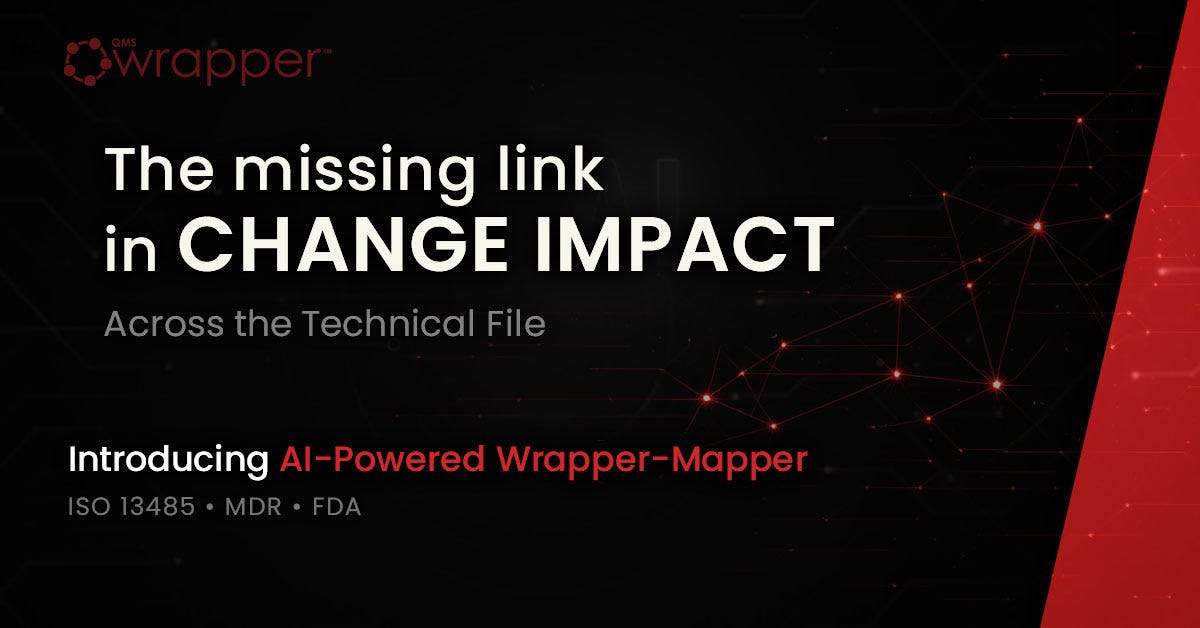
This is exactly what we introduced in **qmsWrapper 10.2**.
At the center is Wrapper-Mapper — an AI engine designed to answer one critical question:
When something changes, what else across your QMS is affected?
Instead of treating change as an isolated action, the system connects:
Event → Impact → Implementation → Traceability
So when something happens:
- affected requirements are identified
- risks are flagged
- tests are linked
- documentation stays aligned
Not manually. Not after the audit.
In real time.
Why This Matters
Think of it like this:
A complaint triggers a change.
That change affects:
- a requirement
- which affects a risk
- which affects a test
In most systems — that chain is invisible.
In a connected QMS, that chain becomes the system itself.
Want to See How This Works in Practice?
We broke this down in a short, practical report:
AI QMS for Medical Devices — Understand what must change before you act
Or See It Live
If you’re preparing for MDR or FDA audits and want to see how this works in your own setup:
**Book a QMS demo** https://qmswrapper.com/qms-software-demo/
Most QMS systems help you approve a change.
Very few help you understand it.
And in modern MedTech — that difference defines audit readiness.
메타데이터
- post_id
- b093fd86b1e6
- slug
- you-approved-the-change-but-do-you-know-what-else-changed-b093fd86b1e6
- url
- https://medium.com/@qmswrapper/you-approved-the-change-but-do-you-know-what-else-changed-b093fd86b1e6
- canonical_url
- https://medium.com/@qmswrapper/you-approved-the-change-but-do-you-know-what-else-changed-b093fd86b1e6
- author_url
- https://medium.com/@qmswrapper
- status
- ok
- fetched_at
- 2026-06-09 15:37:30