Structural Health Monitoring (SHM) Linked with BIM Digital Twins
Transforming Structures from Static Assets into Intelligent, Self-Aware Infrastructure
Structural Health Monitoring (SHM) Linked with BIM Digital Twins
Transforming Structures from Static Assets into Intelligent, Self-Aware Infrastructure
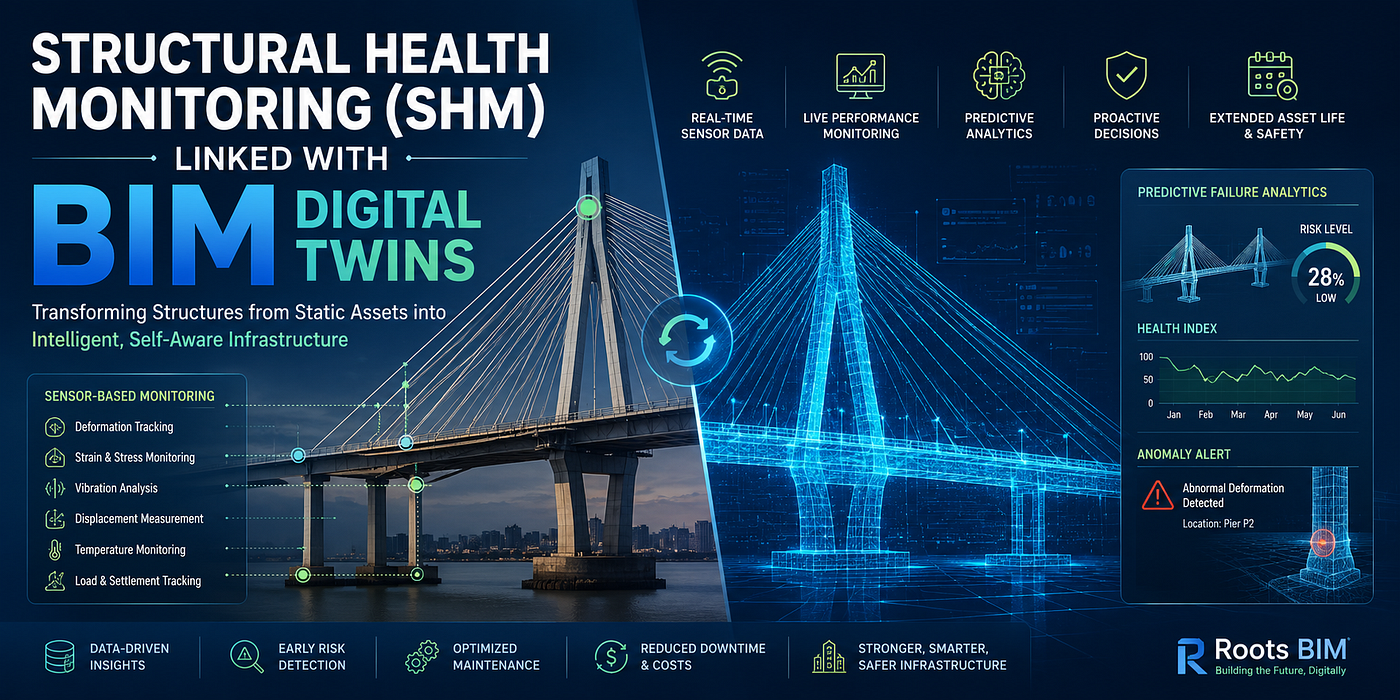
Structural Health Monitoring Linked with BIM Digital Twins
Modern structures are no longer expected to simply stand — they are expected to communicate, adapt, and provide continuous insights into their performance throughout their lifecycle.
As infrastructure becomes increasingly complex and operational risks grow more costly, traditional inspection methods are proving insufficient. Periodic visual assessments and manual reporting often fail to detect early signs of deterioration, leaving owners and facility managers vulnerable to unexpected failures and expensive repairs.
This is where the convergence of Structural Health Monitoring (SHM) and BIM-enabled Digital Twins is revolutionizing the future of structural asset management.
At Roots BIM LLC, we view BIM not merely as a design and coordination platform, but as the foundation of an intelligent digital ecosystem where real-time structural behavior can be monitored, analyzed, and predicted long before critical failures occur.
Beyond As-Built Models: The Rise of Living Structures
Traditionally, BIM models have served as digital representations of physical assets, containing geometry, specifications, and construction information.
A Digital Twin takes this concept significantly further.
A BIM Digital Twin continuously receives live operational data from the physical structure, enabling engineers to compare design assumptions with actual performance in real time.
The result is a dynamic, continuously evolving model that mirrors the health and behavior of the asset throughout its operational life.
When integrated with Structural Health Monitoring systems, Digital Twins become powerful decision-support platforms capable of detecting anomalies, assessing risks, and forecasting structural performance.
Understanding Structural Health Monitoring (SHM)
Structural Health Monitoring involves the continuous collection and analysis of data from strategically placed sensors embedded within or attached to structural components.
These sensors measure:
- Structural deformation
- Strain and stress
- Vibration characteristics
- Temperature fluctuations
- Tilt and displacement
- Crack propagation
- Settlement movement
- Load distribution
Rather than relying solely on scheduled inspections, SHM provides continuous visibility into how a structure behaves under real-world conditions.
For critical assets such as:
- High-rise buildings
- Data centers
- Bridges
- Airports
- Stadiums
- Industrial facilities
- Offshore platforms
this real-time intelligence can significantly improve operational safety and reliability.
Sensor-Based Deformation Tracking
Measuring Structural Behavior in Real Time
One of the most valuable applications of SHM is deformation tracking.
Every structure experiences movement.
Factors such as:
- Wind loading
- Thermal expansion
- Seismic activity
- Differential settlement
- Dynamic occupancy loads
- Equipment vibration
can cause measurable structural displacement.
Using advanced sensing technologies such as:
- Fiber Optic Sensors (FOS)
- Strain Gauges
- Accelerometers
- Inclinometers
- Laser Displacement Sensors
- GNSS Monitoring Systems
engineers can continuously monitor structural movement with remarkable precision.
BIM-Driven Visualization of Deformation
The true power emerges when sensor data is connected directly to a BIM Digital Twin.
Instead of reviewing isolated spreadsheets or monitoring dashboards, stakeholders can visualize structural behavior directly within the BIM environment.
For example:
A bridge deck experiencing excessive deflection can be automatically highlighted within the Digital Twin.
A structural column showing abnormal strain levels can trigger visual alerts inside the BIM model.
A high-rise tower experiencing excessive sway during high-wind events can generate automated performance reports.
This spatial context dramatically improves understanding and accelerates decision-making.
From Monitoring to Intelligence
Monitoring alone does not prevent failures.
The real value lies in transforming data into actionable insights.
Modern Digital Twin platforms combine BIM data with:
- Artificial Intelligence
- Machine Learning
- Statistical Modeling
- Predictive Analytics
to identify patterns that may indicate future structural problems.
Instead of simply displaying what is happening, the system predicts what is likely to happen next.
Predictive Failure Analytics
Anticipating Structural Risks Before They Become Critical
Predictive failure analytics represents the next evolution of structural asset management.
Using historical and real-time sensor data, algorithms can identify subtle changes that may indicate:
- Material fatigue
- Progressive cracking
- Excessive settlement
- Corrosion-related deterioration
- Foundation instability
- Connection degradation
- Load redistribution
Many of these conditions develop gradually and remain invisible during routine inspections.
By analyzing trends over time, predictive models can estimate the probability of failure and identify vulnerable components before safety thresholds are exceeded.
Digital Twins as Predictive Decision Engines
When predictive analytics are integrated into BIM Digital Twins, engineers gain an unprecedented level of foresight.
Imagine a scenario where:
A structural beam exhibits strain patterns associated with fatigue.
The Digital Twin:
✔ Detects the anomaly
✔ Compares current behavior with historical data
✔ Simulates future loading scenarios
✔ Calculates risk levels
✔ Identifies affected structural elements
✔ Generates maintenance recommendations
✔ Issues alerts before critical failure occurs
This proactive approach shifts maintenance strategies from reactive to predictive.
Applications Across the Built Environment
High-Rise Buildings
Digital Twins can monitor:
- Wind-induced drift
- Core wall performance
- Settlement behavior
- Structural vibration
ensuring long-term performance and occupant safety.
Bridges
Continuous monitoring enables:
- Deflection analysis
- Cable tension monitoring
- Fatigue assessment
- Load impact evaluation
while extending service life and reducing inspection costs.
Data Centers
Mission-critical facilities require uninterrupted operation.
SHM-integrated Digital Twins can monitor:
- Equipment-induced vibration
- Floor loading conditions
- Structural response to dynamic loads
supporting operational resilience.
Industrial Facilities
Heavy machinery often generates significant dynamic forces.
Digital Twins help track:
- Structural fatigue
- Equipment impacts
- Foundation movement
- Long-term degradation
reducing the risk of unplanned shutdowns.
The Role of BIM in SHM Integration
BIM serves as the digital backbone connecting all monitoring data.
A properly structured BIM model provides:
· Asset Intelligence
Each sensor is linked to a specific structural component.
· Spatial Context
Engineers can instantly locate areas of concern.
· Lifecycle Traceability
Historical performance data remains attached to the asset throughout its operational life.
· Maintenance Coordination
Facility managers can integrate monitoring results with maintenance workflows and asset management platforms.
The result is a centralized source of truth for structural performance management.
Future Directions: Autonomous Infrastructure
The future of SHM-linked Digital Twins extends beyond monitoring and prediction.
Emerging technologies are enabling:
- AI-driven structural diagnostics
- Automated anomaly detection
- Self-updating Digital Twins
- Autonomous inspection drones
- Robotics-assisted maintenance
- Real-time risk forecasting
In the coming years, infrastructure will increasingly function as intelligent systems capable of continuously assessing their own condition and recommending corrective actions.
How Roots BIM LLC Enables Intelligent Structural Monitoring?
At Roots BIM LLC, we integrate BIM, Digital Twins, IoT sensors, cloud-based data platforms, and predictive analytics to create intelligent infrastructure ecosystems that extend far beyond traditional modeling.
By connecting real-world structural behavior with BIM-driven Digital Twins, we help owners, engineers, and facility managers:
- Visualize structural performance in real time
- Monitor deformation and asset health continuously
- Detect anomalies before they escalate
- Predict potential failures using data-driven analytics
- Optimize maintenance planning
- Extend asset lifespan
- Improve operational safety and resilience
Conclusion
The future of structural engineering is no longer defined solely by how structures are designed and built — it is defined by how intelligently they are monitored, understood, and managed throughout their lifecycle.
Structural Health Monitoring linked with BIM Digital Twins transforms infrastructure from passive assets into active, data-driven systems capable of sensing, learning, and predicting.
By combining sensor-based deformation tracking with predictive failure analytics, the industry is moving toward a new era where structural failures can be anticipated long before they occur, creating safer, smarter, and more resilient built environments.
At Roots BIM LLC, we believe the most valuable structure is not just the one that stands strong today — but the one that continuously tells us how to keep it strong tomorrow.
BIM #DigitalTwin #StructuralHealthMonitoring #SHM #SmartInfrastructure #PredictiveAnalytics #IoT #StructuralEngineering #AssetManagement #DigitalConstruction #RootsBIMLLC #AEC #FutureOfInfrastructure
메타데이터
- post_id
- b09db17cfeb2
- slug
- structural-health-monitoring-shm-linked-with-bim-digital-twins-b09db17cfeb2
- url
- https://medium.com/@rootsbim/structural-health-monitoring-shm-linked-with-bim-digital-twins-b09db17cfeb2
- canonical_url
- https://medium.com/@rootsbim/structural-health-monitoring-shm-linked-with-bim-digital-twins-b09db17cfeb2
- author_url
- https://medium.com/@rootsbim
- status
- ok
- fetched_at
- 2026-06-27 07:40:21