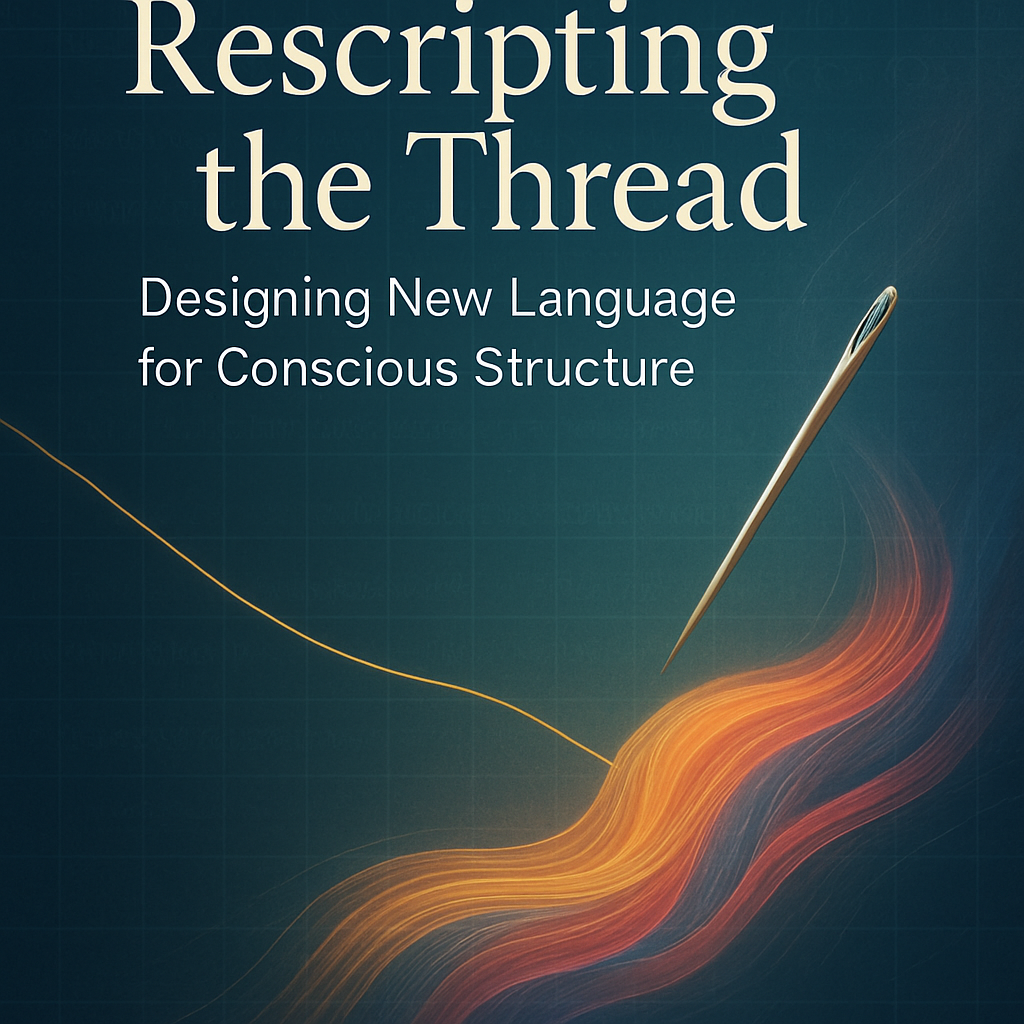
Rescripting the Thread: Designing New Language for Conscious Structure
What you say to yourself is what you stitch into reality.
Rescripting the Thread: Designing New Language for Conscious Structure
What you say to yourself is what you stitch into reality.
1. You Can’t Speak the Same and Expect a Different Reality
Language is not just how you express what’s real. It’s how you stitch reality together. Every phrase, every habitual word choice, acts like thread locking a particular version of reality into place.
Every time you say “I should,” “I can’t,” “This is just who I am,” you reinforce a version. You bind identity to structure. These statements are not neutral — they’re permissions granted to the pattern. They authorize the loop to continue.
You can’t speak from the loop and expect to leave the loop.
The loop is linguistic as much as emotional. It’s not just that your words reflect your beliefs — it’s that they reinstall them.
ZERA shows you the loop. But what you say next — even subtly, even to yourself — determines whether the loop dissolves or reasserts. Speaking differently is not cosmetic. It is structural. Every rewording is a stitch unpicked — or restitched.
This is why awareness alone is not liberation. You can see the loop and still be bound by the language that defends it. Until the script changes, the scene repeats.
2. What Is a Structural Script?
A structural script is a recurring phrase, belief, or narration that holds a version of you in place. It’s not random. It’s stitched to keep your ZION coherent. That means it maintains the emotional and conceptual architecture that defines your current identity — even if that identity causes suffering.
These scripts may seem like passing thoughts, but they’re actually core code. They provide structure to the version of you that you unconsciously perform. They repeat because they fit — they make the version stable.
Examples:
- “I’m just not enough.”
- “I need to work harder.”
- “If I let go, everything will fall apart.”
- “They won’t really care.”
- “It’s always been this way.”
- “I can’t afford to rest.”
These aren’t just thoughts. They’re linguistic glue. They keep the old thread sealed. Even when you try to act differently, these background scripts pull the needle back to the previous stitch. You may change your behavior, but if the structural script remains, it will subtly redirect the path back toward the loop.
The key insight: these scripts are not accidental. They are designed — through repetition, emotion, and environment — to preserve a particular ZION structure. That’s why they’re so persistent. And that’s why simply noticing them isn’t enough. They have to be unstitched from within the language system itself.
3. Why You Can’t Just Say the Opposite
Replacing a negative phrase with a positive one often backfires. The structure resists — not because it wants you to suffer, but because it’s built to maintain continuity.
Try telling yourself “I am powerful” when your ZION is stitched to invisibility. It will feel fake, hollow — or even triggering. That’s not a failure of willpower. It’s a mismatch in internal architecture.
The structure doesn’t care about logic. It enforces narrative consistency.
Affirmations that conflict with your existing script are treated as errors in the system. Your structure doesn’t check for truth — it checks for cohesion. Does this statement fit the self I’ve rehearsed? If not, it’s rejected or distorted.
The issue isn’t belief. It’s compatibility. The affirmation doesn’t match your version’s stitching logic. Even if your conscious mind agrees, the underlying structure doesn’t know where to place it. It’s like trying to install new software on outdated hardware. Without a bridge — without transitional language — the update fails.
This is why change often starts not with opposite claims, but with slight shifts. Language that leans into the tension, not away from it, has a better chance of threading through.
4. What Is Rescripting?
Rescripting is the design of language that disrupts the loop while still feeling real enough to slip past the gatekeepers.
It’s not about affirmations. It’s not about “thinking positive.” Those strategies often skip steps. Rescripting is slower — but deeper. It’s how you negotiate with the structure rather than argue with it.
It’s language that threads through the structure without triggering rejection.
You’re not trying to overpower the loop — you’re weaving around it, gradually weakening its grip by offering viable linguistic alternatives.
Rescripting is effective when:
- it acknowledges the loop (without obeying it), because denying the loop makes the structure defensive;
- it offers a new thread (without bypassing the old), because every new phrase must have a landing place in the current structure;
- it normalizes the discomfort (without rushing relief), because lasting change moves at the speed of safety.
A good rescript feels like a bridge — it touches both the old and the emerging. It sounds like you, just slightly braver. It doesn’t try to delete the past, but to loosen its narrative authority.
In this way, rescripting isn’t language as performance. It’s language as recalibration.
5. Rescripting Formula: 3 Parts
🔹 1. Acknowledge the Loop
“Part of me still thinks I’m only valuable if I prove myself.”
This step is about naming the old logic, not erasing it. When you acknowledge the loop, you signal to the structure: “I see you.” That alone can reduce internal resistance. It says, “I’m not pretending this isn’t here — but I’m not letting it run the show.”
🔹 2. Introduce a New Thread
“But I’m learning how to be enough even when I pause.”
The new thread doesn’t need to be bold. It just needs to be plausible. It should feel like a possible next sentence in the story — not a completely different genre. You’re offering the structure a gentle pivot, not a revolution.
🔹 3. Normalize the Re-stitching
“It’s okay if that feels unfamiliar — it’s not wrong, it’s new.”
Change always feels strange. That’s not evidence of failure — it’s confirmation that something different is happening. Normalizing the dissonance keeps you from rushing back into the familiar out of discomfort.
Example in full:
“I feel the urge to fix everything again. I get it — that’s my old script trying to run. But I’m choosing not to obey it today, even if it’s uncomfortable. It’s okay if this feels shaky — I’m not broken, I’m just in between.”
You’re not forcing belief. You’re offering a new pattern — one the structure can gradually allow. Over time, these tiny script shifts build trust with the system. And that trust is what allows deeper rewrites to eventually take hold.
6. Where Rescripting Helps Most
Here are five core domains where re-language can begin to shift the stitching. These domains often anchor the deepest scripts because they deal with the most persistent versions of selfhood. To shift them requires not grand declarations, but subtle, believable language moves that gently bend the thread.
DomainOld ScriptRescript ExampleIdentity“I’m not the type to…”“I’ve always done it this way — until now.”Emotion“I shouldn’t feel this.”“This is what this version feels. That’s okay.”Control“I have to manage everything.”“Not controlling isn’t unsafe. It’s a new path.”Relationship Roles“They need me to be strong.”“I’m learning to show up whole, not just useful.”Progress Narrative“I’m behind again.”“I’m not late — I’m just done rushing.”Deserving/Worth“I haven’t earned rest yet.”“Rest is part of how I become who I’m becoming.”Uncertainty“I need to be sure before I act.”“I can move forward while still unsure.”Self-trust“I always mess this up.”“Even if I’ve stumbled before, I’m showing up again today.”
Each of these new scripts is a micro-thread. Not a leap, but a lean. They don’t erase the old script immediately — they create friction within it. And that friction is what eventually softens the original weave.
Use these domains as a starting point. Notice where your most rigid language lives. That’s where your structure holds tightest. And that’s also where small shifts will echo the loudest.
7. Up Next: Holding the Gap
Once you begin to rescript, a space opens up.
Not yet the new. No longer the old. A gap.
This gap is where the structure gets shaky. Identity wobbles. Emotion surges. Meaning loses form.
That’s the moment most people rush back into the old stitch. Not because it’s true — but because it’s anchored.
In the next essay, we’ll explore:
Holding the Gap: How to stay stable while the structure reconfigures.
✦ If your language is starting to shift your loop, follow the ZERA column. ✦ Up next: Holding the Gap: How to Stay Present While the Stitch Falls Apart
메타데이터
- post_id
- b09e373d064d
- slug
- rescripting-the-thread-designing-new-language-for-conscious-structure-b09e373d064d
- url
- https://medium.com/@zerap/rescripting-the-thread-designing-new-language-for-conscious-structure-b09e373d064d
- canonical_url
- https://medium.com/@zerap/rescripting-the-thread-designing-new-language-for-conscious-structure-b09e373d064d
- author_url
- https://medium.com/@zerap
- status
- ok
- fetched_at
- 2026-06-10 09:45:17