Shin Megami Tensei III: One of the hardest RPGs you’re ever likely to play (Part 4).
Hello, my name is Carl, and I am here to eat crow. I lambasted and slammed “Shin Megami Tensei …if”, rightfully so, and I stick by…
Shin Megami Tensei III: One of the hardest RPGs you’re ever likely to play (Part 4).
Hello, my name is Carl, and I am here to eat crow. I lambasted and slammed “Shin Megami Tensei …if”, rightfully so, and I stick by everything I said to this day (be on the lookout for a possible Monday Misfire revival).
If you took anything from the tone of that review, stated or not, I all but swore off the series. Yes, Shin Megami Tensei 1 and 2 were alright, perhaps closer to subpar, for sure tedious, and severely dated, but interesting in an inexplicable kind of way. But “if” killed off any aspiration I had to continue with the SMT for many years. So why am I eating crow? Because I overlooked this game sitting on the shelf of my local gaming shop for several months, and I questioned myself as I walked to the counter with Nocturne:
“Do I really want to walk down this avenue again?” I kept asking myself.

I was a teacher at the time, and 30 euros was a lot to me, but I was in a risk-taking kind of mood that evening. While this wasn’t a fantastic game by any stretch, it was a gigantic, humongous leap forward from “if” and seems to have set the series on the right track, perhaps reawakening my interest in SMT.

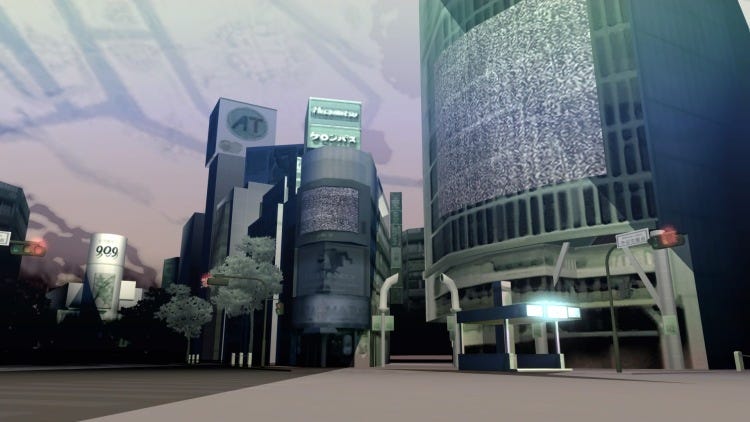
I will give all due credit to the atmosphere this game creates. I haven’t seen anything quite like it, and even more modern games struggle to create such a powerful ambiance. I suppose it is fitting that several days after finishing this game, I was in some old abandoned Soviet resort in a random town in the country of Georgia. One particular building (pictured above) was overrun by nature, long past its heyday. But the feelings it elicited closely resembled what I felt playing the game and what I think the developers were going for here. A vast emptiness, the mystery of the unknown, occasional hints of a bygone era, with delicate wafts of hopelessness. There is something very peculiar about the Japan that Nocturne portrays. It’s an enigma, slightly bizarre, definitely spooky, with underlying tones of sadness and a constant subtle aura of danger as if this Tokyo is the wild west on steroids.

The first few hours, I was on edge, mostly because I was looking for any reason possible to drop the game based on previous experience with the series, I’ll admit. But it did just enough to keep me enticed, and an odd thing started to happen: I began to feel more comfortable with Nocturne.
Don’t get me wrong, it can be a tough game, even brutal at times. There is one boss early in the game who looks like a skeleton bullfighter who can rip you apart without wasting a breath if you aren’t careful and prepared, and even when prepared, can push your team to the absolute limits. It is early on, and where one of my first major gripes arises, sometimes serious battles happen with no warning. You could be walking around anywhere, not just a dungeon, and unexpectedly be thrown into a rough battle. Preparation is key, and one of the things this battle taught me is that buffs and debuffs are paramount to success for every single boss battle moving forward. It is incredible how much of a difference these spells + focus make. Don’t use them and watch as you get torn apart. Use them and coast through the battle.

This happened with another boss battle later in the game, often viewed as even tougher than the bullfighter, which also happens without warning. I neglected buffs and debuffs and got whooped, only to go back into the battle a second time, solely focusing on those two things, and, again, coasted. I’d claim the game is almost too focused on these two aspects to its detriment and to the point where no other strategy is really needed. Though in the case of that battle, a unique gimmick was introduced where the boss alternated between positive and negative special attacks every 8 rounds, either fully healing or insta-killing the character whose current HP was the lowest percent of their total HP, and for the other 7 rounds had strong attacks. It also must be stated that where the moon cycle is upon entering battle can have all sorts of different effects, good or bad, so experiment with that! Many spells, such as estoma, lift, and light, are also reset with a new moon.

There is not a lot of character customization in this game, but one of the flexibilities offered is the ability to change magatama. These odd little parasites attach to the main character, an odd mix of part human and part demon, and offer specific protections, attacks, and stat bonuses. Having a tough time against a boss or enemies that use fire? Attach a magatama that is strong against that. Whatever a boss’s strength, there is surely a magatama that can help your chances. They are expensive but highly worth it.

As is the case with any other SMT and Persona games, it is possible to negotiate with demons. While I found negotiation with demons in, for example, Persona 5 way too easy, I’d place this game on the opposite end of the spectrum, too difficult and cumbersome. It didn’t help that demons would sometimes take loads of money and/or items only to, in the end, run off with everything. It almost struck me as unfair not to have a chance to catch up to them and beat them down to get your stuff back. I thought the original Persona (Revelations) struck a fine balance between the two aforementioned games, and, ideally, I’d prefer something in between Persona 5 and Nocturne as far as ease of negotiation, not too easy as Persona 5 but not so unforgiving as Nocturne, but somewhere in the middle. Once enough demons are captured, the chance to fuse two or more demons leads to many exceptionally strong demons.
I loved Persona 5, but one minor weak point was some of the tracks; they were too upbeat, and I yearned for darker, bleaker songs. In fact, having now played this game, if there is one thing I could take from Nocturne to replace something from Persona 5, I’d take some of the more desolate songs and inject them into Persona 5. I can even say that one of the few highlights of the earlier games, if included, was the music, and this trend continues with Nocturne. One of my favorite tracks is the hypnotic, industrial-sounding track that plays in the different kalpas in the Labyrinth of Amala, though I only did the first two. I also really loved how the track that plays for the bullfighter, skeleton biker, etc., enhanced those fights. It felt like I was falling through some messed-up dimension, and the only way out was to get into these fights that were equally bizarre as they were hard.

But that is what makes this game so unique, its fascinating blend of eccentric and doom and gloom post-apocalyptic wasteland. While the world is nothing to marvel at, it does create a curious wonderment, but for reasons I could never quite pinpoint. There is nothing in this game that outright impresses, whether it is looking at enemy sprites or the sprites of the few allies your hero comes across, or the drab-looking dungeons. But, just the same, there is a cohesiveness to the world that mixes well with the story and music. After all, how many bright colors could we expect if the world were laid to ruin?

How did the world fall into ruin? A cult destroys the world through an event called the Conception, thinking it will prevent the world’s demise. Tokyo, where the main character awakens, is turned into a hellhole surrounded by a mysterious sphere and filled with the spirits of the many humans who died in this event. Some demons fight amongst each other and other beings who want to remake the world into their ideals. Plus, this ultimate, all-powerful, for lack of a better word, god-like being called Kagutsuchi, who decides when to destroy the world and how to remake it, almost like the world continuously goes through these cycles.

As inhospitable as the world is, devoid of human life for the most part, there are a few humans the main character comes across throughout the game who play an integral role in the plot, though sometimes it is difficult to determine their motives. There are important choices the main character needs to make that cause the plot to branch off in different directions. As cool as it was to play through the game once, it was not so amazing that I’d be enticed to play through it again to make different choices and see the different paths they lead me down.

I had a fun time playing this game, but in the last 10 or so hours, out of 45 total, it started to drag a lot. My end-game level was 70 with my demon allies anywhere from the low 50s to the high 60s, and the last few bosses pushed me to my limits. Estoma, which is supposed to prevent battles for a short time, seemingly stopped working in the closing hours, and my opinion of the game started to drop. The rate of random encounters is borderline unbearable at times, even obnoxious. I started to feel this as early as the Yoyogi Park area. I wanted to play this game blind, but that portion ended that quickly, as it is easy to get lost, but the game picked up again after that for several hours.
The fact that your party can be instantly killed makes some of the later dungeons a complete slog, especially if you have to redo a lot of it. Part of it was my fault for not switching to the proper magatama, but still, a one-hit kill to your main character (game over) is punishing. Resource management is difficult, and you need to be strategic, making sure you’re never short of healing items. One thing I found that helped a lot was having several demons out of the party, on my bench, so to speak, who could heal and run through their MP. As the game progresses, your demon-carrying capacity increases, and any spare change should be used for MP healing items, making item management a little less stressful.

Overall, I wouldn’t recommend Shin Megami Tensei 3 to just anyone, including casual RPG fans. This is a tough game that has no problems ripping you a new one if you make a wrong move. Where most games are unforgiving, SMT3 piles on the pain. But for those with perseverance and patience, there is a solid game here with an intriguing story to tell.
메타데이터
- post_id
- b0d33dc0fdd7
- slug
- shin-megami-tensei-iii-one-of-the-hardest-rpgs-youre-ever-likely-to-play-part-4-b0d33dc0fdd7
- url
- https://medium.com/@carld18/shin-megami-tensei-iii-one-of-the-hardest-rpgs-youre-ever-likely-to-play-part-4-b0d33dc0fdd7
- canonical_url
- https://medium.com/@carld18/shin-megami-tensei-iii-one-of-the-hardest-rpgs-youre-ever-likely-to-play-part-4-b0d33dc0fdd7
- author_url
- https://medium.com/@carld18
- status
- ok
- fetched_at
- 2026-06-22 12:55:45