Measuring the Impact of the Arts: A Collaboration Story
How a community partnership is supporting the High’s research on the impact of art museums on their visitors
Measuring the Impact of the Arts: A Collaboration Story
How a community partnership is supporting the High’s research on the impact of art museums on their visitors
By Julia Forbes, Associate Director, Institutional Research, High Museum of Art
The High’s institutional research division in the Learning and Civic Engagement department was established in 2023 to expand the museum’s capacity as a knowledge-building institution. Brenau University has been an Academic Affiliate of the High since 2010. Over the years, the museum and Brenau staff have worked together to create meaningful experiences at the High for Brenau students — including tours, internships, and behind-the-scenes experiences that look in depth at the many professions an art museum can offer. “We are now in the sixteenth year of the partnership. In this time, Brenau students, faculty, and staff have had the experience of visiting selected exhibits as a group,” Brenau professor Claudia Wilburn shared. “This year we elevated the annual exhibit of Brenau student art at the High by including performances by their peers in dance, music, and theater.”
So, it made perfect sense that when the High decided to embark on a large-scale well-being study, we would reach out to longtime partner Brenau University. In 2025, we launched an exciting new research project with Atlanta-based arts and health research firm Performance Hypothesis. Our two-year well-being study examines the impact of art museum visitation on individuals through the lens of five capacities: social, emotional, intellectual, physical, and spiritual. Leading the project as coprincipal investigators are Andrew Westover (Eleanor McDonald Storza Deputy Director, Learning and Civic Engagement) and myself (Associate Director of Institutional Research) at the High alongside Professor of Music Barbara Steinhaus and Professor of Art and Design Claudia Wilburn at Brenau.
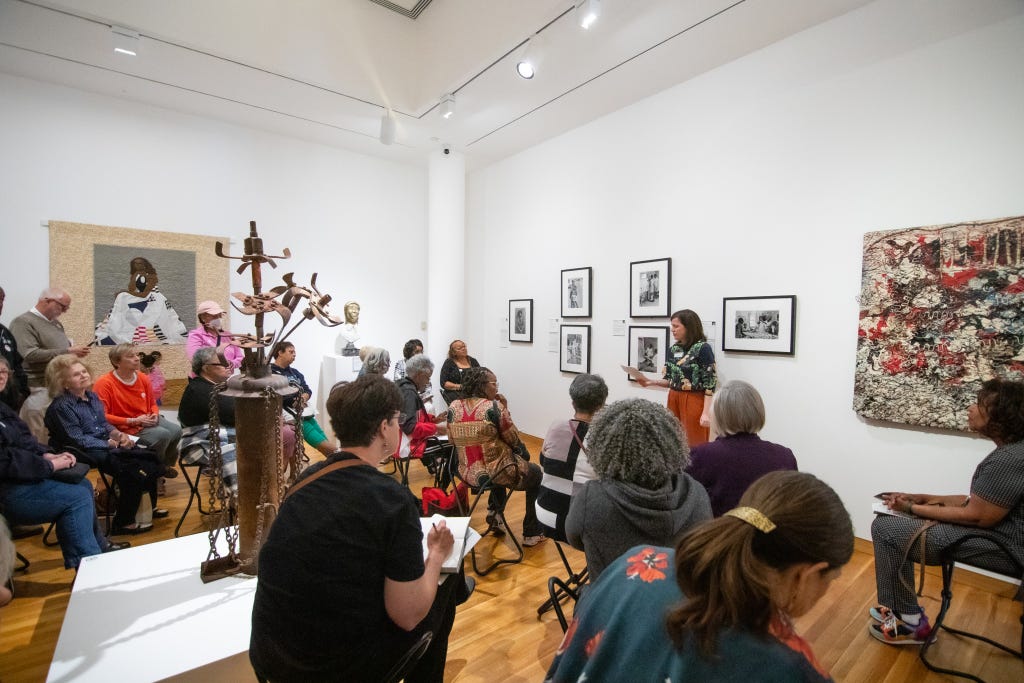
Through quantitative and qualitative tools, this mixed-methods project measures how art and arts programming personally impact our visitors. From August 2025 through January 2026, the High and Brenau teams collected data from visitors who participated in three of the High’s signature art education programs, each designed for specific audiences: Access for All (older adults), Oasis (all adults), and UPS Second Sundays (families). Data collection methods included surveys, interviews, participatory photography, and heart rate monitoring. We anticipate that our research will provide data-driven rationale for ways visual art museums can contribute to their visitors’ individual growth and interpersonal development.


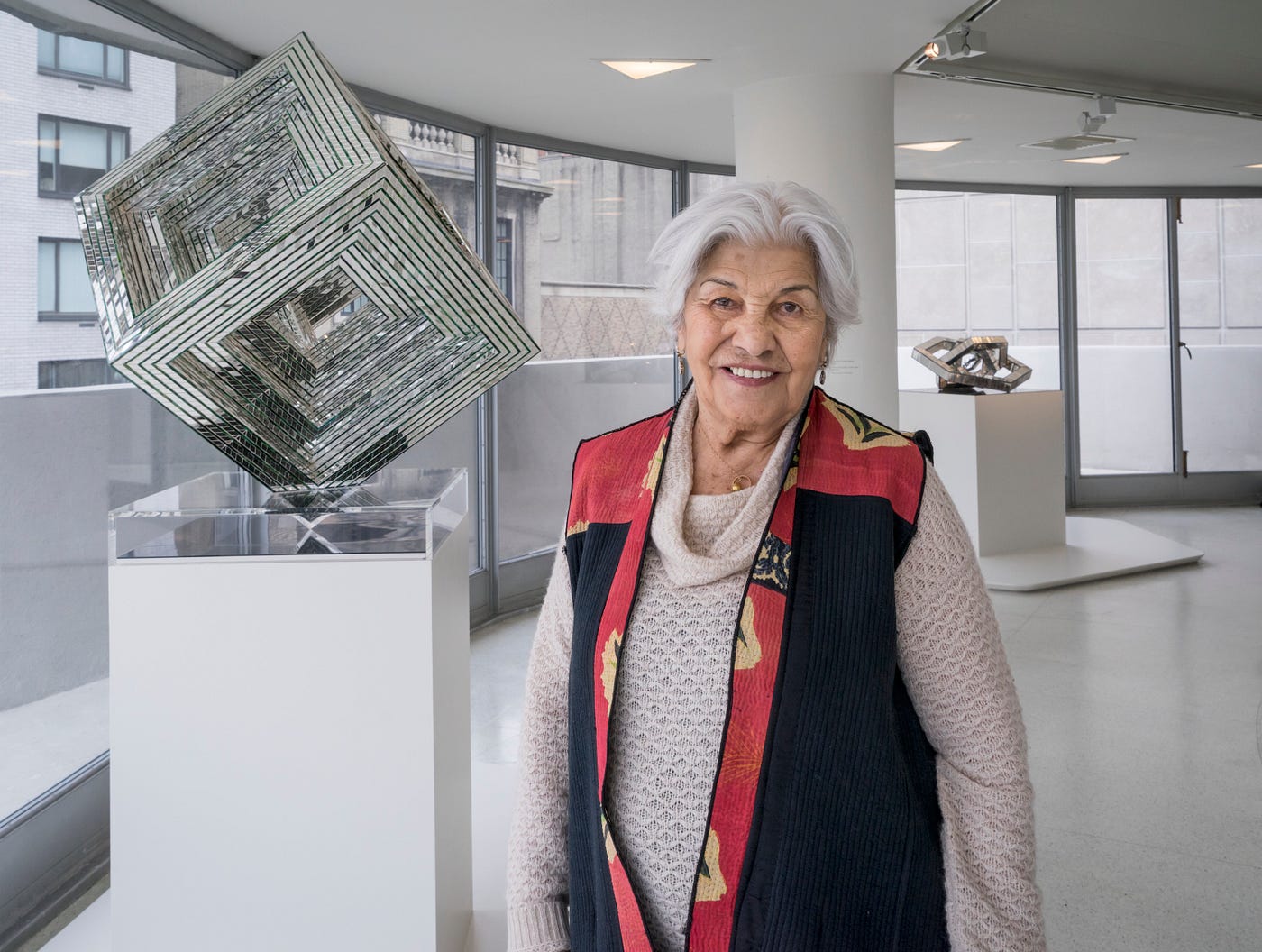
Left: Brenau University research assistant Bethany King and professor Barbara Steinhaus. Right: Julia Forbes, Associate Director, Institutional Research at the High. Photos by Tameka Cole, courtesy of the High Museum of Art.
One of the exciting aspects of this project was bringing on seven Brenau graduate students as paid data collectors. The Brenau team led by Dr. Gale Starich (Dean of the Sidney O. Smith Jr. Graduate School and Ivester College of Health Sciences) and Dr. Andrea Birch (Dean of the College of Fine Arts and Humanities) consulted with one another on which graduate student populations would best fit the study. Because health science disciplines require familiarity with clinical protocol, graduate students from those degree programs were invited to apply, and the final group comprised students from the departments of psychology, nursing, and physical therapy. “The thorough training our graduate students received for collecting data and the inclusive atmosphere at the High allowed for our Brenau students to carry out their roles without disrespecting the individuality of museum visitors,” Professor Steinhaus said. Together with the students, the High and Brenau teams gathered data from more than seven hundred visitors. To better understand the personal impact of this research experience on these students, I sat down with one of them, Cydney Jones, a doctoral candidate in clinical psychology.
Julia Forbes: Cydney, tell me a bit about yourself and what you are studying at Brenau.
Cydney Jones: I’m pretty much a native Georgian. I’m a military kid. I was born in Japan, and then I lived in Maryland for a little while. But my family is from Georgia. I grew up in Conyers. We have roots here as far back as we can go. I was always twenty minutes from Atlanta from second grade and beyond. So, this is home.
This is my first semester at Brenau. I am getting my doctorate in clinical counseling psychology, and ultimately, I want to go on to have a community center. Therapy is great and important, but I think that the way that we engage with it is different for everybody, and having a center in the community that helps people pick and choose the therapeutic aspects that are helpful for them would be better.

Left to right: Brenau University research assistants Cydney Jones and Mary Francis Riley and Brenau professor Claudia Wilburn. Photo by Julia Forbes, courtesy of the High Museum of Art.
JF: Why did you want to take on one of the research assistant positions and collect data for the High’s well-being study?
CJ: So, you get a lot of emails in the summer before school starts. All of them felt like a good opportunity but weren’t necessarily aligned for me. I didn’t really feel like I could take one on, when I didn’t know what the balance of school, life, and work was going to be just yet. I wanted to take my time and not just jump into things. But when I got the email about this research assistant position, I was immediately like, “This one is it!” It really bridged the gap between my personal and professional interests. One of my major goals was getting back to doing what I enjoy outside of school. I wanted to go to more museums. I got to see so much cool stuff going to the High for six months. I got to see three exhibitions!
But the main reason why I chose this opportunity was because this was my first research experience with a big external program — I mean, it’s not with my professor or something that I crafted. So, it was nice to be able to do it, and I feel like I got a lot out of it.
JF: What did you learn from this experience?
CJ: I think a lot of what I learned through this experience carries over to psychology and communication. Being around people is always going to be something that’s applicable in different settings. There was a lot of trust, a lot of the seven of us noticing each other. We were all sitting pretty close together when we were doing things, but we each had our separate task — so somewhere between being able to acknowledge that we were a team and are doing things together but giving each other the space and the opportunity to do our own thing and not necessarily overcorrect. We were also aware when someone needed help even if they may not be asking for it in that moment. And I think you see that a lot in the therapeutic world because we’re there as supports. We’re there as people to listen, to talk, to understand, and experience, but we’re also there to let people live their lives and not impede in that sense. So, I think finding balance is something that carries over to practice.
This was also my first time recruiting participants in person, and that third wall, so to speak, was broken between a researcher and a participant. It was exciting. A lot of times people walked up to us and asked, “What are you guys doing?” Being genuinely interested in furthering and advancing science — I think that was so great.
JF: How will you apply these new skills to your own work as you pursue your degree?
CJ: Being a research assistant in someone else’s project is so different from doing your own. You have so much on your mind when you are crafting and creating a research study, and you can be so [big picture–focused]. But in this experience, I was able to ground in the work and just be there to collect data, and that was freeing in a way. But it also felt important and very balanced too. When I’m doing that part of my dissertation, this experience will remind me of what it was like to be a research assistant [and of] the importance of gathering data as a process in and of itself and not just a means to an end. Because data collection is make or break; it can really feel like that when you are conducting it. But as a research assistant, it felt less weighty. I think knowing your place on a project is important, and I was able to grasp that a little bit more firmly through this experience.
I really enjoyed every second. I’m grateful for the opportunity. Like I said, when I got the email, I was like, “Oh my gosh, no way, this is really cool.” And of course, this is a longstanding partnership with Brenau, but I’ve never gotten an opportunity like this, and this will be my fourth year as a student. I love that you’re engaging with us and that we have this full-circle moment. It was great!
Our study will conclude in 2027, and we hope to begin sharing the results of our findings in late 2026.
Stay connected! Follow us: Medium | Instagram | Facebook | Threads | YouTube
메타데이터
- post_id
- b0eb62a7deeb
- slug
- measuring-the-impact-of-the-arts-a-collaboration-story-b0eb62a7deeb
- url
- https://medium.com/high-museum-of-art/measuring-the-impact-of-the-arts-a-collaboration-story-b0eb62a7deeb
- canonical_url
- https://medium.com/high-museum-of-art/measuring-the-impact-of-the-arts-a-collaboration-story-b0eb62a7deeb
- author_url
- https://medium.com/@highmuseumofart
- status
- ok
- fetched_at
- 2026-06-14 11:28:49