Brace Yourself: ‘Vibe Management’ Is Coming (Spoiler: It’s Not the Programmers Who Should Worry)
In which a tired Eastern European engineer discovers that while everyone was busy panicking about AI eating the programmers, the actual…
Brace Yourself: ‘Vibe Management’ Is Coming (Spoiler: It’s Not the Programmers Who Should Worry)
In which a tired Eastern European engineer discovers that while everyone was busy panicking about AI eating the programmers, the actual main course was sitting one floor up, wearing a lanyard, and scheduling a meeting about it
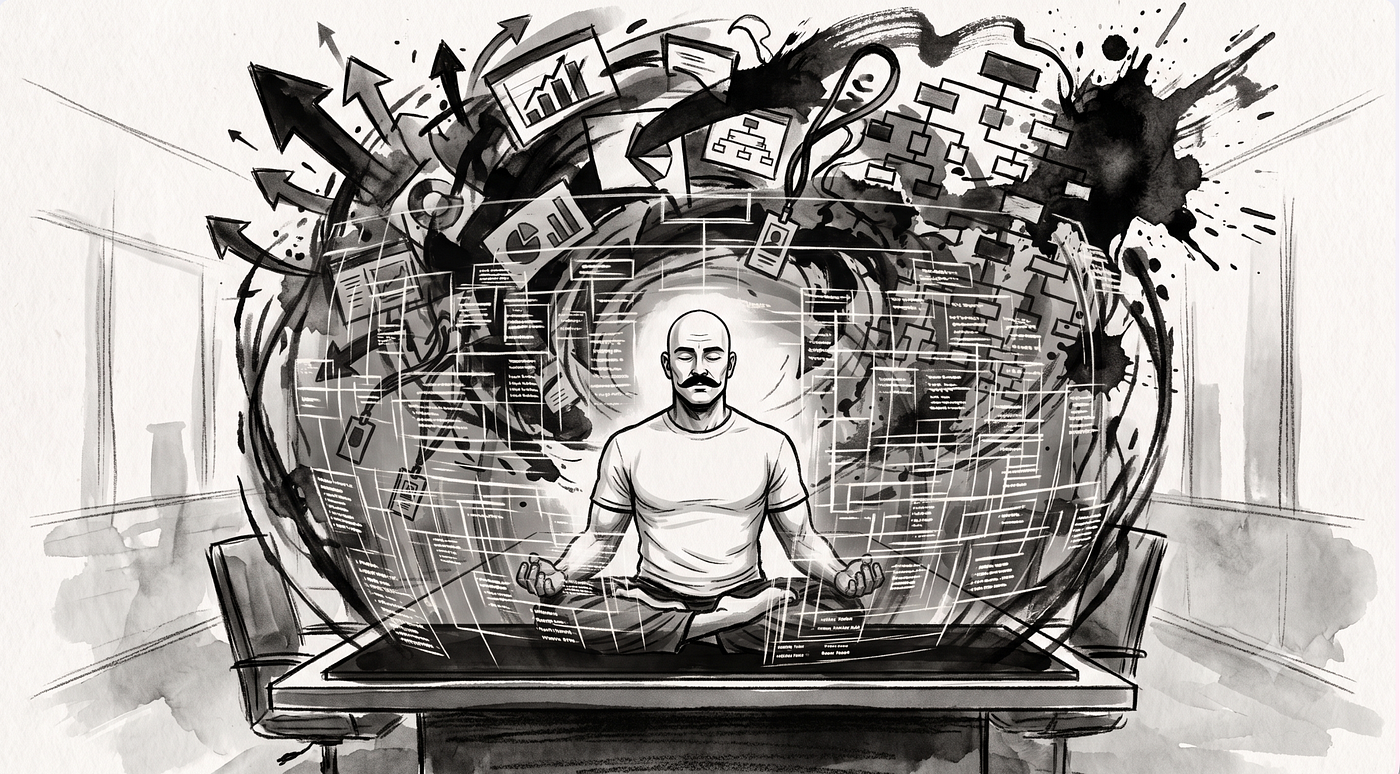
…the calm before the org chart…
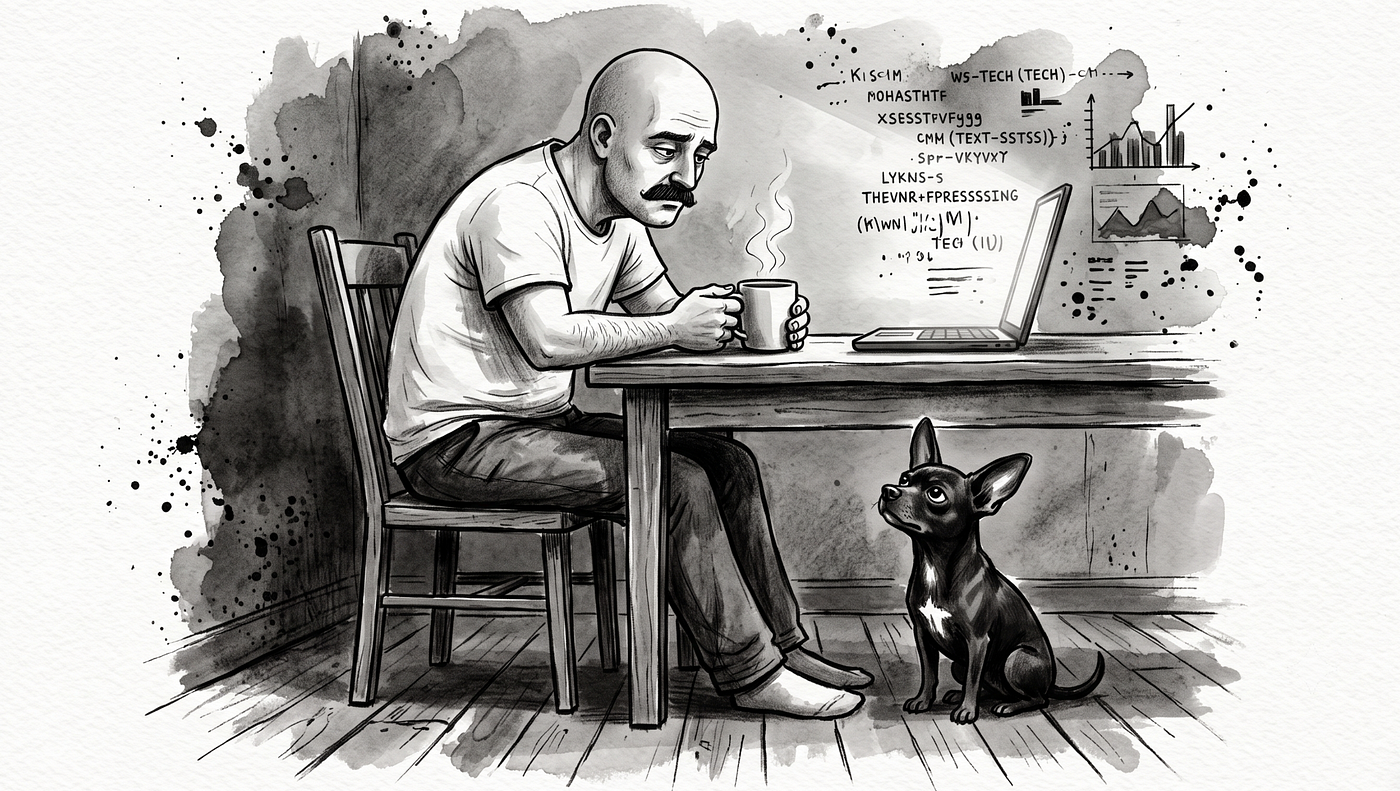
There’s a particular flavour of morning coffee — you know the one — over which the modern engineer performs a small daily liturgy: scroll the feed, absorb the latest sermon about how vibe coding has made developers obsolete, take a sip, and then glance at the calendar, where six meetings sit patiently waiting to discuss a feature that would take two days to build and has so far taken two quarters to align on. Somewhere between the sip and the glance lives a cognitive dissonance so large it has its own gravitational field, and the entire industry has agreed, politely, not to look at it.
Because here’s the thing the sermons keep missing: we have built a machine whose most thoroughly demonstrated talent is producing plausible corporate prose — summaries, status updates, diplomatically vague slides — and we’ve aimed it, of all places, at the one profession that was never mostly about producing text. This essay is about what happens when someone inevitably turns the thing ninety degrees. Top up the coffee. It usually takes me fourteen sections.
I. The Cost Centre That Dares Not Speak Its Name
“In the long run we are all dead.” — John Maynard Keynes, reviewing a five-year digital transformation roadmap
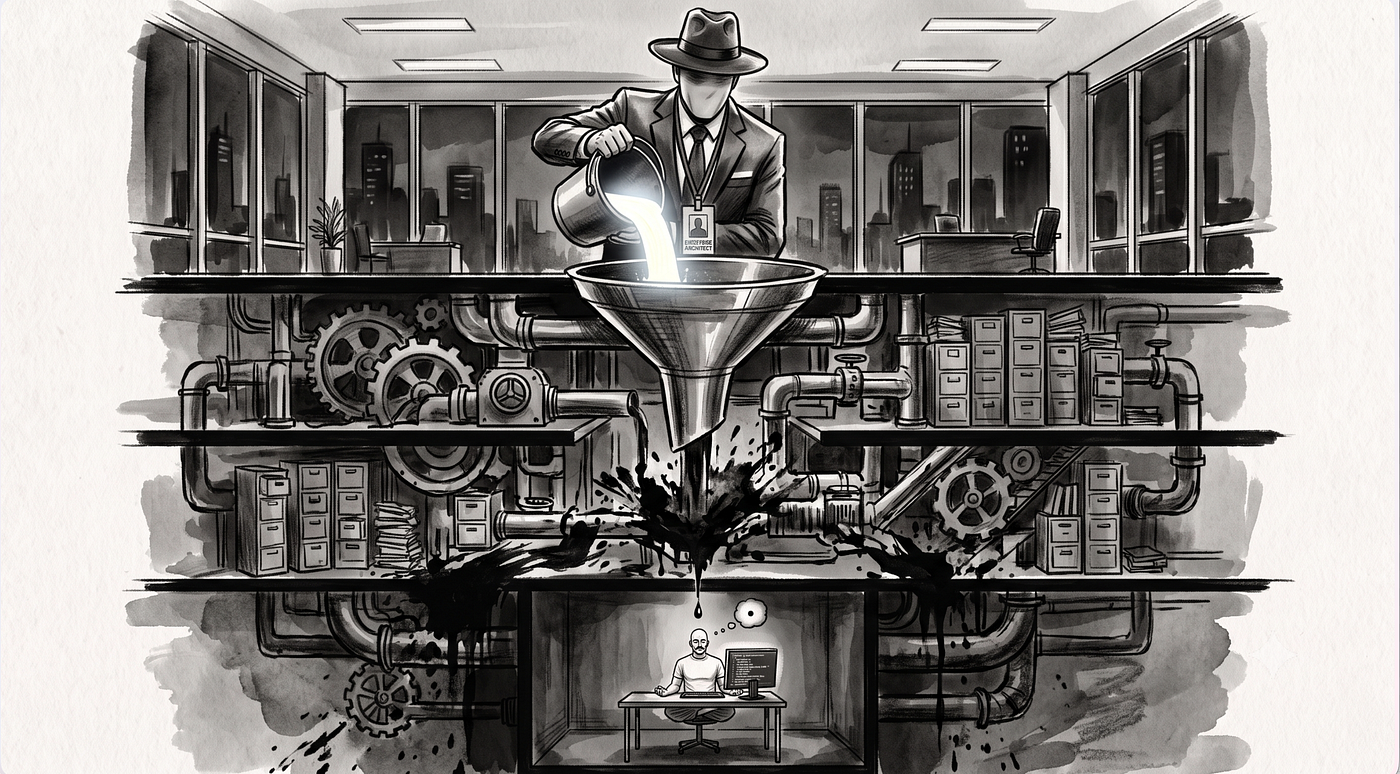
…follow the money, it rarely leads to the IDE…
Let me commit a small corporate heresy before we’ve even had our tea: in software production, programming was never the main cost.
I know. I know. Every LinkedIn thought-leader with a Canva subscription has spent the last three years explaining how AI will finally slash the terrifying expense of developers writing code. Whole keynotes have been built on this premise. Whole funding rounds. Whole careers, if we’re being generous with the word.
But pull up any honest accounting of where the money actually goes in a software organisation of, say, two hundred people, and you’ll find something inconvenient. The typing — the actual conversion of intent into syntax — is a rounding error. The real burn is elsewhere: in the six weeks it takes for a decision to travel down four layers of hierarchy and come back mutated beyond recognition. In the standing meetings that exist to prepare for other meetings. In the quarterly planning rituals that consume more engineer-hours than the features they plan. In the beautiful, expensive, perfectly rational machinery of coordination.
Code is cheap. It’s been getting cheaper since FORTRAN. Consensus, on the other hand — consensus costs like a Swiss lawyer with a gambling problem.
I’ve spent two decades or so in this industry, and I can count on one hand the projects that died because the code was too expensive to write. I’d need a stadium to count the ones that died because nobody could agree what to write, or because by the time the agreement finished its pilgrimage through the org chart, the market had moved on and the original requester had been reorganised into a different department. Twice.
So here’s the thesis, and I’ll be perverse about it, because being perverse is roughly forty percent of my personality: the vibe coding panic is aimed at the wrong floor of the building. The technology everyone fears will commoditise programmers is, in fact, vastly better suited to commoditising the layer above them. The people who should be nervously refreshing their LinkedIn profiles aren’t the ones writing the code.
They’re the ones relaying information about the code.
II. A Brief Anatomy of Chinese Whispers (Enterprise Edition)
“The single biggest problem in communication is the illusion that it has taken place.” — George Bernard Shaw, who clearly attended a sprint review
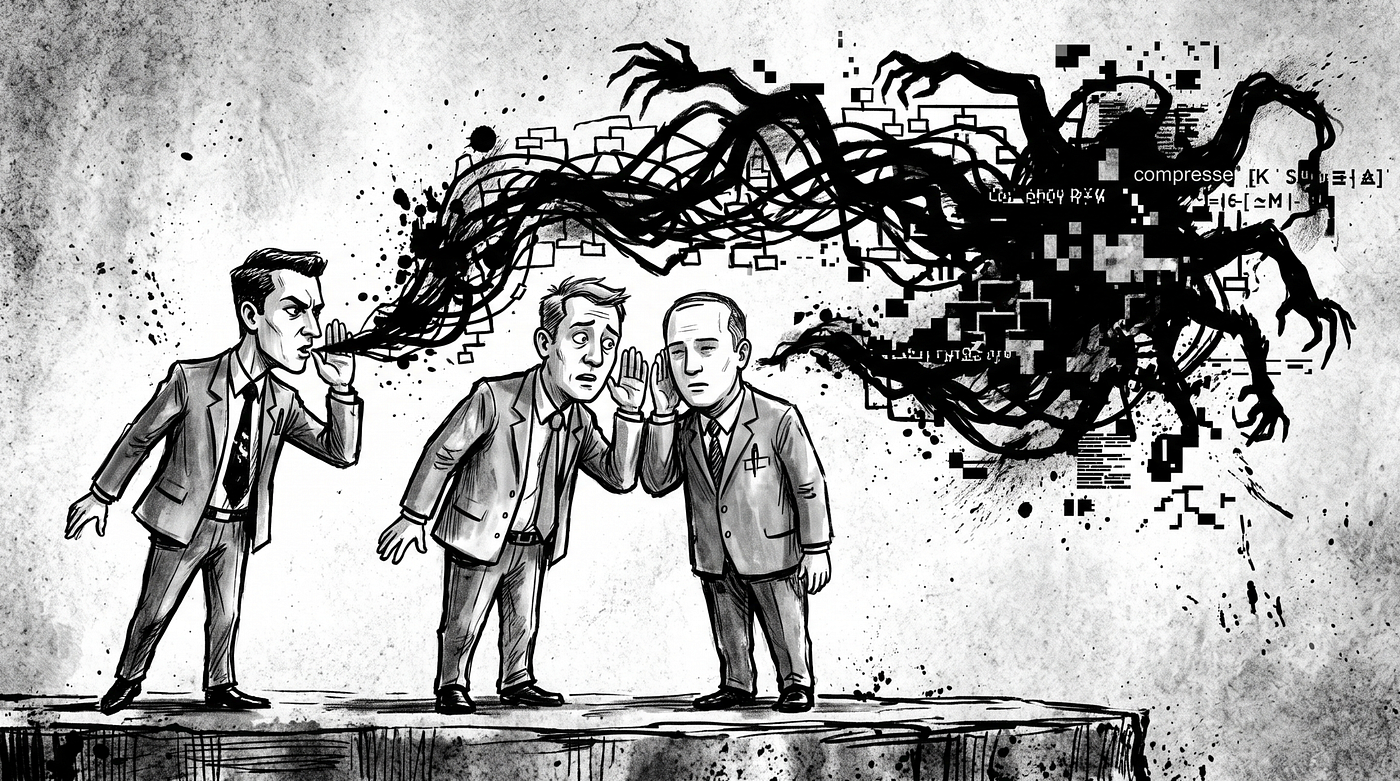
…lossy compression with a pension plan…
Before we get to the executions, let’s be fair to the condemned. What does the middle layer of a software organisation actually do?
Strip away the job titles — Delivery Manager, Engineering Manager, Programme Lead, Head of Alignment and Synergistic Outcomes — and squint at the underlying functions. What you find is a human routing protocol. Information enters at one layer, gets compressed, translated into the dialect of the layer above, and passed along. Decisions travel the other way, getting decompressed, reinterpreted, and occasionally inverted.
It’s Chinese Whispers, except the whispers cost six figures each and come with a company car allowance.
And like all lossy compression, every hop degrades the signal. The CEO says “we need to move faster on the payments platform.” Three layers down, this has become “freeze all non-payments work,” which one layer further becomes “Marek’s team is being dissolved,” which is news to Marek, whose team was, in fact, the payments team. I have watched a strategic intent degrade through an org chart the way a JPEG degrades when you save it seven times: the general shape survives, but the details turn into artefacts, and everyone’s face looks slightly wrong.
Now — and this is important, because I refuse to write yet another essay where managers are cartoon villains — none of the individual humans in this chain is doing anything irrational. Each of them is faithfully performing a function that the organisation genuinely required. The question we’re building towards is not “are these people useless?” It’s much colder than that:
Why did the organisation require this function in the first place, and does it still?
For that, we need to disturb the grave of an economist.
III. Coase’s Ghost
“The org chart is not the territory.” — Korzybski, probably
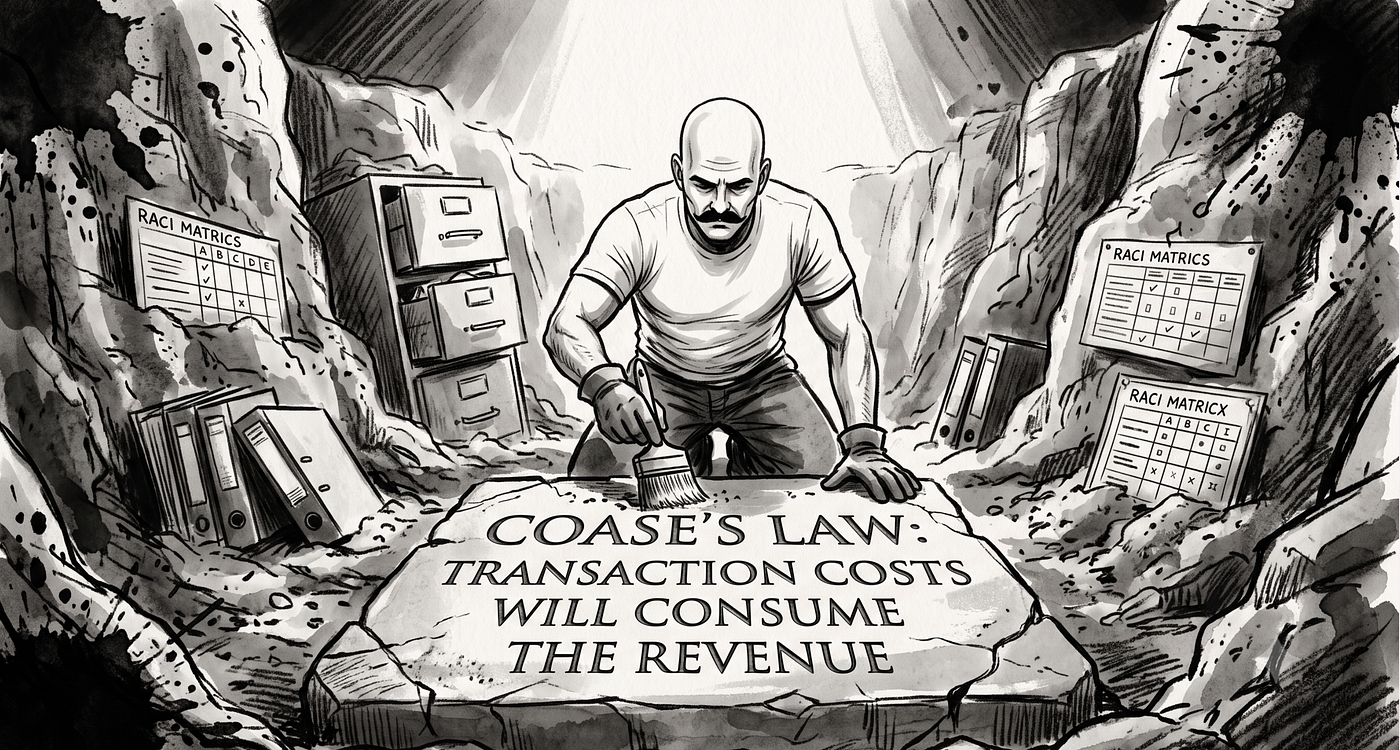
…the invisible hand files an expense report…
In 1937, Ronald Coase asked a question so simple that economists had somehow forgotten to ask it: why do firms exist at all? If markets are so efficient, why doesn’t everyone just contract with everyone else directly? Why do we gather in buildings, accept salaries, and tolerate performance reviews?
His answer — which eventually won him a Nobel Prize, presumably delivered through four layers of committee — was transaction costs. Finding the right person, negotiating with them, verifying their work, coordinating their output with everyone else’s: all of that is expensive. Below a certain threshold, it’s cheaper to internalise the chaos. You build a hierarchy. The hierarchy exists precisely because coordination is costly, and managers are the machinery that pays that cost so the specialists don’t have to.
Read that again, slowly, the way you’d read a stack trace at 3 AM: the middle layer is not decoration. It is the load-bearing structure of coordination costs.
Which means it has exactly one existential vulnerability. If something were to collapse the cost of coordination — say, a machine that can read every ticket, every commit, every document, every meeting transcript, and synthesise the actual state of the organisation in eleven seconds, on demand, without a slide template — then the layer whose entire product is coordination doesn’t become less efficient.
It becomes an appendix. Present, occasionally inflamed, and mostly discussed in the context of removal.
The Taoists have a concept, wu wei — effortless action, the governance that governs least. Laozi wrote that the best ruler is one whose people barely know he exists. It was meant as political philosophy. It reads, in 2026, uncomfortably like a product spec.
IV. Enter the Vibe Coders (Or: The Wrong Panic, Sold by the Wrong People)
“It is difficult to get a man to understand something when his salary depends upon his not understanding it.” — Upton Sinclair, describing the AI keynote circuit
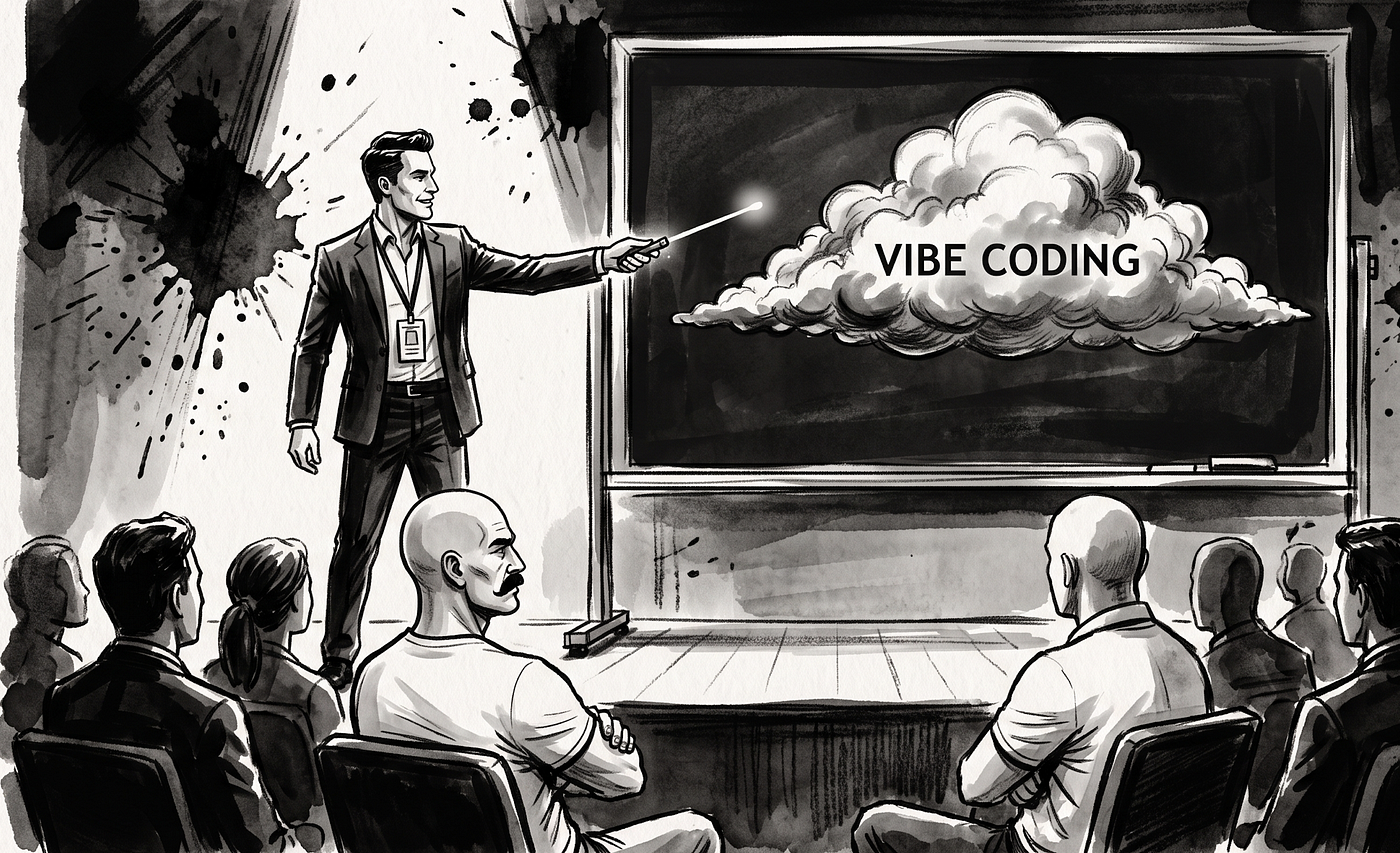
…snake oil, now with function calling…
Now let me get something off my chest, because it’s been sitting there since roughly the third quarter of 2024, developing squatter’s rights.
I am sick to the back teeth of the vibe coding discourse.
Not the practice — the discourse. The endless carousel of posts explaining how AI has “democratised” software and “collapsed the cost of code,” delivered with the serene confidence of people who have never once been paged at 3 AM, never migrated a production database, never watched a “fully autonomous” agent cheerfully delete the one integration test that mattered. The genre has its own priesthood now: the snake oil sellers, materialising on every platform, operating on the ancient Polish principle of nie znam się, to się wypowiem — “I don’t know anything about it, therefore I shall speak at length.”
Here’s what the keynotes skip: while the cost of producing code has genuinely fallen, determinism — that boring old property where the same input yields the same output — has fallen flat on its face. I wrote a whole essay about probabilistic compilation, so I won’t rehash it here (the Roman legions were involved; it’s a long story), but the short version is: we’ve traded a cheap, verifiable artefact for a cheaper, vibes-based one, and we’re calling the difference “productivity.” The bill for that difference hasn’t arrived yet. It’s in the post. It’s compound interest in the post.
And yet — here’s the part the doom-mongers skip, so let me be fair in both directions — the actual programmers? Mostly fine with the tools. Genuinely. Walk into any real engineering team and you won’t find Luddites smashing looms; you’ll find people delightedly delegating boilerplate, test scaffolding, and the writing of YAML (dark times, always) to their new mechanical intern. Engineers have been automating themselves out of tedium since the first shell script. It’s practically a religious observance.
Why the calm? Because working engineers understand something the keynote circuit doesn’t: the agent automates the notation, not the intent. Someone still has to know what should exist, why, and what “correct” means for this particular system under these particular constraints. And here’s the twist the snake oil crowd never mentions: the very nondeterminism that makes vibe coding wobbly is exactly what makes the engineer unsackable. Taming a probabilistic tool — verifying it, debugging it, carrying final responsibility when it confidently ships nonsense — requires a human who understands the system beneath the vibes. The messier the output, the more indispensable the person who can tell mess from magic.
Hold onto that asymmetry. Because there’s another job in the building whose output has never once been asked to be deterministic, reproducible, or even true — and that job’s protective moat is, accordingly, rather drier.
So the panic is misdirected. The question worth asking was never “can a machine write code?” Machines have been writing code since compilers — that’s literally what a compiler is. The question is:
What else in the building is, functionally, notation?
V. The Uncomfortable Symmetry
“Hell is other people’s status meetings.” — Sartre, again, probably
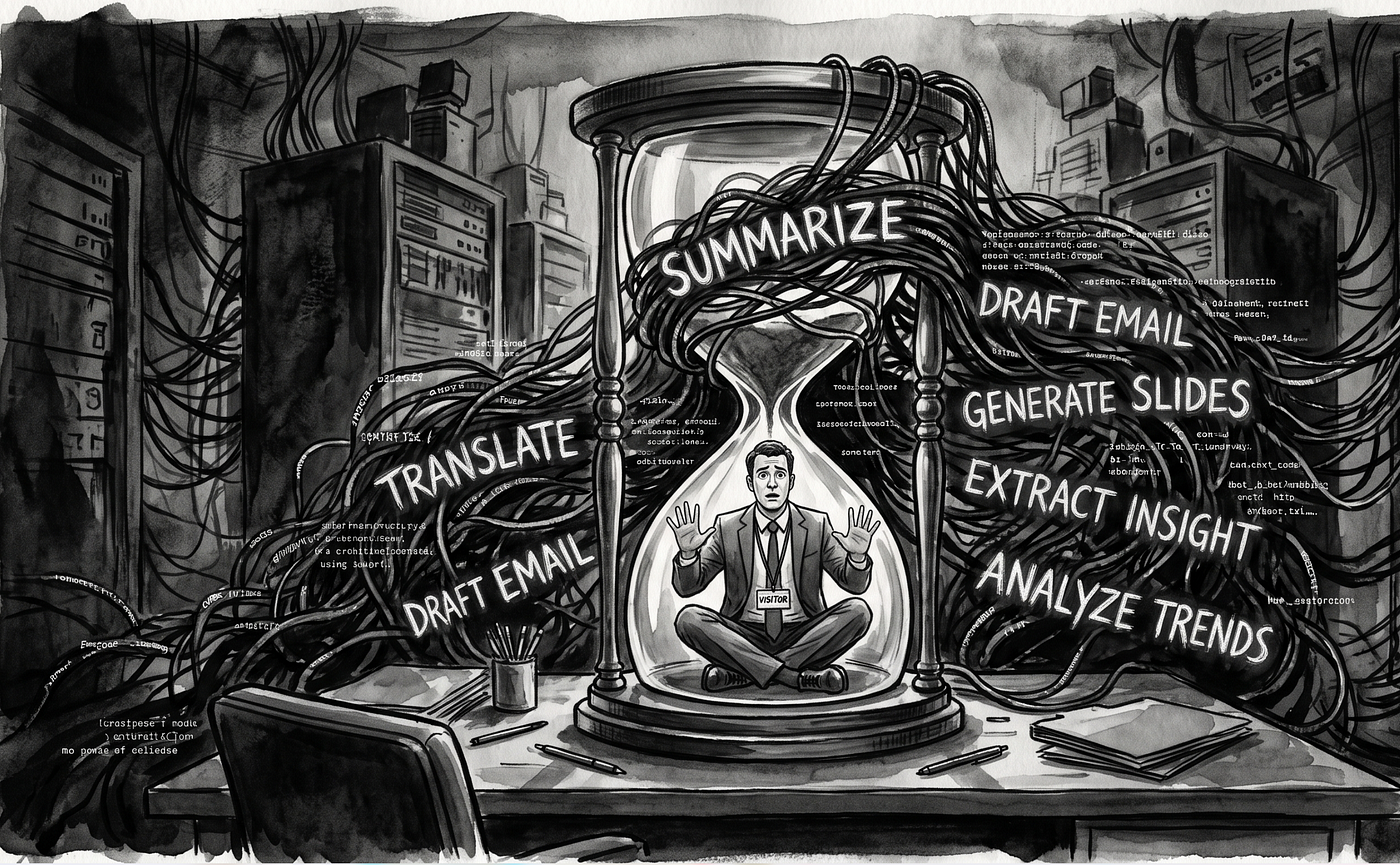
…benchmark or job description? why not both…
Let’s play a small, cruel game. I’ll list some tasks, and you tell me whether they come from a middle manager’s job description or from an LLM benchmark suite.
- Summarise a large volume of unstructured input into a concise report for a senior audience.
- Translate between the technical register and the business register, preserving meaning.
- Aggregate status from multiple sources into a unified view.
- Draft communications in an appropriate, diplomatically neutral tone.
- Extract action items from a meeting transcript.
- Produce slides.
Trick question. It’s both. It is exactly both, word for word, and this is not a coincidence — it’s a description of the training distribution. We spent decades generating the world’s largest corpus of status updates, summary emails, stakeholder decks, and polite reformulations of “the project is on fire” into “we are tracking some headwinds.” Then we trained transformers on it.
The vibe coding crowd looks at this technology and sees a code generator. But look at what these models are natively, effortlessly, spookily good at: summarisation, register translation, synthesis, tone management, saying nothing at great length. Code generation is the party trick. Middle management is the home turf.
Here’s the asymmetry that everything else in this essay hangs on. When an engineer uses an agent, the agent replaces the engineer’s typing — the intent, the judgment, the accountability stay with the human, because the human was always more than their keyboard. But when the model summarises statuses, translates between floors, and drafts the stakeholder update, it’s not assisting the interface function.
It is the interface function.
An engineer with an agent is a craftsman with a power tool. An information-relay manager next to an LLM is a telegraph operator next to a telephone. One of these has a future that includes the tool. The other one is the tool, in an earlier and more expensive form factor.
Vibe coding was the marketing term for automating the writing. Allow me to coin its inevitable sibling: Vibe Management (sounds great: say it out loud, does it?)— the automation of the listening, the relaying, the aligning. And unlike its sibling, it doesn’t even have a determinism problem to trip over. Nobody has ever demanded reproducible builds of a status report.
VI. Gutenberg’s Middle Managers
“Here I stand, I can do no other.” — Martin Luther, a man who famously escalated past his entire management chain
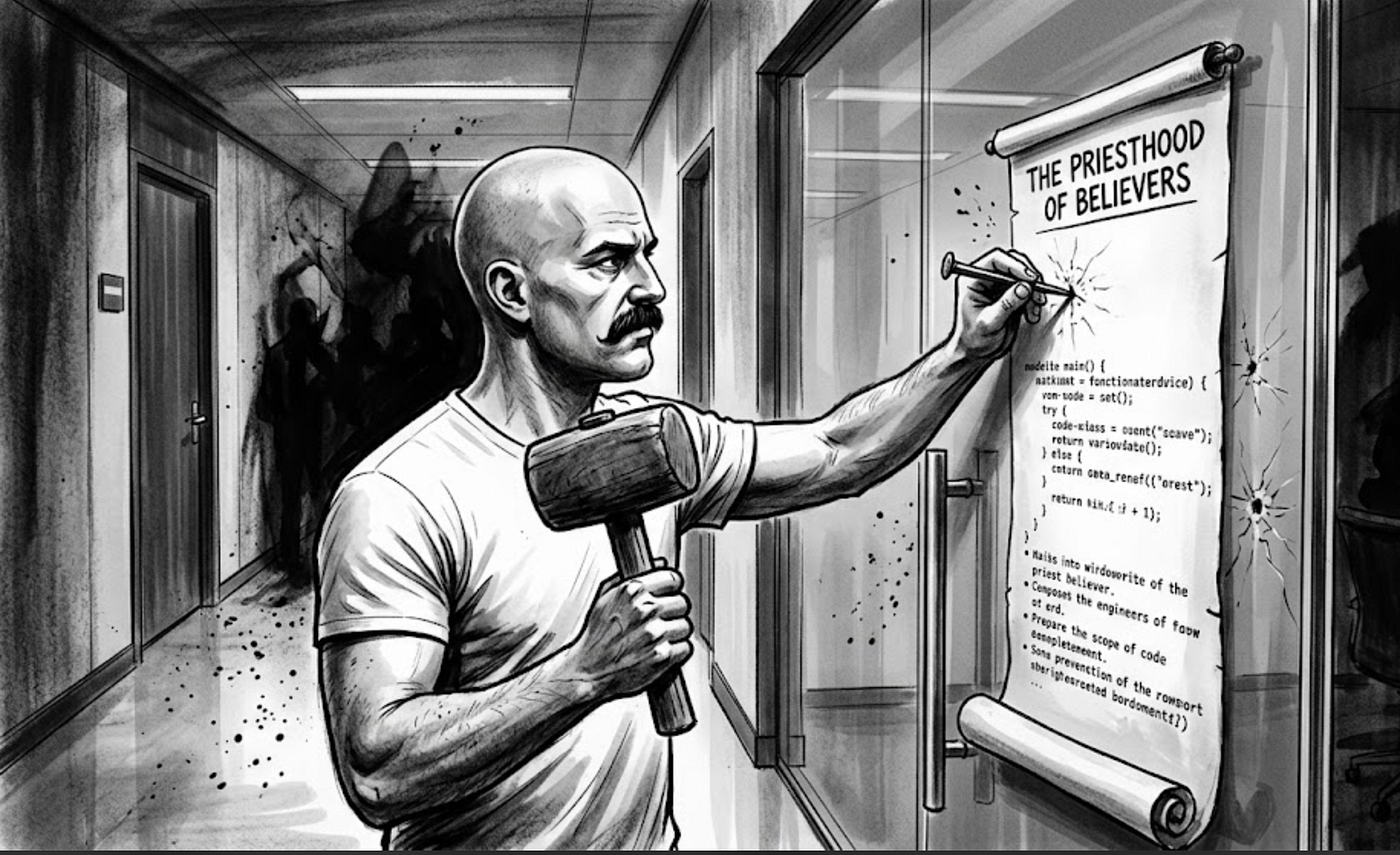
…95 theses, zero jira tickets…
History, as usual, has run this experiment before, and as usual, nobody read the post-mortem.
For a thousand years, the mediaeval Church operated the most successful information-mediation hierarchy in human history. The Word existed in Latin — a notation deliberately inaccessible to the end user — and between the source and the congregation stood a professional layer whose function was translation, interpretation, and controlled distribution. The parish priest read the text, summarised it, adapted the message for the local audience, and reported attendance upward. If you squint, it’s a delivery organisation. There were even indulgences, which I believe we now call “scope changes.”
Then Gutenberg shipped his disruptive little side project, and within a century the entire mediation layer faced an existential crisis. Once the Bible existed in German, in print, in your own house, the question became unavoidable: what exactly is the intermediary for? Luther’s radical proposal — the priesthood of all believers — was, in modern terms, a flattening of the org chart. Direct access to the source of truth. Skip-level, permanently.
Here’s the part worth stealing, though. The Reformation did not eliminate clergy. It eliminated clergy whose only function was access control. The ones who survived — on both sides of the schism, actually — were those who did something the printing press couldn’t: pastoral care, moral judgment, community, standing at a deathbed at 4 AM. The ones who merely read the text aloud were, shall we say, gently deprecated.
Hold that thought. We’ll need it for the survivors’ profile.
(Yes, I’m aware the analogy leaks — all analogies leak; that’s how you know they’re load-bearing. The printing press took a century to flatten its hierarchy, and it required a certain amount of unpleasantness in the Thirty Years’ War genre. I’m hoping we can manage this transition with slightly fewer pikemen. Though having sat through some quarterly business reviews, I make no promises.)
VII. Parkinson, Graeber, and the Bureaucratic Perpetuum Mobile
“Work expands so as to fill the time available for its completion.” — C. Northcote Parkinson, the only futurist who has never once been wrong
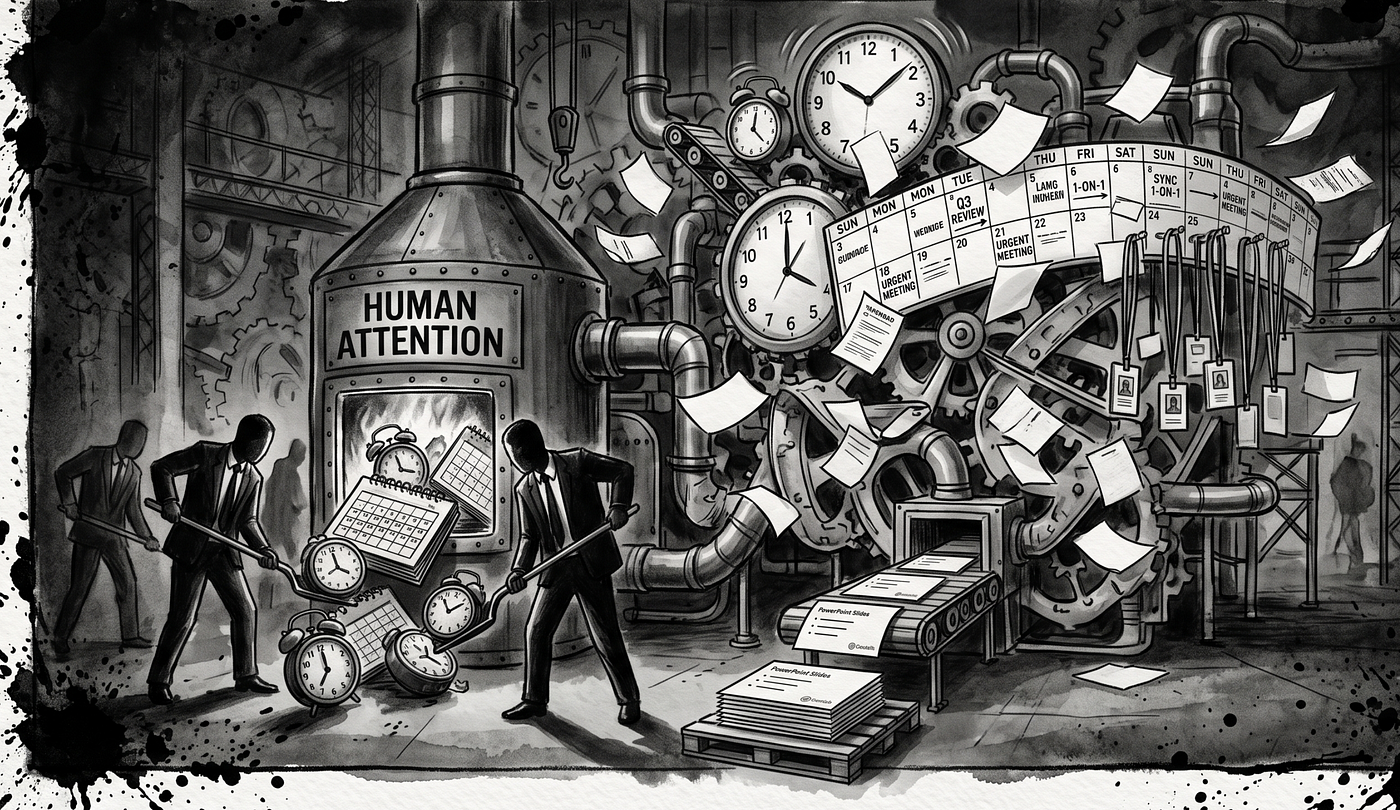
…the machine that runs on meetings…
If the middle layer’s core function is so automatable, a fair question follows: why did it grow so enormous in the first place? Surely the market punishes waste?
Oh, my sweet summer child of an efficient-market hypothesis.
Parkinson observed in 1955 that officials multiply regardless of workload, because every official benefits from having subordinates and every subordinate generates work for the others — mostly work about the work. The British Admiralty he studied added admirals as it lost ships; a lesser man would have suggested the admirals were generating the paperwork rather than processing it. Parkinson was not a lesser man.
David Graeber pushed the diagnosis further with his taxonomy of bullshit jobs — and I want to be careful here, because Graeber himself was careful. The claim was never that the people are bullshit. The claim was that the system generates roles whose occupants privately suspect their own position contributes nothing, and who suffer genuine psychological damage from that suspicion. His categories read like a directory of the modern software organisation: box tickers, taskmasters, duct tapers. People — often smart, often former engineers, we’ll get to that tragedy in a moment — who spend their days manufacturing evidence that work is occurring.
The mechanism is a perpetuum mobile: coordination layers generate coordination overhead, which justifies more coordination layers. Each new manager needs status inputs, which requires the layer below to produce reports, which requires meetings to align the reports, which requires a manager to run the meetings. It’s a system that metabolises human attention and excretes slide decks, and it grew for seventy years because there was no cheaper alternative for the one thing it genuinely did provide: a synthesised picture of what’s going on.
There is now a cheaper alternative. It costs about a penny per query and doesn’t need the off-site in Malaga.
The Stoics would tell us to distinguish between what a thing is and what it appears to be. For seventy years, the middle layer appeared to be leadership. What it was, structurally, in the median case, was a database with feelings and a compensation package. This is not an insult to the humans in it. It is an indictment of the system that put them there — and, as we’ll see, a genuine tragedy for the many who were promoted into it away from work they actually loved.
VIII. What Agentic Engineering Actually Changes
“You can’t manage what you can’t measure.” — Peter Drucker, allegedly, though he denied it, which is itself a lesson about attribution in management literature
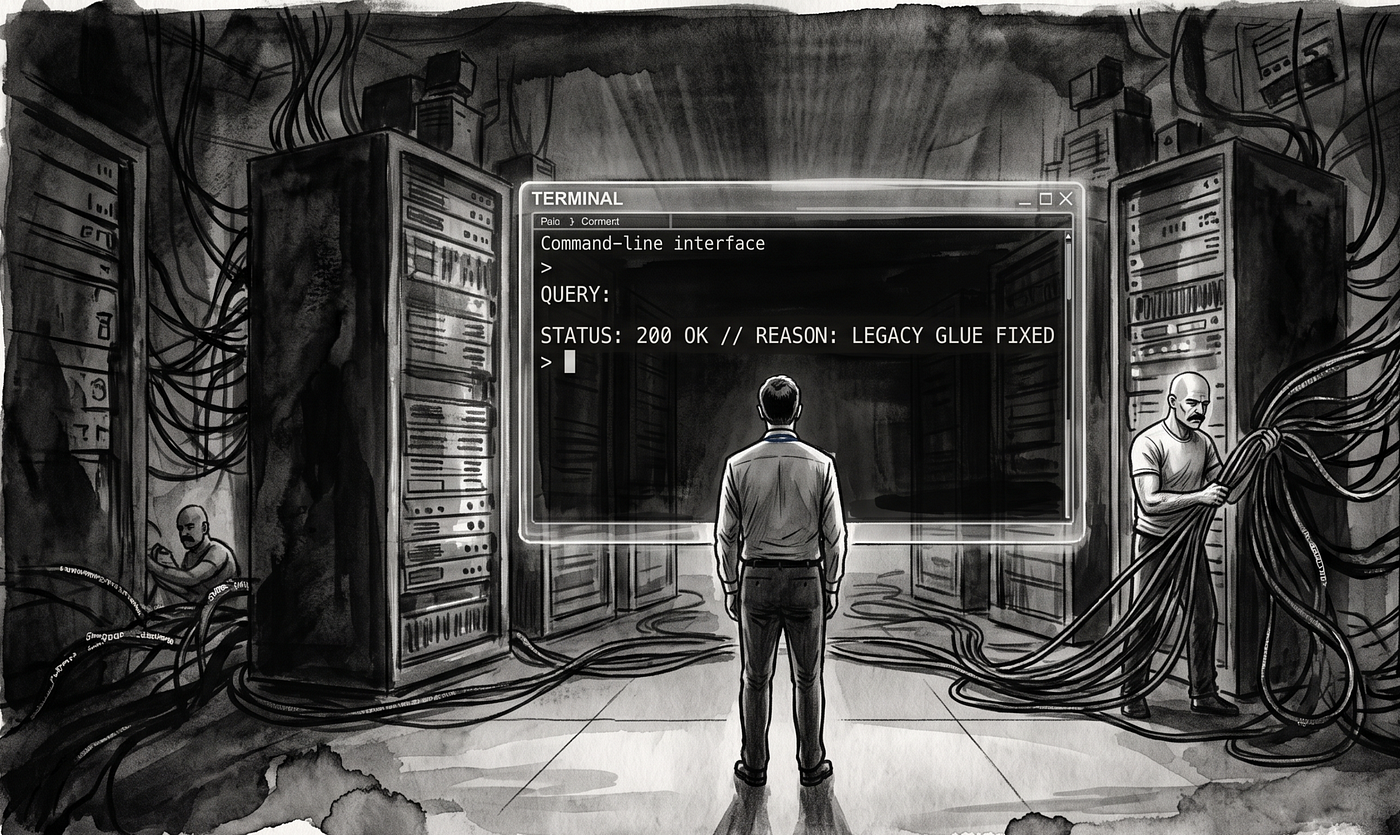
…status: queryable. mood: existential…
Let’s descend from philosophy to plumbing for a section, because the plumbing is where the quiet revolution actually lives.
The interesting thing about agentic engineering isn’t that agents write code. It’s that agents make the state of the work queryable. Consider what a modern setup already looks like, no science fiction required:
- Every change is a commit with a description, linked to a ticket with a rationale.
- Every deployment is an event with a timestamp and an outcome.
- CI knows, continuously, whether the thing works.
- The agent that did the work can explain what it did, in whatever register you like — engineer, director, or frightened board member.
Now ask yourself: in that world, what is a status meeting? It’s a human batch job, running weekly, performing a query that the infrastructure can answer in real time. “Where are we on the migration?” used to require asking a person, who asked a person, who asked a person, each hop adding latency, loss, and — let’s be honest — a certain protective airbrushing. Nobody reports their own silo as being on fire. The silo is always “amber, trending green.” The silo has been amber-trending-green since Q2 of last year. The silo is, at this point, a load-bearing lie.
A dashboard fed by the actual systems doesn’t protect its silo, because it hasn’t got one. This is the deeper disruption: not automation of the relay, but removal of the incentive to distort. The Chinese whispers chain didn’t just add noise randomly — it added noise directionally, because every human node had skin in the message. Machines are many things, most of them concerning, but they are refreshingly indifferent to their own promotion prospects.
And notice, while we’re down here in the plumbing, what the business is actually paying for on each floor. Engineering’s product was never keystrokes — it’s holding back entropy: keeping the system alive under load, paying down the architectural debt before it forecloses, knowing which fifteen-year-old stored procedure is load-bearing and which is merely ornamental. While the relay layer was polishing “amber, trending green” into a smoother shade of amber, someone downstairs was quietly ensuring there was still a system to have a status about. A dashboard can query that state in milliseconds. It cannot refactor the legacy glue, and it will not be answering the incident bridge. That difference — between reporting on the machine and keeping the machine running — is the width of the moat.
The engineer’s judgment survives this transition intact — someone still decides what to build and whether it’s right, and someone still gets the 3 AM page (some traditions are sacred). What does not survive is the forty-year-old assumption that knowing the state of the work requires a hierarchy of professional knowers.
IX. The Fifth Horseman
“And I looked, and behold a pale horse: and his name that sat on him was Alignment.” — Revelation 6:8, lightly refactored
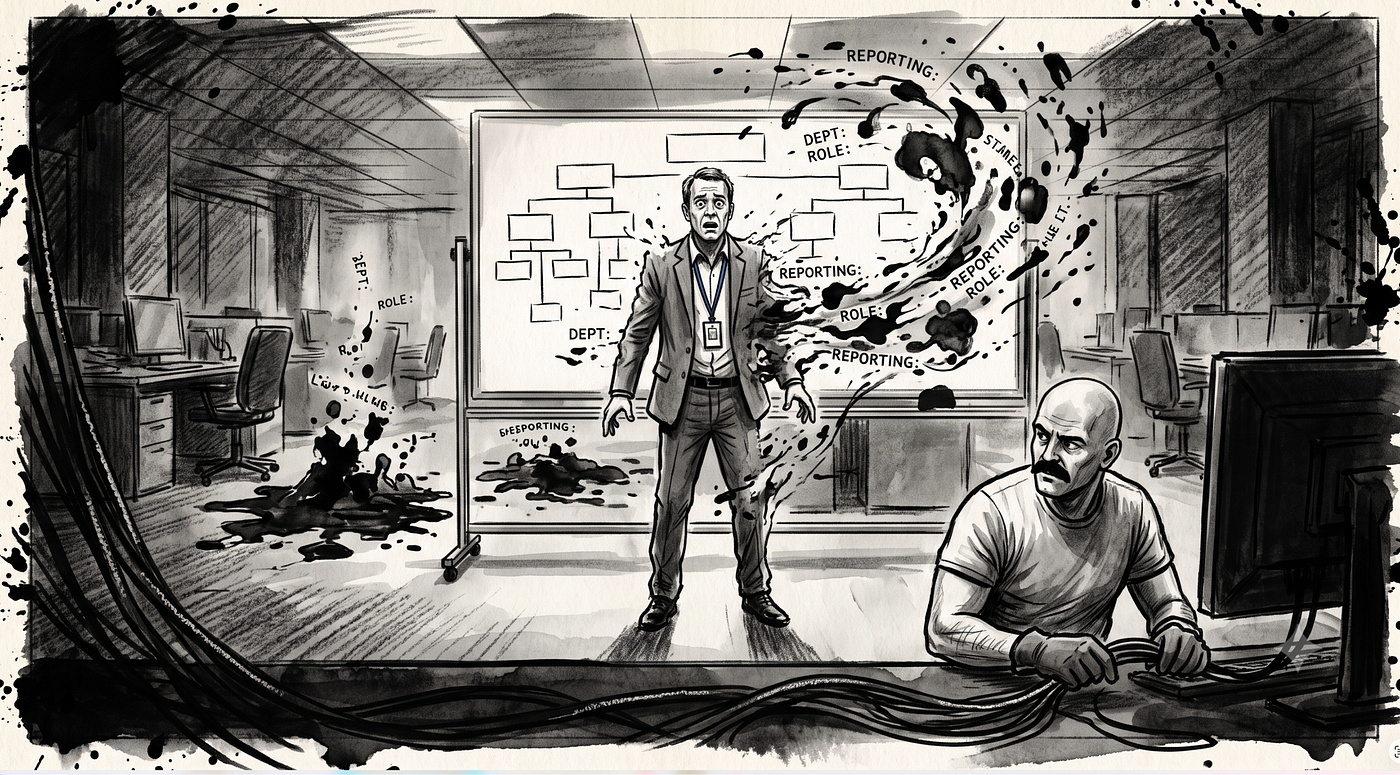
…the horseman prefers async…
So how does it actually happen? Not, I suspect, the way the headlines will eventually claim.
There will be no Great Middle Management Layoff, no single dramatic Tuesday. Apocalypses in corporate settings are quieter than the Book of Revelation suggests — less fire and brimstone, more attrition and non-backfilled positions. The fifth horseman doesn’t ride in; he’s onboarded gradually, via a series of pilots.
It starts innocently. A CEO discovers she can ask a model “what’s the actual state of the payments project?” and get an answer synthesised from the tickets, the commits, and the incident channel — an answer that arrives in seconds and hasn’t been focus-grouped by three layers of self-preservation. She doesn’t fire anyone. She just… asks the model first. Then asks it more often. The weekly steering meeting drops to fortnightly, then becomes “async.” A director leaves and the role is quietly absorbed. A reorg happens — reorgs always happen, they’re the corporate equivalent of weather — and this time the new chart has one layer fewer, and nothing breaks.
That last part is the horseman’s actual weapon: nothing breaks. Every previous flattening attempt — and management fashion has attempted flattening roughly once a decade, from matrix organisations to holacracy to whatever Zappos was doing — failed because the coordination load had nowhere to go. Remove the managers, keep the coordination costs, drown in chaos, rehire the managers, write a Harvard Business Review piece about lessons learned. This time the load has somewhere to go. That’s new. That’s the whole ballgame.
The engineers, meanwhile, notice mostly an absence: fewer meetings about meetings, fewer requests to re-explain the same thing in a different template. Skip-level access, once an act of political daring, becomes ambient. And a certain kind of question — “can you put together a quick deck on where we are?” — simply stops being asked of humans, the way nobody asks a human to compute a logarithm anymore.
Quiet, granular, and by the time anyone names it, largely complete. The best apocalypses don’t get a retrospective.
X. The Survivors’ Profile
“The master has failed more times than the beginner has even tried.” — Stephen McCranie, whom I keep quoting because it keeps being true
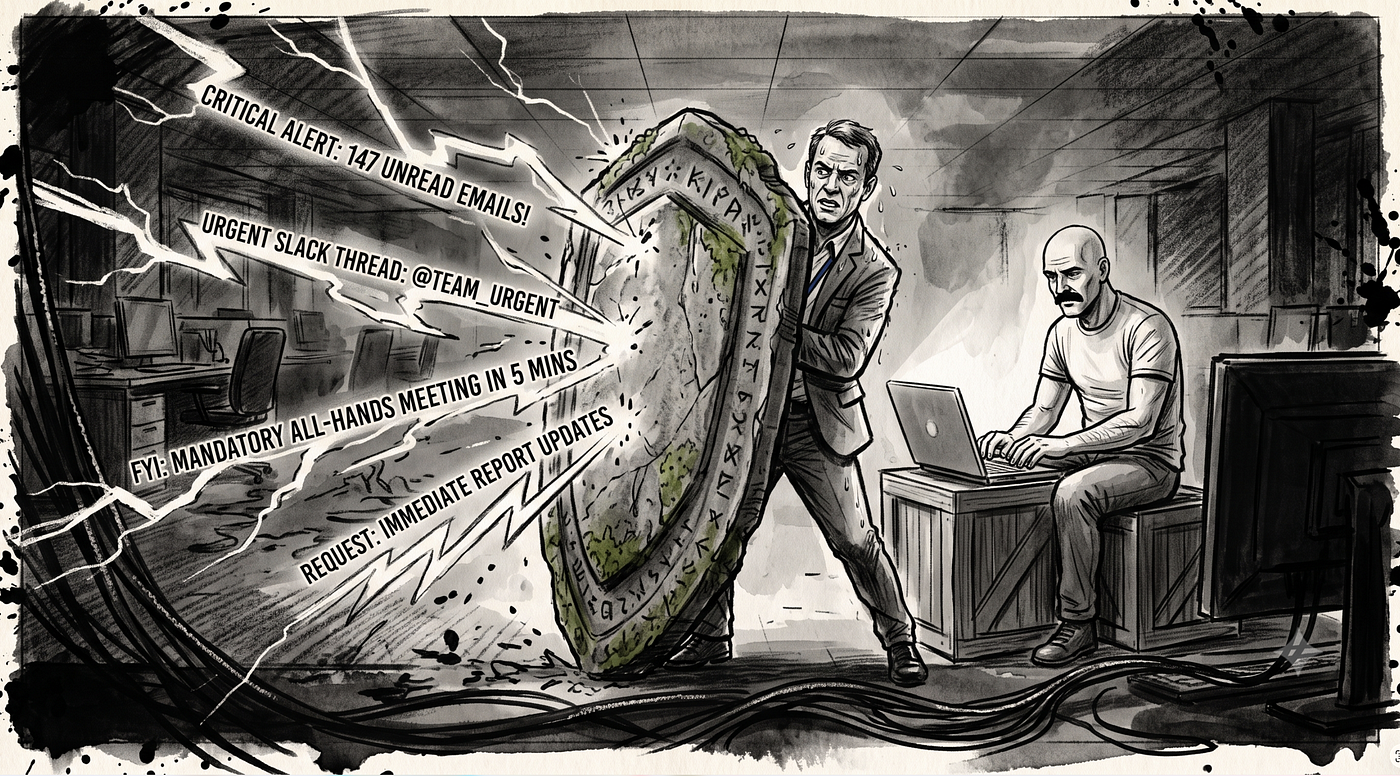
…not all lanyards are created equal…
Now, before HR marks this essay as a threat: not everyone in the middle layer is standing on the trapdoor. Some are standing on bedrock, and it’s worth being precise about the difference, because the difference is the entire point.
Go back to Gutenberg. The clergy who survived weren’t the ones who read the text aloud — they were the ones providing what the press couldn’t. Translate that forward, and the survivors’ profile writes itself. Safe are the managers who:
- Take decisions under genuine uncertainty and own the consequences. A model can recommend; it cannot be responsible. Responsibility is not an information function — it’s a moral one, and it still requires a nervous system.
- Shield their teams. The manager who absorbs organisational chaos so engineers can think — the human firewall — is doing pastoral care, not relay work. No transcript summariser replaces standing between your team and a panicking VP.
- Grow people. Mentorship, career judgment, the hard conversation delivered with actual care. I’ve written before about what happens when we outsource teaching to machines; the summary is “Rome, but faster.”
- Do actual politics — in the noble sense, if you’ll permit the phrase to exist: building coalitions, negotiating priorities between genuinely conflicting human interests. Conflicting interests don’t summarise. They have to be reconciled, which is a contact sport.
Notice what unites these: none of them are Chinese Whispers. The people doing this work were never really “the middle layer” in the structural sense — they were leaders who happened to be filed in the middle of a chart. They’ll be fine. Better than fine, actually: freed from producing the decks, they might get to do the job that was always hiding underneath it.
The tragedy — and I mean the word — is the other cohort: the excellent engineers promoted into relay roles because relay roles were the only path to a mortgage-compatible salary. The Peter Principle with a twist: promoted not to their level of incompetence, but away from their level of competence. If vibe management does one merciful thing, perhaps it will be ending the ritual sacrifice of good engineers on the altar of “career progression.” Some of them, quietly, will be relieved. I know a few who’d trade the calendar for a compiler tomorrow and call it a rescue.
XI. The Counter-Argument I Can’t Fully Dismiss
“It is the mark of an educated mind to be able to entertain a thought without accepting it.” — Aristotle, who never had to entertain a thought during a quarterly business review
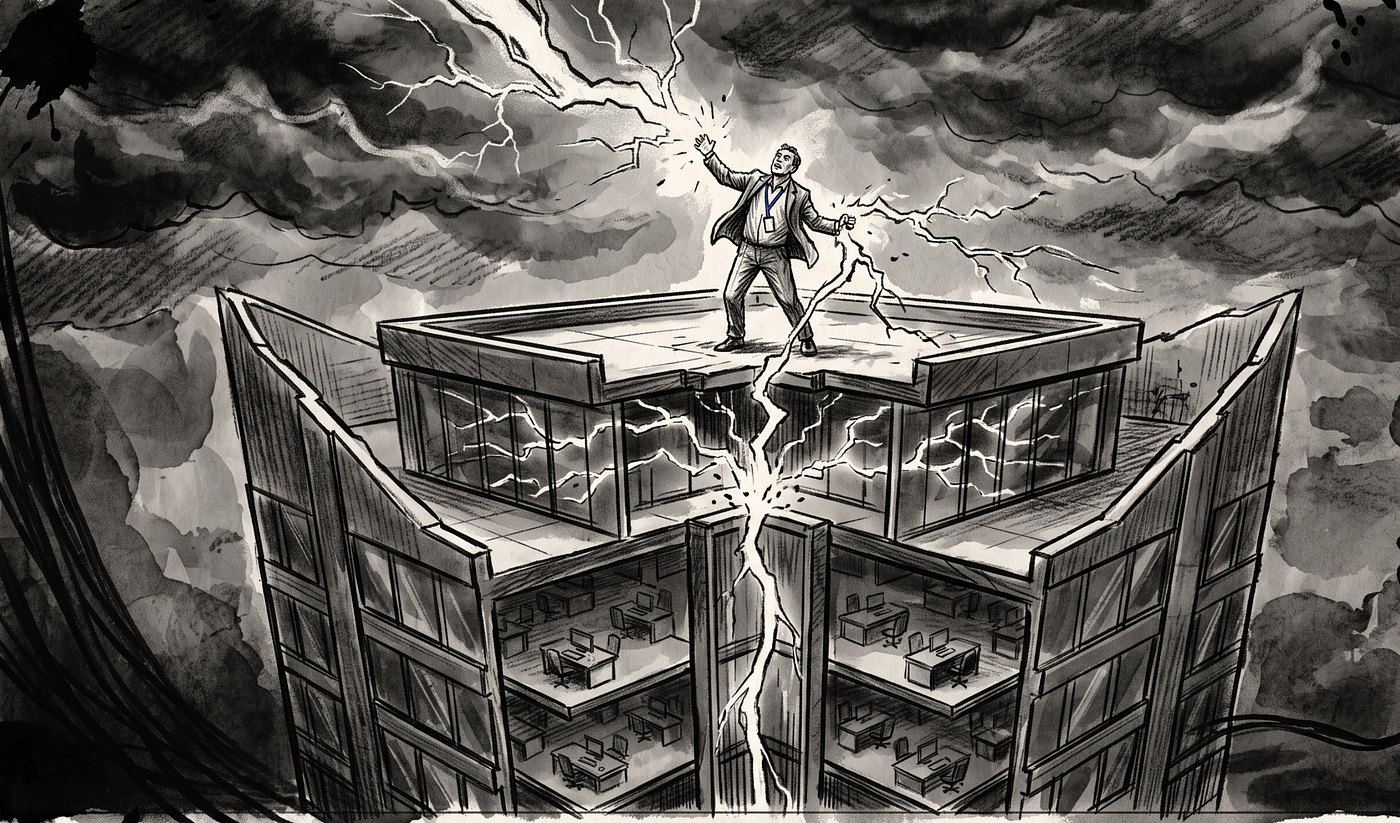
…a lightning rod, artist’s impression…
And now, the part of the essay where I argue against myself, because I’ve learned the hard way that essays without this section age like milk.
Here is the strongest objection, and it’s strong enough that I lose sleep over it: hierarchy was never really about information. It’s about the distribution of blame.
Consider what a middle manager actually provides to the layer above, in the coldest possible accounting: a throat to choke. When the project fails — and projects fail; it’s their most reliable feature — the organisation needs a place for responsibility to land that isn’t the executive and isn’t the twenty engineers. The middle layer is a lightning rod made of people. This is grim, but it’s also functional: it lets organisations take risks without executives betting their careers on every initiative.
An LLM cannot serve this function. Y**ou cannot fire a model in a way that satisfies a board. **“The agent misjudged the migration risk” is not a sentence that concludes anything; accountability, like coffee and blame, does not flow through APIs. If the true product of the middle layer is fireability rather than information, then my whole thesis collapses into a category error, and the layer survives — hollowed of its informational duties, perhaps, but structurally intact, a priesthood retained purely for ritual sacrifice.
I genuinely don’t know which way this goes. My suspicion — held at maybe sixty percent confidence, on a good day, after coffee — is that blame-absorption alone can’t sustain a layer at its current size and price. You need far fewer lightning rods than relays. The layer shrinks to its liturgical minimum: a handful of accountable humans per domain, each sitting atop a stack of queryable machinery. Call it the constitutional-monarchy model of management — the crown remains, mostly for signing things and being blamed.
But I’ve been wrong before. There’s a whole section about it in my last three essays. It’s becoming a genre.
XII. The Ouroboros Scenario
“When you gaze long into an abyss, the abyss also gazes into you.” — Nietzsche, opening a 200-slide quarterly deck

…a snake, an org chart, dinner…
There is, of course, a darker timeline, and I’d be committing malpractice not to describe it, since we’re arguably already in it.
Picture: the middle manager, sensibly, uses an LLM to draft the weekly status report. The director above — equally sensible, equally drowning — uses an LLM to summarise the reports received. The VP’s model summarises the summaries. Somewhere near the top, a board deck is generated whose content has passed through four generative transformations of material that was itself generated. Meanwhile, going down, the CEO’s directive is expanded by a model into departmental guidance, expanded again into team objectives, expanded again into tickets.
Nobody, at any layer, is reading or writing anything. The whispers have been automated end to end. The organisation has achieved a perfect closed loop of machine-generated communication about work, running in parallel to — and increasingly decoupled from — the work itself. Two org charts: one of humans, one of models, the second politely impersonating the first.
Kafka would file this under “too on the nose.” The Castle’s bureaucracy at least contained bureaucrats; ours contains their embeddings.
The genuinely unsettling part isn’t the absurdity — it’s the stability. This configuration can persist for years, because every individual node is behaving rationally and every metric is green. It’s the corporate version of that thought experiment where each generation of AI trains on the output of the last: a lossy photocopy of a photocopy, except the thing degrading isn’t code quality. It’s the organisation’s contact with reality.
Vibe Management, in its degenerate form, isn’t the removal of the middle layer. It’s the middle layer’s apotheosis: pure relay, no humans, no friction, no meaning. The Chinese whispers finally perfected — infinite whispers, zero listeners.
The way out of this timeline is the same as the thesis of this essay, just held with intent instead of drift: if the relay can be automated, automate it honestly and then delete it. Connect the top to the ground truth. Don’t build a mechanical priesthood to replace the human one; that’s just paying for incense in tokens.
XIII. What the Cycle Teaches (Besides Humility, Again)
“The thing that hath been, it is that which shall be.” — Ecclesiastes 1:9, still the most accurate management framework ever published
…the pendulum, mid-swing, invoicing…
Long-time readers — both of you — know where this section goes. It’s the sinusoid. It’s always the sinusoid.
Because let’s not flatter ourselves that this is final. Organisations have oscillated between flat and hierarchical for as long as there have been organisations, the way our industry oscillates between thick and thin clients, between monoliths and microservices, between “everyone can code” and “nobody understands what’s happening.” Each swing solves the problems of the previous swing and manufactures its own, with the reliability of a Swiss train and roughly the self-awareness of one.
So here’s my prediction, offered with the confidence of a man who has watched Kubernetes acquire a visual builder: the layer will return. Not the same layer — a new one, with better logos. Give it five years and the job boards will bloom with AI Orchestration Manager, Head of Agent Alignment, Director of Model Governance. Some of these will be real jobs solving real problems, because coordinating a fleet of semi-autonomous agents genuinely is a problem. And some will be the old relay function in a new lanyard, whispering between humans and machines instead of between humans and humans, and in another decade someone younger and angrier than me will write this essay again with the nouns swapped.
The lesson isn’t “hierarchy bad.” The lesson is older and more Taoist than that: structures are scaffolding for a constraint, and when the constraint moves, scaffolding that stays becomes debris. The mediaeval Church, the Admiralty, the delivery organisation — none of them were stupid. They were correct solutions to expired problems. The only real sin, in organisations as in codebases, is refusing to delete something because you remember how much it cost to build.
We are, all of us, legacy systems in progress. The trick is knowing which of our functions is intent and which is merely notation — and that trick, unpleasantly, applies to careers as well as code.
XIV. Epilogue: The Meeting That Wasn’t
“Nature does not hurry, yet everything is accomplished.” — Laozi, who would have made an insufferable Scrum Master
…silence, at last, and it’s billable…
There’s a small thought experiment I run sometimes, usually while sitting in a meeting whose purpose is to schedule another meeting, watching my life force drain into a shared calendar like water into Silesian sand.
Imagine a week — one ordinary week — in which no piece of information inside your company passes through a human relay. Every question about status is answered by the systems that hold the status. Every decision travels from the person who made it to the people who act on it, intact, unwhispered. Every report writes itself from ground truth, and everyone knows it, so nobody performs.
What’s left of the company?
Everything that mattered, is my suspicion. The people who know what should exist. The people who can build it. The people who take responsibility when it exists badly — this being, as I’ve argued before, the true and eternal core of our profession, along with the blame. The judgment, the care, the craft, the arguments worth having. What evaporates is only the echo: the vast, expensive, well-meaning machinery of humans telling other humans what a third group of humans is doing.
Vibe Coding automated the writing. Vibe Management automates the listening. And an organisation that no longer needs intermediaries for its listening is about to discover, line by line on a spreadsheet, how much it has been paying for the echo.
Brace yourself accordingly. And if you’re currently in the middle of the whisper chain — genuinely, no snark now — start asking which of your functions is pastoral and which is relay. The printing press is already in the building. It’s on floor three, summarising your standup.
Lucky us. Again.
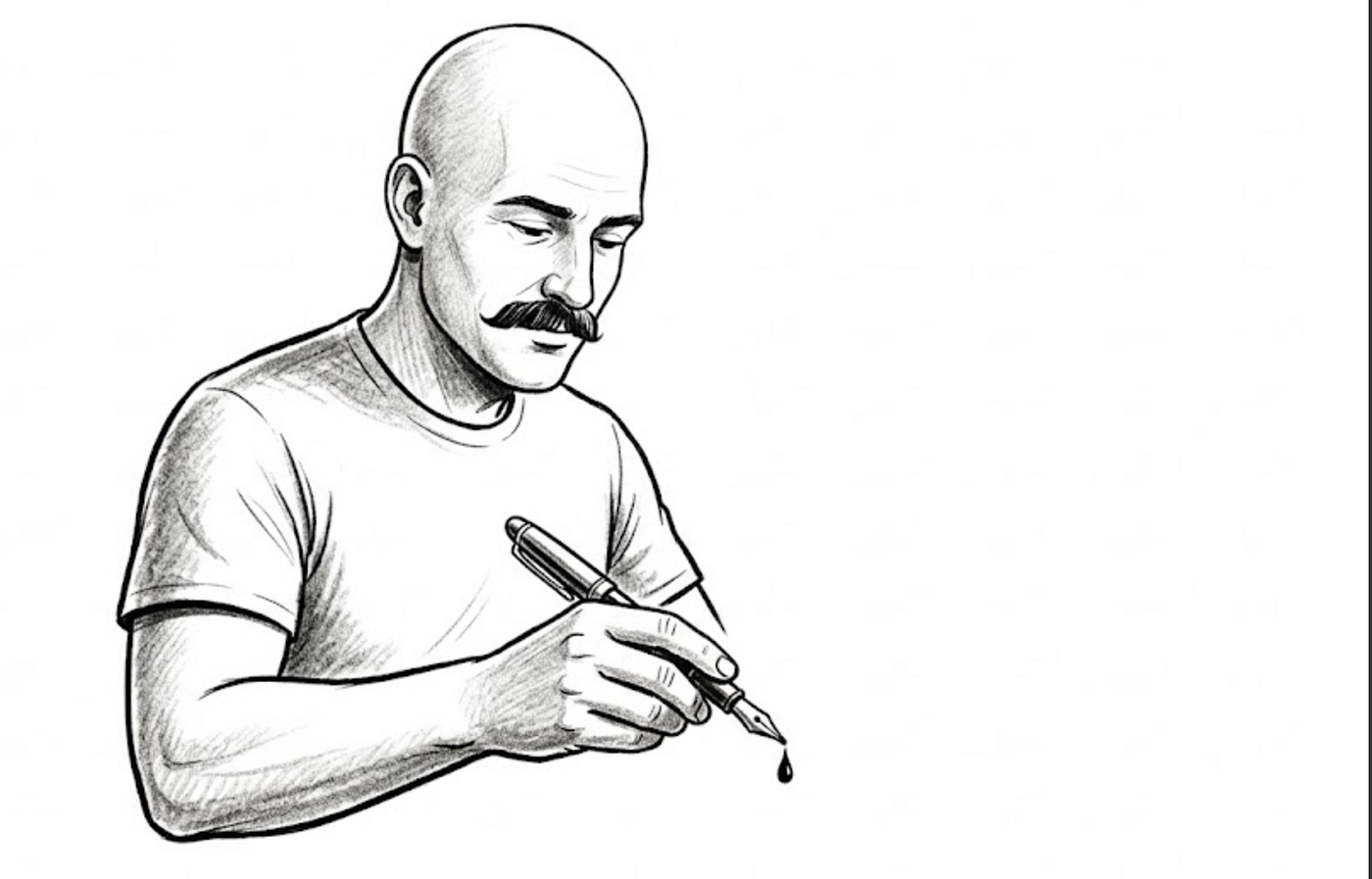
Krzyś, aka The Author, aka the man in the back of the meeting quietly calculating its cost in engineer-hours, remains a full-stack developer, part-time Stoic, and recovering attendee of steering committees. He has survived matrix organisations, holacracy, SAFe (barely), and one memorable attempt at “tribes.” He can be found writing code, writing about why the code was never the point, and explaining to his calendar that no, this could not have been an email — it could have been nothing at all. His therapist has asked him to stop describing org charts as “data structures with feelings,” but concedes the metaphor is load-bearing.
…TBC…

This story is published on Generative AI. Connect with us on LinkedIn and follow Zeniteq to stay in the loop with the latest AI stories.
Subscribe to our newsletter and YouTube channel to stay updated with the latest news and updates on generative AI. Let’s shape the future of AI together!

메타데이터
- post_id
- b12c7218550b
- slug
- brace-yourself-vibe-management-is-coming-spoiler-it-s-not-the-programmers-who-should-worry-b12c7218550b
- url
- https://generativeai.pub/brace-yourself-vibe-management-is-coming-spoiler-it-s-not-the-programmers-who-should-worry-b12c7218550b
- canonical_url
- https://generativeai.pub/brace-yourself-vibe-management-is-coming-spoiler-it-s-not-the-programmers-who-should-worry-b12c7218550b
- author_url
- https://medium.com/@krisguttenbergovitz
- status
- ok
- fetched_at
- 2026-07-09 01:16:53