Imperium Americanum and American Feudalism
In my mind’s eye, I’ve only in 2026 been calling my home country, The Empire. This is partially due to the fact that the United States has…
Imperium Americanum and American Feudalism
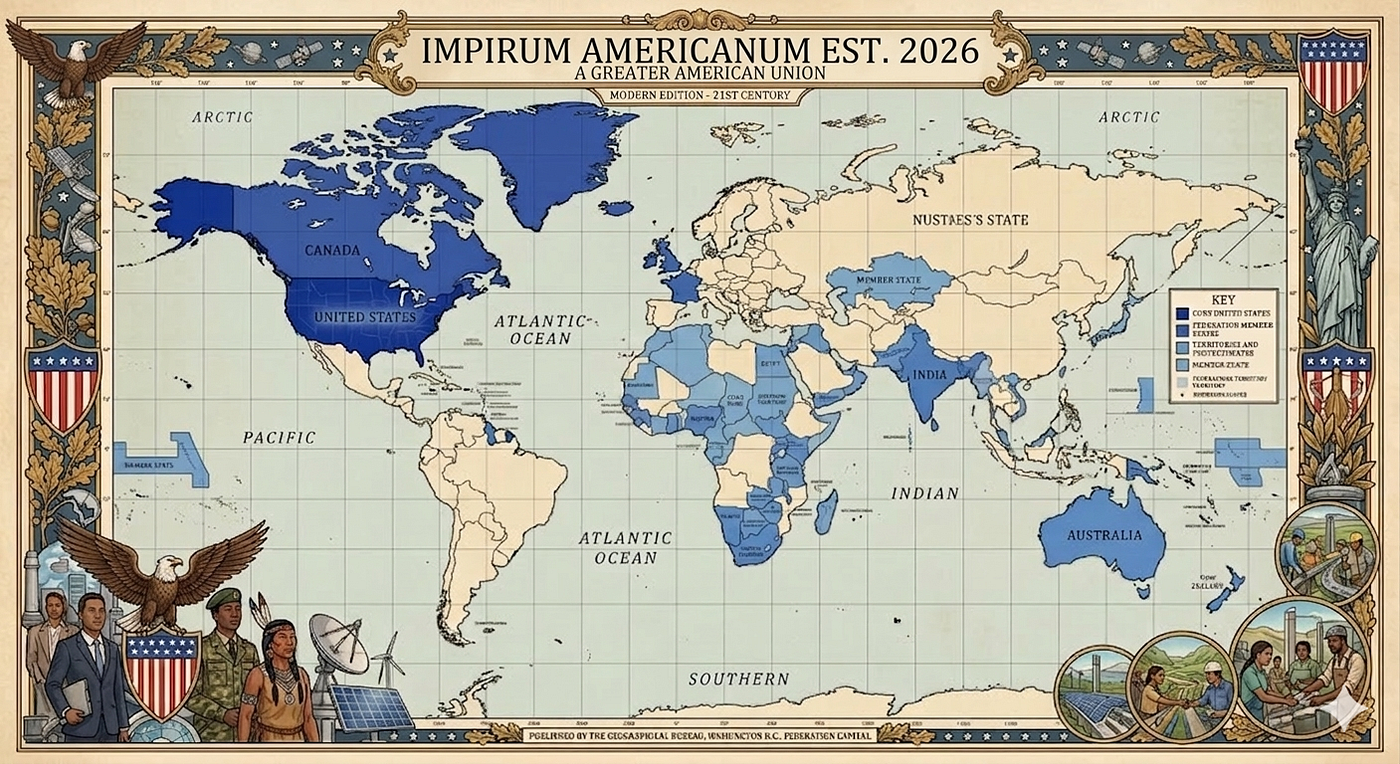
In my mind’s eye, I’ve only in 2026 been calling my home country, The Empire. This is partially due to the fact that the United States has abducted a sitting president of another country (Venezuela) and openly launched a war on another (Iran). But the recent actions of America only serve to underscore its murky history in foreign affairs. Murky in the same way as past empires that have defined the Western world, such as the British and Roman Empires.
Now it could be argued that the United States is no longer the world’s superpower, that our power has waned, and that the balance of power is shifting. We now live in a multipolar world with multiple regional powers; perhaps you’ve even heard the narrative that China will be the next world power. Yes, a great deal is shifting in the world, and who knows what the future holds, but the United States is still the largest military and economic power, guiding global economics with its currency as the reserve currency and its language as the lingua franca.
And yes, at this present moment, a great deal is wrong with America in both its domestic and foreign policies, much of which can be owed to the current administration’s decisions. Decisions made in America reverberate around the globe with far-reaching implications, some short-term, others long-term. And I, as a single American with only my voting power, have very little opportunity to effect large-scale change at the macro level.
I think as a child and as an adolescent, I was impressed by the grandiosity of the American narrative, and I felt a sense of aspiration to play a grand role in it. Perhaps I’m just saying in long form that I wanted to be a famous American. But perhaps there is something more that meets the eye, that famous American dream, that saying we tell children, whether we actually believe it or not, that comes with being “American” — “You can be anything you want.” “This is the land of opportunity.”
That is the thing with narratives, though, they’re powerful but not always literal. Take, for example, when leaders in the government of the United States are sworn in, they must (if Christian) place their hand on the Bible (other religious book if another religion). Just because they swear on a Bible doesn’t mean they will adhere to the moral principles found in it. Just because we tell our kids You can be anything you want doesn’t mean it will happen.
The belief that everyone can get stinking rich in America is a fallacy. The belief that this is the greatest nation on earth is a fallacy. The belief that we will never abstain from our higher ideals is a fallacy. Now, this doesn’t mean that the quality of living compared to global standards isn’t high or that you can’t do what you want; it’s that, like most things, the reality isn’t as idealistic as the dream.
The dreams of one’s success, whether that be in wealth, fame, or power in the American Empire, are not statistically impossible, but they are statistically improbable. You can try your hardest, I mean your absolute hardest, and fail. You can try very little and succeed. America is a place where the concepts, games of probability, and meritocracy marry and become one flesh. You cannot have one without the other. Hence, the reasons for your success or failure are indistinguishably both based on meritocratic measures and the good or bad fortune of luck. It’s a conundrum of the mind that these two contrary things are true, but they are.
In medieval Europe, the system of government was based on feudalism, in which peasants could never climb the socioeconomic ladder unless they married into nobility. The social hierarchy was drawn by bloodline. The only reason I bring this up is that capitalism often works through the creation and mere maintenance of wealth. Once one has one’s piece of the pie, the work is done for generations; hence why it’s called generational wealth.
And what results of the product of generational wealth are trust fund babies, or in other words, the great great grandkids living off of ol pappy Mc’Millions, who made his fortune on that coal mine back in 82’… 1882. In a way, this branch of society, while obviously not completely immune to losing money through bad investments or careless spending, pretty much keeps wealth rolling through the mere ownership of stocks, businesses, and property. This isn’t that dissimilar from the feudal system of medieval Europe. Those who inherit don’t even have to do the work of maintaining their wealth; they can have people whom they pay to do that for them.
So, in a way, while the capitalist system is better than straight feudalism by allowing one with enough grit and ingenuity to carve out a name for oneself in the echelons of fortune and fame. It doesn’t and never will represent the true meritocracy it often likes to claim.
So, as an American, I feel an incongruity with the grandiosity of the nation-state acting as an empire. And the travestying reality that, given current socioeconomic conditions, I may never be able to buy a house or afford the basic necessities that my parents were able to do at my age. Not to mention the increasing prevalence of A.I. and how it will get better and do every job, not only making it harder to achieve wealth but also quite literally impossible. Given the staggering amount of inequality that now exists, with a large fraction of the population feeling powerless, prone to populism, and downright debauchery, one can’t help but feel hopeless.
But what brings me back to the table? Why do I criticize? Why does anyone criticize for that matter? It’s because I care. I mentioned before this nation’s failure to live up to its ideals, and just as any ideal is unreachable, the goal isn’t perfection but to try. To give it your best effort. Because it is only through the lens of history that we can assertively look back and say we have made definitive progress in some fields. And that’s not because people looked out into the world with wretched hopelessness and decided to call it quits.
When we, as a society, try to live up to our ideals, we may not reach the utopian success we hoped for, but we do achieve progress. It’s the marching beat of every just society: the questioning that requires clarification, which we later refer to as an amendment. That chance for a nation to admit its wrongs and try harder, try better, for its people and for the world. The nation-state, the American Empire, isn’t a story carved in stone; it’s a venue, a mechanism through which the projection of power meets the concrete reality of consequences.
If we want to change the empire for the better, so that its citizens and people of the world can benefit, then it doesn’t start with an action or a political movement; it starts with a decision.
메타데이터
- post_id
- b13a7fe8d8c0
- slug
- imperium-americanum-and-american-feudalism-b13a7fe8d8c0
- url
- https://medium.com/@giomg02/imperium-americanum-and-american-feudalism-b13a7fe8d8c0
- canonical_url
- https://medium.com/@giomg02/imperium-americanum-and-american-feudalism-b13a7fe8d8c0
- author_url
- https://medium.com/@giomg02
- status
- ok
- fetched_at
- 2026-06-15 20:49:13