How Physics AI Is Transforming Simulations
Physics AI: Merging Machine Learning with Simulation
**How Physics AI Is Transforming Simulations**
Physics AI: Merging Machine Learning with Simulation
The frontier of engineering simulation is rapidly evolving as Physics AI — machine learning trained on physics data — brings near–real-time analysis to once time‑intensive workflows. Instead of running a single simulation at a time, Physics AI learns from hundreds of past finite element (FEA/CFD/etc.) analyses and then predicts outcomes for new designs almost instantly. In effect, it maps geometry to performance through modern geometric deep learning, enabling designers to iterate faster. Once trained on existing simulation data, a Physics AI model can output full animated physics results orders of magnitude faster than a conventional solver. altair.comcommunity.altair.com.
In practice, engineers simply feed their CAD/mesh into the trained model and get instant contours or force plots. For example, Altair’s PhysicsAI demo showed a team importing a 3D HVAC duct model and clicking “Predict” — the AI returned a detailed pressure map in ~3 seconds community.altair.com, compared to minutes or hours with a CFD solver. In another case, a head‑impact crash test was predicted in full animation by the AIcommunity.altair.com. These breakthroughs — achieved by geometric deep nets that work directly on meshes — slash runtimes from days or months to mere seconds altair.comcommunity.altair.com.
By blending AI with physics, Physics AI doesn’t replace traditional solvers; rather, it augments them. Tens to thousands of solver runs (FEA, CFD, etc.) are first used as training datamachinedesign.com. The model then generalizes to new designs, essentially serving as a super‑fast surrogate for the solver. The result is an “accelerated design cycle”: teams can explore many more “what-if” scenarios early on, catching problems in the digital lab long before hardware prototypes. (As one Altair expert notes, geometric deep learning for simulation could spawn foundational AI models akin to language models — but built on geometry and physics machinedesign.com.)
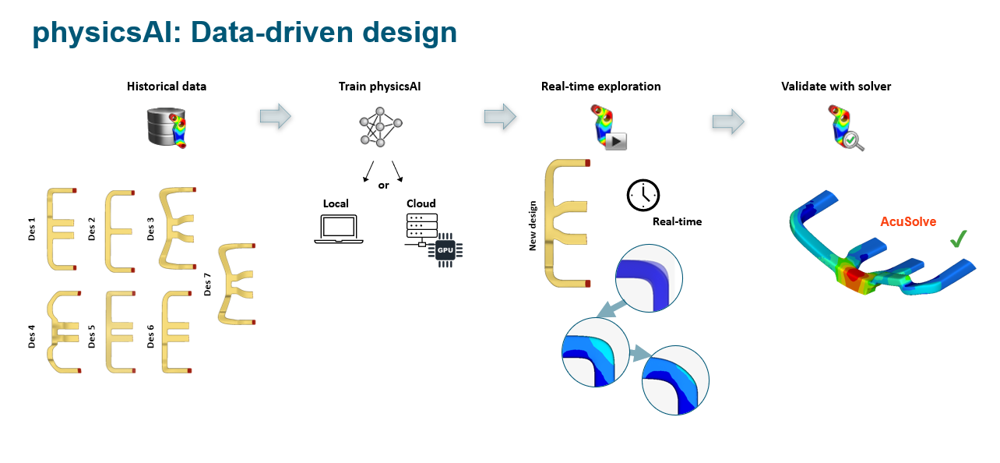
Data-driven workflow: Physics AI trains on historical CAE simulations, enabling “new design” predictions in real-time before final validation with a solver community.altair.com.
How Physics AI Works
At its core, Physics AI is data-driven. First, engineers gather past simulation results — for instance, dozens or hundreds of solved models with varying shapes or load cases. This “historical data” (FEA meshes and output fields) is fed into a geometric deep learning engine. Because it operates on the mesh/CAD itself (instead of hand‑crafted parameters), the AI learns shape–performance relationships directlyaltair.com. Training can run on local workstations or in the cloud on GPUs (e.g. Altair’s cloud-based Altair One platform) altair.com.
Once trained, generating predictions is as easy as importing a new CAD file and hitting “Predict.” The model quickly outputs a full set of physics results — e.g. stress, pressure or flow fields — as colored contours. These results come with a confidence score, too, flagging any novel design that’s outside the AI’s learned domain altair.com. Engineers then validate the AI’s predictions with a traditional solver. In essence, Physics AI becomes a rapid “first-pass” simulator: it filters out poor designs instantly and highlights promising ones for detailed simulation altair.comaltair.com.
This hybrid workflow — AI-driven sketching followed by selective solver runs — slashes time and cost. In one Altair study of an auto crash rail (a key component of the crush zone), researchers trained Physics AI on 450 crash simulations and tested it on 50 more. The AI’s Pareto-optimized designs agreed with the full FEA results within ~15% and came back five times faster than running FEA for each new design altair.com. In short, Physics AI handled early-stage design and optimization, deferring full solver validation only to the most promising candidates.
Physics AI models (powered by GPUs or cloud HPC) learn from existing CAE studies and then deliver blazing-fast physics predictions directly from CAD or mesh inputs altair.comaltair.com.
Breakthroughs in Geometric Deep Learning
Physics AI’s secret sauce is geometric deep learning — a class of machine learning that works on 3D shapes and meshes. Unlike generic ML, it understands the geometry of engineering models. For example, Altair’s Physics.
AI operates directly on simulation meshes or native CAD, eliminating the need for laborious parameterization altair.com. It literally learns how variations in the shape (say, a bracket’s thickness or angle) affect the stress or flow fields. This approach is solver-agnostic: it can be trained on FEA outputs from any physics (structures, fluid, thermal, electromagnetics, etc.) altair.com.
The result is extremely fast predictions. Altair claims PhysicsAI models can run up to 1000× faster than a traditional solver altair.comaltair.com (in practice, typical speedups of 10–100× have been demonstrated community.altair.com). Crucially, this is not just a single scalar output — Physics AI gives full-field animated results. In other words, it predicts every point’s pressure, temperature or displacement in a few seconds, enabling live “what-if” exploration.
Because it’s data-driven, Physics AI also improves over time. New simulation data (or even legacy datasets) can be added to retrain or refine the model. Teams can maintain a Physics AI repository of designs, continuously boosting the AI’s coverage. The emerging vision is akin to building a digital twin brain: a physics-aware model that “knows” engineering domains just like an LLM knows language. Indeed, Dr. Fatma Koçer of Altair envisions geometric deep learning unleashing “foundational models akin to LLMs but built on geometry and physics”machinedesign.com.

AI-augmented CAE: By predicting physics outcomes almost instantly from a model’s geometry, Physics AI gives engineers faster insight (lightbulb) and a head start on optimization before final solver validation altair.comaltair.com.

Real-World Applications & Industries
Physics AI’s potential spans many engineering fields. Early demonstrations have covered automotive crash and structural safety — e.g. optimizing crumple-zone rails and head impacts altair.comcommunity.altair.com — as well as HVAC and fluid flow (the duct pressure example above community.altair.com). Its applications go well beyond: any domain that uses FEA/CFD can benefit. For instance:
- Automotive & Heavy Equipment: Crash, durability, NVH and thermal management. Physics AI has been used to speed up crashworthiness design (rails and crumple zones) with near-FEA accuracy altair.com.
- Aerospace & Defense: Structural analysis of frames and wings, aerodynamic flow simulations, and electronics cooling. Faster iterating on stress or airflow can cut design cycles.
- Consumer Products & Manufacturing: Design of household appliances, packaging, and thermal systems (e.g. HVAC, heat exchangers) — improving airflow and temperature uniformity via rapid CFD predictions altair.com.
- Energy & Utilities: Wind-turbine aerodynamics, power generation component stresses, and even weather/climate models can leverage Physics AI’s speed.
Many of these are in industries that dominate simulation today. In fact, aerospace, automotive, high-tech electronics and heavy equipment make up ~76% of the $10B simulation marketmachinedesign.com. Physics AI aims to democratize simulation across these and other sectors by removing computational bottlenecks. For example, rather than reserving detailed FEA for after a design is “frozen,” companies can integrate AI‑powered CAE much earlier. In the Altair HyperWorks platform, PhysicsAI is embedded so that designers can run what-if studies with a click, leveraging the cloud/HPC backend (Altair One) to train models in minutesaltair.com.
Even non-traditional fields can benefit. Consider sports equipment or consumer electronics, where designers juggle many variants; or construction and AEC, where structural simulations can be huge. Anywhere that a CAD model needs physics feedback, AI can speed it up. And because Physics AI uses historical data, it’s compatible with older projects or different CAE solvers — making it a powerful tool for companies with large simulation archives altair.com.
Conclusion
Physics AI represents a paradigm shift in simulation-driven design. By learning from prior CAE results and applying geometric deep learning, it brings near-real-time physics predictions into the engineer’s toolkit. This lets teams evaluate many more ideas, discover better designs sooner, and reduce reliance on lengthy CPU/GPU solves. The end result is faster innovation: more designs make it to market quicker and with greater confidence. As Altair notes, PhysicsAI can produce “better design insights up to 1000× faster” than legacy solvers altair.com.
The coming era of AI‑augmented CAE promises that concepts once confined to overnight batches can now be interrogated interactively. For Medium’s tech readers, that means the boundaries between CAD modeling and simulation are blurring — machine learning is putting on its goggles, so to speak, and physically seeing the world. The impact will be felt across aerospace, automotive, electronics, and beyond: wherever complex physics meets creative design, Physics AI is taking simulation to the next level.
메타데이터
- post_id
- b1445ae512ba
- slug
- how-physics-ai-is-transforming-simulations-b1445ae512ba
- url
- https://medium.com/@jhparmar/how-physics-ai-is-transforming-simulations-b1445ae512ba
- canonical_url
- https://medium.com/@jhparmar/how-physics-ai-is-transforming-simulations-b1445ae512ba
- author_url
- https://medium.com/@jhparmar
- status
- ok
- fetched_at
- 2026-07-17 06:58:23