How AI Frees Teams to Focus on Higher-Value Work
Modern businesses are under constant pressure to do more with less. Teams are expected to deliver faster results, improve customer…
How AI Frees Teams to Focus on Higher-Value Work
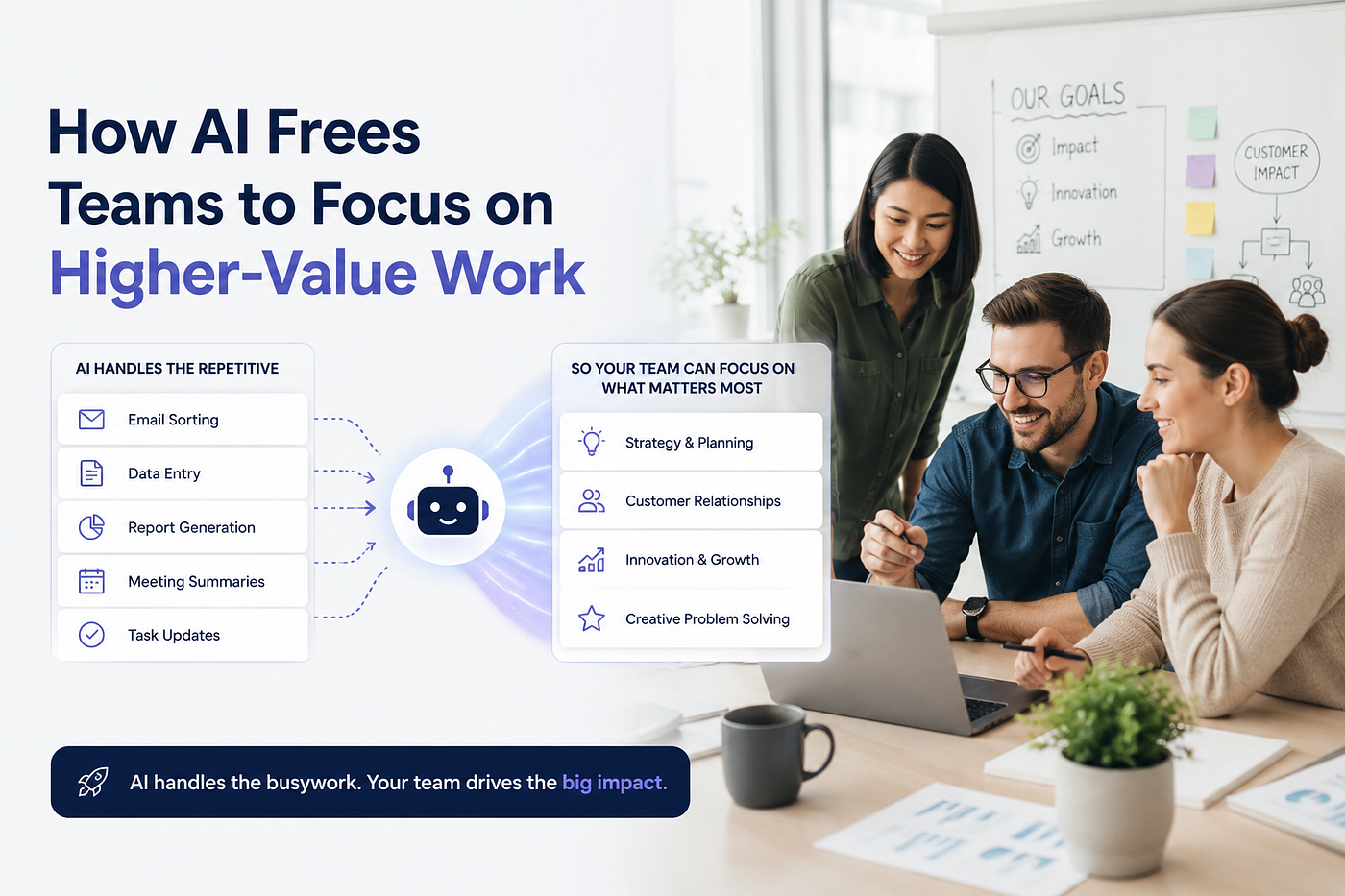
Modern businesses are under constant pressure to do more with less. Teams are expected to deliver faster results, improve customer experiences, reduce operational costs, and still maintain accuracy across every process. Yet many organizations continue to spend a large portion of their workday on repetitive tasks, manual approvals, scattered communication, and inefficient workflows.
This is where artificial intelligence is transforming the workplace.
AI is no longer just a futuristic concept reserved for tech giants. It is now becoming a practical business capability that helps organizations automate repetitive activities, streamline operations, and enable employees to focus on strategic, creative, and customer-centric work. Instead of replacing human talent, AI is creating opportunities for smarter and more efficient human + AI collaboration.
Combined with advanced BPM tools and modern workflow platforms, AI is helping organizations unlock a new level of productivity and operational excellence.
The Shift From Manual Work to Intelligent Workflows
For decades, businesses relied heavily on manual processes to manage approvals, documentation, reporting, customer requests, and operational workflows. While traditional automation helped reduce some inefficiencies, it often lacked adaptability and intelligence.
AI changes this equation by introducing systems that can:
- Analyze large amounts of data quickly
- Detect patterns and bottlenecks
- Predict outcomes
- Automate repetitive decisions
- Recommend process improvements
- Support employees with real-time insights
This shift allows employees to move away from low-value administrative work and focus on activities that require human judgment, creativity, empathy, and strategic thinking.
Organizations adopting AI-powered business process management are seeing measurable improvements in operational agility, employee productivity, and customer satisfaction.
Why Repetitive Work Hurts Business Growth
Many teams spend hours every week on tasks that do not directly contribute to innovation or business growth. Examples include:
- Manual data entry
- Email routing
- Document approvals
- Status tracking
- Report generation
- Invoice processing
- Compliance checks
Although necessary, these tasks consume valuable employee time and energy.
Over time, repetitive work creates several business challenges:
Reduced Employee Engagement
Employees often feel frustrated when most of their work involves repetitive administrative activities instead of meaningful contributions.
Slower Decision-Making
Manual workflows create delays that impact customer experiences and operational efficiency.
Increased Human Error
Repetitive tasks increase the likelihood of mistakes, inconsistencies, and compliance risks.
Limited Scalability
Organizations struggle to scale operations when growth depends heavily on manual effort.
AI-powered business process management solutions address these issues by intelligently automating routine tasks while enabling teams to focus on higher-value initiatives.
How AI Enables Higher-Value Work
AI supports teams by acting as a productivity accelerator rather than a replacement for human expertise. The goal is not to eliminate employees but to help them operate at a higher level.
Automating Repetitive Operational Tasks
AI can handle time-consuming routine work such as:
- Data classification
- Ticket routing
- Workflow triggers
- Appointment scheduling
- Invoice matching
- Compliance verification
- Customer query categorization
This automation reduces operational friction and frees employees to focus on analysis, innovation, and customer engagement.
For example, finance teams can spend less time processing invoices and more time on financial planning and forecasting.
Improving Decision-Making With Real-Time Insights
AI systems can process operational data instantly and provide recommendations that support faster and smarter decisions.
Instead of manually reviewing spreadsheets or reports, managers can receive predictive insights about:
- Process bottlenecks
- Customer behavior
- Resource allocation
- Risk factors
- Performance trends
This improves responsiveness while reducing decision fatigue.
Enhancing Customer Experiences
AI-powered workflow software can automate customer service processes, personalize interactions, and reduce response times.
However, the most successful organizations still maintain a balance between automation and human interaction. Customers may appreciate AI-driven efficiency, but they still value empathy and relationship-building from human teams.
This is where effective human + AI collaboration becomes critical.
Human + AI Collaboration Creates Better Outcomes
One of the biggest misconceptions about AI is that it eliminates the need for human involvement. In reality, the most successful AI strategies are built around collaboration between technology and people.
AI excels at handling speed, scale, and pattern recognition. Humans excel at creativity, emotional intelligence, ethics, and strategic thinking.
Together, they create stronger operational outcomes.
For example:
- AI identifies workflow bottlenecks while managers redesign processes
- AI analyzes customer trends while marketing teams create personalized campaigns
- AI automates support requests while agents resolve complex customer concerns
- AI generates operational insights while executives drive strategic decisions
This collaborative model allows businesses to improve efficiency without losing the human context that drives trust and innovation.
The Growing Role of AI in Business Process Management
AI is rapidly becoming a core capability within modern business process management systems.
Organizations are increasingly integrating AI into:
- Process automation
- Workflow optimization
- Process discovery
- Predictive analytics
- Intelligent document processing
- Decision automation
Modern business process improvement software now uses AI to continuously monitor workflows and recommend operational enhancements automatically.
Instead of waiting months to identify inefficiencies, organizations can detect issues in real time and respond proactively.
This enables businesses to become more agile, scalable, and resilient.
Why Businesses Are Investing in BPM Tools
Companies are recognizing that operational excellence cannot rely solely on disconnected systems and manual coordination. As a result, many organizations are investing in advanced bpm tools that combine automation, AI, and workflow intelligence.
These tools help organizations:
- Standardize operations
- Improve visibility across departments
- Automate approvals and workflows
- Reduce manual intervention
- Increase operational consistency
- Improve compliance management
The demand for enterprise business process management software continues to rise because organizations need scalable systems that support both efficiency and adaptability.
Businesses that modernize workflows early are gaining a significant competitive advantage.
AI-Powered Workflow Software Improves Team Productivity
Modern workflow software is evolving far beyond simple task automation.
AI-powered workflow systems can now:
- Predict workflow delays
- Automatically assign tasks
- Recommend process optimizations
- Analyze team productivity
- Detect operational risks
- Generate intelligent reports
This creates a more proactive operational environment where teams spend less time managing processes and more time delivering value.
For example, HR teams can automate onboarding workflows while focusing more on employee engagement and talent development. Similarly, IT teams can automate ticket routing and prioritize strategic digital transformation initiatives.
The Importance of Business Process Management Training
Technology alone does not guarantee successful transformation.
Organizations also need employees who understand how to manage, optimize, and continuously improve workflows effectively. This is why business process management training is becoming increasingly important.
Training helps teams:
- Understand process optimization strategies
- Improve workflow design
- Use AI-powered systems effectively
- Align operations with business goals
- Build cross-functional collaboration
Companies that invest in both technology and workforce capability tend to achieve stronger long-term operational outcomes.
AI adoption works best when employees view technology as a support system rather than a threat.
Choosing the Right Business Process Management Solutions
With growing demand for operational efficiency, many organizations are evaluating different business process management solutions to support their transformation goals.
However, selecting the right platform requires careful consideration.
Businesses should evaluate solutions based on:
Scalability
Can the platform support future business growth?
AI Capabilities
Does the system include intelligent automation and predictive analytics?
Integration Flexibility
Can it connect with existing systems and applications?
User Experience
Is the platform intuitive for both technical and non-technical users?
Customization
Can workflows adapt to unique business needs?
Leading business process management software companies are now focusing heavily on low-code and AI-driven capabilities to simplify workflow automation and improve accessibility across organizations.
How Enterprise Organizations Are Leading the AI Shift
Large enterprises are often early adopters of AI-driven operations because they manage complex workflows across multiple departments and regions.
Enterprise business process management software helps these organizations:
- Improve governance
- Increase operational transparency
- Standardize global workflows
- Reduce compliance risks
- Accelerate digital transformation
AI enables enterprise teams to process large operational volumes without increasing workforce pressure.
At the same time, smaller businesses are also benefiting from AI-powered solutions that were previously accessible only to large corporations.
Today, even mid-sized companies can access affordable business process improvement software that supports automation and intelligent workflow management.
The Rise of Intelligent BPM Platforms
Many vendors featured in the top 10 business process management software rankings are now integrating advanced AI capabilities directly into their platforms.
This includes features such as:
- AI-driven process discovery
- Intelligent workflow recommendations
- Predictive process analytics
- Natural language automation
- Automated document understanding
- AI copilots for workflow management
These capabilities are helping businesses move beyond static workflows toward adaptive and continuously optimized operations.
The future of business process management will increasingly revolve around intelligent systems that learn and evolve over time.
AI Allows Teams to Focus on Innovation
One of the biggest advantages of AI-driven operations is the ability to reclaim time for strategic work.
When employees spend less time on repetitive administrative activities, they can focus more on:
- Innovation
- Customer relationships
- Strategic planning
- Product development
- Creative problem-solving
- Operational improvement
This creates stronger employee engagement and higher organizational value.
Businesses that successfully combine AI with human expertise are building more adaptive, resilient, and future-ready organizations.
Final Thoughts
AI is fundamentally reshaping how businesses operate. By automating repetitive tasks, improving workflow visibility, and enabling faster decision-making, AI allows teams to focus on work that truly drives business growth.
The future is not about humans competing against technology. It is about building stronger human + AI collaboration models where technology handles operational complexity while people focus on creativity, leadership, and innovation.
Organizations investing in intelligent BPM tools, advanced workflow software, and scalable business process management solutions are positioning themselves for long-term success in an increasingly digital economy.
As AI capabilities continue to evolve, businesses that embrace intelligent automation thoughtfully and strategically will be best prepared to unlock higher productivity, stronger customer experiences, and sustainable operational excellence.
메타데이터
- post_id
- b14ec4ad082c
- slug
- how-ai-frees-teams-to-focus-on-higher-value-work-b14ec4ad082c
- url
- https://medium.com/@BPMSoftwareAustralia/how-ai-frees-teams-to-focus-on-higher-value-work-b14ec4ad082c
- canonical_url
- https://medium.com/@BPMSoftwareAustralia/how-ai-frees-teams-to-focus-on-higher-value-work-b14ec4ad082c
- author_url
- https://medium.com/@BPMSoftwareAustralia
- status
- ok
- fetched_at
- 2026-06-15 20:49:13



