Forging a Unified India — Part 3: Dissolution of States for complete unity
Part 1 of this series explained how over 550 princely states were convinced to accede to India. It is well known that all these states…
Forging a Unified India — Part 3: Dissolution of States for complete unity
Part 1 of this series explained how over 550 princely states were convinced to accede to India. It is well known that all these states were asked to surrender only the matters of Defense, Foreign Affairs and Communications to the Indian Union while acceding — which means they were allowed to retain their political structure, including their monarchs, constitutions, assemblies, internal administration, and any laws not related to the above 3 subjects. So how did we come from there to the fully integrated Indian Union as we see today?
The problem with the 3-subject accession
After independence, the map of India still looked like the jigsaw puzzle, except that Pakistan was carved out of the north-west and eastern parts of the country. There were 11 provinces directly under the administration of the Indian Union and over 550 small & large princely states, under their own administration.
While some of the states were making significant progress towards representative government, the majority of the states were still stuck in autocracy, fiscal indiscipline and were too small to introduce efficient administration. For example, there were around 222 states in the Kathiawar region of Gujarat, where multiplicity of customs and other barriers made communication and trade virtually impossible. The border states like Tripura and Cooch Behar were particularly vulnerable as Pakistan was trying to stoke communal tension to merge them with East Pakistan. In such circumstances, Patel and Menon concluded that only by full integration of these states can India become a functional nation state.
Unity through Betrayal
As a first step in this process, Patel and Menon decided that the various small states should be merged, either into provinces like Bombay or Orissa, or into separate Unions. Merger of states implied that the princes would lose their governing powers which shall be transferred to an elected legislative assembly and executive. The declared policy was that only the small non-viable states would be merged, and the large viable states like Bhopal or Hyderabad would not be touched.
This was perceived as a breach of the promises made to the princes when they acceded into India, that their administration would not be disturbed. And now the government had decided to destroy the separate identity of the states at the altar of political integration.
To sweeten the deal a bit, in return for surrendering their governing powers, the princes were offered guaranteed privy purses and they were allowed to retain their palaces, privileges & titles (it is another matter that the privy purses and the titles were withdrawn in the 1970s). Through a combination of sama, dama, danda & bheda, the states were made to accept the mergers willingly or unwillingly.
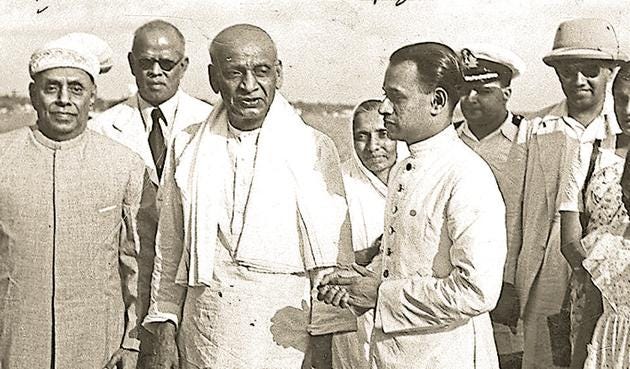
But it was soon realized that the powers still enjoyed by these newly created unions were hindering the government’s development programmes. Thus in May 1948, various unions were forced to sign new Instruments of Accession ceding to the Union, the powers to form laws on all subjects falling in the Union and Concurrent list (instead of only the 3 subjects agreed earlier). The rulers were continuously warned that if they did not comply, the Praja Mandals would rebel and overthrow their governments.
While the initial plan was restricted to the smaller unviable states, later on even the large states like Jaipur, Indore & Gwalior were also merged and their identities extinguished, very much against the repeated promises made to them over the years. By the end of 1950, all states except Kashmir had adopted the Constitution of India as their own Constitution. It was only in 2019 that the Indian Constitution was made applicable on Kashmir as well. Readers are recommended to read “Dethroned” by John Zubrzycki for more stories and insights on how this was achieved.
Conclusion: All’s well that ends well?
While the government continuously went back on its promises, blackmailed the princes into giving more and more powers to the government, finally reaching a point when the states ceased to exist; these actions were done on the premise that these were for the greater good of the nation. While the dissolution of the states did help in the national integration of the people and rapid movement towards democracy and development, it broke the personal connection that the citizens had with their rulers.
Today it would be difficult to imagine a broken India with each state having its own identity, ruler and laws, often at conflict with those of other states, or even India, prompting the suggestion that the end justifies the means. But only the history of the past 75 years is the final judge which can decide whether the decision turned out to be in the best interests of the nation.
메타데이터
- post_id
- b150aba66f1d
- slug
- forging-a-unified-india-part-3-dissolution-of-states-for-complete-unity-b150aba66f1d
- url
- https://medium.com/@akshatgoyal13/forging-a-unified-india-part-3-dissolution-of-states-for-complete-unity-b150aba66f1d
- canonical_url
- https://medium.com/@akshatgoyal13/forging-a-unified-india-part-3-dissolution-of-states-for-complete-unity-b150aba66f1d
- author_url
- https://medium.com/@akshatgoyal13
- status
- ok
- fetched_at
- 2026-06-27 18:20:27