“We Are the Guardians of Where We Live”: The Other Face of the Campaign to End Sealing
In 2024, Laakkuluk Williamson Bathory travelled to Toronto to cut open a fat, silver-haired seal beneath the glass ceiling of the Art…
“We Are the Guardians of Where We Live”: The Other Face of the Campaign to End Sealing
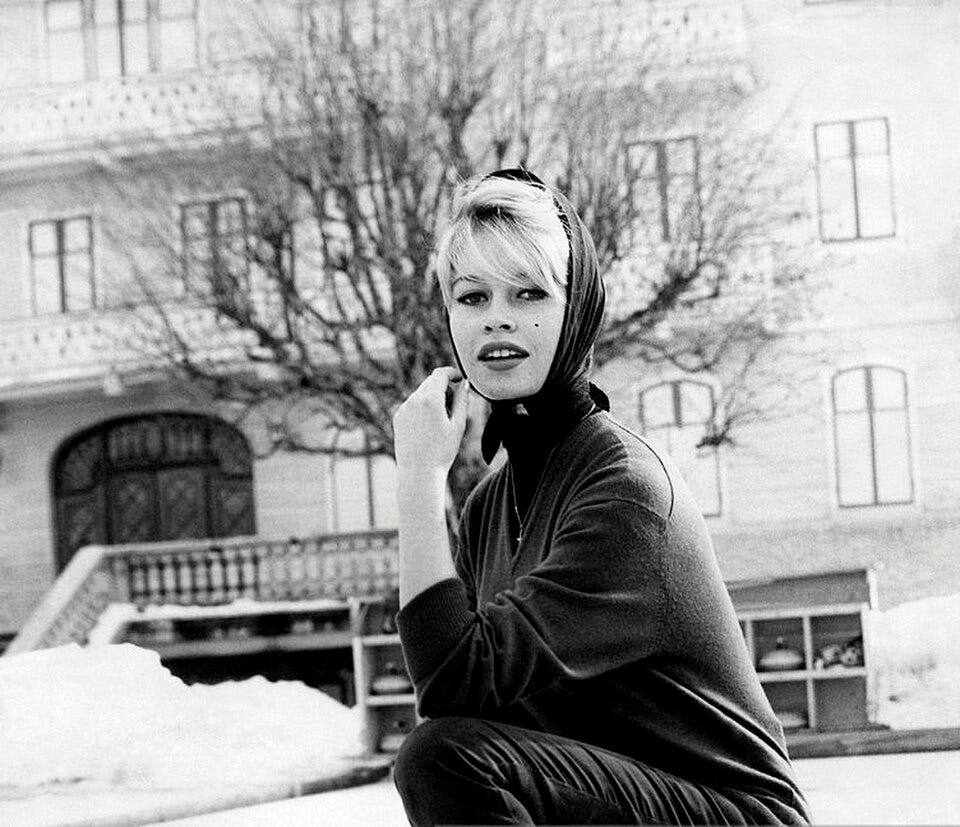
The French actress and model Brigitte Bardot posing on a curling field in Cortina d’Ampezzo, Italy, 1958, via Wikimedia Commons
In 2024, Laakkuluk Williamson Bathory travelled to Toronto to cut open a fat, silver-haired seal beneath the glass ceiling of the Art Gallery of Ontario.
The rules and regulations of the Canadian government were none of her concern. As a proud Kalaaleq woman, as an Inuk storyteller, poet, and visual artist based in Nunavut, what mattered to her was to sharpen her ulu knife, kneel on the floor of the Walker Court, and do what her ancestors — and thousands of Inuit across North America and Greenland (Kalaallit Nunaat) — have done since time immemorial: slit open freshly-hunted seals, and share morsels of their meat and fat with friends, family, and guests.
Nearly half a century earlier, in 1977, another woman travelled to eastern Canada. She was French, born and raised in Paris, in her family’s luxurious, nine-bedroom apartment in the 16th arrondissement. She brought with her a devotion to animals and a twenty-year career in filmmaking that she had just chosen to leave behind.
This is how Simone de Beauvoir described her in 1959:
She is the new idol of American youth. She ranks as a great international star. Nevertheless, her fellow-countrymen continue to shy away from her. Not a week goes by without articles in the press telling all about her recent moods and love affairs or offering a new interpretation of her personality.
Her name was Brigitte Bardot.
In early 1977, Bardot turned her attention to Canada and launched a campaign that would come to define her for years to come: the protection of seals and the abolition of seal hunting.
She began in Blanc-Sablon, a small coastal town on the border between northern Quebec and Labrador, along the Strait of Belle-Isle — a place shaped by continuous Indigenous presence for nearly nine thousand years, long before the first English fishermen and explorers ever set foot there, long before the first Frenchmen and Frenchwomen settled in the bay and took up the hunt for seals.
From the Strait of Belle-Isle, Bardot boarded a helicopter and flew out over the frozen expanse of Labrador. And there, on Labrador’s ice floes, she posed for photographs cradling a white-coated seal pup, her eyes closed, her long blonde hair spilling gently across its fur.
It had been four years since she stepped away from a celebrated and transformative film career — one that saw her collaborating with directors and artists such as Roger Vadim, Jean-Luc Godard, Louis Malle, and Jean Cocteau. Yet Bardot remained an icon — the French icon par excellence, an emblem of beauty, sexual freedom, and feminism, admired, scrutinised, celebrated, criticised, sexualised and adored in equal measure.
It took only a handful of carefully staged, carefully framed photographs for her to become the face of the anti-seal hunting movement and to launch one of the most visible animal rights campaigns of the twentieth century.
As Bardot galvanised public opinion across Europe, international outrage swelled at what Western media framed as the deliberate, senseless slaughter of innocent seal pups. The result? The sealskin market collapsed. In 1983, the European Economic Community banned the import of whitecoat harp seal pup furs. Four years later, in 1987, Canada outlawed the commercial hunt of baby harp seals and blueback hooded seals.
It was a victory — but only for some. For the descendants of the people who had lived in the Canadian Arctic for millennia, it was a catastrophe.
As Bardot had ships named after her and Greenpeace Canada intensified its campaign against commercial sealing, Inuit sealers were demonised. Their livelihoods unravelled. With the collapse of the sealskin market — one of the few reliable sources of income in many northern communities — came deepening poverty and humiliation. Once again, Inuit culture was misunderstood, vilified, and judged through a purely Western approach to wildlife conservation. Inuit voices were sidelined, if not silenced. And in the years that followed, suicide rates among Inuit communities jumped.
The very big island
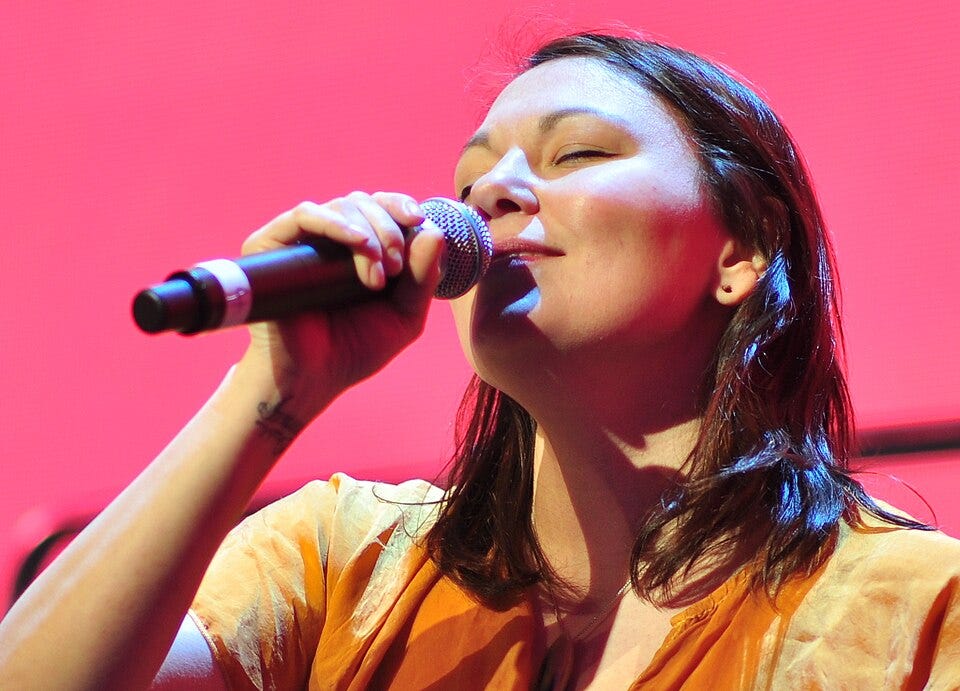
Tanya Tagaq at the 2017 Pop Conference, MoPOP, Seattle, Washington, photograph by Joe Mabel, via Wikimedia Commons
Tanya Tagaq Gillis was born two years before the world watched Brigitte Bardot cradle seal pups on Canada’s ice floes.
In a 2014 conversation with Matthew Zuras, Tagaq describes her homeland — Iqaluktuuttiaq, “a good fishing place”, a hamlet on the southeastern coast of Victoria Island, at the western edge of Queen Maud Gulf in Nunavut (ᓄᓇᕗᑦ)- in these terms:
*Nunavut is so far up north that there are no trees. The sea ice in the winter is about seven to ten feet thick, so it’s a complete wasteland. It’s beautiful and it’s amazing, but it’s hard to carve out an existence from it. There are no greenhouses. When you get stuff flown up, inevitably it freezes in the airplane. There are no roads, so you get half-frozen or wilted vegetables.*
In Nunavut, hunting seals is not a matter of fun, sport, or self-serving pride. It is a matter of sheer survival. It is about sustaining one’s body on food that is nourishing, locally sourced, and often healthier than most processed and imported goods.
It is about acknowledging that human well-being is inseparable from the well-being of wildlife, because, as Tagaq explains,
when you aren’t from a city and you aren’t born and raised around skyscrapers and only picking food up from the grocery store, you understand the process of a living thing becoming your food.
In this sense, Nunavut, that beautiful and amazing wasteland described by Tagaq, is one of those places where seals are respected because they are hunted — not in spite of it.
Within Inuit cosmology, seals and humans exist in a relationship of reciprocity. Each group bears responsibility for the other’s survival. Each group needs the other’s well-being to survive. Hunters are required and expected to always act according to this tenet, as it is on this tenet that their survival, and the survival of their communities, depends.
Edmund Searles recalls a seal hunt with two Inuit brothers, Pauloosie and Ooleetoa, near their home in southern Baffin Island, in Nunavut — the “very big island”, as it is known in Inuktitut. There, they spotted an 800-pound bearded seal at an aglu, a breathing hole.
Searles recalls how, after killing the seal, the brothers began butchering it immediately, there on the ice, where the animal had drawn its last breath. As they worked, Pauloosie explained that it is crucial for a hunter to have the seal’s blood on his hands and clothes, because “one must accept this blood as a sign of respect to the animal and to ensure successful hunts in the future”. Seals, he claimed, would not come to hunters refusing this contact.
When a seal is spotted peeking out of a breathing hole, Inuit hunters approach it not simply as a prey, but as a sentient being, one that chooses to offer and sacrifice itself to make life possible for those waiting above the ice. So, as the seal gives its life so that Inuit men, women, and children may live, hunters are expected to honour its sacrifice by treating the seal’s body — its meat, its fat, and its blood — with care.
They are expected to share it within the community so that its spirit may embark on a new, crucial journey — a journey back to the spirit world, where it will be reborn into another seal.
Breathing holes embody this relationship. Cut through thick ice, regularly maintained by seals and relied upon by hunters, they are sites of encounter, contact zones where predator and prey renew their contract and meet not as enemies but as participants in a shared system of survival. Without them, seals would suffocate during the long Arctic days and nights, when much of the sea above them freezes over. Without them, Inuit hunters would lose access to one of their primary sources of sustenance.
Alethea Arnaquq-Baril was born in what is now Iqaluit (“the place of many fish”), at the northern end of Frobisher Bay in Nunavut’s Qikiqtaaluk region. She made her film, Angry Inuk, to “unshame” the practice of sealing, as she puts it in an interview with Jen McNeely.
She made it to reject the stigma imposed by decades of Western activism, and to present sealing as it is lived within Inuit communities, where meat is distributed according to longstanding customs of sharing, where hunters make sure no part of the animal is wasted, and the seal, through its death, through its sacrifice, literally ensures community survival and cohesion. Because in the Arctic, sharing is also survival.
“We do not sell the meat, we share it. The hunters, by custom, have to share it”, says Aaju Peter, who collaborated on the film. In the Arctic, sharing is more than a simple act of generosity — it is a necessity.
Seal hunting, as practiced by Inuit communities, is not the senseless, evil violence it is often made out to be. It’s not aggressive or driven by spectacle or excess. On the contrary, it is a “peaceful” process, as Tanya Tagaq once said, grounded in the understanding that “we are all part of nature” and that “nature eats things and we are part of that”.
Food (In)Security
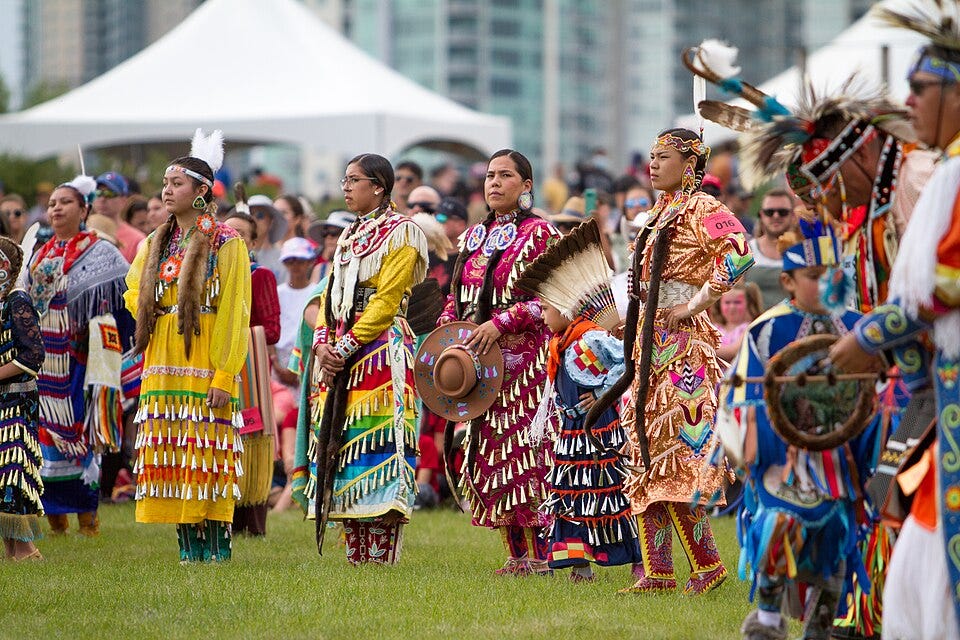
First Nations dancers watch the Canada Day celebrations in Calgary, Alberta, 2022, photograph by Dwayne Reilander, via Wikimedia Commons
The 1996 World Food Summit defined food security as a condition that only exists when
all people, at all times, have physical and economic access to sufficient, safe, and nutritious food that meets their dietary needs and food preferences for an active and healthy life.
Oxfam offers a similar definition: food security can only exist
when all people, at all times, have physical, social, and economic access to sufficient, safe, and nutritious food that meets their food preferences and dietary needs for an active and healthy lifestyle.
Food must be safe. Food must be sufficiently nutritious to support an active diet and a healthy life. Food must be reliably available and sufficient over time — it can’t be only temporarily available, because moderate food insecurity still constitutes food insecurity. And it must be affordable.
These are precisely the conditions that many Inuit communities across the Inuit Nunangat — the Inuit homeland — have long been denied. In Nunatsiavut, in Northern Labrador, rates of food insecurity in 2017 were five times higher than those recorded among non-Inuit households across Canada. Only five years earlier, in 2012, 42 per cent of Inuit adults were living in food-insecure households, a figure that once again far exceeded the national average. Couples without children were statistically less likely to experience food insecurity, but unemployed adults, women, lone parents, and couples with children were disproportionately affected.
Forty years after Bardot’s campaign, Inuit communities continue to experience some of the highest suicide rates in Canada — and in the whole world — across all age groups, but most alarmingly among youth. In Nunavik, for example, the suicide rate among Inuit male youth continues to be forty times greater than that of their non-Indigenous counterparts. The generational toll is stark: between 2014 and 2018 84 per cent of Inuit males who died by suicide were under the age of twenty-five — the very cohort upon whom the future of Inuit communities and culture depends.
And if this were not enough, according to Inuit Tapiriit Kanatami, in 2011, 70 per cent of Inuit households experienced food insecurity — a statistic that translates into numbers and somewhat obscures the lived realities of thousands of mothers and fathers who found themselves financially unable to feed their children food that was safe, nutritious, sufficient, and reliably available.
Among non-Indigenous Canadian households, the figure stood at just 8.3 per cent. In that same year, Inuit living in Inuit Nunangat were recorded as having an average life expectancy of 70.8 years, nearly a decade lower than the 80.6 years recorded among non-Indigenous Canadians.
This is what happens when ancestral knowledge systems are consistently eroded, when the natural transmission of Traditional Ecological Knowledge is disrupted and prevented from being organically transferred from one generation to the next, when Inuit skills are publicly downplayed, ridiculed, and demonised, and access to ancestral hunting grounds is restricted.
This is what happens when environmentalism is done to Indigenous peoples rather than with them. When outsiders with power and global influence turn their gaze toward a unique place like the Canadian Arctic — where Inuit and wildlife have co-existed for centuries — and deliberately ignore local truths while treating wildlife as a sealed-off compartment detached from Indigenous lived realities.
It would be reductive to attribute rising suicide rates or persistent food insecurity solely to Brigitte Bardot’s well-meaning but misdirected campaign. Her activism — and the widespread support it received across Europe and beyond — are only part of the story. They are symptoms of a broader system: one that too often lacks the capacity or the willingness to look beyond its own value system; one that privileges its own moral and ecological frameworks while marginalising and silencing others.
Bardot’s campaign, like that of Greenpeace Canada, is part of that long-standing colonial assault on Indigenous knowledge systems that began when the first European landed on the shores of what is now North America — an assault that, over time, has metamorphosed into one on Indigenous bodies themselves, affecting the physical and mental well-being of thousands of Indigenous Canadians, and undermining their ability to function, thrive, and make a difference within Canadian society.
This pattern is not unique to Canada.
It took a catastrophic, year-long bushfire season for mainstream Australia to recognise that Aboriginal knowledge should — and could — have a place in Australian environmental conservation. In Australia, cultural burning practices have been prevented, if not actively forbidden, for decades. They have been ignored, ridiculed, and dismissed as the product of a “backward” people fundamentally incompatible with modernity.
Then came the Black Summer. The evidence that emerged from its ashes was staggering: the areas most severely affected were often those untouched by Aboriginal burning, where Aboriginal custodians had been prevented from applying their mosaic of strategically planned control burns.
As Aaju Peter has often made clear in interviews, for Indigenous peoples in Canada and around the world, the issue has never been opposition to conservation, but exclusion from it — an exclusion that, for Inuit communities across the Canadian Arctic, has meant enduring the long-lasting damage brought on by Brigitte Bardot’s anti-sealing campaign.
“We’ve lived here ten times longer than the people that are imposing these policies”, Aaju Peter once said in an interview with Hanna Pfeiffer,
We are the guardians of where we live, and as guardians, we want this earth to become safer for our wildlife, less polluted, and less at risk of oil spills. We are not against our country, nor are we against our environment. We actually want the best. We are not excluding anybody. Our notion of sovereignty is welcoming everybody, as long as the visitors have our best interests in mind, as long as they are not going to destroy our way of life.
The knowledge is indeed in the landscape — and Inuit communities continue to defend it, despite decades of erasure, exclusion, and demonisation. Recognising this knowledge is the first step in reimagining the future of conservation itself: one that is not imposed from the outside, but built in partnership with those who have long understood how to live on, with, and off the land, whether that land is the Inuit Nunangat, Kalaallit Nunaat/Greenland, or the country now known as Australia.
Originally published at https://overland.org.au on July 8, 2026.
메타데이터
- post_id
- b152c1810b93
- slug
- we-are-the-guardians-of-where-we-live-the-other-face-of-the-campaign-to-end-sealing-b152c1810b93
- url
- https://medium.com/thought-thinkers/we-are-the-guardians-of-where-we-live-the-other-face-of-the-campaign-to-end-sealing-b152c1810b93
- canonical_url
- https://medium.com/thought-thinkers/we-are-the-guardians-of-where-we-live-the-other-face-of-the-campaign-to-end-sealing-b152c1810b93
- author_url
- https://medium.com/@sararelli
- status
- ok
- fetched_at
- 2026-07-11 19:25:18